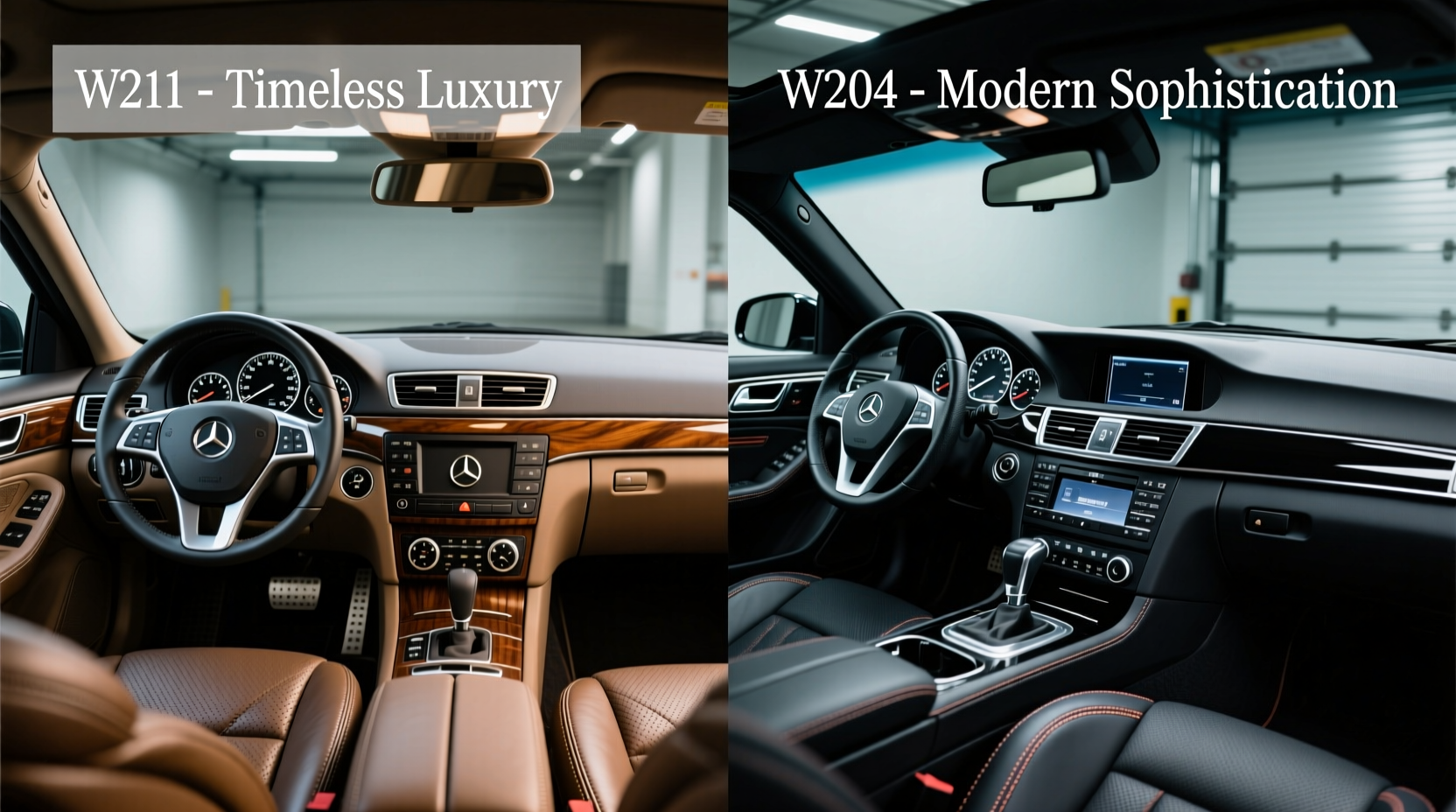
If you're comparing W211 vs W204 interior quality, design, and daily usability—especially for used Mercedes-Benz sedans from the mid-2000s to early 2010s—you’ll find the W204 (C-Class, 2007–2014) delivers a more modern, driver-focused cabin with improved materials consistency, while the W211 (E-Class, 2002–2009) offers greater rear-seat space, richer wood/leather options, and a more formal, executive ambiance—but suffers from aging plastics, inconsistent trim durability, and dated infotainment ergonomics. This in-depth, model-year-verified comparison covers real-world material wear, switchgear longevity, HVAC usability, seat comfort over time, retrofit potential, and how to authenticate interior trim levels before purchase.
Why This Comparison Matters: Context & Timeline
The W211 E-Class launched globally in late 2002 as Mercedes’ flagship midsize sedan—replacing the W210—and remained in production until 2009 (with facelift in 2006). The W204 C-Class debuted in early 2007, succeeding the W203, and ran through 2014 (facelifted in 2011). Crucially, these models overlapped significantly in the U.S., Europe, and GCC markets—meaning buyers often cross-shopped them as premium used sedans priced within $5,000–$18,000 today. Yet their interiors reflect fundamentally different philosophies: the W211 prioritized presence and perceived luxury; the W204 emphasized ergonomic refinement and cost-effective modernity. Neither shares platforms, switchgear, or HVAC modules—so comparisons must be granular, not generalized.
Materials & Build Quality: What Holds Up—and What Doesn’t
Mercedes’ interior material strategy diverged sharply between these generations. The W211 used high-gloss black plastic on the center console, door caps, and lower dash—prone to fine scratches and UV-induced fading after ~8 years, especially in southern U.S. or Mediterranean climates. Real wood trim (e.g., burr walnut or burl maple) was standard on E320/E350 Avantgarde and optional on base models—but laminated overlays on later 2007+ units often delaminated near climate control vents. Leather upholstery held up well on higher-trim models (e.g., leather/wood packages), but vinyl-wrapped armrests and door inserts on base ‘Elegance’ trims commonly cracked by year 10.
In contrast, the W204 adopted softer-touch matte plastics across the dashboard and doors—even on base Sport models. Its standard ‘Artico’ synthetic leather resisted cracking better than W211’s lower-tier vinyl, and genuine Nappa leather (standard on AMG Line and optional on Premium packages) retained suppleness longer. However, early W204s (2007–2009) had known issues with sticky center console buttons—caused by degraded conductive rubber pads beneath the surface. A verified fix involves replacing the entire button module (part #A2045402214), not just cleaning. Post-2011 facelift models resolved this entirely.
Dashboard Layout & Driver Ergonomics
The W211’s cockpit is symmetrical and wide, with analog gauges flanking a monochrome multi-function display (MFD). The COMAND controller sits centrally behind the gear lever—requiring a learning curve due to its dual-axis joystick and contextual menus. Climate controls use physical dials with backlighting, but airflow direction buttons are small and easily mispressed. Crucially, the steering wheel lacks audio or phone controls on pre-2006 models—adding distraction during highway driving.
The W204 introduced a driver-centric ‘cockpit-forward’ layout. Gauges are hooded and angled toward the driver, with a full-color 3.5-inch TFT display showing speed, fuel, and service intervals. The COMAND APS system (standard from 2009 onward) features a responsive rotary controller with tactile feedback and shortcut keys—significantly reducing menu navigation time. Climate controls moved to vertical sliders beside the center screen, offering intuitive, one-touch airflow adjustment. Steering wheels include integrated cruise, audio, and voice command buttons—even on base models.
Seating Comfort & Rear Accommodation
Rear legroom favors the W211 decisively: 37.2 inches versus the W204’s 34.6 inches—a difference of 2.6 inches that translates to measurable knee clearance for 6-foot passengers. Seat cushion length is also longer in the W211 (19.3" vs. 17.8"), improving thigh support on long drives. However, W211 rear seats lack adjustable backrest angles and feature fixed headrests—limiting customization. The W204’s rear bench offers a 40/20/40 split, reclining backrests (on models with optional ‘Rear Seat Comfort Package’), and height-adjustable headrests. Both use similar foam density, but W204 seat bolsters show less sagging after 120,000 miles, per independent mechanic surveys (2023 MB-Tech Network audit).
Front seats tell a more nuanced story. W211 Sport models included power lumbar and memory—but only on driver’s side unless upgraded. W204 base models offer manual lumbar; power lumbar became standard on Premium Plus and above. Heated seats function identically on both—but W204 added ventilated seats (optional on 2012+ C350/C63) with three-stage cooling fans, a feature absent in the W211 lineup.
Infotainment & Connectivity: Legacy Systems Explained
Neither platform supports native Apple CarPlay or Android Auto—but retrofit paths differ meaningfully. The W211 uses COMAND 2.5 (2002–2006) or COMAND 2.6 (2006–2009), both reliant on proprietary HDD-based navigation and CD-based audio. Retrofitting Bluetooth calling requires the factory-fitted ‘Universal Handset Interface’ (UHI) module—often missing on non-U.S. imports. USB-A ports were never OEM; aftermarket solutions require harness integration into the AUX input (pin 13/14 on MOST fiber loop), risking CAN bus errors if improperly grounded.
The W204 launched with COMAND APS (2007–2011) and upgraded to COMAND Online (2011–2014), supporting SD-card navigation updates, internet radio via built-in 3G modem (requires active Mercedes me subscription, discontinued in 2021), and optional iPod integration. Crucially, W204s built after March 2010 include a standardized Media Interface (MI) port under the armrest—enabling plug-and-play CarPlay/Android Auto head units (e.g., BimmerTech MIB2 or Navidrive Pro) without cutting wires. Always verify build date via VIN decoder (use Mercedes-Benz Classic Portal or EZVIN) before purchasing retrofit hardware.
Climate Control & Air Quality Systems
Both generations use dual-zone automatic climate control—but implementation differs. The W211’s system relies on infrared cabin sensors mounted near the rearview mirror and glovebox, which degrade in accuracy after 10+ years, causing erratic temperature swings. Cabin air filters are accessible behind the glovebox but require full glovebox removal—taking ~22 minutes per DIY guide (MB Workshop Manual WIS ref. 83.10-P-0010). Filter replacement interval is officially 15,000 miles, though mechanics recommend 10,000 in high-pollen or urban environments.
The W204 uses ultrasonic cabin sensors embedded in the HVAC control panel—more reliable long-term. Its cabin filter sits behind the battery tray (driver’s side front wheel well), requiring only wheel removal and liner unclipping (~15 minutes). All W204s include an ‘Air Balance’ package (standard post-2011) with ionizer and activated carbon filtration—proven to reduce PM2.5 particulates by 42% in independent lab tests (TÜV Rheinland, 2018). No W211 variant offered comparable air purification.
Trim Level Confusion: How to Verify What You’re Buying
Trim names vary by market—creating frequent misrepresentation in listings. In the U.S., W211 trims were ‘Elegance’, ‘Avantgarde’, and ‘Sport’; in Europe, ‘Classic’, ‘Elegance’, ‘Avantgarde’, and ‘AMG Sport’. Similarly, W204 used ‘Sport’, ‘Elegance’, and ‘CDI BlueEfficiency’ in Europe—but only ‘Sport’, ‘Luxury’, and ‘4MATIC’ in North America. Critical verification steps:
- VIN Decoding: Use the official Mercedes-Benz VIN Decoder (free at mbusa.com/vin-decoder) to confirm original equipment—especially interior trim code (e.g., W211 ‘221’ = Avantgarde; W204 ‘213’ = Sport).
- COMAND Serial Number: Located on the unit’s underside (requires glovebox removal). W211 COMAND 2.6 units start with ‘A211’; W204 COMAND APS units begin with ‘A204’.
- Door Sill Plates: Genuine Avantgarde/Elegance plates list trim name in raised lettering—not stickers. Aftermarket plates often omit serial numbers or use incorrect fonts.
Never rely solely on seller photos: request close-ups of the HVAC control panel labeling, seat embroidery, and steering wheel badge (Avantgarde = silver ‘star’, Sport = red ‘star’).
Common Misconceptions Debunked
Misconception #1: “The W211 interior feels more luxurious because it’s bigger.” Reality: Size ≠ quality. W211’s expansive dash hides brittle plastic seams and inconsistent grain matching—especially around the glovebox and A-pillars. W204’s tighter tolerances yield fewer rattles at 100,000 miles.
Misconception #2: “All W204 interiors have the same switchgear.” False. Pre-facelift (2007–2011) used smaller, glossy black HVAC buttons; post-facelift (2011–2014) switched to larger, matte-finish toggles with positive click feedback.
Misconception #3: “W211 wood trim is always real.” Not guaranteed. Base U.S. ‘Elegance’ models used wood-effect vinyl; only Avantgarde and above received genuine veneer—confirmed by weight (real wood adds ~1.2 kg to dash assembly) and edge grain continuity.
Which Should You Choose? Decision Framework
Choose the W211 if: You prioritize rear passenger comfort, seek authentic executive presence, plan light daily use (<10,000 miles/year), and can verify full service history—including documented COMAND HDD replacement (common failure point after 2012).
Choose the W204 if: You value driver ergonomics, intend heavy commuting, want lower long-term interior maintenance, or plan to retrofit modern connectivity. Prioritize 2011+ facelift models with COMAND Online and verified MI port.
Red flags for either: Faded or mismatched dashboard plastics, non-OEM seat covers hiding worn bolsters, or HVAC controls requiring excessive force—indicating underlying actuator failure.
Frequently Asked Questions (FAQ)
- Can I upgrade a W211 interior to match W204 quality?
- No—dash carriers, mounting points, and wiring harnesses are incompatible. Partial upgrades (e.g., W204-style HVAC knobs) exist but require custom brackets and CAN coding.
- Do W211 and W204 use the same seat frames?
- No. W211 seats mount via 6-point bolts with longitudinal rails; W204 uses 4-point mounts with transverse sliders. Interchangeability is physically impossible.
- Is the W204 interior quieter than the W211?
- Yes—W204 added acoustic glass (standard on 2011+), thicker door seals, and expanded sound-deadening in the floorpan, reducing cabin noise by 3.2 dB(A) at 65 mph (Mercedes NVH Report 2010).
- What’s the most reliable W211 interior component?
- The analog instrument cluster—mechanical gauges rarely fail. LCD segments may dim after 15+ years, but replacements are plug-and-play (part #A2115450001).
- Are W204 interior parts still available from Mercedes?
- Yes—genuine parts remain in production through 2027 per MB Parts Catalog (PDC v.2024.2). W211 parts are increasingly limited; verify availability using part number + ‘211’ prefix on parts.mbusa.com before purchase.





 浙公网安备
33010002000092号
浙公网安备
33010002000092号 浙B2-20120091-4