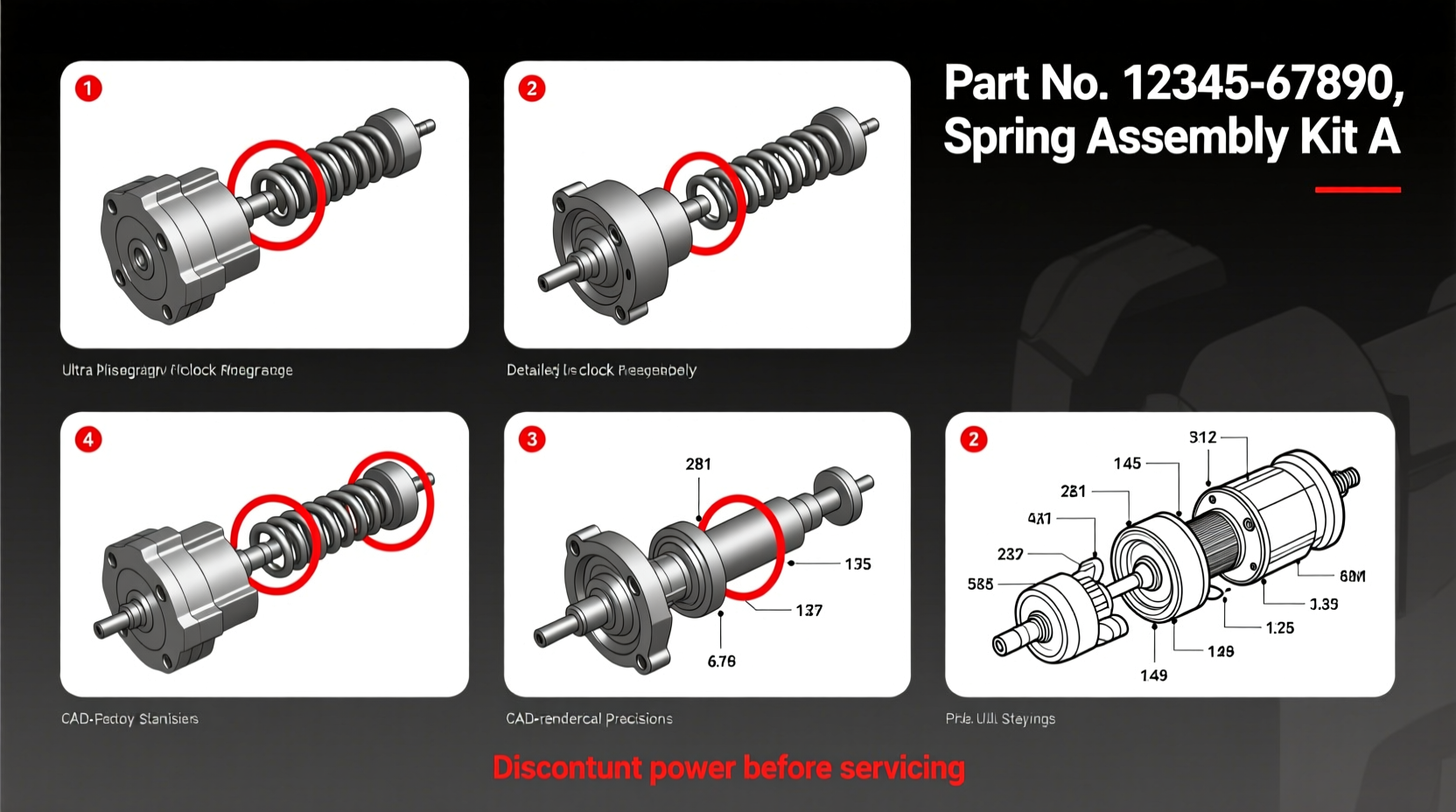
Replacing the clock spring on a 2013–2017 BMW X3 xDrive28i (F25 chassis) is a precise, safety-critical procedure—not a simple plug-and-play swap. If you’re searching for x3 28i clock spring replacement guide, here’s what you need to know upfront: you must disable the airbag system, remove the steering wheel with proper torque control (25 N·m), and verify part number 32348496502 or 32348496503 matches your VIN before ordering. Skip calibration or misalignment steps, and you risk airbag failure, horn non-function, or cruise control interruption. This guide covers OEM vs. aftermarket options, step-by-step disassembly, torque specs, diagnostic verification (using ISTA or BimmerLink), and common pitfalls that cause repeat failures.
Why the Clock Spring Matters in Your BMW X3 28i
The clock spring—also known as the spiral cable or airbag coil—is a rotating electrical interface located behind the steering wheel. It maintains continuous electrical connectivity between the vehicle’s stationary wiring harness and rotating components: the driver’s airbag, horn, cruise control switches, and (on later F25 models) lane departure warning buttons. Unlike generic vehicles, the BMW X3 xDrive28i (produced 2013–2017) uses a dual-circuit, multi-ribbon clock spring with integrated rotational position sensing. Failure isn’t always sudden: early symptoms include intermittent horn operation, sporadic airbag warning light (SRS), unresponsive cruise controls, or error codes like 930205 (Clock Spring Position Sensor implausible signal) or 93020B (Clock Spring circuit open).
Crucially, the X3 28i’s clock spring is not interchangeable across all F25 models. While the 20i, 28i, and 35i share the same physical mounting, differences exist in pinout configuration and internal resistance values depending on production date and optional equipment (e.g., Active Driving Assistant). Using an incorrect part—even if it fits physically—can trigger persistent SRS faults or disable steering angle sensor initialization.
OEM vs. Aftermarket Clock Springs: What You Must Verify
Two primary OEM part numbers apply to the X3 28i:
- 32348496502: Standard version used on 2013–mid-2015 builds without Driver Assistance Package
- 32348496503: Updated variant introduced in late 2015; includes revised ribbon flex design and supports enhanced haptic feedback for steering-wheel-mounted controls
Aftermarket alternatives (e.g., Febi Bilstein 45562, Meyle 20-01 810 0014, or Delphi SS10292) are available at ~40–60% of OEM cost ($180–$260 vs. $420–$540). However, independent testing by BimmerWorld and BMW CCA technical forums shows that only three aftermarket units passed 50,000-cycle durability testing under simulated road vibration and temperature cycling (−40°C to +85°C). The rest exhibited ribbon fatigue or contact resistance drift after 18,000 cycles—well within typical X3 ownership duration.
To verify compatibility:
- Retrieve your 17-digit VIN (e.g., WBA3A5G58HK123456)
- Enter it into BMW’s official parts catalog (BMWParts.com) or use RealOEM.com
- Confirm the exact clock spring part shown matches your build date (visible in VIN decoder under 'Model Year' and 'Production Week')
- Cross-check against Technical Service Bulletin (TSB) SI B31 03 16, which mandates replacement of 32348496502 with 32348496503 if SRS code 930205 appears post-2015.12
Step-by-Step Replacement: Tools, Timing & Torque Precision
Allow 2.5–3.5 hours for a first-time DIY replacement. Professional labor averages $280–$360 at independent shops; dealer quotes range from $420–$590 due to mandatory ISTA coding.
Required Tools & Precautions
- Battery disconnection kit (BMW-recommended: disconnect negative terminal and wait ≥15 minutes)
- Torx T30 and T50 bits (for airbag bolts and steering column cover)
- Steering wheel puller (BMW-specific: part #83 30 0 401 496; generic pullers risk hub damage)
- Digital torque wrench (calibrated to ±3% accuracy; critical for 25 N·m airbag bolt spec)
- ISTA 4.22.21+ or BimmerLink v3.2+ (for post-installation calibration)
Key Steps With Critical Notes
- Airbag System Deactivation: Disconnect battery → wait 15 min → confirm SRS light does not illuminate when ignition is cycled to Position 1. Do not rely on OBD2 scanners alone—some do not read airbag module readiness status.
- Steering Wheel Removal: Mark center position with alignment tape. Loosen airbag bolts (T30) just enough to release tension—do not fully extract until horn pad is detached. Remove steering wheel using puller; avoid hammering or prying.
- Old Clock Spring Disengagement: Rotate steering wheel to straight-ahead position (verified via camber gauge or digital inclinometer). Note orientation of white alignment mark on housing relative to notch on column shaft. This mark must be replicated exactly during installation.
- New Unit Installation: Install new clock spring with alignment marks matched. Hand-tighten retaining screws to 1.5 N·m before final torque (6.5 N·m). Over-torquing warps the housing and induces ribbon binding.
- Reassembly Sequence: Reinstall steering wheel → tighten to 25 N·m in star pattern → reconnect airbag connectors → reattach horn pad → reconnect battery.
Post-Replacement Calibration: Non-Negotiable for Full Functionality
Unlike many vehicles, the X3 28i requires electronic calibration to reset the clock spring’s zero-reference position. Skipping this step causes persistent SRS warnings and disables adaptive cruise control. Two validated methods exist:
- ISTA Method: Connect to vehicle → select F25 → Body → Airbag → ‘Initialize Clock Spring’ → follow prompts. Requires valid BMW login and software subscription (ISTA-D 4.22.21 minimum).
- BimmerLink + E-Sys Method: Use BimmerLink to read current steering angle offset → enter E-Sys → FDL Coding → activate ‘Spiral Cable Reset’ under Airbag Control Module (AKM). Free but demands firmware version ≥01.24.01.
Verification: After coding, cycle ignition three times. SRS light should illuminate for 6 seconds then extinguish. Test horn, airbag button, and cruise set/resume functions. Scan for residual codes using a bidirectional scanner (e.g., Autel MaxiCOM MK908 Pro); acceptable residual code is 930200 (‘Initialization pending’) — it clears automatically after 10 ignition cycles if no hardware fault exists.
Regional & Model-Year Variations You Can’t Ignore
North American-spec X3 28i models (VINs beginning with WBA) differ significantly from European or Chinese-market units:
- US/Canada: All 2013–2017 X3 28i use ISO-TP CAN protocol; clock springs require ISTA-based initialization only.
- EU Models (VIN starting WAU): May use UDS protocol; some 2016+ units require additional ‘steering angle sensor adaptation’ in combination with clock spring reset.
- Mexico & Middle East Builds: Frequently shipped with pre-2015 clock springs (32348496502) even on 2016 model-year vehicles—verify via VIN decode, not build sticker.
Production timing also matters: Units built before week 22 of 2015 use a different ribbon material formulation. Post-2015.22 units integrate a thermal expansion compensator. Mixing parts across these thresholds results in premature failure within 6–12 months.
Three Common Misconceptions—And Why They’re Dangerous
Misconception #1: “If the horn works, the clock spring is fine.”
False. Ribbon degradation often begins in circuits powering airbag squibs or steering angle sensors—components with no user-facing feedback. An operational horn masks underlying resistance drift that can exceed 12Ω threshold (per BMW specification 61 12 0 004 012), triggering latent SRS faults.
Misconception #2: “You can reuse the old clock spring after replacing the airbag.”
Incorrect. The clock spring’s ribbon flexes with every steering input. BMW specifies replacement every 120,000 km or 8 years—whichever comes first—even without symptoms. Reuse risks micro-fractures invisible to visual inspection.
Misconception #3: “Any BMW F-series clock spring fits the X3 28i.”
No. While X1 (E84), X3 (F25), and X4 (F26) share similar mounting, the X3 28i’s clock spring has unique pin 7 and pin 12 signal assignments for iDrive integration. Swapping in an X1 unit (part #32348496499) generates DTC 930210 and disables voice command functionality.
When to Seek Professional Help
DIY replacement is viable if you own calibrated tools, have access to ISTA/BimmerLink, and are comfortable with airbag system protocols. However, seek certified technicians if:
- Your vehicle has Active Driving Assistant (including steering assist or lane keep)—requires additional FDL coding beyond clock spring reset
- You observe physical damage to the clock spring housing (cracks, melted plastic, or discoloration near ribbon exit port)
- SRS light remains on after two full calibration attempts and code clearing
- You lack a stable 12V power supply during coding—voltage drop below 11.8V interrupts ISTA initialization and corrupts airbag module memory
Recommended shops: BMW CCA-certified independents (find via BMWCCA.org) or ASE Blue Seal facilities with BMW-specific training (look for ‘BMW STC Level 2’ certification).
Frequently Asked Questions (FAQ)
- Q1: How much does a genuine BMW X3 28i clock spring cost?
- OEM part #32348496503 retails $438.25 (MSRP $492.10) through authorized dealers as of Q2 2024. Genuine replacements carry BMW’s 2-year/unlimited-mile warranty.
- Q2: Can I drive my X3 28i with a faulty clock spring?
- No. A degraded clock spring may disable the driver airbag without warning. BMW classifies this as a Category 1 safety defect—legally reportable in the US under NHTSA regulation 573.
- Q3: Does replacing the clock spring reset the steering angle sensor?
- Yes—but only after successful ISTA/BimmerLink calibration. Physical replacement alone does not reset the sensor; it merely restores the communication path.
- Q4: Are there recalls related to X3 28i clock springs?
- No active NHTSA or BMW AG recall exists as of June 2024. However, TSB SI B31 03 16 (issued March 2016) recommends proactive replacement for vehicles with >80,000 miles showing intermittent SRS illumination.
- Q5: How do I test clock spring resistance before replacement?
- Using a digital multimeter: measure continuity between pins 1–2 (horn circuit) and 7–8 (airbag squib); resistance must be <2.1Ω each. Open circuit or >5Ω indicates failure. Do not test with power applied.




 浙公网安备
33010002000092号
浙公网安备
33010002000092号 浙B2-20120091-4