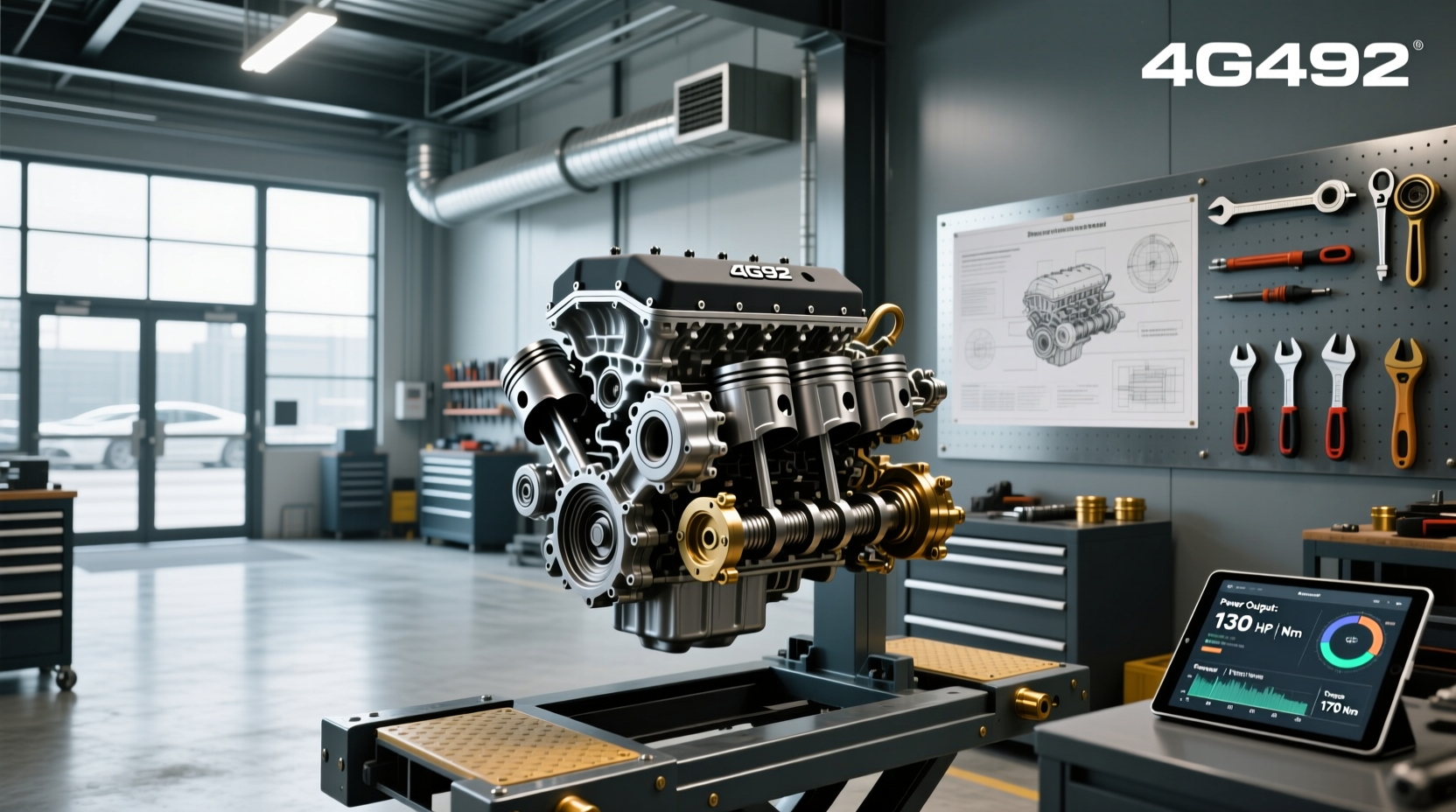
The Mitsubishi 4G92 engine specs reveal a high-revving 1.6L inline-4 powerplant known for its strong naturally aspirated performance and MIVEC variable valve timing technology. With a displacement of 1,597 cc, bore x stroke of 81 mm x 77.5 mm, and compression ratios up to 11.0:1, the DOHC 4G92 produces as much as 107 kW (145 PS) at 7,000 rpm and 149 Nm of torque at 4,500 rpm1. Designed primarily for compact JDM models like the Mirage Asti RX-R and Lancer Cedia, this engine balances fuel efficiency with sporty responsiveness—making it a favorite among enthusiasts seeking reliable daily drivers with mild tuning potential.
Understanding the Mitsubishi 4G92 Engine Family
The 4G92 is part of Mitsubishi’s broader 4G9 series of inline-four gasoline engines, which includes the 4G91 (1.5L), 4G93 (1.8L), and 4G94 (2.0L). Introduced in late 1991 as an evolution of the 4G91, the 4G92 was engineered to deliver improved low-end torque while maintaining high-rpm efficiency2. Unlike the turbocharged 4G63 found in Evolution models, the 4G92 focuses on lightweight design, smooth operation, and excellent throttle response—ideal for front-wheel-drive economy cars that still offer engaging driving dynamics.
⚙️ Key characteristics include:
- Configuration: Inline-4, DOHC or SOHC depending on variant
- Valvetrain: 16-valve with optional MIVEC (Mitsubishi Innovative Valve timing Electronic Control)
- Fuel system: Multi-point fuel injection (MPFI); later GDI versions exist but are rare
- Cooling system: Water-cooled with aluminum head and cast iron block
- Redline: Up to 7,500 rpm on performance trims
This engine family was used globally across various markets, though specifications differ significantly between Japanese Domestic Market (JDM), European, and Southeast Asian applications. For example, European-spec 4G92s in the Mitsubishi Carisma often came in SOHC form with lower output for better fuel economy, whereas JDM models featured DOHC and MIVEC for enhanced performance.
Detailed Technical Specifications by Variant
To fully understand what the 4g92 engine specs mean in real-world use, it's essential to break down the data by major subtypes. There are three primary configurations: SOHC non-MIVEC, DOHC non-MIVEC, and DOHC MIVEC. Each serves different performance and efficiency goals.
| Specification | SOHC Non-MIVEC | DOHC Non-MIVEC | DOHC MIVEC |
|---|---|---|---|
| Displacement | 1,597 cc | 1,597 cc | 1,597 cc |
| Bore x Stroke | 81 mm × 77.5 mm | 81 mm × 77.5 mm | 81 mm × 77.5 mm |
| Compression Ratio | 9.5:1 – 10.0:1 | 10.5:1 | 11.0:1 |
| Max Power | 80–85 kW (109–116 PS) | 100 kW (136 PS) | 107 kW (145 PS) |
| Power RPM | 6,000 rpm | 6,500 rpm | 7,000 rpm |
| Max Torque | 138–142 Nm | 144 Nm | 149 Nm |
| Torque RPM | 4,500 rpm | 4,500 rpm | 4,500 rpm |
| Valvetrain | SOHC, 16V | DOHC, 16V | DOHC, 16V + MIVEC |
| Fuel Recommendation | Regular Unleaded | Premium Unleaded | Premium Unleaded |
As shown above, the MIVEC version delivers peak power higher in the rev range due to variable intake valve timing, which optimizes airflow at high engine speeds. This makes it particularly responsive above 5,000 rpm, ideal for spirited driving. However, below 4,000 rpm, torque delivery can feel less immediate than fixed-timing engines, leading some drivers to describe it as having a “peaky” powerband.
Vehicles Equipped with the 4G92 Engine
🔍 One of the most common follow-up questions after checking 4g92 engine specs is: Which cars actually used this engine? The answer varies by region and model year, but several key models stand out:
- Mitsubishi Mirage Asti RX-R (Hatchback) – JDM model featuring the DOHC MIVEC 4G92, producing 145 PS. Known for sharp handling and high-revving character.
- Mitsubishi Lancer (Various Generations) – Used in GLXi, GTi, and Cedia trims, especially in Asia and Europe. Output ranged from 110 PS (SOHC) to 145 PS (MIVEC DOHC).
- Mitsubishi Carisma (DA platform) – Offered in Europe with SOHC 4G92 engines focused on durability and fuel economy rather than performance.
- Proton Models (Malaysia) – Some Proton Wira and Putra variants were fitted with licensed 4G92 engines under local production agreements.
- Mitsubishi Pajero iO / Pajero Pinin (Mini SUV) – Certain 1.6L trims utilized the SOHC 4G92 for urban commuting and light off-road capability.
📌 It’s important to note that identifying whether a specific vehicle has a true MIVEC-equipped 4G92 requires checking the engine code stamped on the block or reviewing factory documentation. Many non-MIVEC DOHC engines are visually similar but lack the performance enhancements.
MIVEC Technology: How It Works and Why It Matters
✨ The introduction of MIVEC (Mitsubishi Innovative Valve timing Electronic Control) in the 4G92 marked a significant advancement in naturally aspirated engine design. Unlike traditional fixed cam profiles, MIVEC adjusts intake valve timing based on engine load and speed, improving both efficiency and high-end power.
Here’s how it works:
- Below 3,500 rpm, the engine uses a mild cam profile for stable idle and better low-speed torque.
- Above 4,500 rpm, hydraulic pressure activates a switching mechanism that engages a more aggressive cam lobe.
- This shift increases valve overlap and lift, allowing more air into the combustion chamber at high RPMs.
⚡ Benefits include:
- Up to 10% increase in peak horsepower without increasing displacement
- Better emissions control through optimized combustion phasing
- Improved fuel economy during cruising thanks to reduced pumping losses
However, MIVEC systems require precise maintenance. Issues such as worn timing belts, low oil pressure, or clogged oil passages can prevent the system from activating properly, resulting in sluggish performance even if the engine otherwise runs fine.
Reliability and Common Issues
✅ The 4G92 engine is generally considered reliable when maintained correctly. Its cast-iron cylinder block provides durability, while the aluminum head helps reduce weight. That said, certain weaknesses emerge over time, especially in older or poorly serviced units.
Known Problems:
- Timing Belt Failure: Interference design means a broken belt can cause bent valves. Recommended replacement every 90,000–100,000 km (55,000–62,000 miles).
- MIVEC Solenoid Clogging: Debris in engine oil can block the solenoid, preventing MIVEC engagement. Regular oil changes with quality filters help avoid this.
- Head Gasket Leaks: While not widespread, some high-mileage engines develop coolant leaks between cylinders, especially if overheating occurred.
- Intake Manifold Cracking: Plastic manifolds on later models may crack due to thermal cycling, causing vacuum leaks and rough idling.
- EGR System Carbon Buildup: Common in European diesel-dominated markets where petrol engines see less frequent use.
🔧 Preventative tips:
- Use only OEM-spec timing components during service
- Change engine oil every 8,000–10,000 km using 5W-30 or 10W-40 synthetic blend
- Inspect spark plugs and ignition coils annually for signs of wear
- Flush cooling system every 4 years to prevent corrosion
Tuning Potential and Aftermarket Support
📈 Enthusiasts often ask: Can you turbocharge a 4G92 engine? While technically possible, the 4G92 is not built for forced induction like the legendary 4G63. Most stock internals—including pistons and connecting rods—are designed for high-revving NA use, not sustained boost pressure.
Based on community feedback from forums like EvolutionM.net and Reddit, pushing more than 7–8 psi of boost on pump gas risks detonation, especially with the high 11.0:1 compression ratio of MIVEC models3. Safe limits for modified builds typically involve:
- Lowering compression to 9.0:1 with forged pistons
- Upgrading to a standalone ECU for precise fuel and timing control
- Installing upgraded injectors (440cc or higher)
- Adding intercooling and reinforced cooling systems
For naturally aspirated tuning, popular upgrades include:
- Performance camshafts (especially for non-MIVEC heads)
- Ported and polished cylinder heads
- Throttle body spacers and cold air intakes
- Header-back exhaust systems with less restrictive catalytic converters
With these modifications, NA outputs can reach around 160–170 wheel horsepower—impressive for a 1.6L four-cylinder—but expect diminishing returns beyond that point without internal engine work.
Regional Differences and Identification Tips
🌐 Because the 4G92 was produced for over a decade and sold worldwide, there are notable differences in tune, emissions equipment, and accessory drives. Knowing how to identify your exact variant is crucial for repairs or swaps.
📍 Identification steps:
- Locate the engine code tag near the cylinder head or on the firewall.
- Look for suffixes like “E” (fuel-injected), “M” (MIVEC), or “D” (distributorless ignition).
- Cross-reference with chassis codes: e.g., HA/HS-series Mirages usually have MIVEC; DA-series Carismas do not.
- Check VIN decoder tools specific to Mitsubishi for factory engine designation.
For instance, a 1997 Japanese-market Mirage Asti RX-R will have a 4G92P engine code indicating MIVEC, while a 2001 European Carisma might carry a 4G92S with SOHC and no variable timing. These distinctions affect compatibility when sourcing parts or considering an engine swap.
Used 4G92 Engines: What to Look For
🛒 If you're searching for a 4g92 engine for sale, either as a replacement or for a project build, here are key evaluation criteria:
- Service History: Ask for records of timing belt changes, oil changes, and any past repairs.
- Compression Test Results: Healthy readings should be within 10% across all cylinders (ideally 130–150 psi).
- Leak-Down Test: More accurate than compression tests; reveals valve seal integrity and ring wear.
- Visual Inspection: Check for oil leaks around the valve cover gasket, timing cover, and rear main seal.
- Startup Behavior: Listen for knocking, ticking, or excessive smoke—blue smoke indicates oil burning.
- ECU Compatibility: Ensure the engine harness and ECU match your intended application, especially for MIVEC models.
When buying online (e.g., eBay or Alibaba), verify seller reputation and request video of the engine running before purchase. Beware of engines advertised as “MIVEC” that lack the solenoid assembly or actuator arm.
Comparison with Other Mitsubishi Engines
📋 To put the 4G92 in context, here’s how it compares to other common Mitsubishi four-cylinder engines:
| Engine | Displacement | Max Power | Turbo Option | Best Use Case |
|---|---|---|---|---|
| 4G92 (MIVEC) | 1.6L | 145 PS | Limited | NA performance, lightweight hatchbacks |
| 4G63 (non-turbo) | 2.0L | 140 PS | No | Base Lancers, reliable daily driver |
| 4G63T (turbo) | 2.0L | 280 PS | Yes | High-performance builds, rally-inspired |
| 4G93 | 1.8L | 125 PS | No | Balanced power and economy |
| 4B11 (non-turbo) | 2.0L | 150 PS | No | Modern replacements, smoother refinement |
While the 4G92 excels in high-RPM efficiency and compactness, the 4G63 remains superior for forced induction projects. Meanwhile, the 4G93 offers slightly more torque at lower RPMs, making it preferable for heavier vehicles like sedans.
Frequently Asked Questions (FAQs)
- ❓ What car has a 4G92 engine?
- The 4G92 engine was used in several Mitsubishi models including the Mirage Asti RX-R, Lancer (GLXi, GTi, Cedia), Carisma, and Pajero iO. It also appeared in select Proton vehicles in Southeast Asia.
- ❓ How many cc is a 4G92 engine?
- The 4G92 has a total displacement of 1,597 cubic centimeters (cc), commonly rounded to 1.6 liters.
- ❓ Is the 4G92 MIVEC engine reliable?
- Yes, the 4G92 MIVEC is generally reliable if maintained properly. Regular oil changes, timely timing belt replacement, and clean fuel systems are critical to long-term durability.
- ❓ Can you turbocharge a 4G92 engine?
- Technically yes, but it's not recommended without internal modifications. Stock 4G92 engines, especially MIVEC variants with 11.0:1 compression, are prone to detonation under boost. For safe turbo builds, lower compression pistons and strengthened internals are required.
- ❓ What is the horsepower of a 4G92 engine?
- Horsepower varies by variant: SOHC models produce 109–116 PS, DOHC non-MIVEC make around 136 PS, and DOHC MIVEC versions reach up to 145 PS (107 kW).





 浙公网安备
33010002000092号
浙公网安备
33010002000092号 浙B2-20120091-4