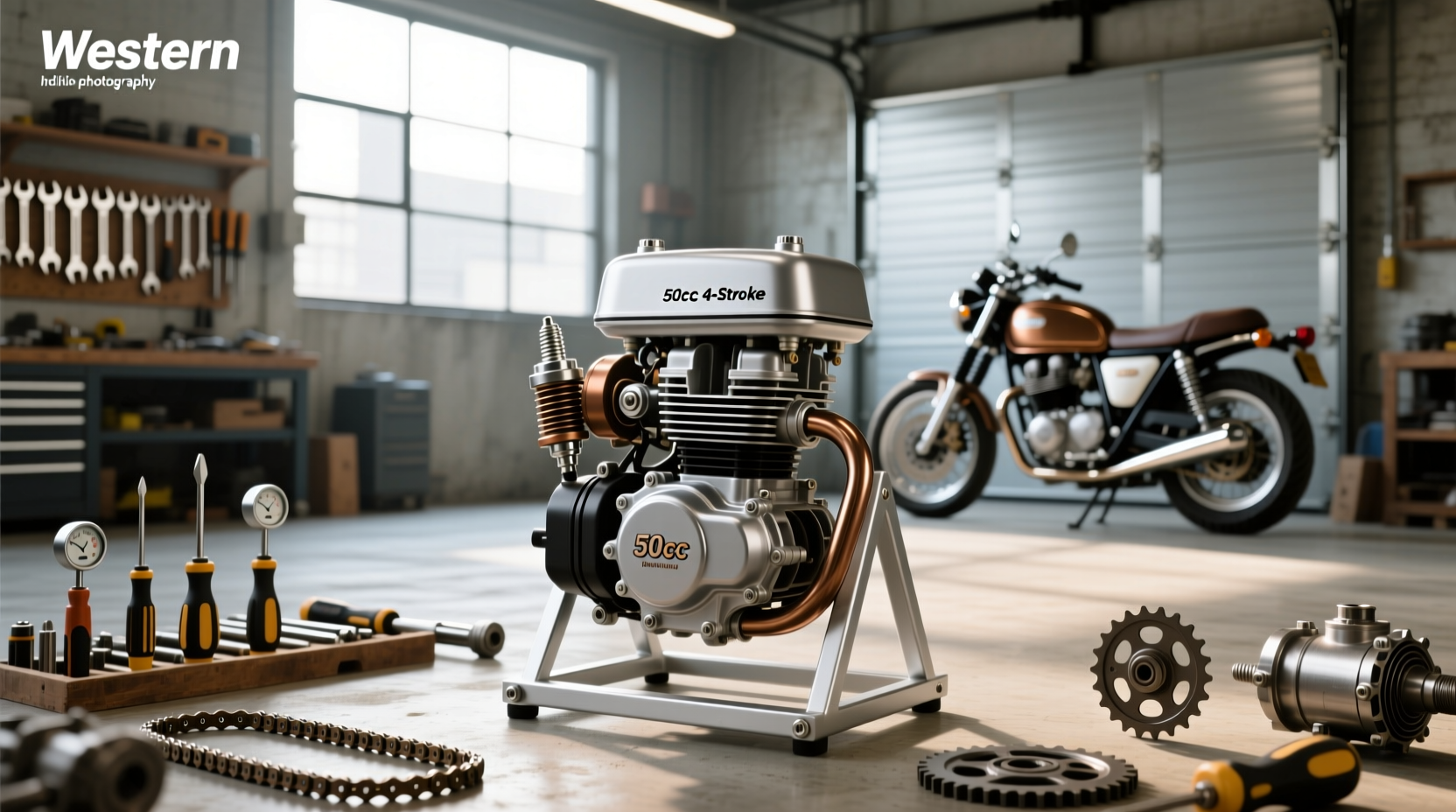
When searching for compact, efficient power solutions in small vehicles or utility equipment, the 50cc 4-stroke engine stands out as a reliable and fuel-efficient choice. Unlike its 2-stroke counterpart, this engine completes four distinct piston strokes—intake, compression, power, and exhaust—per combustion cycle, delivering smoother operation, lower emissions, and better durability. Commonly found in mini bikes, pocket bikes, scooters, go-karts, and even some portable generators or water pumps, the 4-stroke design is ideal for users prioritizing longevity and ease of maintenance over raw power. This guide breaks down everything you need to know about 50cc 4-stroke engines: how they work, performance expectations, real-world applications, common misconceptions, and what to look for when sourcing or upgrading one.
How a 50cc 4-Stroke Engine Works
The term '50cc' refers to the engine's displacement—specifically, 50 cubic centimeters of volume swept by the piston during each stroke. In a 4-stroke configuration, the engine operates through a precise sequence of four phases per power cycle:
- Intake Stroke: The intake valve opens as the piston moves downward, drawing in an air-fuel mixture from the carburetor into the combustion chamber.
- Compression Stroke: Both valves close while the piston rises, compressing the air-fuel mixture to prepare for ignition.
- Power Stroke: At the top of the compression stroke, the spark plug ignites the compressed mixture, forcing the piston back down and generating mechanical power.
- Exhaust Stroke: The exhaust valve opens as the piston rises again, pushing out spent gases before the cycle repeats.
This full-cycle process ensures cleaner combustion and more controlled energy output compared to 2-stroke engines, which combine intake and compression (and exhaust and power) into two strokes using crankcase scavenging.
Performance: Horsepower, Speed, and Torque
A typical stock 50cc 4-stroke engine produces between 2.5 to 4 horsepower (HP), depending on design, compression ratio, and tuning. While this may seem modest, it's sufficient for lightweight applications such as youth-sized dirt bikes, mini motocross karts, or urban commuter scooters limited by law to low-speed operation.
In terms of top speed, most factory-equipped 50cc 4-stroke scooters or mini bikes reach speeds of 25 to 35 mph (40–56 km/h) under optimal conditions. Factors influencing actual performance include:
- Vehicle weight and aerodynamics
- Gear ratio and transmission type (CVT vs. direct drive)
- Carburetion and air filter condition
- Tire size and road surface
- Altitude and ambient temperature
It’s important to note that claims of 50cc engines producing 6–8 HP or reaching 60 mph are typically associated with modified 2-stroke variants or heavily tuned prototypes—not standard 4-stroke production units 1. Misinformation often stems from YouTube videos showcasing experimental builds or mislabeled engine types.
Common Applications of 50cc 4-Stroke Engines
These small-displacement engines serve a variety of practical and recreational purposes:
Scooters and Mopeds ✅
In many countries, especially across Europe and Asia, 50cc scooters are classified as mopeds due to displacement limits. They require no motorcycle license (in some regions), offer excellent fuel economy (~100+ mpg), and are legal for use on bike lanes or restricted roads. Most modern versions use 4-stroke engines for compliance with emission regulations.
Youth Dirt Bikes and Mini ATVs 🏭
Brands like Honda, Yamaha, and KTM have produced youth-oriented off-road motorcycles powered by 50cc 4-strokes. These are designed for beginners aged 5–12, featuring throttle limiters, centrifugal clutches, and rugged construction. Replacement complete engines are available for models like the Honda CRF50 or Yamaha TT-R50.
Go-Karts and Pocket Bikes 🔧
While many entry-level go-karts use 2-stroke engines, there’s growing demand for quieter, cleaner 4-stroke options. A 50cc 4-stroke can propel a lightweight kart at safe speeds suitable for backyard tracks or training circuits. Some kits include mounting brackets, CVT transmission, chain drive, and throttle control.
Utility Equipment ⚙️
Beyond transportation, 50cc-class 4-stroke engines power tools such as pressure washers, water pumps, generators, and brush cutters. Their self-contained oil system and lower vibration make them better suited for prolonged stationary use than 2-strokes.
Buying a Complete 50cc 4-Stroke Engine: What to Know
Whether replacing a damaged unit or building a custom project, purchasing a complete 50cc 4-stroke engine requires attention to several key factors:
Engine Type and Compatibility 📋
Ensure the engine matches your application. For example:
- Is it designed for vertical or horizontal shaft output?
- Does it include a clutch, flywheel, carburetor, and air filter?
- Are mounting bolt patterns standardized or model-specific?
Many aftermarket 'complete engines' sold online (e.g., on Alibaba or regional suppliers) are generic Chinese-made units based on the Honda GX50 design. These are often labeled as “139QMB” or “Ruiing” clones and may vary slightly in dimensions or quality.
New vs. Used Engines ❗
Used engines from decommissioned scooters or mini bikes can be cost-effective but carry risks:
- Unknown maintenance history
- Potential internal wear or seized components
- Lack of warranty or support
If opting for used, inspect for oil leaks, rust, smooth piston movement, and intact wiring harnesses. Ask the seller if the engine ran when removed.
Price Range and Value Assessment 💰
As of 2024, new complete 50cc 4-stroke engines range from $250 to $600 USD, depending on brand, included components, and region. Higher-end options may include electronic ignition, upgraded carburetors, or reinforced casings.
Be cautious of listings advertising 'high-performance' or 'racing' 50cc engines without clear specifications. True performance upgrades involve porting, high-compression heads, or performance cams—not just cosmetic changes.
4-Stroke vs. 2-Stroke: Key Differences
Understanding the fundamental differences helps determine which engine type suits your needs best.
| Feature | 50cc 4-Stroke | 50cc 2-Stroke |
|---|---|---|
| Power Output | 2.5–4 HP | 3–6 HP (higher peak) |
| Fuel Efficiency | High (~100+ mpg) | Moderate (~60–80 mpg) |
| Emissions | Lower (meets Euro 5 in some cases) | Higher (unburned oil/fuel) |
| Lubrication | Separate oil sump | Mixed with fuel (premix or oil pump) |
| Maintenance | Less frequent, oil changes needed | More frequent, carbon buildup issues |
| Noise Level | Quieter | Louder, higher-pitched |
| Weight | Heavier (due to valvetrain) | Lighter |
| Top Speed (Typical) | 25–35 mph | 30–45 mph |
While 2-stroke engines deliver more immediate power and are simpler mechanically, they require more frequent tuning and are increasingly restricted due to environmental concerns.
Maintenance Tips for Longevity
Proper upkeep significantly extends the life of a 50cc 4-stroke engine. Follow these best practices:
Regular Oil Changes 🛢️
Change engine oil every 10–25 hours of operation or every 500 miles if used in a scooter. Use SAE 10W-30 or 10W-40 detergent oil. Overfilling or using non-detergent oil can cause foaming and poor lubrication.
Air Filter Cleaning 🌬️
Inspect and clean the foam air filter monthly. Wash with mild soap and water, let dry completely, then re-oil lightly before reinstalling. A clogged filter reduces performance and increases fuel consumption.
Spark Plug Inspection 🔍
Check the spark plug every 25 hours. Look for fouling, gap wear (should be ~0.028 inches), or cracked insulators. Replace annually or as needed with correct NGK or Denso model.
Carburetor Tuning ⚙️
Adjust idle speed and mixture screws carefully. If the engine runs rough or floods, consider removing and cleaning the carburetor jets with carb cleaner. Use a compressed air blast to clear passages.
Storage Precautions 📦
For long-term storage:
- Add fuel stabilizer and run engine for 5 minutes
- Drain carburetor bowl or disconnect fuel line
- Store in dry, covered area
- Remove battery if equipped
Can You Upgrade a 50cc 4-Stroke Engine?
Yes, but within realistic limits. Unlike 2-strokes, which respond dramatically to modifications, 4-strokes benefit less from bolt-on parts unless combined with internal tuning.
Possible upgrades include:
- Performance carburetor: Larger bore (e.g., 12mm instead of 10mm) improves airflow.
- High-lift camshaft: Increases valve duration and overlap for more top-end power.
- Performance exhaust: Tuned header pipes can improve scavenging.
- Big-bore kit: Replaces piston and cylinder to increase displacement (e.g., 60cc or 70cc).
- High-compression head: Boosts thermal efficiency and power output.
However, increasing displacement or compression without reinforcing other components (crankshaft, bearings, cooling) may lead to premature failure. Always balance performance gains with reliability.
Where to Buy a 50cc 4-Stroke Engine
Several sources exist, each with pros and cons:
OEM Dealerships 👥
Honda, Yamaha, and Piaggio dealers sell genuine replacement engines for branded scooters and mini bikes. These are expensive but come with warranties and guaranteed compatibility.
Specialty Retailers ✈️
Stores like ScooterWorks USA or ThumpAU specialize in small-displacement engines and offer technical support. Prices are mid-to-high range but include curated selection and return policies.
Online Marketplaces 🌐
Platforms like Alibaba.com list numerous manufacturers offering complete 50cc 4-stroke engines in bulk or single units. When buying here:
- Verify supplier ratings and response time
- Request detailed specs (shaft length, rotation direction, mounting pattern)
- Confirm inclusion of carburetor, starter, and ignition system
- Negotiate shipping costs and import duties
Be aware that customer service may be delayed due to time zone differences.
Common Misconceptions About 50cc Engines
Several myths persist about what 50cc engines can do:
- Myth: "A 50cc engine can reach 60 mph."
Reality: Stock 4-stroke models rarely exceed 35 mph. Even modified ones struggle to hit 50 mph safely. - Myth: "All 50cc engines are the same."
Reality: Design varies widely—OEM vs. clone, overhead cam vs. flathead, electronic vs. kick-start only. - Myth: "You don’t need to change oil in a 4-stroke mini bike."
Reality: Lack of oil changes leads to sludge buildup and rapid wear—even in small engines.
Final Considerations Before Purchase
Before investing in a 50cc 4-stroke engine, ask yourself:
- What is my intended use? (commuting, recreation, utility)
- Do I need electric start or is pull-start acceptable?
- Is emissions compliance required in my region?
- Will I perform maintenance myself or rely on a mechanic?
- Am I building from scratch or replacing an existing engine?
Answering these questions will help narrow choices and avoid costly mismatches.
Frequently Asked Questions (FAQ)
Here are answers to common follow-up questions about 50cc 4-stroke engines:
How fast does a 50cc 4-stroke engine go?
A stock 50cc 4-stroke engine in a scooter or mini bike typically reaches 25–35 mph. Top speed depends on gearing, weight, and terrain. Modifications can increase speed slightly, but not beyond 50 mph in most cases.
How much horsepower does a 50cc 4-stroke engine produce?
Most produce 2.5 to 4 HP. High-performance or tuned versions may reach up to 5 HP, but sustained output above that usually requires displacement increases.
Can a 50cc moped go 40 mph?
Under ideal conditions—downhill, tailwind, light rider—a well-tuned 4-stroke might briefly hit 40 mph, but it’s not sustainable or safe. Most are governed to comply with local laws limiting mopeds to 30 mph or less.
What oil should I use in a 50cc 4-stroke engine?
Use SAE 10W-30 or 10W-40 four-stroke motor oil. Avoid 2-stroke oil or non-detergent oils. Change every 10–25 hours of runtime.
Are 50cc 4-stroke engines reliable?
Yes, especially OEM models. With proper maintenance, they can last thousands of miles. Clone engines vary in quality but can be dependable if sourced from reputable suppliers.





 浙公网安备
33010002000092号
浙公网安备
33010002000092号 浙B2-20120091-4