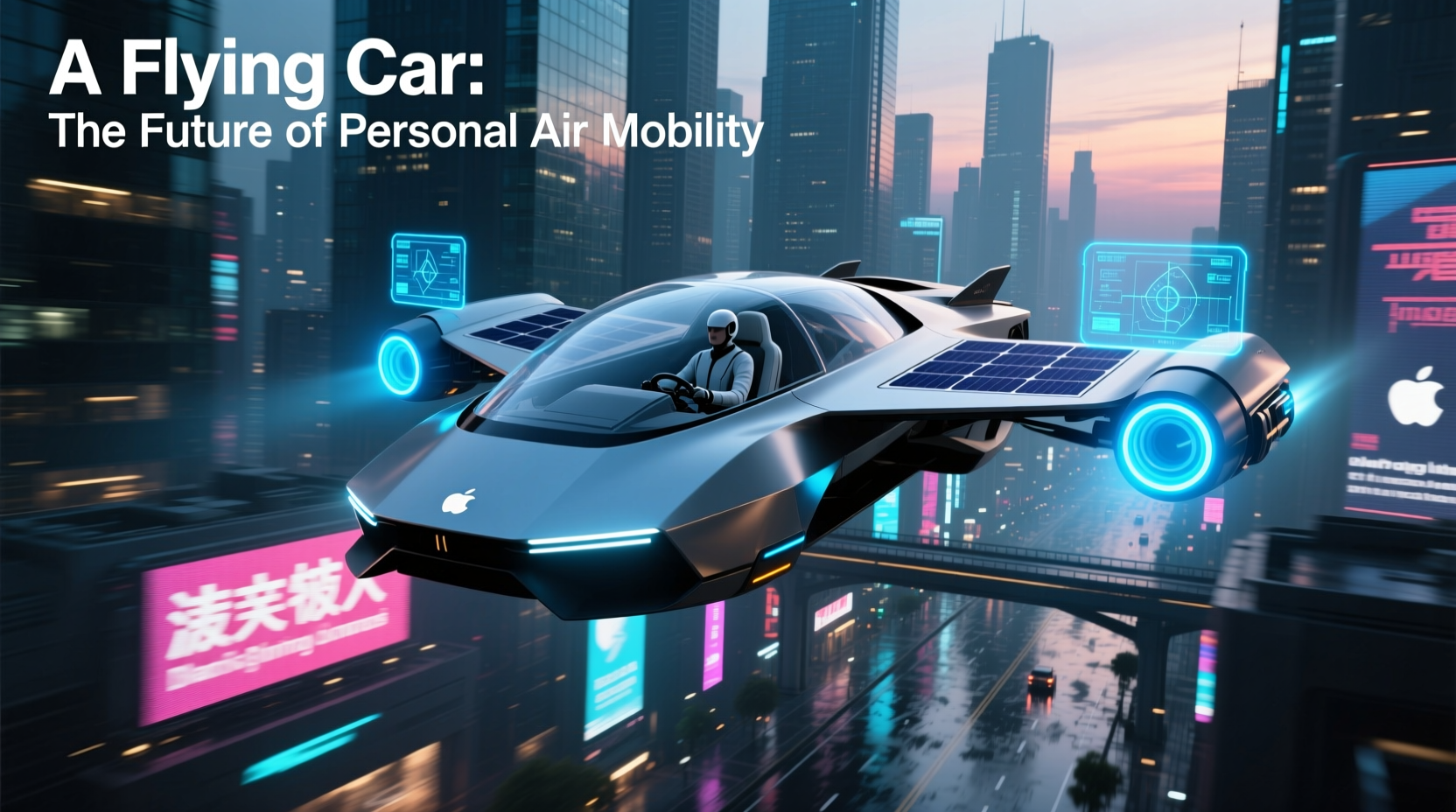
Imagine commuting over traffic in a personal flying car that combines the freedom of aviation with everyday driving. While fully road-legal, mass-market flying cars aren’t yet available to the public, several advanced prototypes—like the PAL-V Liberty and AeroMobil 5.0—are undergoing certification and limited production. These hybrid vehicles represent the cutting edge of urban air mobility, blending electric vertical takeoff and landing (eVTOL) technology with ground-driving capabilities. This article explores the current state of flying cars, their technological foundations, regulatory challenges, leading manufacturers, and realistic timelines for consumer availability.
What Is a Flying Car?
A flying car is a dual-mode vehicle designed to operate both on roads like a conventional automobile and in the air as an aircraft. Unlike traditional airplanes or helicopters, flying cars aim to offer seamless transitions between driving and flying, making them ideal for short-to-medium distance urban and suburban travel. They are often grouped under the broader category of electric vertical takeoff and landing (eVTOL) aircraft, though some models still rely on runways for takeoff and landing.
The concept has evolved from science fiction into tangible engineering projects backed by aerospace companies, startups, and even major automakers. Modern flying cars typically feature lightweight composite materials, folding wings or rotors, advanced avionics, and increasingly, hybrid-electric or fully electric propulsion systems.
How Do Flying Cars Work?
Flying cars use various mechanisms depending on their design:
- Runway-dependent models: Vehicles like the PAL-V Liberty require a short runway for takeoff and landing, functioning similarly to light sport aircraft but capable of being driven on roads afterward.
- eVTOL (electric Vertical Takeoff and Landing): These newer designs, such as those from Joby Aviation or Archer Aviation, lift off vertically using multiple electric rotors, eliminating the need for runways. Though not always drivable on roads, they’re considered next-gen flying cars due to their personal transport function.
- Hybrid transition systems: Some concepts, including the AeroMobil 5.0, use retractable wings and propellers, allowing conversion from car to airplane mode in minutes.
Most modern prototypes integrate fly-by-wire controls, autonomous navigation assistance, and redundant safety systems to meet aviation standards while maintaining automotive usability.
Top Flying Car Models in Development
Several companies are leading the race to bring certified flying cars to market. Below is a comparison of key players and their flagship models:
| Model | Company | Type | Range (Air) | Status |
|---|---|---|---|---|
| PAL-V Liberty | PAL-V (Netherlands) | Gyrocopter-based, roadable | 500 km (310 miles) | Near production; undergoing European certification |
| AeroMobil 5.0 | AeroMobil (Slovakia) | Foldable wing, hybrid-electric | 700 km (435 miles) | In development; expected post-2025 launch |
| XTI TriFan 600 | XTI Aircraft (USA) | eVTOL business jet | 1,200 km (750 miles) | Prototype phase; targeting 2028 certification |
| Joby S4 | Joby Aviation (USA) | Five-seat eVTOL | 240 km (150 miles) | Test flights ongoing; FAA certification in progress |
| Heaviside | Kitty Hawk (USA, project paused) | Single-seat eVTOL | 160 km (100 miles) | Limited testing; commercial plans uncertain |
Each model targets different markets—from private owners seeking novelty and efficiency to urban air taxi services aiming to reduce congestion.
Regulatory Challenges and Certification
One of the biggest hurdles for owning a flying car in the United States or EU is regulatory approval. Flying cars must meet stringent aviation safety standards set by agencies like the Federal Aviation Administration (FAA) in the U.S. and the European Union Aviation Safety Agency (EASA). Simultaneously, they must comply with road vehicle regulations from bodies like the National Highway Traffic Safety Administration (NHTSA) or EU’s type-approval system.
As of 2024, no flying car has received full dual certification for unrestricted public use. However, the PAL-V Liberty has achieved “Special Light-Sport Aircraft” classification from the FAA, meaning it can be flown by licensed sport pilots—but only after completing flight training and registering the vehicle as an aircraft.
Certification timelines vary significantly by country and depend on factors such as noise emissions, airspace integration, pilot licensing requirements, and air traffic control compatibility. Urban environments pose additional challenges due to population density and restricted low-altitude flight zones.
When Will Flying Cars Be Available to Consumers?
While media reports often suggest flying cars are “just around the corner,” the reality is more nuanced. Based on current development stages and regulatory processes:
- 2025–2027: Limited deliveries of pre-ordered models like the PAL-V Liberty may begin, primarily for wealthy enthusiasts and trained pilots.
- 2028–2030: Broader market entry expected for eVTOL air taxis in controlled urban corridors (e.g., Los Angeles, Dubai, Singapore).
- Post-2030: Widespread consumer ownership could become feasible if automation, battery technology, and infrastructure (such as vertiports) mature sufficiently.
Cost remains a significant barrier. Early models are priced between $300,000 and $1.2 million, placing them out of reach for most buyers. Over time, economies of scale and increased competition may drive prices down, similar to early electric vehicles.
Advantages and Disadvantages of Flying Cars
Pros:
- Traffic avoidance: By taking to the skies, flying cars bypass ground congestion, potentially cutting commute times dramatically.
- Environmental potential: Electric-powered models produce zero direct emissions and are quieter than traditional aircraft.
- Emergency access: Useful in disaster response scenarios where roads are damaged or inaccessible.
- Personal freedom: Offers unprecedented mobility for remote or underserved areas.
Cons:
- Safety concerns: Mid-air collisions, mechanical failures, and weather sensitivity remain risks, especially with widespread adoption.
- Noise pollution: Even quiet eVTOLs generate noticeable sound during takeoff and landing, raising community opposition.
- Pilot requirement: Most current models require a pilot’s license, which demands time, money, and physical fitness.
- Infrastructure gaps: There’s a lack of charging/refueling stations, vertiports, and integrated air traffic management for low-altitude drones and flying cars.
Common Misconceptions About Flying Cars
Despite growing interest, several myths persist about this emerging technology:
- Myth: Flying cars will replace regular cars soon. Reality: Mass adoption is decades away due to cost, regulation, and infrastructure needs.
- Myth: Anyone can fly a flying car without training. Reality: Most models require at least a sport pilot certificate; full autonomy is still experimental.
- Myth: Flying cars are completely silent. Reality: While quieter than helicopters, they still produce significant noise, especially during vertical maneuvers.
- Myth: They’re powered entirely by futuristic tech. Reality: Many rely on existing aerospace principles and internal combustion engines, though electrification is accelerating.
Regional Differences in Adoption
Global interest in flying car technology and urban air mobility solutions varies widely:
- United States: Strong innovation ecosystem with FAA involvement, but complex airspace and federal/state coordination slow deployment.
- European Union: EASA has established clear certification pathways for eVTOLs, and countries like Germany and the Netherlands support test flights.
- Middle East: UAE (especially Dubai) actively tests flying taxis, viewing them as symbols of futuristic cities.
- Asia-Pacific: Japan and South Korea invest heavily in eVTOL R&D; China sees strong government-backed drone and air mobility programs.
- Australia and Canada: Regulatory frameworks are evolving, with rural applications seen as promising due to vast distances and sparse populations.
Urban planning, population density, and government policy play crucial roles in determining where flying cars gain traction first.
How to Prepare for Owning a Flying Car
If you're considering becoming an early adopter, here are actionable steps:
- Obtain a pilot’s license: Start with a Sport Pilot or Private Pilot License (PPL), which takes 40–70 hours of flight training and costs $8,000–$15,000.
- Research local laws: Check whether your region allows private aircraft operation and home hangars or rooftop takeoff pads.
- Join enthusiast communities: Groups like the Experimental Aircraft Association (EAA) provide networking and educational resources.
- Monitor manufacturer updates: Sign up for newsletters from PAL-V, AeroMobil, or Joby Aviation to stay informed on delivery timelines.
- Budget beyond purchase price: Factor in maintenance (~$10,000/year), insurance ($15,000+/year initially), fuel/electricity, storage, and recurring certifications.
Future Outlook and Technological Trends
The future of flying car innovation and sustainable air travel hinges on several advancements:
- Better batteries: Higher energy density lithium-sulfur or solid-state batteries will extend range and reduce weight.
- Autonomous flight systems: AI-driven navigation could eventually eliminate the need for human pilots, broadening accessibility.
- Urban Air Mobility (UAM) networks: Cities may develop dedicated sky lanes, automated vertiport scheduling, and digital air traffic control platforms.
- Integration with smart cities: Flying cars could sync with traffic lights, weather data, and emergency services via IoT connectivity.
Partnerships between automakers (e.g., Hyundai, Toyota) and aerospace firms signal long-term commitment. Investment from Uber Elevate (now spun off), Boeing, and Rolls-Royce further validates the sector’s potential.
Frequently Asked Questions (FAQs)
Can I buy a flying car today?
Not for mainstream use. You can reserve models like the PAL-V Liberty or AeroMobil 5.0 with a deposit, but full regulatory approval and delivery are likely years away.
Do you need a pilot’s license to operate a flying car?
Yes, most current models require at least a sport pilot certificate. Fully autonomous versions may change this in the future.
How much does a flying car cost?
Prices range from $300,000 for basic models to over $1 million for luxury or high-performance variants.
Are flying cars safe?
They incorporate multiple safety redundancies, but like all aircraft, they carry inherent risks. Regulatory oversight aims to minimize these through rigorous testing.
Will flying cars help reduce traffic?
Potentially, but only if deployed at scale with proper airspace management. Initially, impact will be minimal due to low numbers and high costs.





 浙公网安备
33010002000092号
浙公网安备
33010002000092号 浙B2-20120091-4