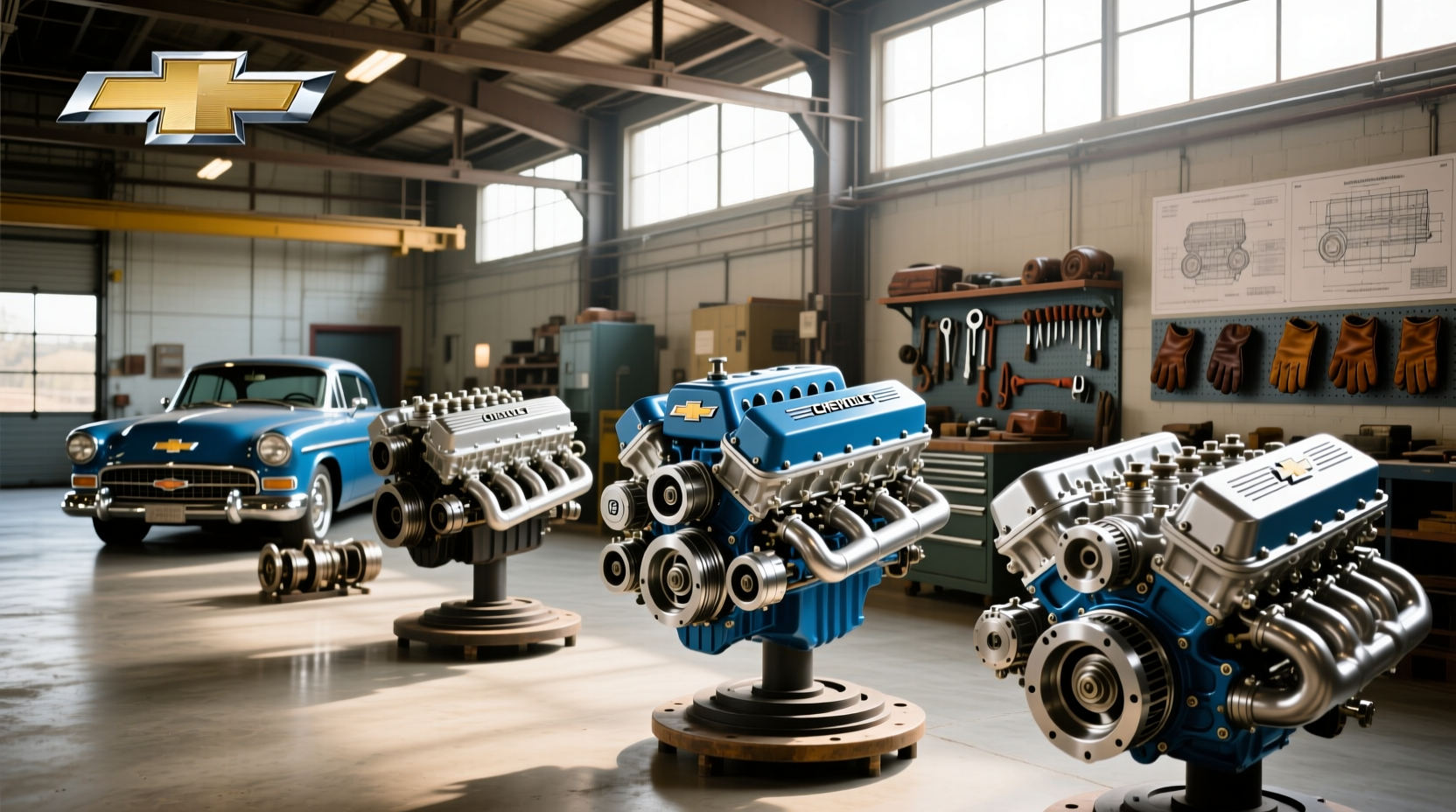
When researching Chevy engine sizes V8, one key fact stands out: Chevrolet has produced a wide range of V8 engines since 1955, with displacements ranging from 265 cubic inches (4.3L) to over 454 cubic inches (7.4L). These include both small-block and big-block families, each designed for different performance, efficiency, and application needs across trucks, SUVs, muscle cars, and crate engine builds.
Understanding Chevrolet's V8 Engine Families
Chevrolet’s V8 engines are broadly categorized into two main families: the small-block and the big-block. While both share a 90-degree V configuration and overhead valve design, they differ significantly in architecture, size, weight, and intended use 1.
⚙️ Small-Block V8 Engines: The Backbone of Chevy Performance
The small-block engine family is arguably the most influential in American automotive history. First introduced in 1955 with the 265 cubic inch (4.3L) V8, it quickly evolved into a versatile platform used in everything from sedans to race cars.
Key characteristics:
- Compact design with consistent external dimensions across generations
- Shared firing order: 1-8-4-3-6-5-7-2 across first- and second-generation models 1
- Lightweight compared to big-blocks, making them ideal for performance tuning
- Widely supported by aftermarket parts and crate engine programs
Notable small-block engine sizes include:
| Displacement (ci) | Displacement (L) | Common Name | Years Produced | Typical Applications |
|---|---|---|---|---|
| 265 | 4.3 | First-Gen Small Block | 1955–1957 | Corvette, Bel Air |
| 283 | 4.6 | 283 V8 | 1957–1967 | Corvette, Impala |
| 302 | 4.9 | Z/28 Engine | 1967–1969 | Camaro Z/28 |
| 305 | 5.0 | 5.0L V8 | 1970–2003 | Trucks, Police Cars |
| 307 | 5.0 | — | 1968–1973 | Passenger Cars |
| 327 | 5.4 | 327 V8 | 1962–1969 | Corvette, Camaro |
| 350 | 5.7 | 5.7L Small Block | 1967–2003+ | Trucks, Muscle Cars, Crate Builds |
| 383 | 6.3 | Stroker Build | Aftermarket | Performance Swaps |
| 400 | 6.6 | SB400 | 1970–1977 | Full-Size Cars |
The 5.7L (350 ci) remains one of the most popular due to its balance of power, reliability, and availability. Even today, rebuilt and crate versions are widely used in restorations and hot rods.
🏭 Big-Block V8 Engines: Power and Torque on Demand
Chevrolet’s big-block engines were developed for high-torque applications where space and weight were less critical. Introduced in 1958, these engines offered larger bores and longer strokes than their small-block counterparts.
Main features:
- Larger physical size and heavier construction
- Designed for maximum horsepower and towing capability
- Used primarily in full-size cars, heavy-duty trucks, and racing applications
- Less common in modern production but still available as crate engines
Prominent big-block engine sizes:
| Displacement (ci) | Displacement (L) | Common Name | Years Produced | Typical Applications |
|---|---|---|---|---|
| 348 | 5.7 | W-Series | 1958–1965 | Trucks, Passenger Cars |
| 396 | 6.5 | Mark IV | 1965–1976 | Chevelle SS, Corvette |
| 402 | 6.6 | — | 1970–1972 | Camaro, Chevelle |
| 427 | 7.0 | 7.0L Big Block | 1966–1969 | Race Cars, High-Performance Models |
| 454 | 7.4 | 7.4L V8 | 1970–1996 | Trucks, Motorhomes, Police Vehicles |
The 454 (7.4L) was especially notable for its use in the K-series pickups and Suburbans, delivering massive torque for hauling and towing. Though no longer in regular production, it lives on through GM’s crate engine program.
Modern V8 Engine Offerings from Chevrolet
While traditional pushrod V8s continue in trucks and performance vehicles, Chevrolet has refined its engine technology under the LS and LT series platforms. These modern small-blocks maintain the compact footprint while improving efficiency, emissions, and power output.
🔧 LS-Series V8 Engines: The New Standard
The LS family, introduced in 1997 with the LS1, represents a major evolution in small-block design. These engines feature aluminum blocks (in many variants), coil-near-plug ignition, and improved airflow.
Common LS-based displacements:
- 5.3L (323 ci): Widely used in Silverado, Tahoe, and Suburban; known for reliability and fuel-saving Active Fuel Management 2
- 6.0L (364 ci): Found in older GMT800 trucks and vans; durable and easily modified
- 6.2L (376 ci): Powers the Corvette, Camaro SS, and high-trim trucks; produces up to 420 hp and 460 lb-ft of torque 3
- 6.6L (403 ci): Used in heavy-duty trucks like the Silverado 2500HD; the L8T variant delivers 401 hp and 464 lb-ft of torque 4
The 6.2L EcoTec3 V8 is particularly significant as it combines traditional pushrod simplicity with direct injection and variable valve timing, enhancing both performance and efficiency.
⚡ Future Developments: The 6.7L V8
Rumors and reports suggest GM is developing a new 6.7L naturally aspirated V8 engine, potentially for the next-generation Corvette and Cadillac CT5-V Blackwing 5. This engine would focus on high-revving performance and improved thermal efficiency, possibly marking a return to large-displacement NA engines in flagship models.
Crate Engines and Performance Applications
For enthusiasts and builders, Chevrolet Performance offers a full line of crate engines that span both vintage and modern designs. These pre-assembled units simplify engine swaps and restorations.
📦 Types of Chevy Crate V8 Engines
Crate engines come in three main forms:
- Short-Block: Includes block, crankshaft, pistons, and connecting rods — foundation for custom builds
- Long-Block: Short-block plus cylinder heads, valvetrain, and often intake manifold
- Dressed Engine: Long-block with accessories (alternator, water pump, etc.) installed
Popular crate engine options include:
- LS3 6.2L: 430 hp, aluminum block, ideal for street performance
- LT4 6.2L Supercharged: Over 600 hp, used in Corvette Z06 and C7 Grand Sport
- 383 Stroker Small Block: Aftermarket-built for increased displacement and torque
- 454 HO Big Block: Delivers classic muscle car feel with modern durability
These engines are used not only in restoration projects but also in custom trucks, hot rods, and off-road vehicles where OEM replacements may not meet performance goals.
Choosing the Right Chevy V8 Size for Your Needs
Selecting the appropriate V8 depends on several factors including vehicle type, intended use, budget, and compatibility.
✅ Matching Engine Size to Application
| Use Case | Recommended V8 Sizes | Why It Fits |
|---|---|---|
| Daily Driving / Commuting | 5.3L, 6.2L (with AFM) | Balances power and fuel economy; smooth operation |
| Towing & Hauling | 6.6L L8T, 6.0L, 454 | High torque at low RPM; proven durability |
| Muscle Car Restoration | 350, 396, 427, 454 | Authenticity and period-correct performance |
| Performance Street Build | LS3 6.2L, 383 Stroker | Strong aftermarket support; tunable power delivery |
| Racing or Track Use | LT4, LS7 7.0L | High-output, lightweight components, track-proven |
🔍 Common Misconceptions About Chevy V8 Sizes
Several myths persist about Chevrolet’s V8 engines. Clarifying these can help avoid costly mistakes:
- Myth: All 5.3L engines are weak. Reality: The 5.3L is one of GM’s most reliable truck engines, with millions built. When properly maintained, it can exceed 300,000 miles.
- Myth: Bigger displacement always means more power. Reality: Modern 6.2L engines produce more horsepower than older 7.4L units due to better airflow, fuel injection, and combustion efficiency.
- Myth: Big-blocks are obsolete. Reality: They remain relevant in drag racing, boat builds, and custom vehicles where raw torque matters more than weight.
- Myth: You can’t swap an LS engine into an old car. Reality: Thousands have done it successfully using adapter kits and modern wiring harnesses.
How to Identify a Chevy V8 Engine Size
If you're working with an unmarked or unknown engine, identifying the exact displacement and model requires checking specific codes.
📌 Steps to Identify Your V8:
- Locate the Engine ID Tag: Usually found on the front passenger-side cylinder head or near the distributor.
- Check the VIN: For factory-installed engines, the eighth digit often indicates engine type (e.g., 'U' = 5.3L, 'E' = 6.0L).
- Measure Bore and Stroke: Using calipers and a depth gauge, calculate displacement manually.
- Decode Casting Numbers: Found on the block, these numbers reveal production date, plant, and engine family.
- Consult a Reference Guide: Resources like the Chevrolet Engine Identification Guide help match numbers to models.
For example, a casting number ending in '010' typically refers to a 350 small-block, while '454' in the code usually indicates a big-block of that size.
Frequently Asked Questions (FAQs)
- ❓ What Chevy cars have a V8 engine?
- Current models include the Corvette, Camaro SS, Tahoe RST, Suburban High Country, and Silverado 1500 with V8 option. Classic models like the Impala SS, Chevelle, and El Camino also featured V8s.
- ❓ Is the Chevy 5.3 a V8?
- Yes, the 5.3L is a V8 engine part of the Gen III/IV LS family. It’s commonly used in trucks and SUVs and known for reliability and fuel-saving cylinder deactivation.
- ❓ What is the best Chevrolet V8 engine?
- "Best" depends on use. For stock reliability: 5.3L or 6.2L. For performance: LS3 or LT4. For classic appeal: 350 or 454. The LS7 7.0L is often praised for its high-RPM capability in the Corvette Z06.
- ❓ Is the Chevy 5.3L V8 a good engine?
- Yes, the 5.3L V8 is considered highly reliable when maintained properly. It powers millions of trucks and has strong aftermarket support. Issues like lifter failure can occur if oil changes are neglected.
- ❓ Are Chevy small-block and big-block engines still made?
- Not in regular production vehicles, but both are available as crate engines from Chevrolet Performance for restoration and custom builds.





 浙公网安备
33010002000092号
浙公网安备
33010002000092号 浙B2-20120091-4