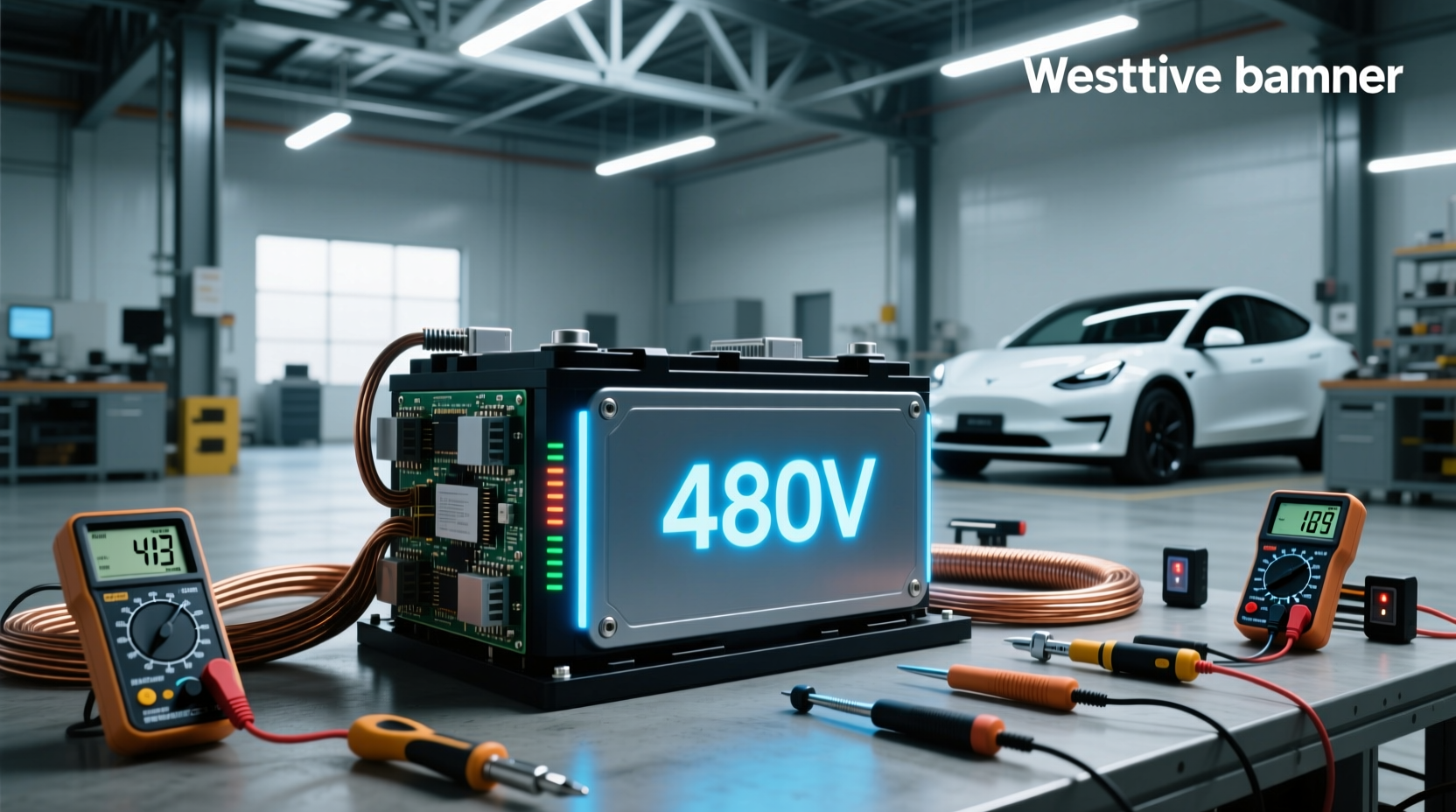
Electric vehicle (EV) battery voltage is a fundamental specification that directly influences performance, efficiency, and system compatibility. Understanding what EV battery voltage means, how it varies across models, and why it matters can help buyers, technicians, and DIY enthusiasts make informed decisions when selecting or maintaining an EV powertrain. Most modern all-electric vehicles operate on nominal voltages between 350V and 800V, with many falling in the 400V range ⚡. This voltage level affects charging speed, motor output, thermal management, and overall energy delivery.
Why EV Battery Voltage Matters for Performance and Efficiency
The voltage of an EV battery pack determines how much electrical potential energy is available to drive the vehicle’s electric motor(s). Higher voltage systems generally allow for lower current draw at the same power level, reducing resistive losses and heat generation in wiring and components ✅. For example, delivering 100 kW of power requires significantly less current at 800V than at 400V, which improves efficiency and enables thinner, lighter cabling — a critical advantage in vehicle design.
This principle follows Ohm’s Law: Power (W) = Voltage (V) × Current (A). By increasing voltage, automakers can reduce amperage, minimizing energy lost as heat and improving overall drivetrain efficiency. That’s why high-performance EVs like the Porsche Taycan and Hyundai Ioniq 5 use 800V architectures — they support faster DC fast charging (often up to 250 kW or more) without requiring excessively thick cables or cooling systems 🔧.
Typical Voltage Ranges Across EV Types
Different categories of electric vehicles use different voltage standards based on size, application, and intended use:
- Low-speed EVs (e.g., golf carts, neighborhood electric vehicles): Typically operate on 48V, 72V, or occasionally 36V systems 🏭. These are simpler, lower-cost setups suitable for short-range, low-power applications.
- Electric bikes and scooters: Often use 36V, 48V, or 72V lithium-ion packs. Voltage here affects top speed and hill-climbing ability.
- Passenger electric cars: Most fall into the 350–450V range (commonly referred to as 400V systems), while newer platforms like those from Hyundai, Kia, and Lucid use 800V architectures for ultra-fast charging.
- Commercial EVs and buses: May use higher-voltage configurations, sometimes exceeding 600V, depending on battery size and motor requirements.
It's important to note that these values refer to nominal voltage — the average operating voltage during discharge. The actual voltage fluctuates during use. A '400V' battery might measure around 450V when fully charged and drop to 350V when nearly depleted.
How Battery Configuration Determines Voltage
EV battery packs are made up of hundreds or thousands of individual cells connected in series and parallel combinations. The total voltage depends primarily on the number of cells wired in series. Each lithium-ion cell has a nominal voltage of about 3.2V to 3.7V, depending on chemistry:
- Lithium Iron Phosphate (LiFePO4): ~3.2–3.3V per cell
- NMC (Nickel Manganese Cobalt): ~3.6–3.7V per cell
- NCA (Nickel Cobalt Aluminum): ~3.6V per cell
To achieve a 400V system using NMC cells (~3.7V each), approximately 108 cells are connected in series (108 × 3.7 ≈ 400V). This configuration is often labeled “108S.” Similarly, an 800V system would require roughly 216 series-connected cells. Parallel connections increase capacity (measured in amp-hours, Ah) but do not affect voltage.
Understanding this series vs. parallel battery configuration is crucial for anyone involved in EV conversions, battery replacements, or DIY energy storage projects. Mixing incorrect configurations can lead to imbalances, reduced lifespan, or safety hazards ❗.
Voltage and Charging: Why 800V Enables Faster Recharging
One of the most significant advantages of higher-voltage battery systems is their ability to support faster DC fast charging. Because power equals voltage times current, an 800V system can deliver high power even at moderate current levels. For instance:
| System Voltage | Charging Current | Delivered Power |
|---|---|---|
| 400V | 250A | 100 kW |
| 800V | 250A | 200 kW |
| 800V | 375A | 300 kW |
As shown, doubling the voltage while keeping current constant doubles the charging power. This allows 800V EVs to add hundreds of miles of range in under 20 minutes at compatible chargers ⚡. However, this benefit only applies if both the vehicle and the charging station support the higher voltage. Not all public chargers offer 800V capability, so real-world gains depend on infrastructure availability.
Common Misconceptions About EV Battery Voltage
Several myths persist about EV battery voltage that can mislead consumers and hobbyists alike:
- Myth: Higher voltage always means longer range. While higher voltage improves efficiency, range is primarily determined by total energy stored (kWh), aerodynamics, weight, and driving habits. A 60 kWh 400V battery may have similar range to a 60 kWh 800V battery.
- Myth: All EVs use the same voltage standard. In reality, there’s no universal standard. Tesla uses a ~350–400V architecture, while some Chinese EVs and luxury models now adopt 800V systems.
- Myth: You can easily upgrade your car’s battery voltage. Changing the nominal voltage of an EV requires redesigning the entire powertrain — including motor controller, charger, and auxiliary systems. It’s not feasible for end users.
How to Check Your EV’s Battery Voltage
If you're curious about your own vehicle’s battery voltage, several methods exist:
- Owner’s manual: Look for specifications under “battery” or “electrical system.” Most list nominal voltage and total capacity.
- OBD2 scanner with EV support: Some advanced diagnostic tools can read live battery data, including pack voltage, state of charge, and temperature.
- Manufacturer app or portal: Tesla, Rivian, and others provide detailed battery metrics through mobile apps.
- Third-party monitoring devices: Devices like CANloggers or EVSE monitors can capture real-time voltage during charging or driving (requires technical setup).
⚠️ Caution: Never attempt to measure high-voltage battery terminals directly unless trained and equipped with proper safety gear. EV batteries operate at lethal voltages and should only be serviced by certified professionals.
Voltage in Aftermarket and Replacement Batteries
When sourcing replacement or aftermarket EV batteries — especially for e-bikes, scooters, or custom builds — matching voltage is essential. Using a 48V battery in a system designed for 36V can damage the motor controller, display, or other electronics. Conversely, a lower-voltage battery will result in poor performance or failure to operate.
Reputable suppliers clearly label battery voltage alongside capacity (Ah) and chemistry (e.g., LiFePO4, NMC). Always verify compatibility before purchase. For example:
- A 48V 20Ah e-bike battery provides ~960Wh of energy.
- A 72V 100Ah LiFePO4 pack offers 7.2 kWh — suitable for solar storage or light EV conversions.
Some vendors offer modular battery systems that allow stacking multiple units in series to reach desired voltages. These must include built-in battery management systems (BMS) to prevent overvoltage, imbalance, or thermal runaway.
Battery Management Systems and Voltage Monitoring
A critical component in every EV battery is the Battery Management System (BMS), which monitors individual cell voltages, temperatures, and overall pack health ⚙️. The BMS ensures that no single cell exceeds safe voltage limits during charging (typically 4.2V for NMC, 3.65V for LiFePO4) and prevents deep discharge below minimum thresholds (e.g., 2.5V per cell).
Without a functioning BMS, cell imbalance can occur, leading to reduced capacity, overheating, or catastrophic failure. In large packs, the BMS communicates with the vehicle’s main computer to report state of charge (SOC), state of health (SOH), and fault codes.
Future Trends: Solid-State and High-Voltage Architectures
Emerging technologies like solid-state batteries may shift voltage norms in coming years. Though still in development, prototypes show promise for higher energy density and improved safety. Some designs operate at higher intrinsic cell voltages, potentially enabling even more efficient 1000V+ systems in premium EVs by 2030.
In addition, automakers are exploring dual-voltage architectures — combining 400V and 800V components — to balance cost and performance. For example, a vehicle might use an 800V main drive system with a 400V auxiliary circuit for heating or onboard electronics.
DIY and Off-Grid Uses of EV Battery Packs
Used or repurposed EV battery modules are increasingly popular in off-grid energy storage and home backup systems. When adapting these for non-automotive use, understanding voltage is vital:
- A single Tesla Model S module outputs ~22V (7S configuration).
- Six such modules in series yield ~132V — suitable for a medium-sized home battery bank.
- Integrating them requires DC-DC conversion, inverters, and robust BMS integration.
Projects involving salvaged EV batteries must account for residual voltage, unpredictable aging, and lack of manufacturer warranties. Always test individual modules before assembly and use isolation monitoring relays for safety.
Regional Differences and Standards
Voltage standards are largely consistent globally due to engineering constraints rather than regional regulations. However, charging infrastructure varies:
- North America and Europe widely support 400V systems.
- China has rapidly deployed 800V-compatible charging stations, particularly along major highways.
- Japan focuses on compact EVs with moderate voltage systems (300–400V).
No international regulation mandates a specific EV battery voltage, but industry consortia like ISO and SAE define safety and communication protocols that indirectly influence design choices.
How Temperature Affects EV Battery Voltage
Operating temperature significantly impacts battery voltage readings and performance. Cold temperatures increase internal resistance, causing voltage sag under load — meaning the battery reads lower voltage when starting the car in winter. This can trigger “low battery” warnings even if SOC is adequate.
Conversely, excessive heat accelerates degradation and increases self-discharge rates. Modern EVs use liquid cooling and pre-conditioning (heating the battery before fast charging) to maintain optimal voltage stability and charging efficiency.
Frequently Asked Questions
- What is the typical voltage of an electric car battery?
- Most electric cars use battery packs with a nominal voltage between 350V and 450V, commonly known as 400V systems. High-performance models like the Porsche Taycan use 800V architectures for faster charging.
- Can I replace my EV battery with a different voltage?
- No. EVs are engineered for specific voltage ranges. Installing a battery with a different voltage can damage the motor, inverter, and control systems. Only OEM-recommended replacements should be used.
- Does higher battery voltage mean better range?
- Not necessarily. Range depends more on total energy capacity (kWh) than voltage. Higher voltage improves efficiency and charging speed but doesn’t directly increase range.
- How does voltage affect charging speed?
- Higher voltage allows more power delivery at lower current, reducing heat and enabling faster DC fast charging. An 800V EV can charge twice as fast as a 400V model using the same current.
- Are 48V systems used in full electric vehicles?
- 48V systems are common in mild hybrids and electric bikes but not in full battery electric vehicles (BEVs). BEVs require much higher voltages (350V+) to deliver sufficient power and efficiency.




 浙公网安备
33010002000092号
浙公网安备
33010002000092号 浙B2-20120091-4