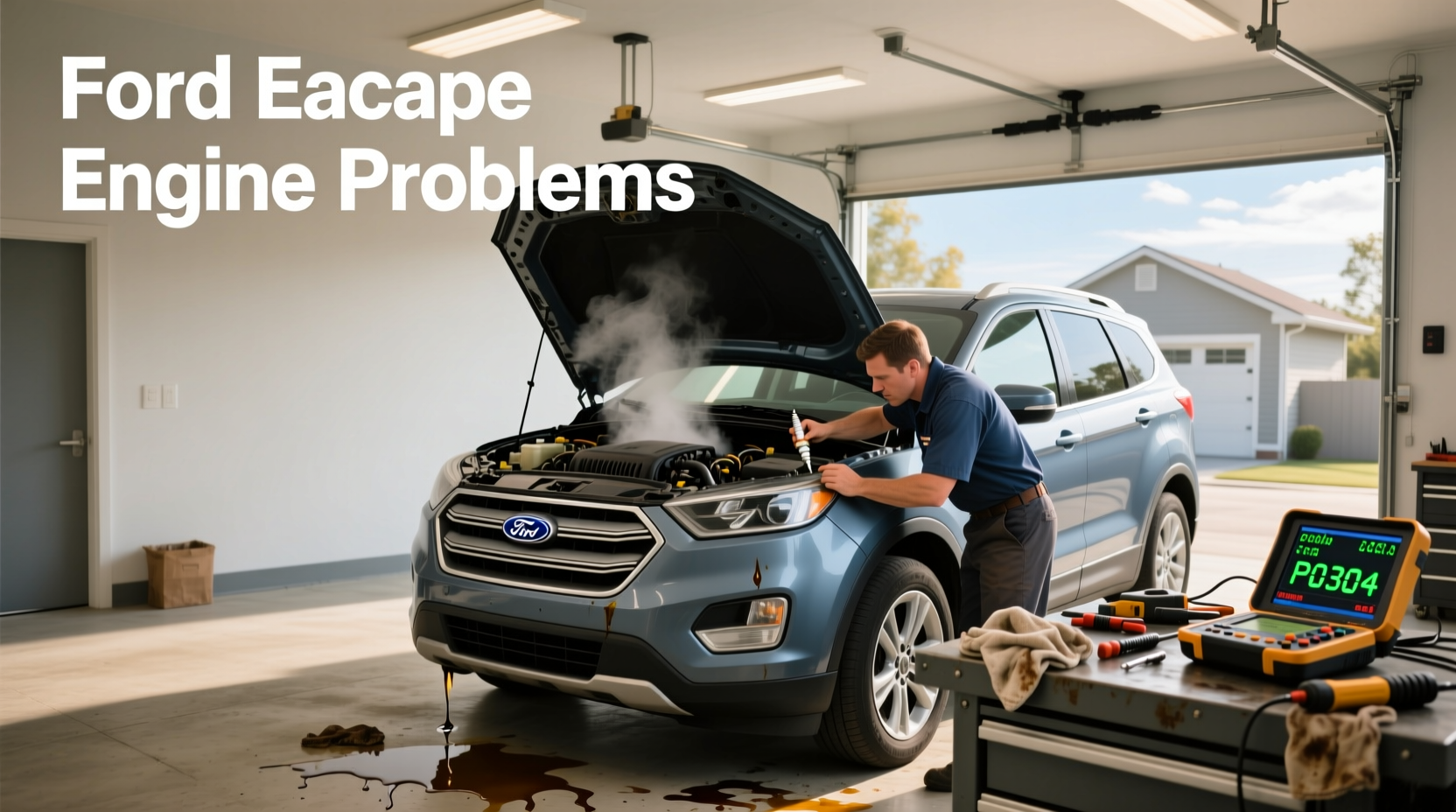
If you're searching for common Ford Escape engine problems, you're not alone. Many owners of 2013–2019 models—especially those with the 1.5L EcoBoost engine—have reported premature engine failures due to a design flaw in the open-deck cylinder block that can lead to cracking under heat stress 1. Later models (2020+) show improved reliability with updated engines and hybrid options. This guide breaks down engine-specific issues by year, explains warning signs, repair or replacement costs, and what steps to take if your Ford Escape engine fails.
Understanding Ford Escape Engine Options by Model Year
The Ford Escape has gone through multiple generations and powertrain updates since its debut. Knowing which engine your model has is the first step in diagnosing potential problems. Below is a breakdown of engine types used over the years:
| Model Years | Engine Type | Horsepower | Key Features |
|---|---|---|---|
| 2001–2007 | 2.3L I4, 3.0L V6 | 130–200 hp | Non-turbo; some AWD variants |
| 2008–2012 | 2.5L I4, 3.0L V6 | 166–240 hp | Improved fuel economy; optional AWD |
| 2013–2019 | 1.6L & 1.5L EcoBoost I3, 2.0L EcoBoost I4 | 179–245 hp | Turbocharged; known 1.5L block issues |
| 2020–Present | 1.5L EcoBoost I3, 2.0L EcoBoost I4, 2.5L Hybrid, PHEV | 181–250 hp | Redesigned 1.5L block; eCVT in hybrids |
🔍 Why it matters: The 1.5L EcoBoost engine introduced in 2013 became infamous for durability concerns, particularly in hot climates or under heavy load. If you own a 2013–2019 Escape with this engine, understanding its weaknesses is critical.
Ford Escape 1.5L EcoBoost Engine: Known Issues and Failures
The 1.5L EcoBoost (I3) engine was designed to balance performance and fuel efficiency. However, real-world use revealed serious flaws:
🔹 Open-Deck Block Design Flaw
The most significant issue lies in the engine’s open-deck cylinder block, which lacks sufficient structural support around the cylinders. Under sustained high temperatures—such as during towing, stop-and-go traffic, or summer driving—the block can warp or crack, leading to coolant leaks, overheating, and eventual engine seizure.
This problem was especially prevalent in:
✅ Hotter climates (e.g., Southwest U.S.)
✅ Vehicles used for frequent short trips (incomplete warm-up cycles)
✅ Models with poor maintenance history
🔧 Symptoms include:
- Overheating without visible coolant loss
- White smoke from exhaust (burning coolant)
- Milky residue on oil cap or dipstick (oil/coolant mixing)
- Misfires or rough idle
🛠️ Fix: Ford issued revised engine blocks starting around 2018–2019. If your vehicle needs replacement, insist on the updated closed-deck design. Some owners report success with aftermarket sleeves or upgraded cooling systems, but these are temporary fixes.
🔹 Timing Chain Tensioner Failure
Another recurring problem in 1.5L engines is premature wear of the timing chain tensioner. A failed tensioner causes slack in the chain, potentially leading to valve-to-piston contact and catastrophic engine damage.
⚙️ Warning signs:
- Rattling noise at startup (especially cold)
- Check Engine Light with codes like P0016 or P0017
- Reduced performance or stalling
✅ Prevention: Regular oil changes with correct viscosity (5W-20) help maintain hydraulic pressure in the tensioner. Consider replacing the tensioner proactively at 100,000 miles, even if no symptoms appear.
2.0L EcoBoost Engine: More Power, Fewer Issues?
The 2.0L EcoBoost (I4) engine produces up to 250 hp and is typically found in higher trims (Titanium, ST-Line). While more robust than the 1.5L, it's not immune to problems:
🔹 Turbocharger Failures
Owners report turbocharger bearing wear or wastegate malfunctions, often after 80,000–120,000 miles. Symptoms include:
- Loss of power or boost pressure
- Whining or grinding noises from engine bay
- Excessive black smoke under acceleration
🛠️ Solution: Replacement is costly ($2,000+), but remanufactured units are available. Avoid aggressive driving when cold and allow proper cool-down periods after highway use to extend turbo life.
🔹 Direct Injection Carbon Buildup
Like many modern GDI engines, the 2.0L EcoBoost suffers from carbon deposits on intake valves, leading to rough idling, misfires, and reduced efficiency.
🧼 Maintenance tip: Perform walnut blasting or chemical cleaning every 60,000 miles. Using top-tier gasoline (with detergent additives) may slow buildup.
Hybrid and Plug-In Hybrid Engines: Reliability Improvements
Starting in 2020, Ford introduced the 2.5L Atkinson-cycle hybrid and PHEV versions. These models eliminate the problematic 1.5L engine and rely on a more durable four-cylinder base.
✅ Advantages of Hybrid Models:
- No turbocharging stress on the engine
- Lower operating temperatures due to electric assist
- Fewer reports of major mechanical failure
- Better long-term reliability according to owner forums 2
⚡ Common minor issues:
- Battery pack degradation after 10+ years
- Inverter or DC-DC converter faults (rare)
- Software glitches requiring module resets
📌 Note: The hybrid system uses an eCVT transmission, which is generally reliable but expensive to repair if damaged.
When Did Ford Fix the 1.5L Engine Problem?
There is no official recall for the 1.5L EcoBoost engine block issue. However, Ford quietly updated the design around 2018–2019. Vehicles built after mid-2019 (model year 2020+) feature a reinforced, closed-deck block that addresses the cracking risk.
🔍 How to verify:
- Ask your dealer or mechanic to check the engine casting number
- Look for service bulletins referencing "improved cylinder block"
- Review build date: post-2019 models are less likely to have the defect
❗ Caveat: Some 2018–2019 models still received older blocks depending on production batch. Always inspect service records and consider a pre-purchase inspection if buying used.
Repair Costs and Warranty Coverage
Replacing a failed 1.5L EcoBoost engine can cost between $4,000 and $7,000 at a dealership. Independent shops may offer lower rates ($3,000–$5,000), but quality varies.
🔧 Cost Breakdown:
- Remanufactured engine: $2,000–$3,500
- Labor (15–20 hours): $1,500–$2,500
- Cooling system flush, gaskets, fluids: $300–$500
✅ Warranty options:
- Factory warranty: 3 years / 36,000 miles (bumper-to-bumper), 5 years / 60,000 miles (powertrain)
- Extended warranties: May cover engine replacement if failure occurs within term
- Lemon law claims: Some owners successfully pursued refunds or replacements for repeated engine failures
📍 Tip: If your engine failed shortly after warranty expiration, contact Ford Customer Service. In some cases, they’ve provided goodwill assistance, especially for documented repeat issues.
Is the Ford Escape Still a Reliable SUV?
The answer depends heavily on the model year and engine choice:
❌ Models to Avoid:
- 2013–2016 Escape with 1.5L EcoBoost: Highest failure rate
- 2017–2019 with early 1.5L blocks: Mixed reliability; inspect carefully
✅ Safer Choices:
- 2020+ Escape (any engine): Improved build quality
- 2020+ Hybrid or PHEV: Best long-term reliability
- 2013–2019 with 2.0L EcoBoost: Stronger engine, fewer thermal issues
📊 According to Consumer Reports and J.D. Power, the 2020 redesign marked a turning point in overall Escape reliability.
How to Protect Your Ford Escape Engine
You can't change the engine design, but you can minimize risks:
🔧 Maintenance Tips:
- Use correct oil: 5W-20 synthetic blend or full synthetic, changed every 5,000–7,500 miles
- Monitor coolant: Flush every 100,000 miles; check for contamination monthly
- Avoid short trips: Let engine reach full operating temperature regularly
- Inspect hoses and belts: Replace if cracked or swollen
- Scan for codes: Use an OBD2 reader periodically to catch issues early
⚠️ Don’t ignore: Any sign of overheating, misfires, or unusual noises. Early diagnosis can prevent total engine failure.
Buying a Used Ford Escape? What to Check
If considering a used Escape, follow this checklist:
📋 Inspection Steps:
- Confirm engine type via VIN or door jamb sticker
- Review service history for overheating repairs or coolant work
- Check for active recalls using NHTSA’s database 3
- Perform a compression test or leak-down test
- Run a coolant system pressure test
- Request an independent pre-purchase inspection
🚫 Red flags:
- Frequent oil top-offs
- Coolant disappearing without external leak
- Rough idle or hesitation under load
Frequently Asked Questions (FAQs)
- ❓ Can a Ford Escape engine be replaced with a newer model block?
- Yes. Many mechanics install the updated closed-deck 1.5L block during replacement. Confirm compatibility with your model year and ECU calibration.
- ❓ How long do Ford Escape engines last?
- With proper care, 2.0L and hybrid engines can exceed 200,000 miles. The 1.5L EcoBoost may fail as early as 60,000–100,000 miles if the block cracks.
- ❓ Is there a recall for the 1.5L EcoBoost engine?
- No official recall exists. However, Ford has addressed related issues like ignition coils and fuel injectors through service campaigns.
- ❓ Should I buy a Ford Escape with the 1.5L engine?
- Only if it’s a 2020 or newer model, or a used one with documented maintenance and no history of overheating. Otherwise, opt for the 2.0L or hybrid.
- ❓ What’s the average cost to replace a Ford Escape engine?
- Between $4,000 and $7,000 at a dealership. Remanufactured engines from reputable suppliers can reduce cost by 20–30%.




 浙公网安备
33010002000092号
浙公网安备
33010002000092号 浙B2-20120091-4