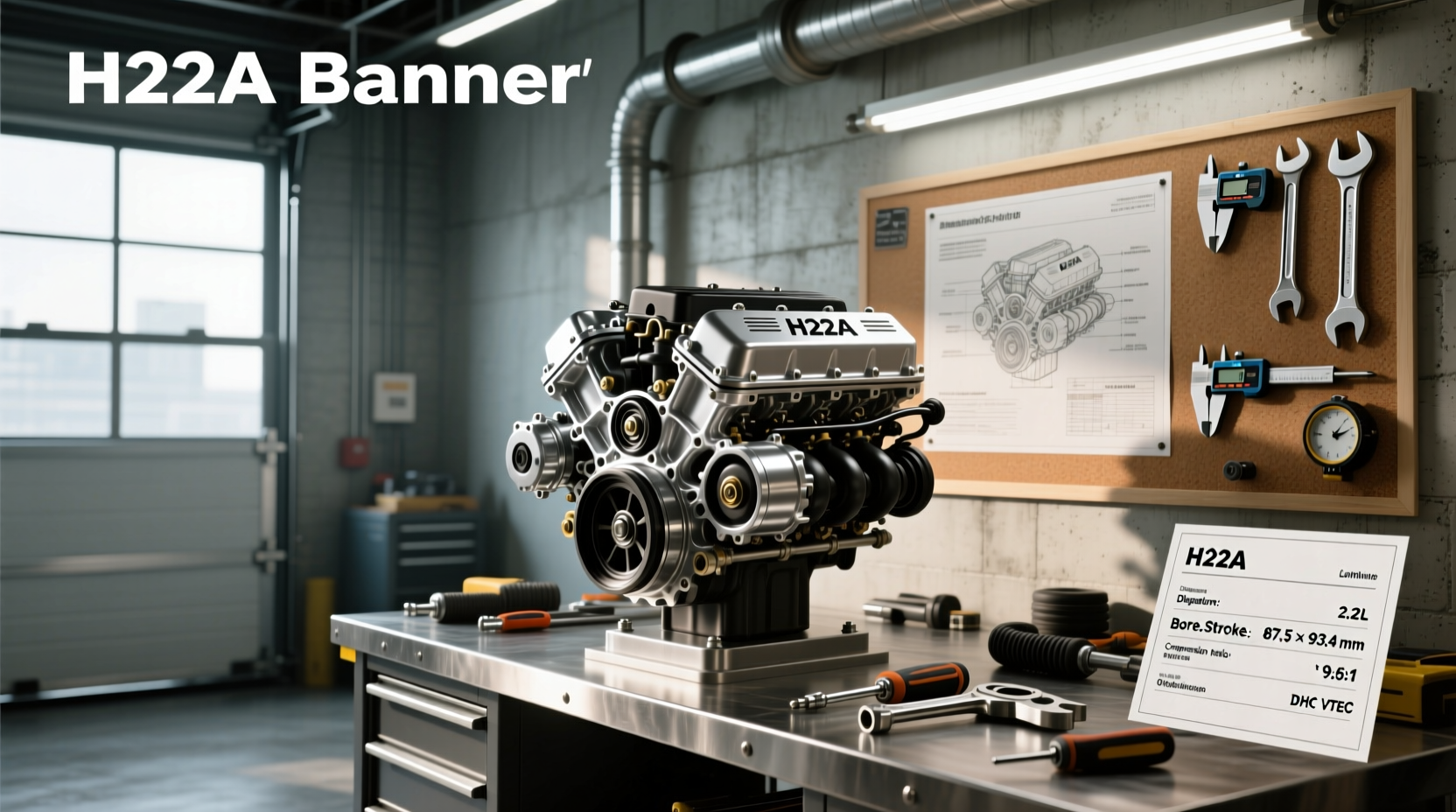
The Honda H22A engine is a high-revving, naturally aspirated inline-four powerplant known for its robust performance and tuning potential. With a displacement of 2.2 liters (2156cc), DOHC 16-valve configuration, and Honda’s signature VTEC system, the H22A delivers between 197 and 220 horsepower depending on market and variant 🌐. This makes it a top choice for enthusiasts looking to upgrade older Civics, CR-Xs, or Integras through engine swaps ⚙️. In this detailed guide, we’ll break down every aspect of the H22A engine specs — from bore and stroke to compression ratios, torque curves, ECU types, and real-world reliability concerns — so you can make informed decisions whether you're rebuilding, sourcing a used unit, or planning a high-performance build ✅.
Understanding the Honda H22A: A Performance-Oriented Powertrain
Introduced in the early 1990s, the H22A was part of Honda’s H-series engine family — designed as a larger-displacement alternative to the B-series engines like the B18C and B20B 1. While not as widely adopted in North America, the H22A gained legendary status among JDM (Japanese Domestic Market) fans due to its use in sporty coupes like the fourth- and fifth-generation Honda Prelude SiR and Type S models 🔧. Unlike smaller four-cylinders, the H22A offered more low-end torque while maintaining strong high-RPM power delivery thanks to aggressive dual-cam VTEC activation on both intake and exhaust valves — a feature rare outside race-tuned engines at the time.
This blend of street usability and track-ready responsiveness made the H22A a favorite among tuners seeking balance between drivability and performance ✨. Even today, many consider it one of the most underrated Honda engines, especially when compared to the later K-series that eventually replaced it.
Detailed H22A Engine Specifications by Variant
One key point users often overlook is that there isn’t just one ‘H22A’ engine — multiple sub-variants exist with different specifications based on model year, region, and application. Below is a comprehensive breakdown of major H22A versions and their technical data:
| Variants | Displacement (cc) | Bore × Stroke | Compression Ratio | Horsepower (PS/hp) | Torque (lb-ft/Nm) | VTEC Activation (RPM) | OBD Standard |
|---|---|---|---|---|---|---|---|
| H22A (BB4/BB1) | 2156 | 87.0 mm × 90.7 mm | 10.6:1 | 200 PS (197 hp) | 152 lb-ft (206 Nm) | 5,500 rpm | OBD-I |
| H22A1 (USDM) | 2156 | 87.0 mm × 90.7 mm | 10.0:1 | 190 hp | 152 lb-ft (206 Nm) | 4,500 rpm | OBD-I |
| H22A4 (USDM) | 2156 | 87.0 mm × 90.7 mm | 9.8:1 | 197 hp | 156 lb-ft (212 Nm) | 4,500 rpm | OBD-II |
| H22A8 (Euro R) | 2157 | 87.0 mm × 90.7 mm | 11.0:1 | 220 hp | 162 lb-ft (220 Nm) | 5,500 rpm | OBD-II |
As shown above, displacement remains consistent across variants (~2.2L), but differences in compression ratio, VTEC engagement point, and emissions systems significantly affect output and compatibility 🔍. For example, the JDM-spec H22A found in the BB4 Prelude produces higher peak power than its USDM counterpart (H22A1), largely due to higher compression and freer-flowing exhaust manifolds.
Key Technical Features of the H22A
- DOHC VTEC System: One of the few production Honda engines where VTEC activates both intake and exhaust camshafts, improving volumetric efficiency at high RPM ⚡.
- Fiber-Reinforced Metal (FRM) Liners: Used in high-output versions like the Type S; these liners reduce weight and improve heat dissipation but require special pistons during rebuilds ❗.
- Closed-Deck Block Design (Early Models): Found in pre-1997 units, offering superior strength under boost — highly sought after for turbo builds 🏭.
- Red Valve Cover: A visual identifier for genuine high-compression JDM H22A engines, particularly those used in SiR and Type S trims ✅.
Which Cars Came with the H22A Engine?
The H22A was primarily installed in premium Honda coupes and sedans aimed at performance-oriented drivers. The most notable applications include:
- Honda Prelude (4th Gen – 1992–1996): Equipped with the H22A (JDM) and H22A1 (USDM), available in SiR and VTi-R trims with 4WS (four-wheel steering) option 📍.
- Honda Prelude (5th Gen – 1997–2001): Featured the H22A4 (OBD-II) in USDM models and H22A (OBD-I) in JDM markets; the latter includes the revered Type S variant with 220 hp.
- Honda Accord Euro R (CL1 – 1998–2002): Powered by the high-compression H22A8, producing up to 220 hp and paired with a close-ratio 6-speed manual transmission ⚙️.
- Rare Applications: Some private conversions and limited regional models (e.g., Japan-only Inspire) also received H22A engines.
Because of its placement in sporty chassis with advanced suspension and handling dynamics, the H22A wasn't just about raw power — it was engineered for balanced driving experiences.
Why Enthusiasts Love the H22A for Engine Swaps
Despite being discontinued over two decades ago, the H22A remains a popular candidate for engine swaps into lighter front-wheel-drive Hondas such as the EG/EK Civic, DC2 Integra, and even CR-X del Sol platforms 🚚. Here's why:
1. Superior Torque Curve Compared to B-Series
While the B16 and B18 engines are known for high-revving nature, they suffer from narrow powerbands. The H22A, with its longer stroke (90.7mm vs. 81.4mm on B18), generates significantly more mid-range torque starting around 3,500 RPM. This translates to better daily drivability and reduced need for constant gear changes.
2. Strong Foundation for Forced Induction
With proper supporting mods (intercooler, fuel system, forged internals), the H22A can reliably produce over 300 wheel horsepower. Early closed-deck blocks are especially resilient under moderate turbocharging pressures (up to 15 psi).
3. Compatibility with K-Swap Mounts and Harnesses
Thanks to shared architecture with other Honda engines, many aftermarket companies offer universal swap kits that simplify mounting the H22A into non-Prelude chassis. Adapting OBD-I or OBD-II ECUs may require rewiring, but plug-and-play solutions exist for common donor vehicles 👥.
4. Unique Sound and Driving Character
The H22A has a deeper, throatier exhaust note than typical high-strung fours, partly due to longer stroke and dual VTEC operation. Combined with smooth redline access past 7,500 RPM, it offers an engaging experience absent in modern turbocharged engines.
Common Issues and Reliability Concerns
Like any aging performance engine, the H22A comes with known weaknesses that buyers and builders should evaluate carefully:
Hydraulic Camshaft Tensioner Failure
Many H22A engines use a hydraulic auto-tensioner for the timing belt, which is prone to failure over time. Once it collapses, valve-to-piston contact becomes likely, leading to catastrophic damage. A common preventative upgrade is replacing it with the manual tensioner from the H23 engine or using a reliable aftermarket kit 🔧.
Oil Consumption in High-Mileage Units
Especially in engines exceeding 150,000 miles, worn piston rings and valve seals can lead to noticeable oil burn. Look for compression and leak-down test results before purchasing a used long block.
FRM Liner Sensitivity During Rebuilds
If your H22A has factory FRM (fiber-reinforced metal) cylinder liners, standard aftermarket pistons won’t work. You must source compatible pistons designed specifically for FRM bores, increasing rebuild costs significantly ❗.
ECU and Wiring Complexity
JDM H22A engines typically come with OBD-I wiring harnesses and P28 ECUs, which aren’t directly compatible with OBD-II vehicles. Swapping requires either converting the dashboard harness or using standalone engine management systems like Hondata or Pectel SQ6.
How to Identify a Genuine H22A Engine
Given the popularity of fake or misrepresented engines online, verifying authenticity is crucial. Use the following checklist:
- Engine Code Stamp: Located on the passenger side of the block near the transmission mount. Should read “H22A” followed by a suffix (e.g., H22A4).
- Valve Cover Color: Red indicates high-compression JDM version; black is usually USDM or lower-spec variant ✅.
- Intake Manifold Design: JDM Type S uses a longer-runner IM for improved top-end power, while USDM models have shorter runners.
- VTEC Solenoid Location: Dual solenoids (intake and exhaust) confirm true DOHC VTEC operation.
- Block Casting Marks: Closed-deck blocks will lack water passages between cylinders when viewed from the side.
Purchasing a Used H22A: What to Look For
If you’re buying a used H22A engine — whether for restoration, rebuild, or swap — follow these guidelines to avoid costly mistakes:
1. Verify Mileage and Maintenance History
Engines with documented service records and regular oil changes are less likely to have internal wear. Be skeptical of units claiming “low mileage” without proof.
2. Request Compression and Leak-Down Tests
A healthy H22A should show 170–190 psi compression across all cylinders, with no more than 10% variation. Leak-down below 10% is ideal. Anything worse suggests ring or valve issues.
3. Inspect for External Leaks
Check the front crank seal, rear main seal, valve cover gasket, and water pump area. Oil or coolant leaks could indicate neglected maintenance.
4. Confirm Included Components
Some sellers advertise “complete engines” but omit critical parts like ECU, harness, distributor, or mounts. Always clarify what’s included before purchase 🛒.
5. Price Benchmarks (as of 2025)
- JDM H22A (Prelude BB4/BB1): $2,500–$3,500
- USDM H22A4 (Prelude BB6/BB8): $2,000–$2,800
- JDM Accord Euro R H22A8: $2,700–$3,800
- Rebuilt Short Block: $4,000+
Prices vary based on condition, location, and inclusion of accessories like transmission or wiring.
H22A vs. K24: Which Is Better for Your Build?
A frequent debate among Honda enthusiasts is whether the H22A outperforms the newer K24A (from the K-series). Here’s a factual comparison:
| Feature | H22A | K24A |
|---|---|---|
| Naturally Aspirated Power | Up to 220 hp | 160–200 hp |
| Torque Output | Higher mid-range (210+ Nm) | Broader curve, but lower peak |
| VTEC Type | DOHC VTEC (dual cam) | i-VTEC (intake only) |
| Aftermarket Support | Moderate, niche-focused | Extensive, mainstream |
| Reliability (Stock) | Good, but tensioner risk | Excellent |
| Turbo Potential | Strong (closed-deck preferred) | Very strong with sleeved block |
In short: Choose the H22A if you value high-RPM excitement, OEM engineering purity, and classic JDM appeal. Opt for the K24 if you want easier integration, better fuel economy, and broader support.
Maintenance Tips for Longevity
To keep your H22A running smoothly for years, adhere to these best practices:
- Replace Timing Belt Every 60,000–90,000 Miles: Include water pump, tensioner, and idler pulleys during service.
- Use High-Quality Synthetic Oil: Recommended viscosity is 10W-30 or 5W-30, changed every 5,000 miles.
- Monitor Coolant Levels: The aluminum block is sensitive to overheating; inspect hoses and thermostat regularly.
- Upgrade to Manual Tensioner: Eliminate risk of hydraulic failure with a solid replacement kit.
- Warm Up Before Revving: Especially important in cold climates to prevent bearing wear.
Final Thoughts: Is the H22A Still Worth It Today?
The Honda H22A engine may be outdated by modern standards, but its combination of linear power delivery, mechanical sophistication, and cult-following status ensures continued relevance in the enthusiast world. Whether you're restoring a vintage Prelude, building a lightweight track car, or simply appreciate finely engineered NA engines, the H22A offers a rewarding experience unmatched by forced-induction alternatives.
However, it’s essential to go in with eyes open: parts are becoming scarcer, expertise harder to find, and certain rebuild challenges (like FRM liners) can increase costs unexpectedly. Weigh your goals — daily driver, weekend cruiser, or full race build — and choose accordingly.
Frequently Asked Questions (FAQs)
- How much horsepower does a stock H22A engine produce?
- The stock H22A produces between 197 and 220 horsepower depending on the variant. JDM models like the Prelude Type S and Accord Euro R deliver the highest output at around 220 hp.
- What cars have the H22A engine?
- The H22A was primarily used in the Honda Prelude (1992–2001) and the Honda Accord Euro R (1998–2002). It was most commonly found in Japanese and European markets.
- Is the H22A better than the K24 for performance builds?
- The H22A excels in high-RPM power and has a more aggressive DOHC VTEC system, making it ideal for NA builds. The K24 offers better aftermarket support and fuel efficiency, making it preferable for daily-driven or turbocharged applications.
- Can I swap an H22A into a Honda Civic?
- Yes, the H22A can be swapped into EG/EK Civics using custom or aftermarket motor mounts, wiring harnesses, and sometimes transmission adapters. It’s a complex project requiring mechanical skill.
- Why do some H22A engines fail prematurely?
- Common causes include hydraulic cam tensioner failure, lack of maintenance, oil starvation, and overheating. Regular servicing and upgrading weak points can prevent most failures.





 浙公网安备
33010002000092号
浙公网安备
33010002000092号 浙B2-20120091-4