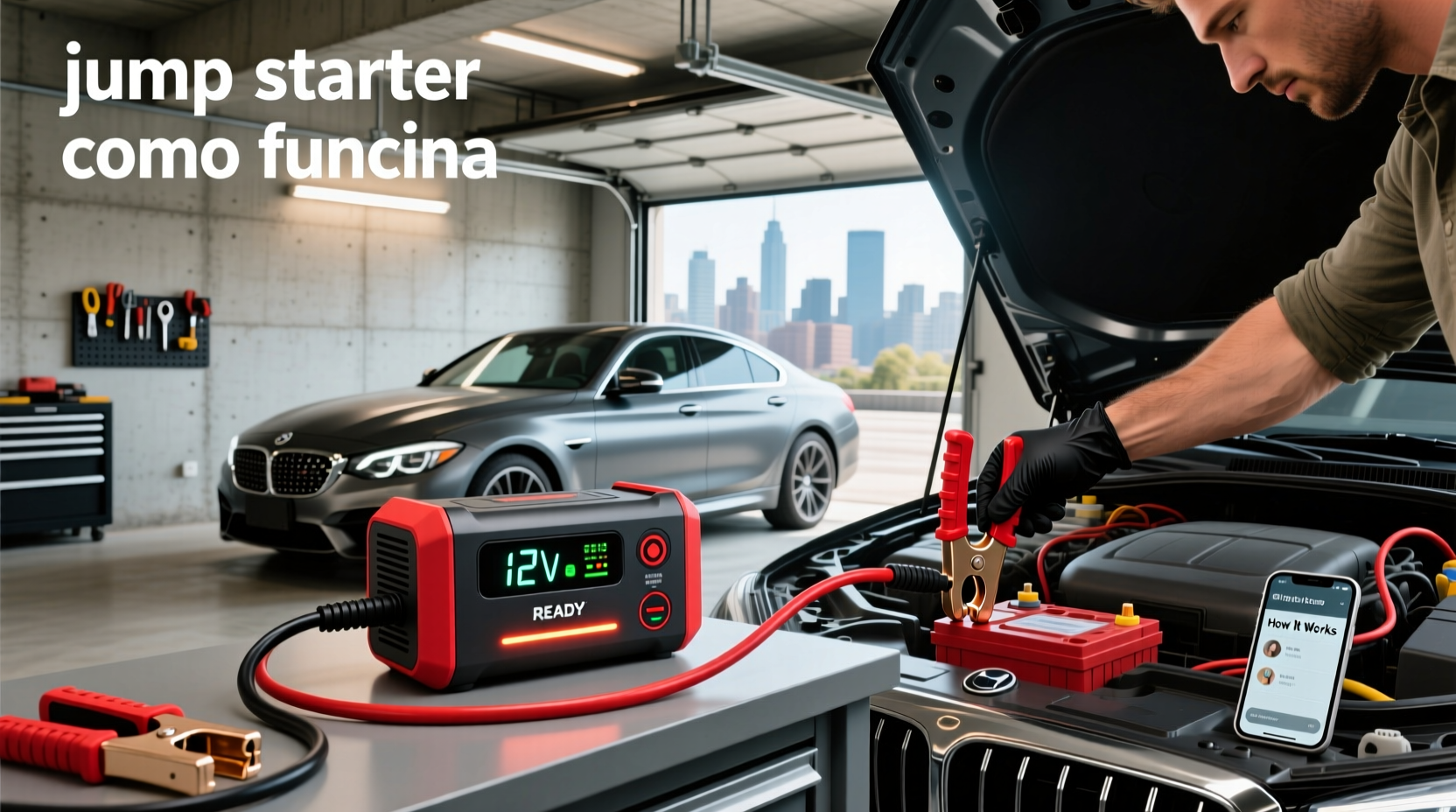
⚡ If you've ever wondered how a jump starter works, you're not alone. Millions of drivers face dead batteries each year, and portable jump starters have become essential tools for quick, independent vehicle restarts without needing another car or jumper cables. These compact devices use high-capacity lithium polymer or lithium-ion batteries to deliver a surge of power—measured in peak amps—to crank a stalled engine. In this guide, we’ll break down the science behind jump starters, explain key components like clamps, circuits, and battery tech, and help you understand real-world performance versus marketing claims.
What Is a Portable Jump Starter?
A portable jump starter is a self-contained power unit designed to start a vehicle with a depleted or dead battery. Unlike traditional jump-starting that requires a second vehicle and jumper cables, a modern jump starter integrates a rechargeable battery pack, safety electronics, and built-in clamps into a handheld device. Most models today operate at 12 volts, matching standard automotive electrical systems, and can deliver anywhere from 400 to over 7,000 peak amperes depending on size and design 1.
These units are commonly used by everyday drivers, roadside assistance professionals, and fleet operators. They’re especially valuable in remote areas, cold climates, or during emergencies when access to help isn’t immediate. Beyond jump-starting, many include additional features such as USB ports for charging phones, LED flashlights, and even built-in air compressors for tire inflation.
Core Components of a Jump Starter ⚙️
To fully grasp how a jump starter como funciona (how it works), it’s important to examine its internal and external parts:
- Battery Pack: Typically made from lithium polymer (LiPo) or lithium iron phosphate (LiFePO4), these provide stable energy storage with high discharge rates needed for engine cranking.
- Power Inverter & Circuitry: Manages voltage regulation, protects against overloads, short circuits, and reverse polarity.
- Jumper Clamps (Alligator Clips): Connect the device to the car battery terminals—red to positive (+), black to negative (-) or grounded metal.
- Display Panel: Shows battery level, output status, and sometimes diagnostic feedback via LCD screens.
- USB/DC Ports: Allow charging of mobile devices or powering accessories.
- Safety Sensors: Detect incorrect connections and prevent sparking or damage.
The integration of these components allows the device to safely transfer stored energy to the vehicle’s starter motor through the battery terminals.
The Science Behind Jump Starting: Voltage, Amperage, and Cranking Power 🔍
Understanding basic electrical principles helps clarify how jump starters work. The three most relevant metrics are:
- Voltage (V): Most passenger vehicles require 12V to operate the ignition and fuel systems. A jump starter must match this voltage to be compatible.
- Cranking Amps (CA): This refers to the current delivered at 32°F (0°C) for 30 seconds while maintaining at least 7.2 volts. It reflects starting capability under moderate conditions.
- Peak Amps (PA): Often advertised prominently, this is the maximum burst of current the device can deliver for a very short duration—sometimes just milliseconds. While useful for overcoming initial resistance, peak amps don’t tell the full story about sustained performance.
For example, a small sedan might need only 400 CA to start, whereas a large diesel truck could require up to 1,000 CA or more. However, manufacturers often highlight peak amps (e.g., “6000A”) which may not reflect usable cranking power. Independent testing has shown significant discrepancies between labeled specs and actual dyno-measured output 2.
Step-by-Step: How to Use a Jump Starter ✅
Using a jump starter correctly ensures both effectiveness and safety. Follow these steps:
- Charge the Device Fully: Before first use or after long storage, ensure the jump starter is fully charged using the included adapter.
- Turn Off All Electronics: Disable headlights, radio, and climate control in the stalled vehicle to reduce load.
- Connect the Clamps:
- Attach the red clamp to the positive (+) terminal of the dead battery.
- Attach the black clamp to an unpainted metal surface away from the battery (engine block or bolt)—this grounds the circuit and reduces spark risk near hydrogen gas.
- Power On the Jump Starter: Press the activation button if required; some models auto-detect load.
- Start the Engine: Turn the ignition key. If the engine doesn’t start within 3–5 seconds, wait 10–15 seconds before retrying to avoid overheating.
- Disconnect Safely: Remove clamps in reverse order—black first, then red—and turn off the jump starter.
Many newer models feature smart protection that prevents connection if polarity is reversed, making them safer for inexperienced users.
Can a Jump Starter Start a Completely Dead Battery? ❓
This is one of the most frequently asked questions: Will a portable jump starter work on a completely dead battery? The answer depends on several factors:
- If the battery is below 5 volts, most starter motors won't engage because the vehicle’s control modules won’t activate.
- Some advanced jump starters include a “boost mode” or “soft start” function that gradually applies voltage to唤醒 (wake up) dormant electronics before delivering full cranking power.
- Lithium iron phosphate (LiFePO4) models tend to perform better in low-voltage scenarios due to higher efficiency and lower internal resistance.
However, if the battery is physically damaged, sulfated, or has an internal short, no jump starter will be able to start the car. In such cases, replacement is necessary.
Differences Between Lithium-Ion, LiPo, and LiFePO4 Batteries 🧰
Not all jump starters use the same battery chemistry. Each type has trade-offs in energy density, lifespan, safety, and cost:
| Battery Type | Energy Density | Lifespan (Cycles) | Safety | Best For |
|---|---|---|---|---|
| Lithium-Ion (Li-ion) | High | 300–500 | Moderate (requires protection circuits) | Compact personal units |
| Lithium Polymer (LiPo) | Very High | 300–400 | Lower (swelling risk) | Ultra-thin designs |
| Lithium Iron Phosphate (LiFePO4) | Moderate | 2,000+ | High (thermally stable) | Frequent use, professional applications |
While LiPo enables smaller, lighter units like the Propower Volt Jump Starter, LiFePO4 offers longer life and better performance in extreme temperatures, making it ideal for commercial fleets or harsh environments.
Real-World Performance vs. Advertised Specs: What to Watch For 📊
Marketing materials often emphasize peak amperage, but real-world performance involves more than raw numbers. Key considerations include:
- Duty Cycle: How long the device can sustain output before overheating.
- Temperature Tolerance: Cold weather reduces battery efficiency. Some models specify operation down to -20°C (-4°F).
- Number of Attempts: Higher-quality units allow multiple start attempts on a single charge.
- Clamp Quality: Poorly insulated or thin-gauge clamps increase resistance and reduce effective power delivery.
Independent reviewers have demonstrated that cheaper models may fail to start even small engines despite claiming thousands of amps 3. Always look for third-party test results when available.
When NOT to Use a Jump Starter ❗
While convenient, jump starters aren’t always the right solution. Avoid using them in these situations:
- Frozen Battery: If the electrolyte inside the battery is frozen, attempting to jump-start can cause explosion. Thaw the battery first.
- Alternator Failure: If the alternator isn’t charging the battery, the car may start once but stall shortly after.
- Severe Battery Damage: Bulging case, acid leaks, or internal shorts mean the battery needs replacement.
- Repeated Jump-Starting: Doing this regularly stresses the starter motor and indicates an underlying issue.
In these cases, mechanical inspection or towing is safer than repeated jump attempts.
Choosing the Right Jump Starter: Key Buying Criteria 📋
Before purchasing, consider these practical factors:
- Engine Size: Gasoline engines up to 6.0L typically need 1,000–2,000 peak amps. Diesel engines may require 2,500+ PA.
- Portability: Urban commuters may prefer pocket-sized models, while truck owners might prioritize power over size.
- Additional Features: Built-in flashlight, USB-C PD charging, and air compressor add utility but also cost and weight.
- Recharge Time: Some units take 3–4 hours; others up to 6–8 hours.
- Warranty & Support: Look for at least a 1-year warranty and accessible customer service.
Also check whether the model includes a carry case, wall charger, and car charger adapter—some budget options omit these.
Regional Variations and Climate Impact 🌍
Performance varies by region due to climate and vehicle types. In colder regions like Canada or Scandinavia, battery capacity drops significantly below freezing. A jump starter rated for 1,500A at room temperature may deliver only 60% of that power at -10°C. Conversely, in hot climates like Mexico or the Middle East, excessive heat accelerates battery degradation over time.
Vehicles also differ globally. European diesels often have higher compression ratios than American counterparts, requiring more cranking power. Meanwhile, older Asian-market cars may have simpler electrical systems that respond better to low-power boosters.
Maintenance Tips for Longevity 🧼
To extend the life of your jump starter:
- Recharge every 3–6 months, even if unused. Lithium batteries degrade faster when deeply discharged.
- Store in a cool, dry place away from direct sunlight.
- Avoid dropping or exposing to water unless specifically rated IP65 or higher.
- Check clamp insulation periodically for cracks or wear.
- Use the correct charger—cheap third-party adapters can damage internal circuits.
Common Misconceptions About Jump Starters 📎
Several myths persist about how jump starters work:
- Myth: More peak amps always mean better performance.
Reality: Sustained cranking amps and battery quality matter more than peak bursts. - Myth: Any jump starter can replace a car battery.
Reality: They are emergency tools, not substitutes for a functioning battery. - Myth: All USB-powered jump starters are weak.
Reality: Some newer models with efficient circuitry can start compact cars reliably.
FAQs About How Jump Starters Work 💡
- How does a jump starter work with a car battery?
- A jump starter connects directly to the car battery terminals, supplying enough current to power the starter motor and ignite the engine. Once running, the alternator takes over charging.
- Can I use a jump starter on a motorcycle or ATV?
- Yes, as long as the device supports 12V systems and delivers sufficient cranking amps. Smaller engines require less power, so most standard jump starters work well.
- Do jump starters work on diesel engines?
- Yes, but larger diesel engines require higher amperage. Ensure the model specifies compatibility with diesel vehicles, ideally supporting at least 2,500 peak amps.
- How long does a jump starter hold its charge?
- Most retain 80–90% charge after 6 months. Lithium iron phosphate models generally hold charge longer than lithium-ion.
- Is it safe to leave a jump starter plugged in overnight?
- Modern units have overcharge protection, so occasional overnight charging is safe. However, prolonged overcharging can shorten battery lifespan.





 浙公网安备
33010002000092号
浙公网安备
33010002000092号 浙B2-20120091-4