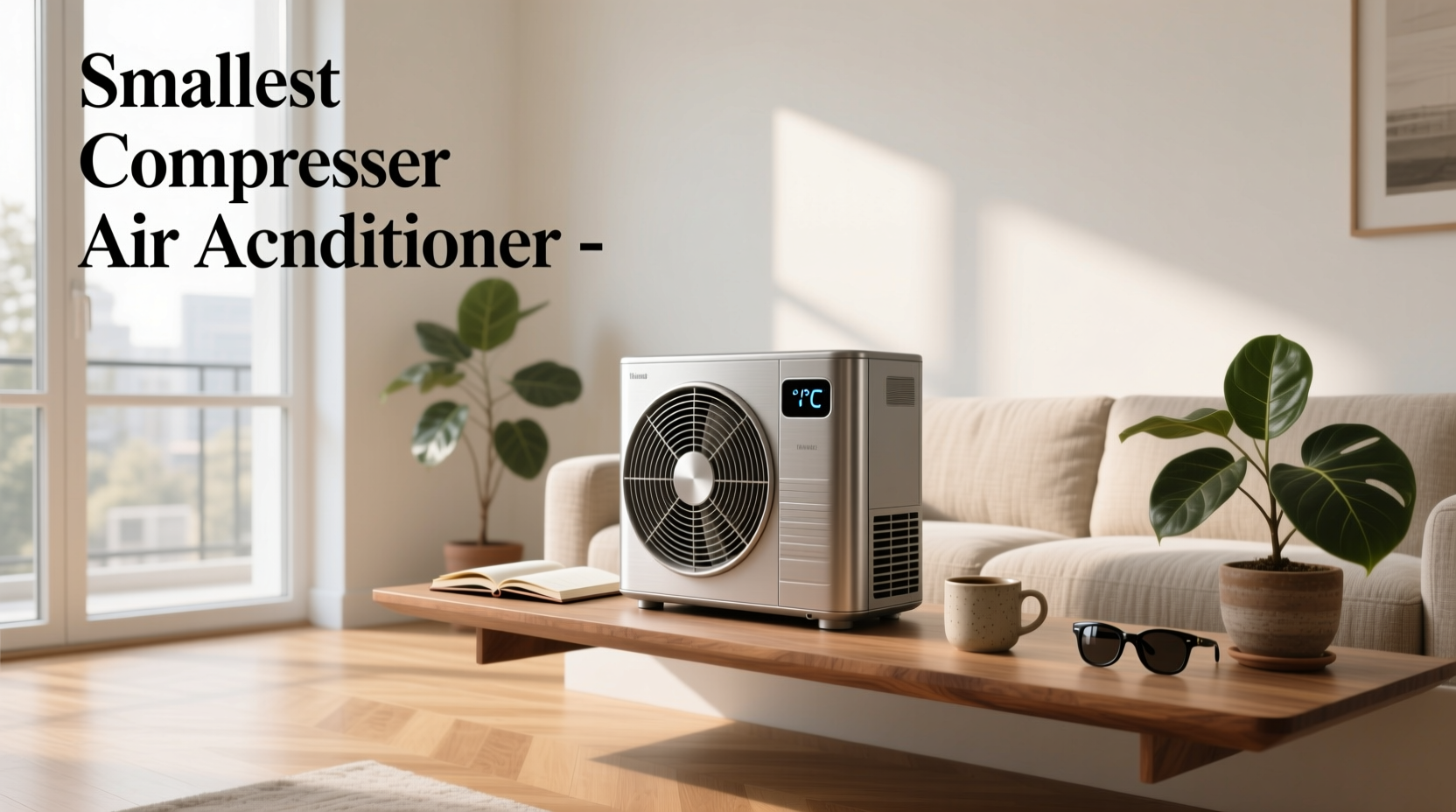
When searching for the smallest compressor air conditioner, users are typically looking for compact, efficient cooling solutions that use vapor-compression refrigeration—unlike evaporative coolers. These units are ideal for tight spaces like RVs, tiny homes, cabins, or personal workspaces where traditional window or central AC systems aren’t feasible. The true smallest compressor air conditioners leverage miniature DC compressors, such as the RIGID HVAC QX1901VDL (12V), which measures just 5.6 x 7.8 cm (2.3 x 3.1 in) and delivers up to 1,535 BTU of cooling power ⚙️.
Understanding Compressor-Based vs. Evaporative Cooling
Before diving into size comparisons, it’s essential to distinguish between compressor-based and evaporative cooling technologies. Many products marketed as “mini air conditioners” use water evaporation and fans to create a cooling sensation but do not lower ambient temperature significantly ✅. True air conditioning requires a refrigerant cycle involving a compressor, condenser, expansion valve, and evaporator.
Compressor-driven units actively remove heat from the air using a closed-loop system with refrigerants like R134A or R410A. This makes them far more effective in hot, humid climates where evaporative coolers fail due to high moisture saturation 🌍. For users seeking actual temperature reduction in confined areas, only compressor-based models qualify as real air conditioners.
Types of Small Compressor Air Conditioners
There are several categories of compact compressor ACs, each suited to different applications:
1. Portable Compressor AC Units (Under 3,000 BTU)
These standalone units are self-contained and often feature wheels or handles for mobility. While most portable ACs range from 8,000–14,000 BTU, some specialized models fall under 3,000 BTU, making them suitable for cooling spaces under 150 sq ft 🏠.
- Cooling Capacity: Typically 2,000–2,800 BTU/h
- Dimensions: As small as 14" H × 12" W × 12" D
- Power Source: Standard 115V AC outlet
- Ventilation: Requires single-hose exhaust through a window kit
While not the absolute smallest in physical footprint, these represent the most accessible consumer-grade compressor ACs designed for bedrooms, offices, or dorm rooms. However, their efficiency is limited by the single-hose design, which creates negative pressure indoors.
2. Mini-Split Systems with Compact Compressors
Mini-split systems separate the indoor blower unit from the outdoor condenser/compressor. Some manufacturers offer ultra-compact outdoor units or all-in-one ductless systems where the entire refrigeration circuit fits within a slim indoor head.
Inverter-driven mini-splits can scale cooling output down to 1,500–2,000 BTU at low load, providing precise climate control. Brands like Mitsubishi, Fujitsu, and Daikin produce models rated as low as 9,000 BTU nominal capacity, but actual minimum output can dip below 2,000 BTU with variable-speed compressors ✨.
For space-constrained installations—such as studio apartments or home additions—these offer superior efficiency and quiet operation compared to portables. Installation requires professional mounting and refrigerant line routing, increasing initial cost ⚠️.
3. DC-Powered Micro Compressor Air Conditioners
The smallest compressor air conditioners by physical dimensions are found in DC-powered micro systems used in automotive, marine, and off-grid applications. These utilize hermetically sealed rotary or reciprocating compressors running on 12V, 24V, or 48V DC power.
A prime example is the RIGID HVAC QX1901VDL (12V), one of the world’s smallest commercially available refrigeration compressors:
| Feature | Specification |
|---|---|
| Model | QX1901VDL |
| Voltage | DC 12V |
| Cooling Capacity | 450W / 1,535 BTU |
| Refrigerant | R134A |
| Weight | 720g (1.6 lbs) |
| Dimensions | 5.6 x 7.8 cm (2.3 x 3.1 in) |
| Application | Mobile cooling, EV battery thermal management, custom builds |
This type of compressor enables truly compact air conditioning systems when integrated into custom enclosures with evaporators and controls. They are commonly used in:
- Electric vehicle battery cooling
- Camper vans and caravans
- Telecom shelters
- Pet transport units
- DIY personal cooling stations
DIY and Custom-Built Mini Compressor ACs
Many online discussions, particularly on forums like Reddit’s r/DIY and DIY Solar Power, revolve around building a mini compressor air conditioner using fridge compressors 🔧. While technically possible, there are significant limitations:
- Fridge compressors are optimized for slow, continuous cooling in insulated environments—not rapid heat removal from open air.
- They lack sufficient airflow integration without additional ducting and fans.
- Most operate on start-stop cycles rather than variable speed, reducing efficiency.
- Safety risks include improper refrigerant handling and electrical hazards.
Successful DIY builds often repurpose complete mini-split components or integrate commercial micro-compressors like those from Aspen or RIGID HVAC. Projects showcased on YouTube and Hackaday demonstrate functional battery-powered vapor-compression units using BLDC-driven compressors and Li-ion packs ⚡.
Key Factors When Choosing the Smallest Compressor AC
Selecting the right compact compressor air conditioner depends on multiple factors beyond just physical size. Consider the following decision criteria:
Cooling Capacity vs. Space Size
Even the smallest compressor AC must match the thermal load of the target area. A general rule is:
- 50–100 BTU per square foot depending on insulation, sun exposure, and occupancy
- Example: A 100 sq ft room may require 5,000–8,000 BTU under normal conditions
Units under 3,000 BTU are best suited for spot cooling or very small enclosed volumes like sleeping pods, server racks, or instrument enclosures 📦.
Power Requirements and Efficiency
AC power (115V/60Hz) is standard for plug-in units, but DC-powered models offer flexibility for off-grid or mobile use:
- DC 12V: Compatible with car batteries and solar setups; ideal for camping
- DC 24V/48V: Used in industrial and electric vehicle applications; higher efficiency
- EER (Energy Efficiency Ratio): Look for values above 8.0 for optimal performance
Low-voltage systems require adequate battery capacity and charge management to avoid deep discharge damage.
Noise Levels
Smaller compressors tend to run at higher RPMs, potentially increasing noise. Check decibel ratings:
- Below 45 dB(A): Quiet, suitable for bedrooms
- 45–55 dB(A): Moderate, typical for office settings
- Above 55 dB(A): May be disruptive for prolonged use
Some micro-compressor units achieve quieter operation through vibration damping and acoustic insulation.
Maintenance and Serviceability
Unlike larger residential systems, mini compressor ACs often have sealed refrigerant circuits. If a leak occurs or the compressor fails, repair may not be economical. Key considerations:
- Limited availability of replacement parts
- Need for vacuum pumps and gauges during servicing
- Disposal regulations for refrigerants (R134A is regulated)
For long-term reliability, choose units with manufacturer warranties and documented service procedures.
Common Misconceptions About Mini Compressor ACs
Several myths persist in online communities regarding the capabilities of small compressor-based cooling systems:
Myth 1: Any Small Fan + Ice = Real Air Conditioning
No. Devices combining a fan with ice or water are evaporative coolers. They provide temporary relief but cannot reduce room temperature effectively, especially in humidity over 50%. True compressor ACs actively extract heat via phase change refrigeration ❗.
Myth 2: Mini Fridge Compressors Can Cool Rooms
Fridge compressors are designed for low-capacity, intermittent duty in well-insulated boxes. Attempting to cool open spaces leads to overheating, short cycling, and premature failure. Purpose-built micro-compressors are engineered for sustained thermal loads.
Myth 3: All 'Portable' ACs Use Compressors
Not true. Many budget 'portable air conditioners' sold online are actually misting fans without refrigerant systems. Always verify the product description includes terms like “vapor compression,” “refrigerant,” or “compressor type.”
Where to Buy Genuine Mini Compressor AC Components
Genuine miniature compressors and compatible parts are available from specialized suppliers rather than mainstream retailers. Recommended sources include:
- RIGID HVAC: Manufacturer of ultra-compact DC compressors for mobile applications 1
- Aspen Compressor: U.S.-based producer of miniature reciprocating compressors for medical and defense uses 2
- Mini Split Warehouse: Supplier of OEM replacement compressors for ductless systems
- ZHEJIANG FOUR SEASON THERMO CO., LTD: Exporter of rotary DC mini compressors for OEM integration
Avoid unverified sellers on global marketplaces offering generic “micro DC compressors” without technical specifications or safety certifications. Counterfeit or poorly manufactured units pose fire and refrigerant leak risks.
Applications and Use Cases
The smallest compressor air conditioners serve niche but critical roles across industries:
- Transportation: Climate control in truck sleeper cabs, ambulances, police vehicles
- Renewable Energy: Battery temperature regulation in solar storage systems
- Medical: Cooling for lab equipment or vaccine transport containers
- Consumer: Personal comfort in tiny homes, RVs, and backyard studios
- Military & Telecom: Environmental control in field shelters and remote repeater stations
As demand grows for energy-efficient, decentralized cooling, advancements in micro-compressor technology will continue to shrink form factors while improving performance.
Future Trends in Miniature Compressor Technology
Emerging innovations point toward even smaller, smarter, and more efficient compressor-based cooling systems:
- Digital Inverters: Enable precise speed control and part-load efficiency
- New Refrigerants: Low-GWP alternatives like R1234yf are being adopted in mobile systems
- Integrated Sensors: Allow predictive maintenance and fault detection
- Thermoelectric Hybrids: Combine compressor cooling with Peltier elements for rapid response
Research institutions and HVAC engineers are exploring piezoelectric compressors and microchannel heat exchangers to further reduce size and weight without sacrificing output.
Conclusion: Defining the Smallest Compressor Air Conditioner
The title of smallest compressor air conditioner belongs not to a finished consumer product, but to the core component—the miniature DC compressor itself. Units like the RIGID QX1901VDL set the benchmark for compactness, delivering meaningful cooling in a package smaller than a smartphone.
For end users, the practical choice depends on application: pre-built portable units under 3,000 BTU for indoor personal cooling, or custom-integrated DC micro-compressor systems for mobile and off-grid needs. Understanding the difference between true refrigeration and evaporative cooling is crucial to making an informed decision.
Always evaluate based on verified cooling capacity, power requirements, noise levels, and serviceability—not just advertised size. With proper selection, even the smallest compressor air conditioner can deliver reliable, effective cooling where traditional systems won’t fit.
Frequently Asked Questions
- What is the smallest compressor air conditioner available for purchase?
- The smallest functional compressor air conditioners use micro DC compressors like the RIGID QX1901VDL (12V), measuring just 5.6 x 7.8 cm. Complete systems based on these are used in specialty applications such as EV cooling and mobile shelters.
- Can I build my own mini compressor air conditioner?
- Yes, but success depends on using purpose-built micro-compressors, proper refrigerant handling, and thermal design. Repurposing fridge compressors rarely works due to insufficient capacity and durability.
- How much cooling does a 1,500 BTU compressor AC provide?
- A 1,500 BTU unit can cool approximately 50–100 sq ft of well-insulated space, depending on ambient temperature and heat load. It's suitable for spot cooling, not whole-room conditioning.
- Are there 12V compressor air conditioners for cars or RVs?
- Yes, 12V DC compressor air conditioners exist for RVs and vans, though they require substantial battery capacity or alternator support. Most are custom-installed systems using commercial micro-compressors.
- Do mini compressor ACs use less refrigerant?
- Yes, due to smaller refrigerant charge volumes. A typical micro-compressor system may hold under 100g of R134A, compared to 1–2 kg in residential units, reducing environmental impact if properly recycled.





 浙公网安备
33010002000092号
浙公网安备
33010002000092号 浙B2-20120091-4