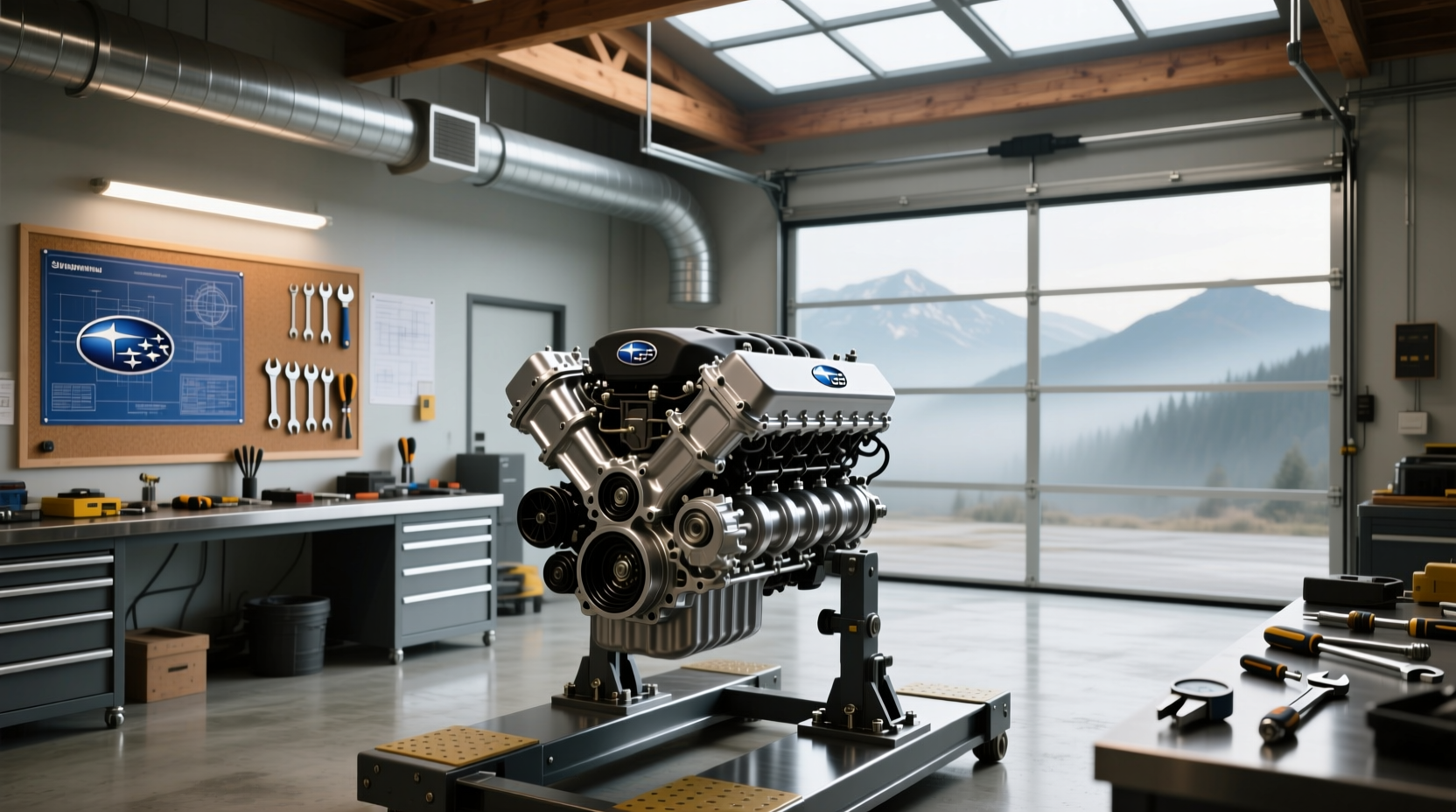
When you search for boxer engine Subaru, what you're really asking is: Why does Subaru use this unique engine layout, and what does it mean for performance, reliability, and driving experience? The answer lies in the horizontally opposed cylinder design that sets Subaru apart from most other carmakers. Unlike inline or V-type engines, Subaru’s boxer (or flat) engine positions its pistons on opposite sides of the crankshaft, moving in a horizontal plane—like two boxers sparring, hence the name1. This configuration delivers a lower center of gravity, improved weight distribution, and smoother operation—all critical advantages for all-wheel-drive vehicles designed for rugged terrain and adverse weather.
Why Subaru Uses Boxer Engines: Core Engineering Philosophy
Subaru has been committed to the boxer engine since the 1960s, starting with the Subaru 1000. This long-standing choice isn’t just tradition—it’s rooted in functional benefits tied directly to their Symmetrical All-Wheel Drive (AWD) system ✅. The low, wide stance of the boxer engine allows it to sit lower in the chassis, which reduces body roll during cornering and enhances stability at high speeds ⚙️. Because the engine’s mass is centered and aligned with the drivetrain, power delivery becomes more efficient and balanced across all four wheels.
This integration between the engine layout and AWD system is central to Subaru’s brand identity. While competitors often adapt AWD systems to existing front-wheel-drive platforms, Subaru designs its entire vehicle architecture around the boxer engine and symmetrical drivetrain 🌐. Models like the Outback, Forester, and WRX benefit significantly from this holistic engineering approach, especially in slippery conditions or off-road scenarios.
How a Boxer Engine Works: Mechanical Layout and Motion
In a traditional inline-four engine, cylinders are arranged vertically in a row. In a V6 or V8, they’re set in two banks at an angle. But in a boxer engine, each pair of opposing pistons moves outward and inward simultaneously, creating a horizontal reciprocating motion ⚙️. For example, in a flat-four (the most common Subaru configuration), there are two cylinders on the left and two on the right, all lying flat.
This horizontal movement results in several mechanical advantages:
- Natural Balance: Opposing pistons cancel out vibration, reducing the need for heavy counterweights or balance shafts.
- Lower Center of Gravity: With the engine sitting lower in the frame, the vehicle’s overall center of gravity drops, improving handling precision.
- Compact Height: Though wider than inline engines, boxer units are shorter in vertical space, allowing for lower hood lines and better aerodynamics.
However, this design also introduces challenges. The wide profile requires more lateral space under the hood, which can complicate service access 🔧. Additionally, because the cylinders extend outward, they’re more exposed to road debris and potential damage in off-road situations unless properly shielded.
Types of Subaru Boxer Engines Over the Years
Subaru has produced several variations of the boxer engine, evolving both naturally aspirated and turbocharged versions across decades:
| Engine Type | Displacement | Applications | Key Features |
|---|---|---|---|
| EJ Series | 1.8L–2.5L | Legacy, Impreza, WRX (1990s–2010s) | Duratec-based, widely tunable, known for head gasket issues in early models |
| FB Series | 2.0L–2.5L | Outback, Forester, Legacy (2010s–present) | Improved efficiency, dual overhead cams, better oil consumption control |
| FA Series | 2.0L–2.4L | WRX, BRZ (turbo/non-turbo) | Higher revving, direct injection, used in Toyota 86 collaboration |
| CB18 (Diesel) | 1.8L | European models only | Rare diesel boxer; not sold in North America |
The EJ25, particularly the turbocharged version found in WRX STI models, became legendary among enthusiasts for its robustness and tuning potential. However, older EJ engines were prone to head gasket failures due to inadequate coolant passage sealing—a well-documented issue that led many owners to perform preemptive repairs or upgrades2.
Advantages of Subaru’s Boxer Engine Design
The primary benefit of the boxer layout is enhanced vehicle dynamics. Here’s how it translates into real-world performance:
- Better Handling: The low-mounted engine improves cornering stability by minimizing roll and pitch. Drivers notice sharper turn-in response and reduced understeer.
- Smoother Power Delivery: Due to inherent balance, boxer engines typically run smoother than inline-fours without additional balancing mechanisms.
- Even Weight Distribution: Combined with symmetrical AWD, the engine helps achieve near 50:50 front-rear weight balance, enhancing traction and control.
- Quieter Operation at Idle: Reduced vibration means less noise and harshness (NVH), contributing to cabin comfort.
These traits make Subarus especially popular in regions with harsh winters or mountainous terrain, such as the northeastern U.S., Canada, and parts of Europe 📍.
Common Drawbacks and Maintenance Concerns
Despite its strengths, the boxer engine isn't without trade-offs. Understanding these limitations helps buyers make informed decisions:
1. Accessibility and Repair Complexity 🔧
Because the cylinders lie flat and spread outward, accessing spark plugs, ignition coils, and exhaust manifolds often requires removing intake components or even the engine itself in some cases. This increases labor time and repair costs compared to more conventional layouts.
2. Oil Consumption Issues ⚠️
Some FB and FA series engines have exhibited higher-than-average oil consumption, particularly after high mileage. This stems from piston ring design and cylinder wall coating wear. While not universal, it’s a known concern reported by owners forums and independent mechanics.
3. Vulnerability to Undercarriage Damage 🚚
The low-slung position makes the engine more susceptible to impact from curbs, speed bumps, or off-road obstacles. Vehicles driven in areas with poor road conditions may require additional skid plates for protection.
4. Limited Manufacturer Support for Performance Tuning
While the EJ25 was highly modifiable, newer FA and FB engines incorporate more integrated electronics and emissions controls, making aftermarket tuning more complex. Enthusiasts note that gains beyond factory settings often require significant investment in supporting modifications.
How Subaru Compares to Other Boxer Engine Manufacturers
Subaru is one of only two automakers currently using boxer engines in mass production—the other being Porsche. However, their applications differ significantly:
- Porsche: Uses boxer engines primarily for performance and rear-engine balance (e.g., 911). Their engines are air- or water-cooled, high-revving, and built for track capability.
- Subaru: Focuses on durability, all-weather capability, and everyday usability. Their engines prioritize torque over peak horsepower and are tuned for longevity.
Historically, BMW used boxer engines in motorcycles (like the R-series), where the layout aids cooling and rider ergonomics. Recently, Chinese EV maker BYD has developed a 2.0L flat-four boxer engine for use as a range extender in plug-in hybrids like the Yangwang U73. Unlike Subaru’s mechanically driven units, BYD’s engine functions solely as a generator, highlighting a shift in how boxer configurations are being reimagined in electrified vehicles.
Myths and Misconceptions About Boxer Engines ❓
Several myths persist about Subaru’s boxer engines. Let’s clarify them:
Myth 1: “Boxer Engines Are Less Reliable”
Reality: When maintained properly, Subaru boxer engines are durable and long-lasting. Many exceed 200,000 miles with regular oil changes and coolant flushes. Reliability concerns often stem from neglecting scheduled maintenance rather than inherent flaws.
Myth 2: “They’re Harder to Repair, So They Must Be Worse”
Reality: Yes, certain repairs take longer, but that doesn’t equate to poor quality. Mechanics familiar with Subaru platforms develop specialized tools and techniques. Choosing a technician experienced with boxer engines mitigates much of the complexity.
Myth 3: “All Subarus Burn Oil”
Reality: While some model years show elevated oil consumption, it’s not universal. Affected models include certain 2011–2014 Foresters and 2012–2013 Imprezas. Later revisions addressed the issue through updated piston rings and manufacturing tolerances.
Tips for Buyers Considering a Subaru with a Boxer Engine
If you're evaluating a Subaru—new or used—here’s what to look for:
- Check Service History: Look for consistent oil changes and timing belt replacements (every 105,000 miles or 105 months).
- Inspect for Leaks: Pay attention to valve cover gaskets and oil pan seals, common leak points.
- Listen for Knocking or Ticking: Unusual noises could indicate rod knock or lifter issues, especially in high-mileage examples.
- Verify Head Gasket Status (EJ Engines): If considering a pre-2010 model, confirm whether head gaskets were replaced.
- Use OBD2 Scanner: Check for stored codes related to misfires, boost leaks, or oxygen sensors.
For new buyers, consider opting for models equipped with the newer FA24 engine (as in the 2022+ WRX), which offers improved power, efficiency, and reduced oil consumption over older units.
Future of the Boxer Engine in Subaru’s Lineup
As the automotive industry shifts toward electrification, Subaru continues to refine its boxer engine technology. The company has confirmed that future hybrid and plug-in hybrid models will retain the boxer layout, integrating electric motors into the symmetrical AWD system ⚡. For instance, the Crosstrek Hybrid uses a 2.0L FB20 boxer engine paired with an electric motor for combined output and improved fuel economy.
Rumors suggest Subaru is developing a next-generation boxer engine with enhanced thermal efficiency, possibly incorporating mild-hybrid systems and variable compression technology. While fully electric models like the Solterra exist, Subaru emphasizes that internal combustion will remain relevant for markets needing rugged, long-range capability.
Frequently Asked Questions About Subaru Boxer Engines
- What makes a boxer engine different from other engine types?
- A boxer engine has horizontally opposed pistons that move in opposite directions, lowering the vehicle’s center of gravity and improving balance compared to inline or V-type engines.
- Are Subaru boxer engines reliable?
- Yes, when properly maintained. Most issues arise from deferred maintenance. Newer FA and FB series engines have addressed earlier concerns like oil consumption and head gasket failure.
- Why do boxer engines cost more to repair?
- Repairs often require disassembling surrounding components due to the engine’s width. Labor-intensive tasks like spark plug replacement increase shop time and cost.
- Can I tow with a Subaru equipped with a boxer engine?
- Yes, but within limits. Models like the Outback have a maximum towing capacity of 3,500 lbs. Always follow manufacturer guidelines and ensure proper cooling.
- Is the boxer engine going away?
- Not immediately. Subaru plans to keep using boxer engines in hybrid and AWD applications, adapting them for future powertrain needs.




 浙公网安备
33010002000092号
浙公网安备
33010002000092号 浙B2-20120091-4