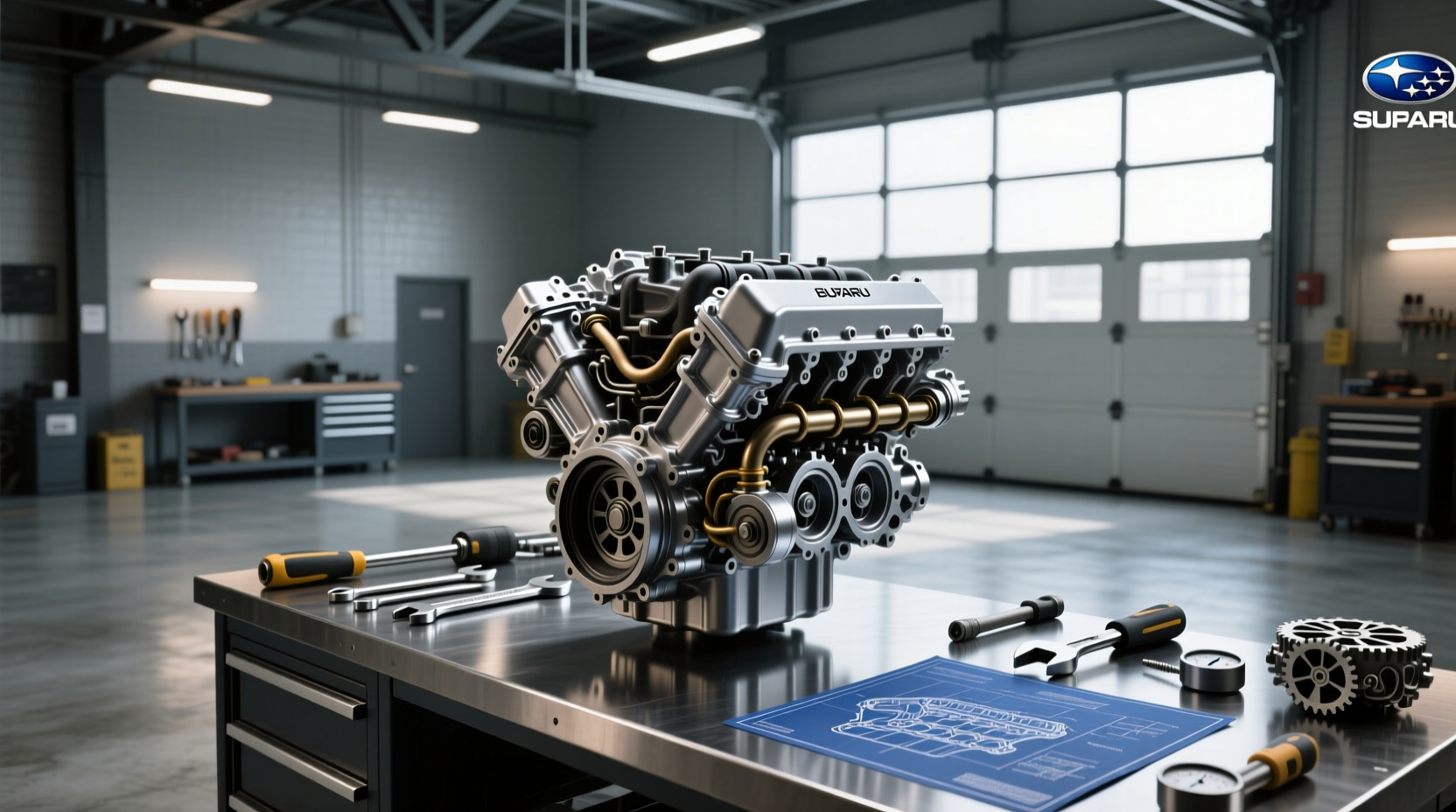
The Subaru boxer engine—also known as a flat-four or horizontally opposed engine—is a defining feature of the brand’s engineering identity. Unlike traditional inline or V-type engines, the Subaru BOXER® layout positions cylinders on opposite sides of the crankshaft, lying flat and firing outward in a motion that resembles boxers punching gloves, hence the name 1. This unique configuration lowers the vehicle’s center of gravity, enhancing stability, reducing body roll, and improving overall handling—especially when paired with Subaru’s Symmetrical All-Wheel Drive system. Whether you're researching the older EJ series or modern FB and FA platforms, understanding how the Subaru boxer engine works, its advantages, common issues, and model-specific applications is essential for buyers, enthusiasts, and DIY mechanics alike.
Why Subaru Uses a Boxer Engine Design
Subaru has used the boxer engine configuration since the 1960s, starting with the EA series and continuing through today’s FB and FA engines. The primary reason for this long-standing commitment lies in the mechanical benefits of the horizontally opposed layout ⚙️.
When cylinders are arranged horizontally, the engine sits lower in the chassis compared to inline or V-type engines. This directly contributes to a lower center of gravity, which enhances cornering stability and reduces the risk of rollover—particularly important in SUVs like the Subaru Outback, Forester, and Ascent. Additionally, because opposing pistons move in sync, the natural movement helps cancel out vibrations, leading to smoother operation without requiring heavy balance shafts.
This design also allows for a more compact engine profile, enabling better weight distribution across the front axle. Combined with symmetrical all-wheel drive, this results in near 50:50 front-to-rear weight balance—a key factor in predictable handling and improved traction in adverse conditions.
How the Boxer Engine Differs from Inline and V-Type Engines
To fully appreciate the uniqueness of the Subaru boxer engine, it helps to compare it with other common engine layouts:
- Inline (Straight) Engines: Cylinders are arranged in a single row. Common in many Japanese sedans (e.g., Toyota Camry), they are simple and cost-effective but tend to be taller, raising the hood line and center of gravity.
- V-Type Engines: Two banks of cylinders set at an angle (e.g., V6, V8). While powerful and compact in length, they are wider and taller than boxer engines, affecting weight distribution and suspension geometry.
- Boxer (Flat) Engines: Cylinders lie flat on either side of the crankshaft. This creates a low, wide stance ideal for balanced handling and integration with AWD systems.
While Porsche also uses a boxer layout (notably in the 911), Subaru is the only mass-market automaker to apply it across nearly all of its vehicles, from the Impreza to the Legacy and performance-oriented WRX STI.
Key Subaru Boxer Engine Families: EJ, FB, FA, and EZ Series
Over the decades, Subaru has developed several generations of boxer engines, each tailored to different performance, efficiency, and emissions requirements.
EJ Series (1989–2021): The Legendary Foundation
The EJ series is arguably the most iconic Subaru engine family. Introduced in 1989, it replaced the EA series and powered everything from base models to rally-bred WRX STIs 2. Available in displacements from 1.5L to 2.5L, the EJ engines came in both naturally aspirated (NA) and turbocharged variants.
Notable versions include:
- EJ20: 2.0L engine used in WRX models outside North America; known for high-revving performance and tuning potential.
- EJ25: 2.5L variant widely used in North American models like the Outback, Legacy, Forester, and non-turbo Impreza. Known for durability when maintained properly.
- EJ20X/EJ20Y: Twin-turbo engines in the JDM Legacy GT.
- EJ257: Turbocharged 2.5L engine in the USDM WRX STI (2004–2021).
The EJ series used timing belts (requiring replacement every 60,000–100,000 miles), which added maintenance complexity but allowed for lighter engine construction. These engines are praised for their aftermarket support, robustness under boost, and relative simplicity—making them favorites among tuners and drifters.
FB and FA Series (2010–Present): Modern Efficiency and Refinement
Starting around 2010, Subaru introduced the FB and FA engine families to replace the aging EJ platform in most applications. These newer engines prioritize fuel economy, emissions compliance, and longevity—with some trade-offs in serviceability.
Key features:
- Timing Chains Instead of Belts: Eliminates the need for periodic belt replacements, reducing long-term maintenance costs ✅.
- Improved Thermal Efficiency: Higher compression ratios and dual overhead cams enhance power and efficiency.
- Direct and Port Fuel Injection (D-4S): Seen in FA20F (2015+ WRX), combining direct and port injection to reduce carbon buildup on intake valves.
Common variants:
- FB25: 2.5L naturally aspirated engine used in current Outback, Legacy, and Ascent models. Offers smooth power delivery and strong low-end torque.
- FA20: 2.0L turbocharged engine in the WRX (2015–2021). Produces 268 hp and is more compact than the EJ255.
- FA24: 2.4L naturally aspirated (Ascent, Legacy) and turbocharged (2022+ WRX) variants. Delivers more torque and improved responsiveness over the FA20.
While the FB/FA engines are generally reliable, they are more complex than the EJ series, with tighter tolerances and increased reliance on precise oiling and cooling systems.
EZ36: Subaru’s Flat-Six Option
For buyers asking, “Does Subaru have a 6-cylinder engine?”—yes, but only in select models. The EZ36 is a 3.6L flat-six engine that was offered in the Legacy (2008–2019) and Outback (2010–2017) as the top-tier option. It delivers smooth, linear power (256 hp) and a refined driving experience, though it was discontinued due to declining demand and stricter emissions standards.
| Engine Series | Displacement | Configuration | Timing System | Key Models |
|---|---|---|---|---|
| EJ25 | 2.5L | Flat-4, NA/Turbo | Timing Belt | Outback, Legacy, Forester, WRX |
| FB25 | 2.5L | Flat-4, NA | Timing Chain | Outback, Legacy, Ascent |
| FA20 | 2.0L | Flat-4, Turbo | Timing Chain | WRX (2015–2021) |
| FA24 | 2.4L | Flat-4, NA/Turbo | Timing Chain | Ascent, 2022+ WRX |
| EZ36 | 3.6L | Flat-6, NA | Timing Chain | Legacy, Outback (discontinued) |
Are Subaru Boxer Engines Reliable?
One of the most frequently asked questions is: “Is the Subaru 2.5L boxer engine reliable?” The answer depends heavily on maintenance history, driving conditions, and specific engine generation.
In general, Subaru boxer engines are durable when properly maintained. However, they are less forgiving of neglect than some competing engines (e.g., Honda’s K-series or Toyota’s 2GR-FE). Key factors influencing reliability include:
- Oil Changes: Due to the horizontal cylinder orientation, oil drainage can be slower, increasing the risk of sludge buildup if intervals exceed recommendations. Subaru recommends synthetic oil and changes every 6,000 miles or 6 months.
- Cooling System Maintenance: Head gasket failures were more common in early 2000s EJ25 engines (particularly EJ251/252). Regular coolant flushes (every 30,000–50,000 miles) help prevent corrosion and overheating.
- Timing Belt Service: For EJ-series engines, skipping the timing belt replacement can lead to catastrophic interference engine damage.
Modern FB and FA engines have largely resolved head gasket issues thanks to improved materials and redesigned cooling passages. However, newer turbocharged engines like the FA20 require attention to intercooler piping, PCV systems, and carbon buildup on intake valves—especially in stop-and-go driving.
Common Issues by Engine Type
Understanding common failure points helps buyers make informed decisions and avoid costly repairs.
EJ Series: Head Gaskets and Oil Consumption
Pre-2010 EJ25 engines (especially in 2000–2009 Outbacks and Legacies) are known for head gasket leaks. Symptoms include white exhaust smoke, coolant loss, and overheating. While not universal, this issue led to class-action lawsuits and extended warranties. Replacing both front and rear head gaskets with updated OEM or upgraded aftermarket kits (e.g., MLS gaskets) is a common preventive measure.
Some EJ engines also exhibit oil consumption, particularly above 80,000 miles. This may stem from worn piston rings or valve seals, especially under hard driving or poor maintenance.
FB25: Carbon Buildup and Intake Valve Deposits
The FB25, while more reliable than older EJs, suffers from carbon buildup on intake valves due to its port-only fuel injection system. Without fuel washing over the valves (as in direct-injection engines), deposits accumulate, leading to rough idle, misfires, and reduced performance. Regular walnut blasting (every 60,000–80,000 miles) is recommended.
FA20: PCV System Failures and Ringland Damage
The turbocharged FA20 in the 2015–2021 WRX is prone to PCV (Positive Crankcase Ventilation) system issues, which can cause oil leaks into the intake tract. Additionally, aggressive tuning or sustained high-RPM use can lead to ringland failure on pistons—a known weakness under high boost.
Maintenance Tips for Longevity
To maximize the lifespan of any Subaru boxer engine, follow these best practices:
- Use Full Synthetic Oil: Essential for proper lubrication in the horizontal cylinder layout. Change every 6,000 miles or 6 months.
- Replace Coolant on Schedule: Prevents corrosion and maintains efficient heat transfer. Use Subaru-approved coolant.
- Inspect Hoses and Belts: Especially on older models with accessory belts and EJ-series timing belts.
- Address Check Engine Lights Promptly: Early diagnosis of misfires, oxygen sensor faults, or boost leaks prevents escalation.
- Consider Upgraded Components: For high-mileage or performance use, consider upgraded head gaskets, oil pumps, or cooling system parts.
Performance Tuning and Aftermarket Support
Subaru boxer engines, especially the EJ and FA series, enjoy robust aftermarket support. Enthusiasts often modify engines for increased power via:
- Turbo upgrades (e.g., VF52 to VF56 swap)
- Engine management tuning (Cobb AccessPORT, OpenSource)
- Stroker kits (e.g., EJ25 to EJ26 conversions)
- Forged internals (pistons, rods) for high-horsepower builds
The EJ257 (STI engine) and FA20 (WRX) are particularly popular for builds ranging from daily drivers to track-focused machines. However, modifications must respect the engine’s limitations—especially regarding oiling, cooling, and internal strength.
Which Subaru Engines Should You Avoid?
While no engine is universally bad, certain variants have higher reputations for issues:
- EJ251/EJ252 (2000–2009 NA models): Highest incidence of head gasket failure.
- Early FB25 (2010–2012): Some reports of premature wear, though less severe than EJ issues.
- High-mileage EJ engines with unknown history: Risk of hidden sludge, ring wear, or timing belt neglect.
When buying used, always request maintenance records, perform a compression test, and inspect for oil or coolant leaks.
Final Thoughts: Weighing the Pros and Cons
The Subaru boxer engine offers distinct advantages in balance, handling, and AWD integration. Its low center of gravity enhances real-world driving dynamics, especially in adverse weather. However, it also demands consistent maintenance and can be more expensive to repair than conventional engines.
For buyers, the choice comes down to priorities:
- If you value tuning potential and simplicity: Look for a well-maintained EJ-powered WRX or Legacy.
- If you want modern reliability and lower maintenance: Choose a FB25 or FA24-equipped model.
- If you prefer refinement and smoothness: Consider a used EZ36-equipped Outback or Legacy (while available).
Regardless of generation, the boxer engine remains central to Subaru’s brand identity—offering a compelling blend of engineering integrity and all-weather capability.
Frequently Asked Questions
- ❓ What makes a Subaru engine a boxer?
- A boxer engine has cylinders arranged horizontally on opposite sides of the crankshaft. Pistons move in and out simultaneously, like boxers throwing punches, creating inherent balance and a low center of gravity.
- ❓ Is the Subaru 2.5L engine a boxer?
- Yes, all Subaru 4-cylinder engines, including the 2.5L (EJ25, FB25), are boxer (flat-four) engines. They are not inline or V-type configurations.
- ❓ Are Subaru boxer engines reliable?
- They are generally reliable with proper maintenance. Older EJ25 engines had head gasket concerns, while newer FB and FA engines are more durable but require attention to carbon buildup and oil quality.
- ❓ Why do Subaru engines fail?
- Common causes include neglected oil changes, timing belt failure (on EJ engines), cooling system issues, and PCV problems in turbo models. Lack of maintenance is the biggest risk factor.
- ❓ Does Subaru still make the EJ engine?
- No, Subaru discontinued the EJ series after 2021. The last application was the WRX STI. Current models use FB, FA, or FA24 engines.




 浙公网安备
33010002000092号
浙公网安备
33010002000092号 浙B2-20120091-4