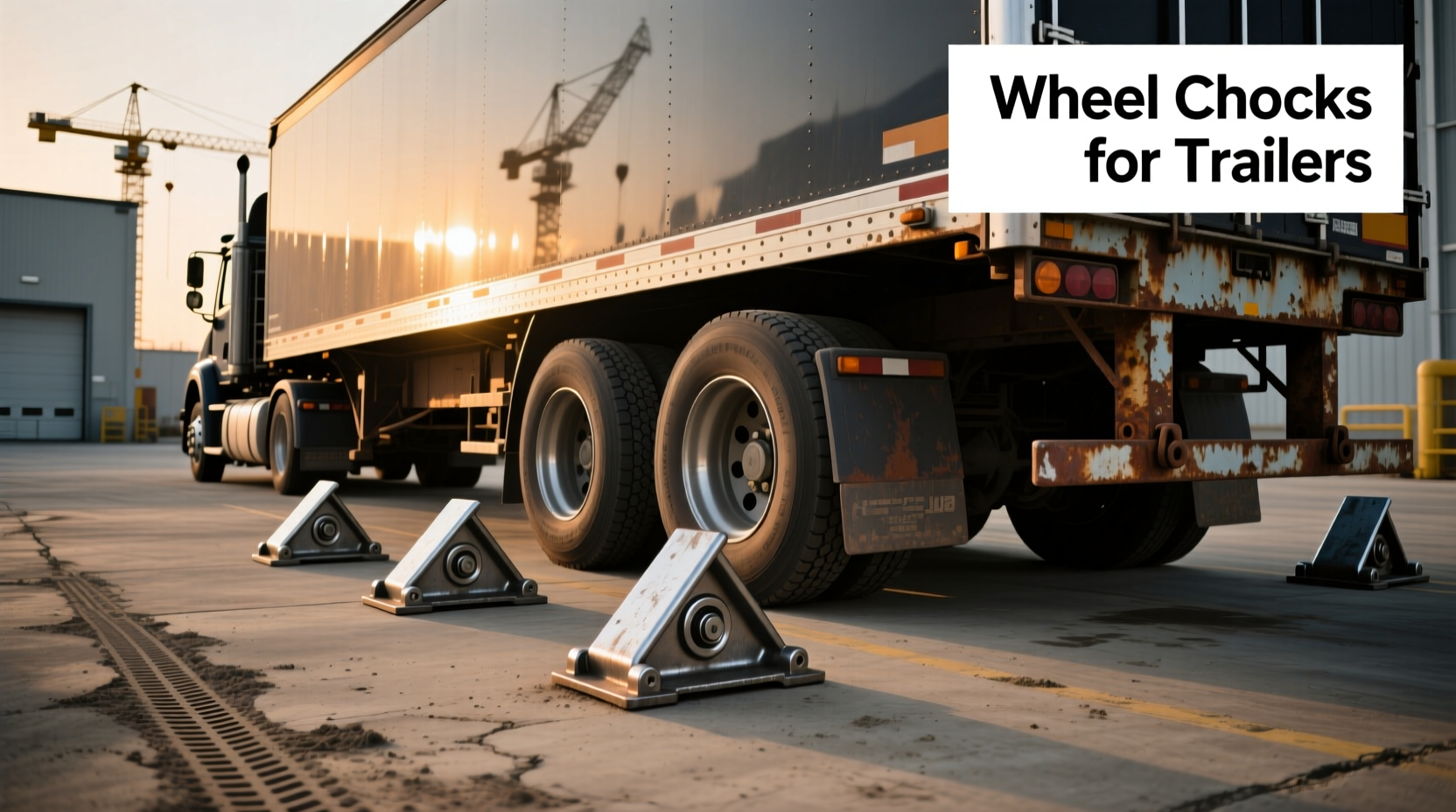
When securing a trailer on an incline or during loading and unloading, wheel chocks for trailers are essential for preventing unintended movement. Using properly sized, durable chocks made from rubber, plastic, or composite materials significantly reduces the risk of rollaway incidents that can lead to injury or property damage. The right chock should match your trailer’s tire diameter, weight class, and operating environment—whether it’s a camper, utility trailer, or commercial freight unit. This guide covers everything you need to know about selecting, using, and maintaining trailer wheel chocks based on real-world applications, safety standards, and common user concerns.
Why Wheel Chocks Are Critical for Trailer Safety
🚚 Trailers, unlike passenger vehicles, often lack parking brakes or have brakes that aren’t designed to hold the full weight over time. Even when parked on level ground, external forces like wind, uneven terrain settlement, or accidental contact can cause movement. Wheel chocks act as mechanical stops, blocking forward or backward motion by creating resistance against tire rotation.
This is especially important in high-risk scenarios such as:
- Loading/unloading with forklifts or ramps 📦
- Parking on slopes or soft surfaces ⚠️
- Long-term storage in exposed areas ☔
- Towing vehicle disconnection 🔧
According to OSHA and transportation safety guidelines, wheel chocks must be used whenever a trailer is stationary and uncoupled from its towing vehicle 1. Failure to do so increases liability and accident risks, particularly in industrial, construction, or logistics settings.
How to Determine the Correct Size for Trailer Wheel Chocks
📏 One of the most frequently asked questions is: What size wheel chock do I need? The answer depends on your trailer's tire height and gross weight. A general rule of thumb is that the chock should reach at least one-quarter the height of the tire.
For example:
- If your trailer tire has a 30-inch diameter, the minimum chock height should be around 7.5 inches.
- A 24-inch tire requires a minimum 6-inch chock.
- Larger trailers (e.g., semi-trailers) may require 8–10 inch chocks.
Using undersized chocks creates a dangerous gap between the tire and the stop surface, allowing the tire to climb over the block under force. Oversized chocks, while safer in terms of grip, may be unnecessarily heavy and cumbersome for smaller trailers.
To measure correctly:
- Measure the outer diameter of your trailer tire.
- Divide by four to get the recommended minimum chock height.
- Check manufacturer specifications—some chocks list compatible tire sizes.
Always opt for slightly taller chocks if your trailer operates on uneven or sloped terrain. Height isn’t the only factor—width matters too. Wider chocks distribute pressure better and resist lateral shifting.
Rubber vs. Plastic vs. Composite: Material Comparison
The choice of material affects durability, traction, and environmental performance. Let’s break down the pros and cons of each type commonly used for wheel chocks for trailers.
| Material | Pros | Cons | Best For |
|---|---|---|---|
| Rubber | High friction, weather-resistant, less likely to damage tires | Can degrade in extreme UV exposure; heavier than plastic | Commercial trailers, frequent use, wet conditions |
| Plastic (Polypropylene/Polyethylene) | Lightweight, affordable, won't rust or rot | Lower grip on ice/snow; may crack in cold temps | Recreational trailers, RVs, light-duty use |
| Composite/Fiberglass-Reinforced | Durable, UV-stable, moderate weight | Higher cost; limited availability | Industrial fleets, long-term deployment |
Rubber chocks are generally preferred for heavy trailers due to their superior grip and resilience. However, modern high-density plastics have improved significantly and are now suitable for many non-commercial applications.
Avoid foam or low-density plastic chocks—they compress under load and offer minimal resistance.
Do You Need Two or Four Wheel Chocks?
✅ While regulations vary by jurisdiction and application, best practice recommends placing chocks on **both sides** of at least one axle. For maximum security—especially with tandem-axle trailers or on slopes—it’s advisable to use two chocks per side (four total).
However, in most standard situations:
- Use two chocks placed snugly against the tires of the rear axle.
- Place them on the downhill side if parked on a slope.
- When the trailer is uncoupled, always chock both wheels of the landing gear end.
Some users rely on single chocks with integrated ropes or chains to secure both wheels simultaneously. These can work but are only effective if the connecting strap is taut and anchored properly. Loose straps reduce effectiveness and create tripping hazards.
Proper Placement and Usage Techniques
📍 Where and how you place wheel chocks determines their effectiveness. Incorrect positioning renders even the best chocks useless.
Step-by-Step Chocking Procedure
- Engage the trailer brake before setting chocks.
- Position chocks tightly against the tire tread—no gaps.
- For uphill/downhill parking: Place chocks behind the tires when facing downhill, and in front when facing uphill.
- On level ground: Use chocks on both sides of the rear axle.
- Double-check fit: Ensure the chock base is flat on the ground and not tilted.
Never place chocks on loose gravel, ice, or slippery surfaces unless combined with additional stabilization methods. If necessary, clear debris or place a metal plate underneath for better grip.
Chocks with Rope or Chain Attachments
🔧 Some models include built-in eyelets or loops for attaching ropes or chains. These help prevent loss and allow quick deployment. However:
- Ropes should be UV-resistant nylon or polyester.
- Chains provide more durability but add weight.
- Ensure attachments don’t interfere with tire clearance or suspension components.
While convenient, attached ropes shouldn’t replace proper placement. They’re aids—not substitutes—for correct chocking technique.
Regulatory Requirements and Industry Standards
📋 In professional transport and logistics, compliance with safety standards is mandatory. Key regulatory bodies include:
- OSHA (U.S.): Requires wheel chocks when loading/unloading trucks at docks 1.
- FMCSA (Federal Motor Carrier Safety Administration): Recommends chocks during inspection, maintenance, and coupling operations.
- DOT (Department of Transportation): Does not specify exact chock dimensions but mandates securement of all vehicles during service.
In Canada, Transport Canada enforces similar rules under the Commercial Vehicle Safety Alliance (CVSA) standards. European Union directives also emphasize immobilization during cargo handling.
Failure to comply can result in fines, failed inspections, or denied insurance claims after an incident.
Common Misconceptions About Trailer Wheel Chocks
❌ Despite widespread use, several myths persist:
Misconception 1: “Small chocks are fine for small trailers.”
Even lightweight trailers can gain momentum on slight inclines. Always follow the 1/4-tire-height rule regardless of trailer size.
Misconception 2: “Parking on grass or dirt eliminates the need for chocks.”
Soft ground can shift or erode, especially after rain. Tires may slowly sink or roll. Chocks are still required.
Misconception 3: “If the brake is set, chocks aren’t needed.”
Trailer brakes are secondary systems and can fail due to air leaks (in air-braked units) or mechanical wear. Chocks provide redundant safety.
Misconception 4: “Any block of wood works as a chock.”
While DIY wooden chocks are sometimes used (as seen in online videos), they compress, splinter, or slip easily. Purpose-built chocks are tested for load retention and slip resistance.
Environmental and Operational Factors That Affect Chock Performance
🌍 Temperature, moisture, and terrain play crucial roles in chock effectiveness.
Cold Weather Challenges
In freezing conditions, rubber becomes stiffer and less grippy. Some plastics become brittle and prone to cracking. Look for chocks rated for low-temperature use (e.g., -30°F / -34°C). Textured or grooved surfaces improve ice traction.
Wet or Muddy Conditions
Water reduces friction between chock and tire. Choose chocks with drainage channels or anti-slip patterns. Avoid smooth-bottomed models.
Uneven or Soft Surfaces
On sand, mud, or gravel, chocks can sink or tilt. Use larger base plates or pair chocks with steel mats for stability.
Maintenance and Inspection Tips
🛠️ Regular inspection ensures continued reliability. Here’s what to check monthly or before critical use:
- Cracks or splits in rubber or plastic.
- Worn contact surfaces that reduce grip.
- Loose or damaged attachment points for ropes/chains.
- Deformation from prolonged compression.
- Fade or UV damage indicating material breakdown.
Replace chocks showing any signs of structural compromise. Store them indoors when not in use to extend lifespan.
Alternatives and Supplementary Devices
While wheel chocks remain the primary method, other tools enhance security:
- Trailer stabilizers/jacks: Prevent rocking but don’t stop rolling.
- Wheel clamps: More permanent lockout devices, often used for theft prevention.
- Electronic parking brakes: Found on newer trailers but still benefit from physical chocks.
- Ground anchors with straps: Used in high-wind areas or long-term setups.
No alternative fully replaces the simplicity and effectiveness of proper wheel chocks.
Buying Considerations: What to Look For
🛒 When purchasing wheel chocks for trailers, focus on these key features:
Load Rating
Ensure the chock is rated for your trailer’s GVWR (Gross Vehicle Weight Rating). Most manufacturers list maximum supported weight per chock.
Design Features
- Beveled front edge for easier placement.
- Non-slip bottom texture.
- Visibility markings (e.g., reflective strips, bright colors).
- Ease of transport (handles, rope loops).
Portability
For RV owners or occasional users, lightweight plastic chocks may be preferable. Fleet operators should prioritize durability over weight.
FAQs About Wheel Chocks for Trailers
Below are answers to some of the most commonly searched questions related to trailer wheel chocks.
Can I use car wheel chocks for my trailer?
Only if they meet the size and load requirements. Most car chocks are 4–5 inches tall, which may be insufficient for larger trailer tires. Always verify compatibility with your tire dimensions.
Are rubber wheel chocks better than plastic?
Rubber generally offers better traction and durability, especially in commercial or outdoor environments. Plastic is lighter and cheaper, making it suitable for recreational use. Choose based on your operating conditions and frequency of use.
Where should I store wheel chocks when not in use?
Store them in a dry, shaded area away from direct sunlight and extreme temperatures. UV exposure degrades both rubber and plastic over time. Keeping them inside the trailer or in a storage compartment prolongs life.
Do wheel chocks expire?
They don’t have a set expiration date, but material degradation occurs over time. Inspect regularly for cracks, warping, or reduced elasticity. Replace every 3–5 years with regular use, or sooner if damage is evident.
Can I make my own wheel chocks?
While possible (using hardwood or laminated boards), homemade chocks lack standardized testing for load capacity and slip resistance. They are not recommended for commercial use or heavy trailers. For personal, light-duty applications, ensure they are thick enough (at least 1/4 tire height) and securely fastened.





 浙公网安备
33010002000092号
浙公网安备
33010002000092号 浙B2-20120091-4