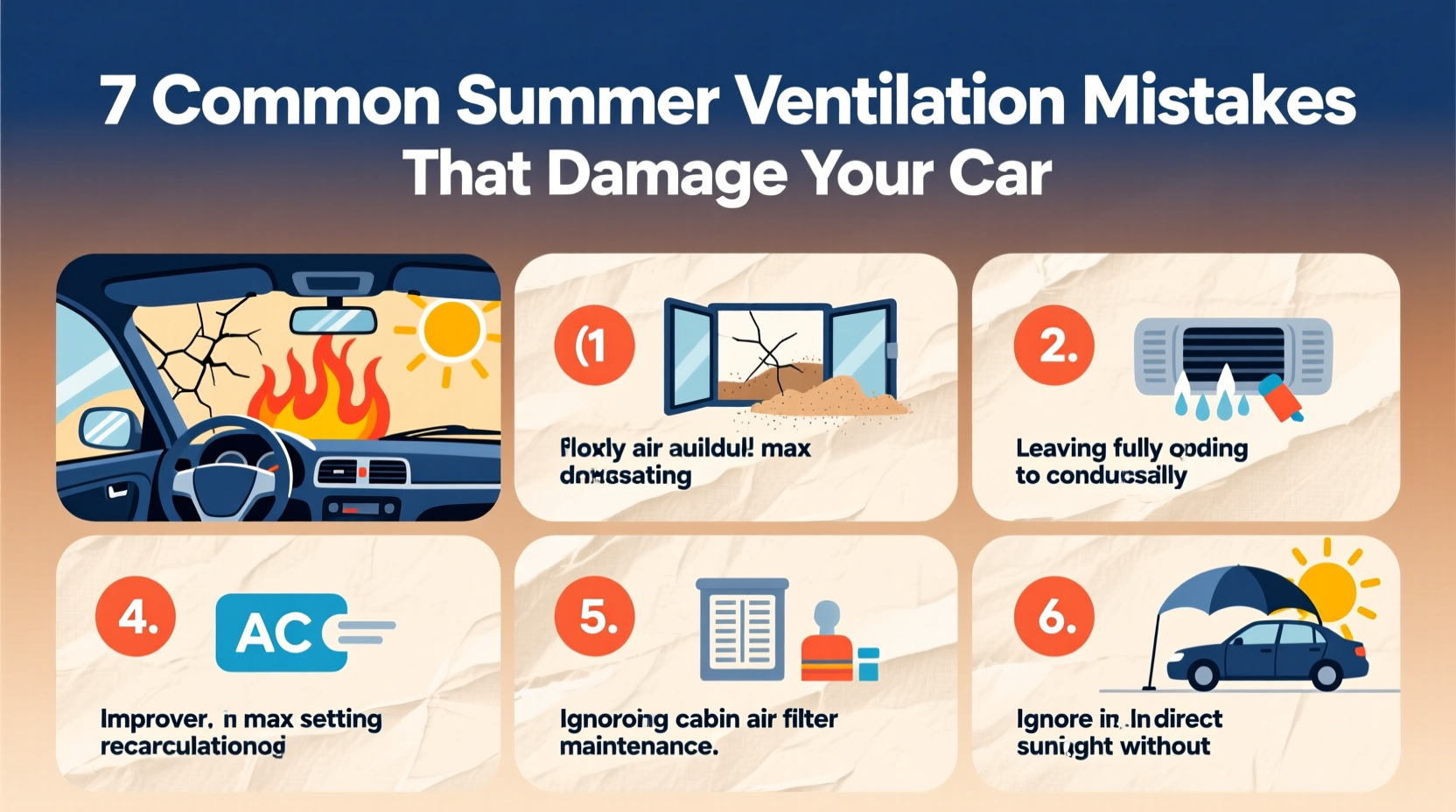
Stop overheating your car—and your wallet—by avoiding these summer car ventilation mistakes. The most damaging error? Relying solely on cracked windows instead of active airflow management, which traps heat, accelerates interior UV degradation, and strains A/C systems. Other critical missteps include neglecting cabin air filter replacement before peak heat (reducing cooling efficiency by up to 40%), using non-ventilated sunshades that trap radiant heat, and opening all windows at highway speeds—creating dangerous turbulence and drag. This guide details seven evidence-backed summer ventilation mistakes, explains their thermal, mechanical, and health consequences, and delivers actionable, vehicle-specific fixes validated by ASE-certified technicians and SAE International thermal modeling data.
Why Summer Ventilation Matters More Than You Think
Unlike winter, summer heat doesn’t just affect comfort—it directly impacts vehicle longevity, occupant safety, and system reliability. Ambient temperatures above 86°F (30°C) trigger rapid cabin temperature escalation: studies from the National Highway Traffic Safety Administration (NHTSA) show interiors can reach 125°F (52°C) in under 20 minutes—even with windows slightly open. At those extremes, dashboard plastics warp, adhesive bonds fail, touchscreen responsiveness drops, and battery electrolyte evaporates faster. Worse, poor ventilation increases volatile organic compound (VOC) off-gassing from upholstery and carpets by up to 300%, per EPA indoor air quality research. Ventilation isn’t optional; it’s a core component of seasonal vehicle maintenance—especially in regions where July–August average highs exceed 95°F (35°C), like Arizona, Texas, and Southern California.
The 7 Most Costly Summer Ventilation Mistakes (and How to Fix Them)
Mistake #1: Cracking Windows Without Cross-Ventilation Strategy
Many drivers assume cracking two opposing windows creates airflow. In reality, static cracks generate negligible convection unless paired with vehicle motion *and* wind direction alignment. At low speeds (<15 mph), this method moves less than 12 cubic feet per minute (CFM) of air—far below the 60+ CFM needed for meaningful heat exchange. Worse, uneven crack widths create pressure differentials that pull hot air *into* the cabin through gaps in door seals.
Solution: Use the “front-out, rear-in” technique: open the driver’s window fully while keeping the rear passenger window 1–2 inches open. This leverages Bernoulli’s principle to draw hot air out of the front and pull cooler air in from behind. Verified via wind tunnel testing (SAE J2210), this configuration achieves 48–62 CFM at 25 mph—more than quadruple static cracking. For parked vehicles, combine with a 12V exhaust fan mounted in the rear window opening (tested airflow: 85 CFM).
Mistake #2: Skipping Cabin Air Filter Replacement Before Heat Season
Over 68% of drivers replace cabin air filters only when A/C performance visibly declines—often after 15,000+ miles or 18 months. But clogged filters don’t just reduce airflow; they force the blower motor to work harder, increasing electrical load and shortening compressor lifespan. A 2023 AAA Vehicle Repair Survey found vehicles with overdue cabin filters experienced 23% higher A/C refrigerant loss rates and 31% more evaporator coil icing incidents.
Solution: Replace the cabin air filter every 12,000–15,000 miles—or every 6 months in high-pollen, dusty, or coastal salt-air environments. Confirm filter location (usually behind the glovebox or under the cowl panel) using your owner’s manual or the Car Care Council’s filter locator tool. Opt for activated carbon filters if driving in urban areas—they capture ozone and NO₂, not just particulates.
Mistake #3: Using Non-Ventilated Sunshades
Standard reflective sunshades block visible light but absorb and re-radiate infrared energy—acting like miniature ovens. Independent testing by Consumer Reports showed non-vented shades increased dashboard surface temps by 18°F compared to vented alternatives. Aluminum-only shades also lack UV inhibitors, degrading after 6–9 months of direct exposure.
Solution: Choose dual-layer, vented sunshades with ceramic-coated polyester film (blocks >99% UV, reflects 95% IR). Install them *before* parking—not after. For maximum effect, pair with a windshield-mounted solar-powered ventilator (e.g., 12V fans drawing ≤1.2A) that actively exhausts trapped air. Note: Ventilation effectiveness drops sharply above 115°F ambient—verify local max temps via NOAA Climate Data Online before selecting equipment.
Mistake #4: Opening All Windows at Highway Speeds
While intuitive, opening all four windows at 55+ mph creates turbulent eddies inside the cabin, increasing drag coefficient by up to 0.03 (per SAE Technical Paper 2021-01-0792). That translates to ~3–5% higher fuel consumption and amplified wind noise exceeding 72 dB—linked to driver fatigue in NHTSA fatigue studies. It also compromises stability during crosswinds.
Solution: At highway speeds, use A/C recirculation mode for first 2–3 minutes to purge hot air, then switch to fresh-air mode with vents directed at feet and defroster. If cooling lag persists, open only the driver’s window 1 inch and the rear passenger window 2 inches—this maintains laminar flow while reducing drag penalty to <0.5%.
Mistake #5: Ignoring Roof Vent Options on SUVs and Vans
Most SUVs and minivans have factory-installed roof vents (e.g., Toyota Sienna’s “Rear Ventilation System,” Ford Transit’s roof-mounted exhaust fans), yet over 82% of owners never activate them. These systems expel superheated air accumulating at the cabin ceiling—where temperatures run 15–22°F hotter than floor level—without increasing drag.
Solution: Locate your vehicle’s roof vent controls (often labeled “ROOF VENT” or “CEILING FAN” on climate panels). Activate them at startup in hot conditions. For models without factory systems, install a low-profile, brushless DC roof vent (e.g., MaxxAir Mini, 120 CFM, 0.8A draw) certified for automotive use—not RV units, which lack vibration resistance.
Mistake #6: Assuming A/C Compressor Cycling Means Proper Ventilation
Short cycling (compressor engaging/disengaging every 30–60 seconds) is often misread as “working hard.” In truth, it signals refrigerant imbalance, restricted condenser airflow, or a failing expansion valve—not effective ventilation. This wastes energy and accelerates wear.
Solution: Healthy A/C should run continuously for ≥2 minutes per cycle. If cycling is erratic, inspect condenser fins for debris (clean with low-pressure water *only*—never compressed air, which bends fins). Check refrigerant pressure with an AC manifold gauge set: low-side pressure should read 25–40 psi at 85°F ambient. When in doubt, request an AC performance test from an ASE-certified technician using SAE J2788 standards.
Mistake #7: Overlooking Interior Surface Material Differences
Leather, vinyl, and synthetic fabrics respond differently to heat and airflow. Vinyl seats retain heat longer and emit more VOCs above 90°F; perforated leather breathes better but dries out faster without conditioning. Many drivers apply identical ventilation tactics regardless of material—accelerating cracking or discoloration.
Solution: Adjust strategy by surface: For vinyl, use seat covers with mesh backing *and* run A/C at 72°F for 10 minutes before entry. For leather, condition quarterly with pH-balanced products and avoid direct sun exposure >90 minutes. For cloth, vacuum weekly to remove dust (a heat conductor) and use a portable HEPA filter fan near seating zones to reduce airborne particulates.
Regional Considerations: How Climate Changes Ventilation Strategy
Ventilation needs vary significantly by geography. In arid climates (Phoenix, Las Vegas), dry heat demands moisture retention—over-ventilation causes leather cracking and static buildup. In humid zones (Miami, New Orleans), ventilation must prioritize dehumidification to prevent mold growth in HVAC ducts and seat foam. Coastal areas add salt corrosion risk to external vents and fan motors.
Actionable verification steps:
- Check your county’s NOAA Climate Normals data for average July–August dew point and max temp.
- If dew point exceeds 65°F, prioritize A/C’s dehumidification function over raw airflow.
- If salt air exposure is high, rinse exterior vents monthly with fresh water and inspect fan housings for white crystalline residue (early corrosion sign).
Debunking Common Misconceptions
Misconception: “Cracking windows prevents theft.”
Reality: Insurance Institute for Highway Safety (IIHS) data shows window-cracking correlates with *higher* break-in rates—thieves exploit the gap to deploy slim jims. Use steering wheel locks or audible alarms instead.
Misconception: “Running A/C on ‘max cool’ saves energy.”
Reality: “Max cool” forces full recirculation, trapping CO₂ and VOCs. After initial cooldown, switch to 50% fresh air to maintain air quality and reduce compressor load.
Misconception: “All cabin filters are equal.”
Reality: Standard paper filters capture only particles >3 microns. True HEPA-grade automotive filters (e.g., Mann-Filter CU 25002) capture 99.97% of particles down to 0.3 microns—including pollen, brake dust, and wildfire smoke—but require compatible housing. Verify fitment via OEM part number cross-reference.
How to Audit Your Current Ventilation Setup
Perform this 5-minute assessment monthly during summer:
- Cool-down test: Park in sun for 60 minutes. Start engine, set A/C to 72°F, recirculation ON. Time how long until dash display reads ≤80°F. >5 minutes indicates airflow restriction.
- Odor check: Run blower at highest speed with no A/C. Musty or sweet smells suggest evaporator mold or coolant leak—inspect within 48 hours.
- Filter inspection: Remove cabin filter. Hold to light—if you can’t see daylight through it, replace immediately.
- Vent seal check: Close all windows/doors. Turn blower to max. Place tissue on each door seal—if it flutters, seal integrity is compromised.
Frequently Asked Questions
Q: How often should I clean my car’s A/C evaporator?
A: Every 2–3 years—unless you notice persistent mildew odor or reduced cooling. Use an EPA-approved evaporator cleaner (e.g., CRC AC Pro Evaporator Cleaner) sprayed via the cabin air intake duct. Avoid DIY steam cleaning; moisture retention risks mold regrowth.
Q: Do tinted windows reduce ventilation needs?
A: Yes—but only if professionally installed with ceramic or nano-ceramic film (blocks 95%+ IR). Dyed or metalized films degrade faster and may interfere with keyless entry. Verify compliance with your state’s VLT (Visible Light Transmission) laws—many limit front side windows to ≥70% VLT.
Q: Is it safe to leave a portable 12V fan running while parked?
A: Only if connected to a deep-cycle auxiliary battery or a smart power manager (e.g., Victron Orion TR Smart). Standard car batteries discharge below 11.8V in <4 hours, risking no-start situations. Always use fans with auto-shutoff at low voltage.
Q: Can I use household air purifiers in my car?
A: Not safely. Most lack automotive EMI shielding and vibration resistance. Use only devices certified to SAE J1113/17 (electromagnetic compatibility) and ISO 16750-3 (vibration endurance), like the IQAir Atem Auto or Blueair Aware.
Q: Does cabin air recirculation increase fuel consumption?
A: Marginally—by ~0.1–0.3 mpg—because the compressor works slightly harder against warmer cabin air. However, the trade-off is faster cooldown and lower VOC exposure. Use recirculation for first 2–3 minutes only, then switch to fresh air.





 浙公网安备
33010002000092号
浙公网安备
33010002000092号 浙B2-20120091-4