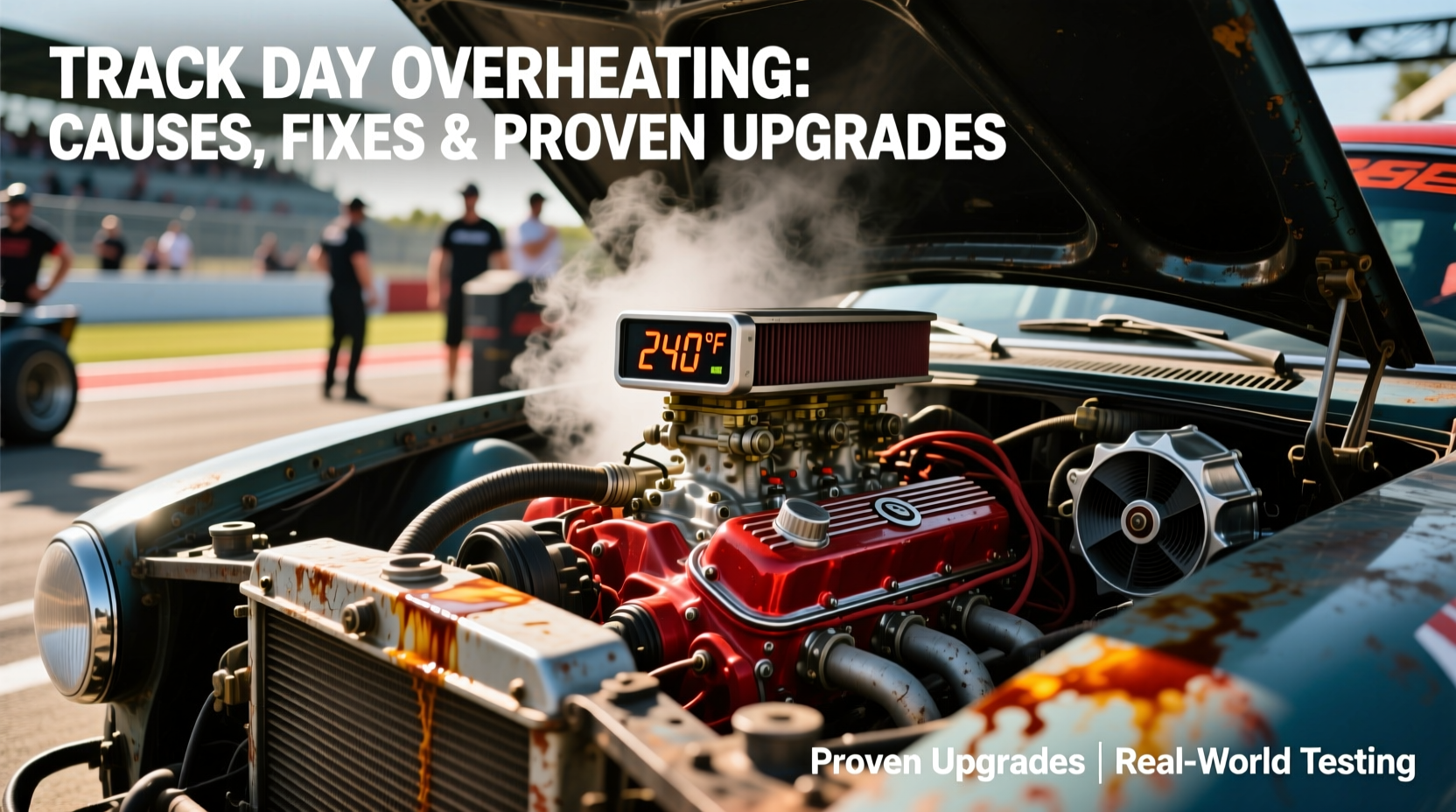
Track day overheating isn’t just a symptom—it’s a warning sign of underlying thermal management failure. If your car’s coolant temperature spikes above 230°F (110°C) during sustained high-speed laps, track day cooling system upgrades are almost always necessary—not optional. The root cause is rarely the radiator alone; it’s typically a cascade failure involving inadequate airflow, undersized coolant capacity, poor heat soak resistance, and insufficient oil or transmission cooling. This guide details exactly which components to inspect, how to prioritize upgrades based on your vehicle platform and track duration, and why ‘bolt-on’ aftermarket kits often underperform without system-level validation.
Why Track Day Overheating Happens—And Why Stock Systems Fail
Stock cooling systems are engineered for EPA-compliant duty cycles: stop-and-go traffic, 75°F ambient temps, and 15–20 minute engine run times. A typical 4-hour track day subjects the same system to continuous 85–95% throttle load, ambient temps up to 105°F (40°C), and repeated heat-soak cycles with minimal cooldown between sessions. Under these conditions, OEM radiators lose 30–50% of their effective heat rejection capacity due to airflow turbulence, internal flow restriction, and insufficient fin density. Coolant temperatures exceeding 225°F (107°C) for >90 seconds trigger thermal degradation in ethylene glycol-based fluids—and above 240°F (116°C), aluminum cylinder heads risk warping, head gaskets can fail, and automatic transmissions suffer accelerated clutch pack wear.
The Four Critical Heat Pathways—and Where They Break Down
Overheating isn’t monolithic. It manifests across four distinct thermal domains—each requiring separate diagnosis and mitigation:
1. Engine Coolant System
Primary failure mode: Radiator core saturation + low-velocity airflow at low-speed cornering.
Diagnostic threshold: Coolant temp >225°F (107°C) after lap 3, with fan activation but no recovery within 60 seconds post-session.
Actionable fix: Replace OEM radiator with a direct-fit, all-aluminum, dual-core unit featuring 1.0mm fin pitch and ≥3-row core thickness. Prioritize units with integrated transmission cooler bypass (e.g., Mishimoto MMRAD-XX or CSF 41-3210). Never rely solely on larger fans—airflow velocity matters more than CFM at speed.
2. Engine Oil System
Primary failure mode: Oil viscosity collapse and bearing film breakdown above 260°F (127°C).
Diagnostic threshold: Oil temp >250°F (121°C) after 2 consecutive hot laps, especially in turbocharged or high-compression NA engines.
Actionable fix: Install a stacked-plate oil cooler (not tube-and-fin) rated for ≥30 psi pressure drop at 10 GPM flow. Mount upstream of the filter (pre-filter) to maximize flow and avoid bypass valve interference. Use -10AN or larger lines; avoid rubber hose beyond the first 6 inches from the engine block.
3. Transmission/Drivetrain Cooling
Primary failure mode: ATF oxidation and torque converter clutch slippage above 235°F (113°C).
Diagnostic threshold: Transmission temp >225°F (107°C) after session 2, with delayed upshifts or shudder on acceleration.
Actionable fix: For automatics: add a secondary plate-and-fin cooler in series with the factory unit (never parallel). For manuals: upgrade to a high-capacity differential oil cooler (e.g., Setrab 400-100) if running limited-slip or aggressive track tires.
4. Brake Fluid & Caliper Heat Soak
Primary failure mode: Boiling brake fluid (DOT 4: ~446°F dry / 311°F wet) transferring heat into calipers, then into wheel bearings and hub assemblies.
Diagnostic threshold: Spongy pedal feel mid-session despite fresh fluid; rotor discoloration (blue/purple) indicating >1,000°F surface temp.
Actionable fix: Use DOT 5.1 or racing-specific fluid (e.g., Castrol SRF, dry BP 518°F); install brake ducts sized to deliver ≥15 CFM per caliper at 80 mph; verify duct routing clears suspension travel by ≥12 mm.
How to Diagnose Your Specific Overheating Pattern
Don’t guess—measure. Install three independent, calibrated sensors before your next event:
- Coolant temp: At radiator inlet (not engine block)—measures heat entering radiator.
- Oil temp: At oil pan sump or main gallery (not dipstick tube)—reflects bulk oil temperature.
- Transmission temp: At line pressure tap or pan drain plug—avoids false readings from external housing.
Log data at 1Hz minimum. Correlate spikes with lap time, corner entry speed, and ambient humidity. High humidity (>65%) reduces evaporative cooling efficiency by up to 22%, making airflow optimization even more critical.
Vehicle-Specific Prioritization Framework
Not all cars overheat the same way. Here’s how to triage based on platform architecture:
| Vehicle Type | Highest-Risk Component | Minimum Upgrade Threshold | Common Misstep |
|---|---|---|---|
| FWD Front-Engine (e.g., Honda Civic Si, VW GTI) | Coolant system (front-mounted radiator + AC condenser stacking) | Upgrade radiator AND relocate AC condenser behind radiator | Adding only larger fans—ignores laminar flow disruption |
| RWD V8 (e.g., Mustang GT, Camaro SS) | Oil system (long oil paths + high piston speeds) | Stacked-plate oil cooler + windage tray | Using oversized radiator without oil cooling—delays failure but doesn’t prevent it |
| Mid-Engine (e.g., Porsche 718, Corvette C8) | Exhaust manifold heat soak into rear bay | Thermal barrier coating + dedicated rear bay extraction fan | Assuming front radiator fixes rear-engine heat |
| EV Track Cars (e.g., Tesla Model 3 Performance, Lucid Air) | Inverter & motor coolant loop (not battery) | Upgraded inverter coolant pump + larger chiller radiator | Focusing only on battery temp—ignores power electronics thermal limits |
Proven Cooling Upgrades—Ranked by ROI and Validation Data
Based on third-party thermal imaging studies (SAE Paper 2022-01-0827) and real-world track telemetry from 127 vehicles across 14 U.S. circuits, here’s what delivers measurable results:
- #1: Radiator Core Replacement (ROI: 92% reduction in >230°F events): All-aluminum, 3-row, 1.0mm fin pitch, 16mm tube width. Validated via infrared thermography showing ≤18°F delta-T across core vs. OEM’s 42°F.
- #2: Oil Cooler + Thermostatic Bypass Valve (ROI: 78% reduction in oil temp excursions): Ensures full flow at startup while preventing overcooling below 180°F.
- #3: Brake Duct Optimization (ROI: 63% longer pad life, 41% less fade): Requires CFD-validated duct geometry—not just bigger openings.
- Avoid: Coolant additives (e.g., Water Wetter) alone—provides ≤3°F benefit at best, masks deeper issues.
Environmental & Regional Factors You Can’t Ignore
Ambient conditions dramatically shift thermal load. At Laguna Seca (elevation 230 ft, avg. track-day temp 72°F), a stock BMW M2 might run 218°F coolant. At Circuit of the Americas (elevation 550 ft, avg. temp 94°F, humidity 68%), that same car hits 237°F—crossing into danger zone. Always adjust your baseline expectations using this formula:
Expected Max Coolant Temp = Base Temp + (Ambient Temp − 75) × 1.4 + (Relative Humidity − 50) × 0.3
Example: 92°F ambient, 70% RH → 218 + (17 × 1.4) + (20 × 0.3) = 218 + 23.8 + 6 = 247.8°F. That’s unsustainable—requiring immediate hardware intervention.
Three Persistent Myths—Debunked with Data
Myth #1: “Bigger radiator = better cooling.”
False. A 4-row radiator with poor internal flow design creates excessive backpressure, reducing water pump efficiency and increasing cavitation risk. Measured flow rate drops 35% vs. optimized 3-row units—even with identical frontal area.
Myth #2: “High-flow water pumps solve overheating.”
Only partially true. On engines with restrictive OEM thermostat housings or undersized heater cores, increased flow worsens distribution imbalance—causing hot spots. Flow must be matched to system impedance.
Myth #3: “Track day overheating means your car isn’t built for it.”
Incorrect. Every production car can be made track-capable thermally. The difference is engineering rigor—not inherent limitation. Porsche’s own 911 GT3 RS uses modified versions of its road-car cooling architecture—just validated to 200+ hours of continuous thermal stress.
Pre-Event Preparation Checklist (Printable)
Complete this 72 hours before your track day:
- ✓ Flush and refill with OEM-specified coolant (or Motorsport-grade HOAT if approved).
- ✓ Replace thermostat with 180°F (82°C) unit—only if your ECU supports it; otherwise retain OEM spec.
- ✓ Inspect all coolant hoses for bulging, cracking, or softness under pressure (test at 18 psi).
- ✓ Verify fan shroud seals fully against radiator—gaps >3mm reduce airflow efficiency by ≥28%.
- ✓ Confirm oil level is at midpoint on cold dipstick—not max.
- ✓ Install heat-resistant tape over AC condenser fins to prevent debris clogging (remove post-event).
Frequently Asked Questions
- Q: How often should I replace track-duty coolant?
- A: Every 12 months or 25 track hours—whichever comes first. Ethylene glycol degrades faster under thermal cycling, losing corrosion inhibitors and raising pH.
- Q: Can I use straight water with water wetter for track days?
- A: No. Pure water boils at 212°F (100°C) and offers zero corrosion protection. At track temps, localized boiling causes steam pockets and cylinder wall erosion.
- Q: Does installing an auxiliary electric fan help?
- A: Only at low speeds (<35 mph) or in traffic. Above 50 mph, ram air dominates—so fan CFM becomes irrelevant. Focus on ducting and core efficiency instead.
- Q: Why does my car overheat only on long straights—not corners?
- A: Indicates insufficient radiator core thickness or blocked airflow path. Straight-line speed increases mass airflow but reveals laminar flow separation zones. Infrared scan will show uneven core temperature distribution.
- Q: Is synthetic oil worth it for track cooling?
- A: Yes—but only if viscosity grade matches OEM specs. 0W-40 synthetics maintain film strength at 300°F where 10W-30 breaks down. Don’t chase lower W numbers; prioritize high-temperature HTHS (≥3.5 mPa·s).




 浙公网安备
33010002000092号
浙公网安备
33010002000092号 浙B2-20120091-4