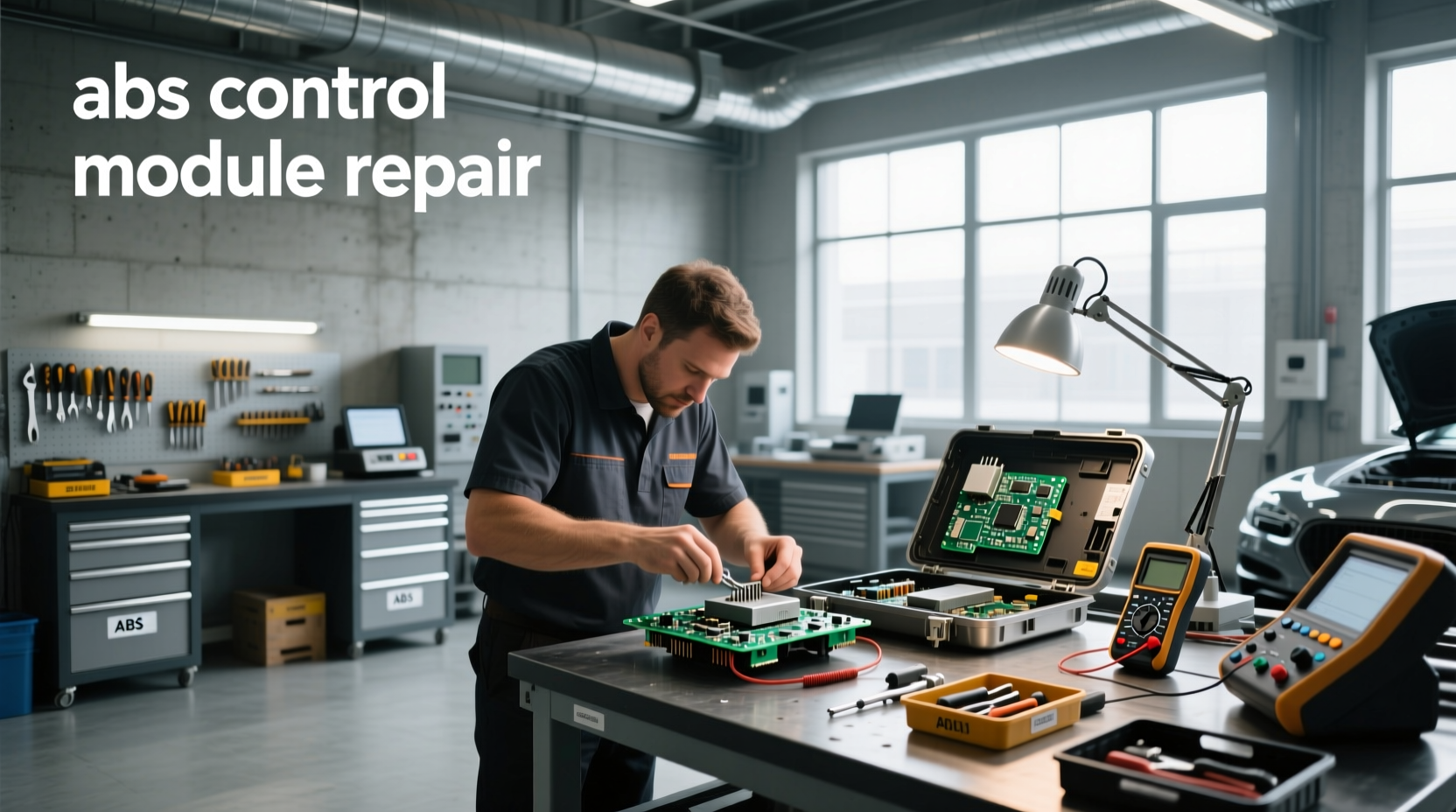
If your vehicle’s ABS warning light is on, the brake pedal feels unusually firm, or wheels lock up during normal braking, you may be dealing with a faulty ABS control module repair issue. This critical component manages your antilock braking system by monitoring wheel speed sensors and modulating brake pressure to prevent skidding. When it fails, safety is compromised. Fortunately, many symptoms can be diagnosed early, and in some cases, repairs—rather than full replacements—are possible. Understanding when and how to approach an ABS control module repair can save hundreds of dollars and keep your car safe on the road.
What Is an ABS Control Module?
The ABS (Anti-lock Braking System) control module ⚙️ is a microprocessor-based unit that acts as the brain of your vehicle’s anti-lock brakes. It continuously receives data from wheel-speed sensors located at each wheel. Based on this input, it determines if any wheel is about to lock up during braking, especially on slippery surfaces. If slippage is detected, the module signals the hydraulic control unit to rapidly pulse the brakes—mimicking threshold braking—allowing the driver to maintain steering control while stopping safely.
This system is vital for modern driving safety, particularly in wet, icy, or loose road conditions. The module itself is typically located near the brake master cylinder in the engine compartment 🔍, often integrated into a larger hydraulic control assembly. While durable, electronic components inside can degrade over time due to heat cycles, moisture exposure, or voltage spikes.
Symptoms of a Failing ABS Control Module
Recognizing early signs of failure is crucial for timely intervention. Ignoring these warnings can lead to complete loss of ABS functionality, increasing stopping distances and reducing control in emergency situations.
- ABS Warning Light Illuminated: A steady or flashing ABS light on the dashboard is the most common indicator. This light activates when the module detects a fault through its self-diagnostic routines.
- Firm Brake Pedal with No Pulsing: During hard braking, especially on low-traction surfaces, you should feel slight pulsations if ABS engages. If the pedal remains rock-solid and doesn’t pulse, the system may not be activating.
- Wheels Lock Up Under Braking: Even moderate braking on damp pavement causing wheel lock indicates the ABS isn’t intervening—often due to a failed module.
- Inaccurate Speedometer Readings: Since the ABS module relies on wheel speed data, a malfunction can sometimes disrupt signals sent to the instrument cluster, leading to incorrect speed display.
- ABS Pump Runs Constantly: After turning off the ignition, hearing the pump motor run continuously suggests a relay or internal circuit failure within the module.
- Intermittent ABS Activation: Brakes engage unexpectedly even during normal driving, such as coasting on dry roads, indicating false sensor readings or processing errors in the module.
These symptoms don't always mean the module itself is bad—faulty wheel speed sensors, damaged wiring harnesses, or low brake fluid can mimic similar issues. Proper diagnosis is essential before proceeding to repair.
Can You Repair an ABS Control Module Instead of Replacing It?
Yes, in many cases, ABS control module repair is a viable alternative to replacement ✅. Factory-new units can cost anywhere from $400 to over $1,000 depending on the make and model, plus labor fees. However, remanufacturing or repairing the existing unit offers significant savings—often cutting costs by 40–60%.
Repair typically involves:
- Disassembling the module housing
- Inspecting for corroded connectors or cracked solder joints
- Replacing failed relays, capacitors, or diodes
- Cleaning internal circuits and resealing against moisture
- Reprogramming or coding the unit to match the vehicle VIN (if required)
Some specialized shops and rebuilders offer bench testing post-repair to ensure full functionality. For certain models like older Toyotas, GMs, or Fords, known failure points (e.g., failed solder joints on circuit boards) make repair both predictable and reliable.
| Vehicle Type | Average New Module Cost | Typical Repair Cost | Repair Success Rate |
|---|---|---|---|
| Ford F-150 (2005–2010) | $600–$900 | $200–$300 | 85% |
| Toyota Camry (2007–2011) | $500–$750 | $180–$250 | 90% |
| GM Trucks (2002–2007) | $700–$1,100 | $220–$350 | 80% |
| Honda Accord (2008–2012) | $450–$650 | $175–$275 | 75% |
When Should You Consider Repair vs. Replacement?
Deciding between repair and replacement depends on several factors including age of the vehicle, availability of parts, and long-term ownership plans.
✅ Choose Repair If:
- You drive an older vehicle where OEM modules are scarce or expensive
- The issue is isolated to internal electronics (e.g., cracked solder joints)
- You’re budget-conscious and want to avoid high dealership pricing
- Reputable rebuilders offer warranties (typically 1–2 years)
❌ Opt for Replacement If:
- The module has physical damage (cracks, water intrusion, burnt components)
- Your car requires specific calibration or VIN coding only available through dealerships
- You plan to keep the vehicle long-term and prefer factory reliability
- Used or remanufactured units lack proper programming support
It's important to note that even “remanufactured” modules sold online may have been repaired using similar techniques. Always verify warranty terms and return policies.
DIY ABS Control Module Repair: Is It Possible?
For technically inclined individuals, DIY ABS control module repair is feasible but comes with caveats 🧰. Basic steps include removing the module, opening the casing, inspecting for visible damage, and resoldering weak joints. However, success requires precision tools, knowledge of circuit boards, and understanding of automotive electrical systems.
Common DIY challenges include:
- Lack of proper diagnostic equipment to test after repair
- Damaged seals leading to future moisture ingress
- Incorrect reassembly causing leaks or shorts
- Failure to reprogram the module, resulting in non-operation
If attempting a DIY fix, follow these best practices:
- Document every step with photos before disassembly
- Use a temperature-controlled soldering iron and rosin-core flux
- Clean the board with isopropyl alcohol before inspection
- Check continuity across key circuits using a multimeter
- Apply conformal coating after repair to protect against corrosion
However, unless you have prior experience with automotive electronics, professional repair is strongly recommended ⚠️.
How to Diagnose an ABS Control Module Problem Accurately
Before investing in repair or replacement, confirm the root cause. Many symptoms attributed to the module actually stem from other components.
Step-by-Step Diagnostic Process:
- Scan for Trouble Codes: Use an OBD-II scanner capable of reading ABS-specific codes (not all basic scanners do). Look for codes like C0035–C0044 (wheel speed sensor faults), C0121 (pump motor circuit), or U0121 (lost communication with ABS module).
- Inspect Wheel Speed Sensors: These are common failure points. Check for debris buildup, broken wires, or air gaps between sensor and tone ring.
- Test Wiring Continuity: Use a multimeter to check for open circuits or shorts between the module and sensors.
- Examine Hydraulic Unit: Listen for abnormal noises from the ABS pump. Check for brake fluid leaks around the module.
- Bench Test the Module: Some auto electricians can test the module off-vehicle using simulated inputs.
Only proceed with ABS control module repair once other potential causes are ruled out. Misdiagnosis leads to unnecessary expenses.
Cost Breakdown: What to Expect When Repairing an ABS Module
Understanding the full cost structure helps set realistic expectations.
- Diagnostic Fee: $50–$120 at most repair shops
- Repair Service: $180–$350 (labor + parts)
- Reprogramming/Coding: $50–$150 (required for many newer vehicles)
- Return Shipping (Mail-In Services): $20–$40 round-trip
- Total Out-of-Pocket: Typically $250–$500
In contrast, replacing with a new OEM part averages $800–$1,500 including installation. Used modules from salvage yards may cost $100–$300 but carry no warranty and may require coding.
Choosing a Reliable Repair Service
Not all repair providers are equal. To ensure quality work:
- Look for companies specializing in ABS or ECM/TCM repairs
- Verify they offer a minimum 1-year warranty
- Ask if they perform functional testing post-repair
- Check customer reviews on independent platforms
- Confirm compatibility with your vehicle’s make/model/year
Many reputable services operate via mail-in programs—you ship the module, they repair and return it within 3–5 business days ⏱️🚚. Ensure packaging is secure to prevent transit damage.
Preventing Future ABS Module Failures
While wear is inevitable, certain habits extend module life:
- Maintain clean, properly filled brake fluid (changed every 2 years)
- Avoid short trips frequently, which allow moisture buildup in brake lines
- Inspect wiring harnesses during routine maintenance
- Address ABS warning lights promptly instead of delaying repairs
- Install protective covers if driving in salty or muddy environments
Moisture and thermal cycling are primary enemies of electronic modules. Parking in garages or covered areas can reduce environmental stress.
Common Myths About ABS Control Module Repair
Misinformation abounds. Let’s clarify a few misconceptions:
- Myth: Once it fails, replacement is the only option.
Reality: Most failures are repairable, especially those involving solder joints or relays. - Myth: Repaired modules aren’t as reliable as new ones.
Reality: Professionally rebuilt units often exceed original build quality with upgraded components. - Myth: All ABS modules need programming.
Reality: Older models (pre-2005) often plug-and-play; newer ones usually require coding. - Myth: You can reset the module by disconnecting the battery.
Reality: While this clears temporary codes, it won’t fix hardware faults or erase permanent DTCs.
Final Thoughts: Making the Right Decision
An ABS control module repair can restore safety and performance without breaking the bank. The key is accurate diagnosis, choosing the right solution path, and avoiding rushed decisions based solely on warning lights. Whether you opt for professional repair, DIY fixes, or full replacement, prioritize safety and long-term reliability. If you're unsure, consult a certified technician with ABS-specific diagnostic tools.
Frequently Asked Questions
Here are answers to common questions about ABS control module repair:
- How do I reset my ABS control module?
- Disconnecting the battery for 10–15 minutes may clear temporary fault codes. However, permanent codes require scanning and clearing with an OBD-II tool. Resetting does not fix hardware issues.
- How much does it cost to repair an ABS control module?
- Typical repair costs range from $180 to $350, depending on vehicle make and service provider. Additional fees may apply for coding or shipping.
- What happens when the ABS control module goes bad?
- A failed module disables the antilock braking system, leading to wheel lockup during braking, increased stopping distance, and loss of stability control features.
- Can I drive with a bad ABS control module?
- You can still drive, but braking performance is reduced in slippery conditions. The regular brakes function, but without ABS protection. It’s unsafe for highway or adverse weather driving.
- Where is the ABS control module located?
- It’s usually found in the engine compartment near the brake master cylinder, often mounted on the firewall or inner fender. On some models, it’s integrated with the hydraulic unit under the vehicle.





 浙公网安备
33010002000092号
浙公网安备
33010002000092号 浙B2-20120091-4