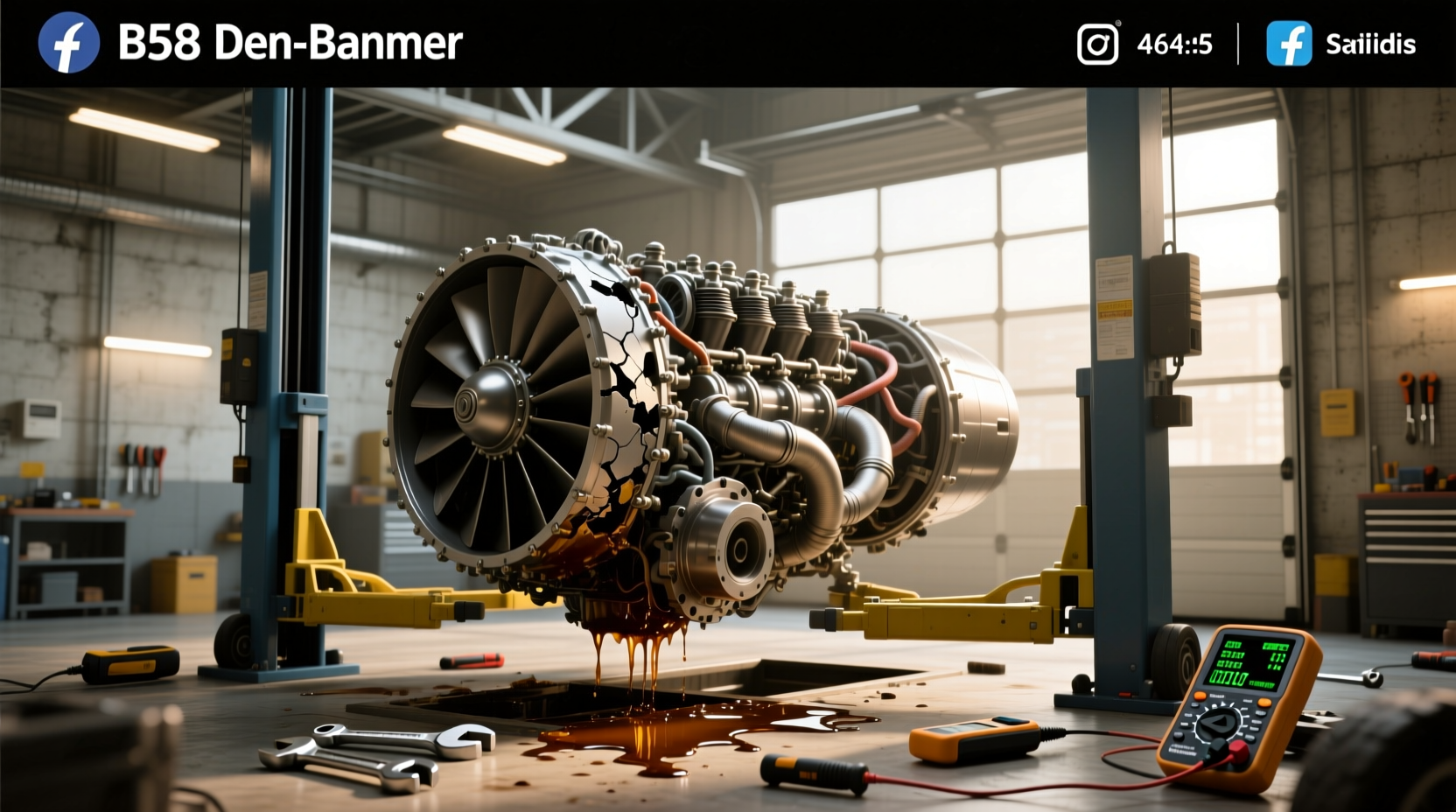
The BMW B58 3.0L turbocharged inline-six engine, introduced in 2015 as a successor to the N55, is widely regarded as one of the most reliable and tunable modern BMW engines 1. While it has earned multiple Ward's 10 Best Engines awards and powers a wide range of vehicles—from the 340i to the Toyota Supra—owners often search for answers regarding potential B58 engine issues, especially as these engines age beyond 60,000 miles. This comprehensive guide examines the most frequently reported B58 engine problems, their root causes, symptoms, repair costs, and preventive maintenance strategies to help current and prospective owners make informed decisions.
Understanding the BMW B58 Engine: Design and Evolution
The B58 engine belongs to BMW’s modular engine family, sharing core architecture with the four-cylinder B48 and six-cylinder diesel B57 units. It features an all-aluminum block, forged crankshaft and connecting rods, direct fuel injection, Valvetronic variable valve lift, and Double-VANOS variable cam timing 2. These design choices contribute to its high strength-to-weight ratio and excellent performance characteristics.
Over the years, BMW has made incremental updates to the B58:
- Gen 1 (2015–2019): Found in early F30 340i, G01 X5, and other models. Most commonly associated with known issues like water pump failures and thermostat malfunctions.
- Gen 2 (2020–present): Introduced on G20 3 Series and newer platforms. Features revised cooling system components, updated high-pressure fuel pump (HPFP), and improved heat retention technology.
- Mild-Hybrid Integration (2022+): In models like the G20 M340i and X5 xDrive45i, the B58 now includes a 48V mild-hybrid system (often called B58TU or B58B) that enhances throttle response and efficiency.
Despite generational improvements, certain mechanical weaknesses persist across model years due to shared component sourcing and thermal management design limitations.
Top 5 Common B58 Engine Problems
1. Water Pump Failure ⚙️
One of the most prevalent issues affecting early B58 engines is premature water pump failure. Unlike traditional belt-driven pumps, the B58 uses an electric water pump located near the thermostat housing. This unit contains a plastic impeller and integrated motor.
Symptoms:
- Overheating warnings on the dashboard
- Loss of cabin heat
- Coolant leaks under the front passenger side of the engine
- Check Engine Light with codes P0217 (engine overheating) or P2181 (cooling system performance)
Why It Happens: The plastic impeller can degrade over time due to heat exposure and coolant chemistry. Once it cracks or breaks apart, coolant flow drops significantly, leading to overheating.
Solution: Replace the entire electric water pump assembly. Some aftermarket manufacturers offer upgraded versions with metal impellers for increased durability. Replacement typically requires draining the coolant and removing several intake components, taking 4–6 hours of labor.
2. Thermostat Housing and Coolant Leaks 🌡️
Closely related to water pump issues, the thermostat housing on Gen 1 B58 engines is made partially from plastic and secured with aluminum bolts. Thermal cycling causes differential expansion between materials, leading to stress fractures.
Symptoms:
- Visible coolant seepage around the thermostat housing
- Drying residue on nearby hoses or engine surfaces
- Frequent need to top off coolant reservoir
- Intermittent temperature fluctuations
Prevention Tip: Many specialists recommend replacing both the water pump and thermostat housing together during service intervals, even if no leak is present, because access is similar and failure risk increases after 60,000 miles.
3. High-Pressure Fuel Pump (HPFP) Wear 🔧
The Bosch-developed HPFP supplies fuel at pressures exceeding 2,000 psi to support direct injection. On higher-mileage B58 engines (typically over 80,000 miles), internal wear reduces output pressure.
Symptoms:
- Engine misfires under load or acceleration
- Limp mode activation
- Rough idle or hesitation
- Diagnostic trouble codes such as P0087 (fuel rail/system pressure too low)
Root Cause: Internal cam follower wear inside the HPFP leads to reduced plunger stroke and insufficient fuel delivery. This issue is more common in areas with lower-quality gasoline or infrequent oil changes, as lubrication comes from engine oil via a linkage rod.
Mitigation: Using premium fuel consistently and changing engine oil every 7,500–10,000 miles with OEM-specification LL-01 or LL-17 FE oils helps prolong HPFP life. For modified engines producing over 450 hp, upgraded HPFPs are strongly recommended.
4. Oil Leaks from Valve Cover and RTV Seals 🛢️
Like many modern engines, the B58 relies on rubber gaskets and silicone (RTV) sealants in various locations. Over time, these materials harden and crack due to heat cycles.
Common Leak Points:
- Valve cover gasket (especially near spark plug tubes)
- Oil filter housing o-ring
- Front crankshaft seal
- Timing cover RTV bead
Diagnosis: Blueish residue around the exhaust manifold or carbon buildup underneath may indicate oil dripping onto hot surfaces. A smoke test can confirm suspected leaks.
Repair Consideration: While not dangerous immediately, persistent oil leaks can lead to burning smells, sensor contamination, or even fire hazards in extreme cases. Addressing them early prevents secondary damage.
5. VANOS Solenoid Performance Degradation ⚠️
The Double-VANOS system adjusts camshaft timing for optimal power and emissions. Solenoids control oil flow to actuate the phasers. Contaminated oil or sludge buildup can clog solenoid screens.
Symptoms:
- Reduced low-end torque
- Check Engine Light with codes P0011, P0021, or P0016
- Delayed throttle response
- Poor cold-start behavior
Solution: Cleaning or replacing the VANOS solenoids is relatively straightforward. However, if the issue stems from poor oil maintenance, simply replacing the solenoid may not resolve the underlying problem. Regular oil changes are critical.
Are There Differences Between B58 Generations?
Yes. Although BMW does not officially recognize a “Gen 1.5” designation, the term is used informally by tuning shops and parts suppliers to describe transitional models built roughly between late 2019 and mid-2020. These engines feature minor revisions such as updated cylinder head casting numbers and revised PCV systems.
Key differences include:
| Feature | Gen 1 (2015–2019) | Gen 2 (2020+) |
|---|---|---|
| Water Pump | Plastic impeller, prone to cracking | Revised design, slightly more durable |
| Thermostat Housing | Plastic components, leak-prone | Improved material blend |
| Fuel System | Single-stage HPFP | Updated HPFP calibration |
| Hybrid Support | No | Integrated 48V mild-hybrid (B58TU) |
| PCV System | Integrated into valve cover | Redesigned for better oil separation |
In general, later-generation B58 engines show improved reliability, though core vulnerabilities remain. The introduction of the 48V system adds complexity but improves start-stop functionality and transient response.
Maintenance Tips to Prevent B58 Engine Issues
Proactive maintenance is the single most effective way to extend B58 engine lifespan and avoid costly repairs.
- Follow Service Intervals: BMW recommends oil changes every 10,000 miles or annually 3. In harsh driving conditions (frequent short trips, towing, track use), reduce this to 7,500 miles.
- Use Correct Oil: Always use BMW-approved LL-01 or LL-17 FE 0W-30 or 5W-30 full synthetic oil. Avoid non-compliant alternatives that may accelerate HPFP wear.
- Cooling System Flush: Replace coolant every 4 years or 60,000 miles to prevent corrosion and maintain proper pH balance.
- Inspect Hoses and Clamps: During routine services, visually check for swelling, brittleness, or leakage in coolant lines.
- Address Small Leaks Immediately: Ignoring minor oil or coolant seepage can lead to major engine damage over time.
Performance Tuning and Longevity: What You Need to Know
The B58 is highly popular in the tuning community due to its strong factory internals and responsiveness to ECU modifications. Stock versions produce between 322 and 382 horsepower depending on application.
Tuning Impact on Reliability:
Stage 1 (software-only) tunes adding ~50 hp generally do not compromise longevity if cooling and fuel systems are maintained. However, aggressive tuning (Stage 2+, methanol injection, larger turbos) increases stress on:
- HPFP (fuel delivery limits)
- Intercooler efficiency
- Exhaust manifold and turbocharger
- Transmission and drivetrain components
Owners pursuing significant power gains should consider supporting mods like upgraded intercoolers, auxiliary radiators, and reinforced engine mounts.
Is the B58 a Reliable Engine Overall?
Yes—the B58 is considered one of BMW’s most reliable engines in recent history. When properly maintained, it can reliably exceed 150,000 miles without major mechanical failure. Its forged internals and robust design make it far more durable than older N54/N55 engines.
However, 'reliable' doesn’t mean 'problem-free.' All engines have wear items, and the B58 is no exception. The key differentiator is that most common issues are predictable, repairable, and rarely catastrophic when addressed promptly.
Buying a Used Car with a B58 Engine: What to Check
If you're considering a pre-owned BMW, Toyota Supra, or other vehicle equipped with the B58, perform the following checks:
- Service Records: Look for consistent oil changes and evidence of cooling system maintenance.
- Coolant Condition: Check for rust-colored fluid or sludge in the expansion tank, which indicates neglect.
- Oil Consumption: Ask if the owner adds oil between changes. More than 1 quart per 1,500 miles may indicate piston ring or PCV issues.
- Scan for Codes: Use an OBD2 scanner to check for stored or pending fault codes related to VANOS, fuel pressure, or cooling.
- Test Drive Behavior: Listen for whining noises (water pump), rough idling, or hesitation during acceleration.
A well-maintained B58-powered vehicle remains an excellent choice for performance-oriented buyers seeking long-term ownership satisfaction.
Frequently Asked Questions About the B58 Engine
- ❓ What cars have the B58 engine?
- The B58 is found in numerous BMW models including the 340i, 440i, 540i, 740i, X3 M40i, X4 M40i, X5 xDrive45i, Z4 M40i, and also powers the Toyota GR Supra and Alpina B3 Bi-Turbo.
- ❓ How much horsepower does the B58 make?
- Output varies by model and tuning: from 322 hp in base configurations to 382 hp in M440i/X5 xDrive45i variants. With tuning, outputs exceeding 500 hp are achievable.
- ❓ Is the B58 better than the N55?
- Yes. The B58 improves upon the N55 with stronger internals, better thermal management, reduced turbo lag, and enhanced fuel efficiency. It also addresses several known N55 weaknesses.
- ❓ Can I prevent B58 water pump failure?
- While failure cannot be entirely prevented, using quality coolant, avoiding overheating, and preemptively replacing the pump at 80,000–100,000 miles can mitigate risk.
- ❓ Does the B58 require premium gas?
- BMW recommends premium unleaded (91 octane or higher). While the engine can run on regular fuel using knock sensors to adjust timing, performance will be reduced and long-term deposits may form.





 浙公网安备
33010002000092号
浙公网安备
33010002000092号 浙B2-20120091-4