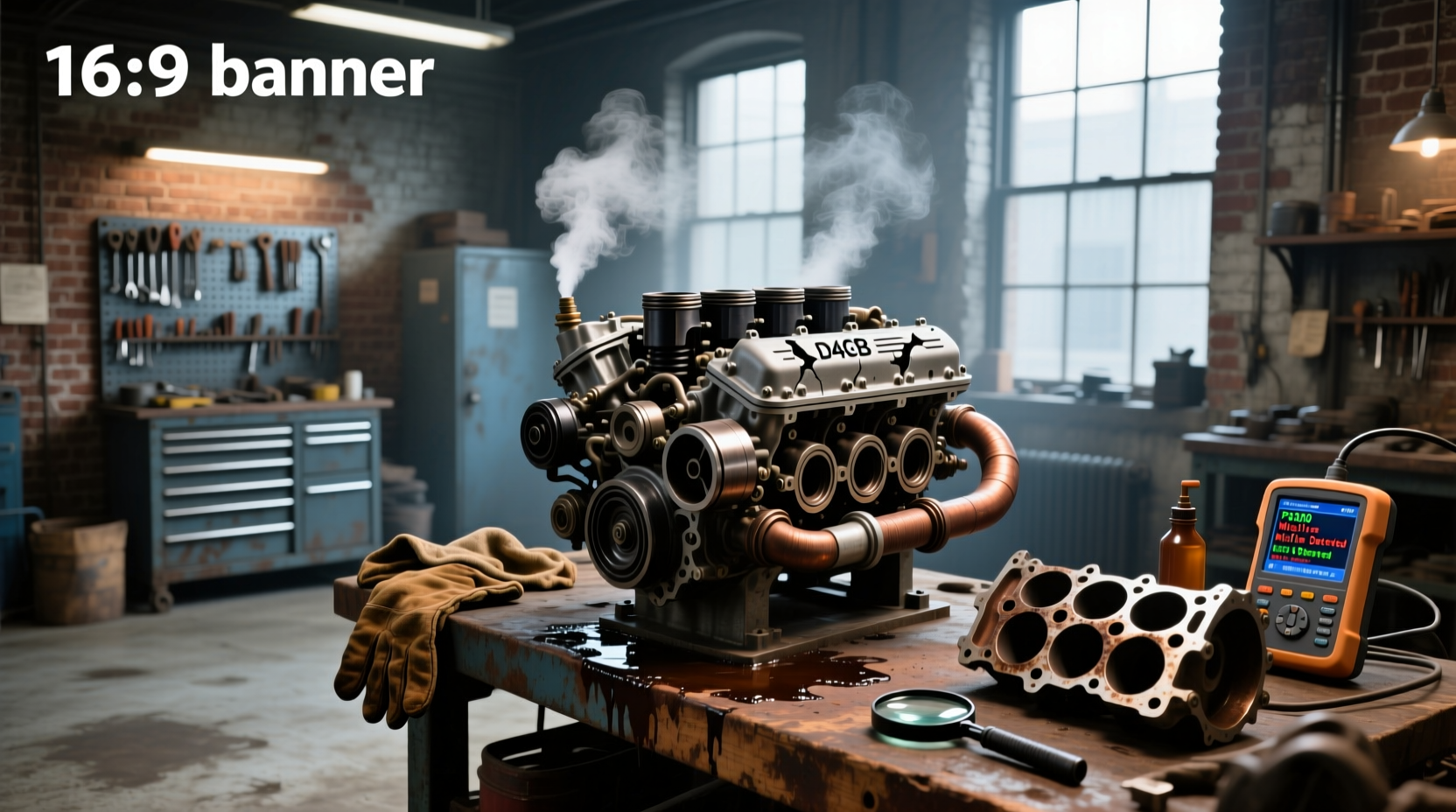
If you own a Hyundai H1, Starex, or a Kia Sorento with the D4CB engine, understanding common D4CB engine problems is essential for long-term reliability. The 2.5L turbocharged diesel D4CB (also known as A-Engine or 2.5 CRDi) has been widely used since 2002 across commercial vans and SUVs. While generally durable, it’s prone to specific mechanical issues—especially when maintenance is delayed. This guide breaks down real-world problems like injector failure, turbocharger wear, oil sludge buildup, timing chain concerns, and EGR system faults, backed by technical insights and repair strategies from mechanics and owners.
What Is the D4CB Engine?
The Hyundai D4CB is a 2.497 cc (2.5L) inline-four, turbocharged diesel engine developed by Hyundai Motor Group. Introduced in 2002, it belongs to the Hyundai A-engine family and is commonly referred to as the 2.5 CRDi due to its common rail direct injection system 1. It features a bore and stroke of 91 mm × 96 mm, producing between 136–170 horsepower depending on the model year and market. The engine was primarily used in:
- Hyundai H1 / Starex / Grand Starex
- Hyundai iLoad / iMax
- Kia Pregio / Granbird (commercial variants)
- Kia Sorento (early diesel models, pre-2010)
This engine went through multiple updates over its production life, improving fuel delivery, emissions control, and cooling efficiency. However, certain design characteristics make it vulnerable to recurring issues under poor maintenance or high-mileage use.
Top 5 D4CB Engine Problems: Symptoms & Causes
Based on service reports, owner forums, and mechanic diagnostics, five major problem areas consistently emerge among D4CB-powered vehicles. Recognizing early warning signs can prevent costly repairs.
🔧 1. Injector Failure and Seal Degradation
Diesel injectors in the D4CB are high-pressure components critical to combustion efficiency. Over time, carbon buildup and fuel contamination lead to clogging or misfiring.
Symptoms:
- Rough idling or engine vibration
- White or black smoke at startup
- Reduced power and fuel economy
- Error codes related to cylinder balance (e.g., P020X series)
Root Cause: Low-quality diesel fuel accelerates injector wear. Additionally, aging injector seals can leak compression into the valve cover, causing oil contamination and potential hydrolock. This issue is more common in engines exceeding 150,000 km without seal replacement.
Solution: Replace all injectors as a set if one fails—uneven spray patterns cause imbalance. Use OEM-spec or Bosch-reconditioned units. Always replace copper sealing washers and O-rings during reinstallation.
⚙️ 2. Turbocharger Wear and Oil Coking
The Garrett or KKK turbocharger boosts performance but relies heavily on clean oil supply and proper cooldown.
Symptoms:
- Whining or grinding noise under acceleration
- Lag in throttle response
- Excessive blue smoke from exhaust
- Oil traces in intercooler piping
Root Cause: Frequent short trips prevent adequate turbo cooldown, leading to oil coking in bearings. Sludge formation from infrequent oil changes further restricts lubrication flow. Some early models had weaker bearing materials that accelerated failure.
Solution: Install a turbo timer or allow 1–2 minutes of idle before shutdown. Upgrade to synthetic 5W-30 or 5W-40 diesel-rated oil. When replacing, consider upgraded ceramic ball-bearing turbos for better longevity.
🧼 3. Oil Sludge and Crankcase Buildup
One of the most widespread issues affecting older D4CB engines is internal sludge accumulation, especially in the sump, valve cover, and PCV system.
Symptoms:
- Low oil pressure warnings
- Clogged oil pickup screen
- PCV valve blockage leading to crankcase pressure
- Increased oil consumption
Root Cause: Extended oil change intervals, stop-and-go driving, and cool-down neglect contribute to condensation and fuel dilution. The closed-loop EGR system recirculates soot-laden gases, accelerating sludge formation.
Solution: Perform regular oil analysis if possible. Flush the crankcase using a solvent-based cleaner only if sludge is minor; otherwise, disassembly may be needed. Replace PCV valve every 60,000 km. Use low-ash CK-4 or CJ-4 oils designed for modern diesels.
🔗 4. Timing Chain Stretch and Guide Failure
Unlike belt-driven engines, the D4CB uses a timing chain—but it's not immune to wear.
Symptoms:
- Rattling noise at cold start
- Check engine light with camshaft position codes (P0016, P0008)
- Hard starting or misfires
Root Cause: The plastic timing chain guides degrade over time, especially when oil flow is restricted. Once a guide collapses, the chain can jump teeth, causing severe engine damage. This typically occurs after 200,000 km, though premature failure happens with poor lubrication.
Solution: Inspect chain tension and guides during major services. Replace the entire kit (chain, guides, tensioner, sprockets) preemptively if noise appears. Proper alignment marks must be followed during reassembly—a task best left to experienced technicians 2.
🌐 5. EGR and DPF System Clogging (Later Models)
Post-2010 D4CB variants equipped with EGR and DPF systems face added complexity.
Symptoms:
- Reduced power mode ('limp home')
- Frequent regeneration failures
- High exhaust backpressure readings
- Fault codes like P2463 (DPF restriction)
Root Cause: Urban driving prevents full regeneration cycles. Soot accumulates in the EGR cooler and DPF, reducing airflow and increasing engine temperature. Coolant leaks into the EGR valve are also reported due to cracked manifolds.
Solution: Avoid disabling EGR/DPF unless legally compliant. Clean EGR valve and cooler every 80,000 km. For DPF issues, forced regeneration via scan tool or professional cleaning may help. In extreme cases, replacement is necessary—but costly.
How to Diagnose D4CB Engine Issues Early
Preventive diagnosis saves money and downtime. Here’s how to catch problems before they escalate:
🔍 Visual Inspection Tips
- Check under the oil cap: milky residue indicates coolant mixing (possible head gasket issue).
- Inspect valve cover: excessive black goo signals sludge risk.
- Look at intercooler pipes: oil pooling suggests turbo seal leakage.
- Examine EGR hose: black crust means heavy soot recirculation.
📊 OBD2 Scanning for Hidden Faults
Use an advanced OBD2 scanner capable of reading live data from:
- Fuel rail pressure
- Boost pressure
- DPF differential pressure
- Injector pulse width
- Camshaft vs crankshaft correlation
Monitor these values during test drives to detect anomalies not triggering check engine lights.
🧰 Compression and Leak-Down Testing
Performed by mechanics, this test reveals internal wear:
- Healthy D4CB should have 350–450 psi compression across all cylinders.
- Leak-down above 15% suggests valve or piston ring issues.
- Low compression with blow-by into oil filler neck points to worn rings.
| Problem | Typical Mileage Onset | Repair Cost Range (USD) | Prevention Tip |
|---|---|---|---|
| Injector Failure | 120,000–180,000 km | $800–$1,600 | Use premium diesel; replace seals at 100k km |
| Turbocharger Failure | 150,000–200,000 km | $1,000–$2,200 | Avoid short trips; install turbo timer |
| Oil Sludge Buildup | 100,000+ km | $300–$900 | Change oil every 10k km; use synthetic |
| Timing Chain Failure | 180,000–250,000 km | $1,200–$2,500 | Replace kit at first rattle |
| EGR/DPF Clogging | 140,000–200,000 km | $600–$3,000 | Drive highway weekly; clean every 80k km |
Maintenance Schedule to Prevent D4CB Engine Problems
Following a strict maintenance plan significantly reduces failure risks:
- Every 10,000 km: Oil and filter change (use API CK-4/CJ-4 rated oil)
- Every 20,000 km: Fuel filter replacement, air filter inspection
- Every 40,000 km: Coolant flush, EGR valve cleaning
- Every 60,000 km: PCV valve replacement, injector leak check
- Every 80,000 km: EGR cooler and intercooler cleaning
- Every 100,000 km: Injector seal replacement, turbo inspection
- Every 180,000–200,000 km: Timing chain kit replacement (preventive)
Additionally, always use diesel exhaust fluid (DEF) if your model requires it, and avoid aftermarket tuning modules that increase fuel pressure beyond factory limits.
Are Rebuilt or Used D4CB Engines Reliable?
When facing major engine damage, many consider replacements. But what options exist?
New vs. Remanufactured vs. Used
- New Engines: Rarely available from dealers after 2019; extremely expensive ($4,000+).
- Remanufactured Units: Factory-refurbished with new internals; come with warranty (e.g., 12 months). Best balance of cost and reliability.
- Used Engines: Sold online (eBay, specialty importers) with mileage claims. Risk varies—always request service history and video run-up tests.
Tip: Look for engines labeled “low hour” or “from non-smoker fleet vehicle.” Avoid units from taxi or delivery fleets with constant idling.
Regional Differences in D4CB Reliability
Engine durability varies by region due to fuel quality, climate, and usage patterns:
- Europe: Strict emissions standards mean earlier adoption of DPF/EGR; higher repair costs.
- Asia-Pacific: Widespread use in commercial transport leads to higher stress but better mechanic familiarity.
- Middle East: High ambient temperatures increase oil breakdown risk; frequent cooling system checks needed.
- Latin America: Lower sulfur diesel improves injector life, but counterfeit parts are common.
If importing a D4CB engine, verify compatibility with your VIN and emission standard (Euro 3, 4, or 5).
Common Misconceptions About the D4CB Engine
Several myths persist about this engine. Let’s clarify:
- Myth: “All D4CB engines burn oil.”
Truth: Only worn engines with damaged piston rings or turbo seals exhibit this. - Myth: “The engine is unreliable past 150,000 km.”
Truth: Well-maintained units exceed 300,000 km. - Myth: “EGR deletion solves all problems.”
Truth: It may improve driveability but increases NOx emissions and could violate local laws. - Myth: “You must replace the entire engine once sludge forms.”
Truth: Mild cases can be resolved with chemical flushes and repeated oil changes.
When to Repair vs. Replace the D4CB Engine
Deciding whether to repair or replace depends on several factors:
✅ Repair If:
- Only one subsystem is failing (e.g., turbo, injectors)
- Engine block is intact with good compression
- Total repair cost is under 40% of vehicle value
🚚 Consider Replacement If:
- Timing chain failure caused bent valves or piston damage
- Cracked cylinder head or block detected
- DPF/EGR integration makes repairs too complex
- Vehicles used commercially where downtime is costly
In some markets, complete engine swaps with newer platforms (like the D4HB or D4FE) are possible but require ECU remapping and mounting modifications.
Final Recommendations for D4CB Owners
The D4CB engine remains a workhorse when properly maintained. Its main weaknesses stem not from inherent design flaws, but from inadequate upkeep and poor operating conditions. To maximize lifespan:
- Stick to a rigorous oil change schedule.
- Address small issues (smoke, noise) immediately.
- Use diagnostic tools regularly, not just when lights appear.
- Choose mechanics familiar with Hyundai diesel systems.
- Keep service records for resale or warranty claims.
While no engine lasts forever, proactive care turns the D4CB into a dependable powerplant—even beyond 300,000 kilometers.
Frequently Asked Questions (FAQs)
- ❓ What vehicles use the D4CB engine?
- The D4CB engine is found in Hyundai H1, Starex, iLoad, and early diesel Kia Sorento models (pre-2010). It was also used in Kia Pregio and some commercial variants in Asia and Europe.
- ❓ How long does a D4CB engine last?
- With proper maintenance, a D4CB engine can last between 250,000 and 350,000 kilometers. Neglecting oil changes or ignoring warning signs can reduce lifespan to under 150,000 km.
- ❓ Can I delete the EGR system on my D4CB engine?
- Technically yes, but it may violate emissions regulations in many countries. EGR deletion can increase engine temperature and soot buildup, potentially leading to other issues.
- ❓ Are D4CB engine parts still available?
- Yes, many OEM and aftermarket parts remain available globally. Injectors, turbos, and gaskets are commonly stocked. For rare items, consider suppliers specializing in commercial van components.
- ❓ Is the D4CB the same as the D4EA engine?
- No. The D4EA is a smaller 2.0L diesel engine used in different Hyundai/Kia models. The D4CB is a 2.5L unit with distinct dimensions, mounting points, and performance characteristics.





 浙公网安备
33010002000092号
浙公网安备
33010002000092号 浙B2-20120091-4