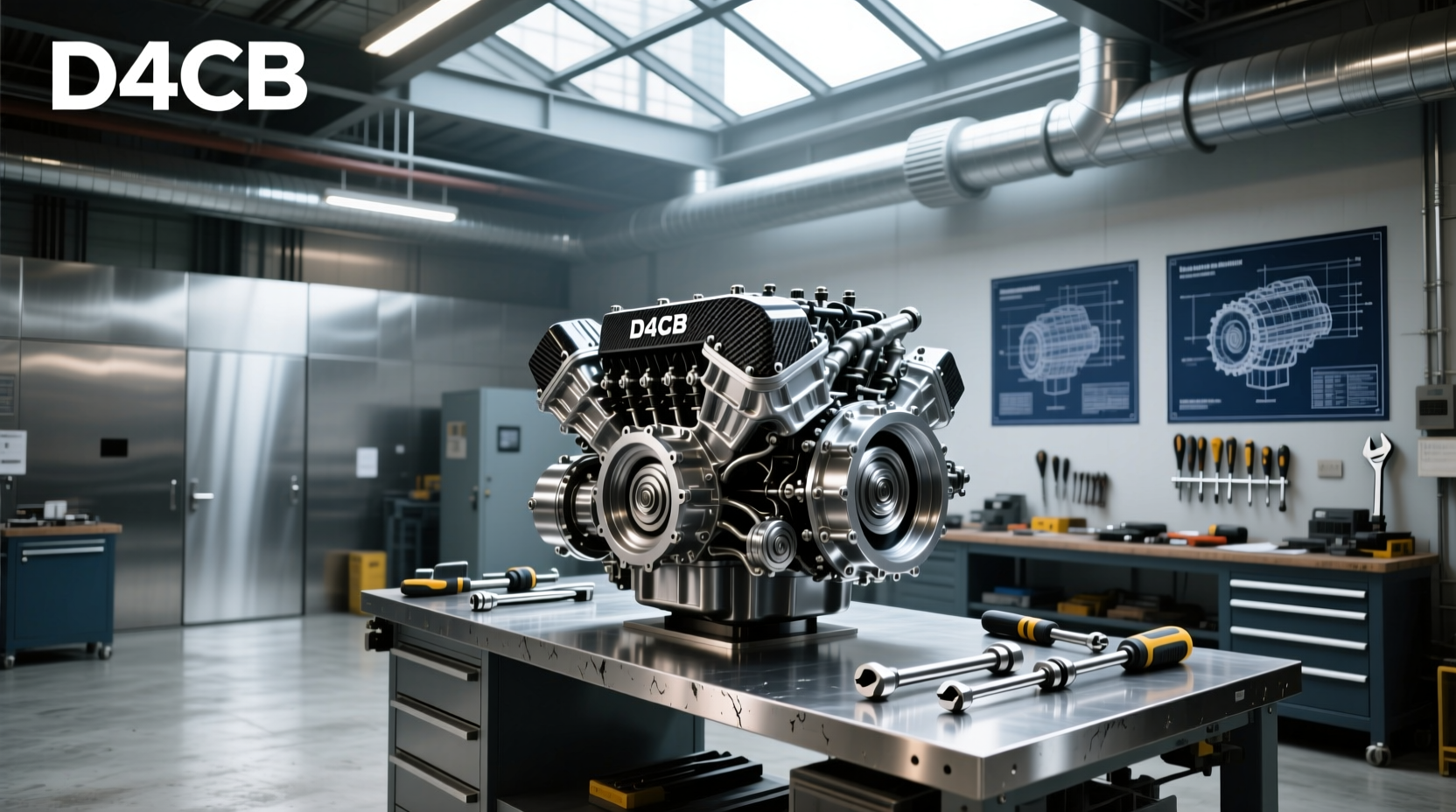
The Hyundai D4CB engine, also known as the A-Engine or 2.5L CRDi, is a widely used diesel powerplant found in vehicles such as the Hyundai H1 (Starex), iLoad, and Kia Sorento from 2002 onward 🏭. Understanding D4CB engine specs is essential for owners, mechanics, and buyers looking to assess reliability, performance, and repair costs. This article provides a comprehensive breakdown of displacement, power output, torque, fuel system design, common failure points, and technical service insights—helping you make informed decisions about maintenance, replacement, or purchase ✅.
What Is the D4CB Engine?
The D4CB is a 2.5-liter inline-four turbocharged diesel engine developed by Hyundai Motor Group and introduced in 2002. It belongs to the Hyundai A-engine family and was primarily marketed under the CRDi (Common Rail Direct injection) branding, which signifies advanced fuel delivery for improved efficiency and reduced emissions ⚙️. The engine code "D4CB" breaks down as follows:
- D: Diesel
- 4: 4 cylinders
- C: Common rail injection
- B: Second version in the series
This naming convention helps identify key engineering features at a glance 🔍. The D4CB replaced earlier mechanical diesel systems with electronic control units (ECUs), high-pressure common rail injectors, and variable geometry turbochargers (VGT), marking a significant leap in refinement and responsiveness compared to predecessors like the D4BH.
D4CB Engine Specifications Overview
Below is a complete technical specification table summarizing core D4CB engine specs based on factory data and verified sources across multiple model years and applications:
| Specification | Value |
|---|---|
| Engine Code | D4CB |
| Also Known As | A-Engine, 2.5 CRDi |
| Displacement | 2,497 cc (2.5L) |
| Configuration | Inline-4, SOHC, 16-valve |
| Bore × Stroke | 91 mm × 96 mm |
| Compression Ratio | 17.8:1 |
| Fuel System | Common Rail Direct Injection (CRDi) |
| Injection Pressure | Up to 1,600 bar |
| Turbocharger Type | Variable Geometry Turbo (VGT) |
| Intercooler | Yes – Air-to-air |
| Max Power Output | 103 kW (140 hp) @ 3,800 rpm |
| Max Torque | 343 Nm (35 kg·m) @ 2,000 rpm |
| Oil Capacity | 6.3 liters (with filter change) |
| Coolant Capacity | Approx. 9.5 liters |
| Emissions Standard | Euro 3 to Euro 5 (varies by year) |
| Production Years | 2002–2019 |
| Applications | Hyundai H1/Starex, iLoad, Kia Sorento, H200 |
These specifications remained largely consistent throughout production, though minor updates were made over time to improve emissions compliance and durability 1.
Performance Across Vehicle Models
The D4CB engine was used in several commercial and passenger vehicles, each tuned slightly differently depending on application. Here's how it performs across major platforms:
Hyundai H1 / Starex (2007–2019)
In the H1 van, the D4CB delivers strong low-end torque ideal for city driving and light cargo transport. With 343 Nm available from just 2,000 rpm, acceleration feels responsive even when fully loaded. Some later models (e.g., H1 Travel 2.5 CRDi Trend Automatik) received an upgraded version producing up to 170 PS and 392 Nm, likely due to revised ECU mapping and turbo calibration 2.
Kia Sorento (2003–2009)
In the first-generation Sorento, the D4CB provided adequate power for a mid-size SUV but lacked refinement at higher speeds. Owners often report noticeable diesel clatter and moderate vibration, especially during cold starts. However, real-world fuel economy averages between 7.5–8.5 L/100km on highways, making it efficient for long-distance travel.
Hyundai iLoad / H200
Used in delivery vans and fleet vehicles, the D4CB here prioritizes reliability and serviceability. These versions typically feature robust cooling systems and simplified electronics to reduce downtime. Many operators praise its longevity when maintained properly, with some engines surpassing 300,000 km without major overhauls.
Common D4CB Engine Problems and Reliability Concerns
While the D4CB offers solid performance, certain components are prone to wear or failure, particularly in older or poorly maintained units. Below are the most frequently reported issues:
1. Turbocharger Failures ⚠️
One of the top complaints involves premature turbo failure, often linked to oil coking in the VGT mechanism. Because the turbo relies on engine oil for lubrication and actuation, delayed oil changes or using incorrect viscosity can lead to sludge buildup and restricted movement. Symptoms include loss of power, excessive smoke, and whining noises.
Solution: Regular oil changes every 10,000 km using API CI-4 or ACEA E7-rated oil help prevent this. If replacing the turbo, ensure proper bleed-off procedures are followed to avoid dry-start damage.
2. Injector Seal Leaks 💧
The high-pressure injectors in the D4CB use copper seals that degrade over time. When these fail, combustion gases escape into the injector gallery, causing hard starting, misfires, and potential fire hazards. Oil may also leak into the combustion chamber.
Solution: Replace all injector seals during major services or if symptoms appear. Use OEM-quality seals; aftermarket versions often fail prematurely.
3. EGR and DPF Clogging (Euro 4/5 Models)
Later D4CB variants equipped with EGR (Exhaust Gas Recirculation) and DPF (Diesel Particulate Filter) systems are susceptible to carbon buildup, especially in urban driving cycles. Restricted airflow leads to reduced performance and increased regeneration frequency.
Solution: Drive at highway speeds regularly to promote passive regeneration. Consider periodic decarbonization treatments or professional cleaning if warning lights appear.
4. Timing Chain Wear
Unlike belt-driven engines, the D4CB uses a timing chain. While designed to last the engine’s life, tensioner wear can cause slack and noise. In extreme cases, skipped teeth result in valve-to-piston contact.
Solution: Listen for rattling on startup. If present, inspect chain stretch and tensioner condition. Replacement is labor-intensive but prevents catastrophic damage.
5. Crankcase Ventilation System (CCV) Blockage
The CCV system manages crankcase pressure and recirculates blow-by gases. Over time, oil mist and soot accumulate, leading to vacuum leaks, oil consumption, and PCV valve sticking.
Solution: Clean or replace the CCV assembly every 100,000 km. This simple step improves engine breathing and reduces oil contamination.
Maintenance Tips for Longevity 🔧
To maximize the lifespan of your D4CB engine, follow these best practices:
- Use high-quality diesel fuel: Low-sulfur diesel minimizes injector fouling and protects emission components.
- Change oil regularly: Stick to 10W-40 or 5W-40 synthetic blend oils rated for diesel engines. Avoid cheap mineral oils.
- Inspect air filters frequently: A clogged air filter increases soot production and strains the turbo.
- Monitor coolant levels: Overheating accelerates internal wear. Check hoses, thermostat, and water pump periodically.
- Address warning lights immediately: Don’t ignore glow plug, check engine, or diesel particulate filter alerts.
Aftermarket Support and Replacement Options
Due to its widespread use, the D4CB has strong aftermarket support globally. Complete short-block assemblies, rebuilt long blocks, and performance upgrades are available through suppliers in Europe, Asia, and North America 🌐.
On platforms like eBay and industrial parts sites, a used D4CB engine with ~100,000 km might cost between $2,500–$3,000 USD, while remanufactured units range from $3,500–$5,000 depending on warranty and included components 🛒. Always verify compatibility with your VIN and model year before purchasing.
How to Verify D4CB Engine Authenticity
If buying a replacement engine or inspecting a used vehicle, confirm the engine type using these methods:
- Check the engine block tag: Located near the alternator or transmission side, it should read "D4CB" or "A-ENG(D4CB)".
- Scan the ECU: Use an OBD-II scanner compatible with Hyundai diesel protocols to retrieve engine ID and calibration data.
- Review service records: Look for references to CRDi maintenance, injector coding, or turbo adjustments.
- Compare physical features: The D4CB has a distinct common rail manifold on top and a VGT turbo mounted toward the firewall.
Regional Differences and Emissions Evolution
The D4CB underwent three major revisions during its 17-year production run:
- Phase 1 (2002–2006): Euro 3 compliant, basic CRDi system, no DPF.
- Phase 2 (2007–2012): Euro 4, added EGR cooler and enhanced diagnostics.
- Phase 3 (2013–2019): Euro 5, integrated DPF and improved VGT control.
These changes affect part interchangeability. For example, a Euro 5 D4CB cannot be directly swapped into a Euro 3 vehicle without reprogramming and hardware modifications.
Is the D4CB Engine Reliable?
Overall, the D4CB earns mixed reviews. In well-maintained applications, it can exceed 400,000 km with only routine servicing. However, neglect—especially poor oil discipline or short-trip usage—can trigger costly repairs within 150,000 km.
Compared to modern diesels like the Hyundai 2.2 U-II, the D4CB lacks advanced noise reduction and emissions controls but remains simpler to diagnose and repair. Its mechanical robustness appeals to fleet operators and DIY mechanics alike 👥.
Frequently Asked Questions (FAQs)
- What vehicles use the D4CB engine?
- The D4CB engine powers the Hyundai H1 (Starex), Hyundai iLoad, Kia Sorento (first generation), and Hyundai H200 van.
- How much horsepower does the D4CB produce?
- The standard D4CB produces 140 horsepower (103 kW) at 3,800 rpm. Some later models, particularly automatic-transmission H1 variants, reached up to 170 PS.
- What is the oil capacity of the D4CB engine?
- The D4CB holds approximately 6.3 liters of engine oil, including filter replacement.
- Are D4CB engines hard to repair?
- No, the D4CB is considered relatively straightforward to work on compared to newer diesel engines. Access to components like injectors and the turbo is reasonable, and repair manuals are widely available online.
- Can I upgrade the D4CB engine for more power?
- Yes, modest gains are possible via ECU remapping, upgraded intercoolers, or performance turbos. However, exceeding factory limits may compromise reliability unless supporting mods (fuel pump, cooling) are also addressed.





 浙公网安备
33010002000092号
浙公网安备
33010002000092号 浙B2-20120091-4