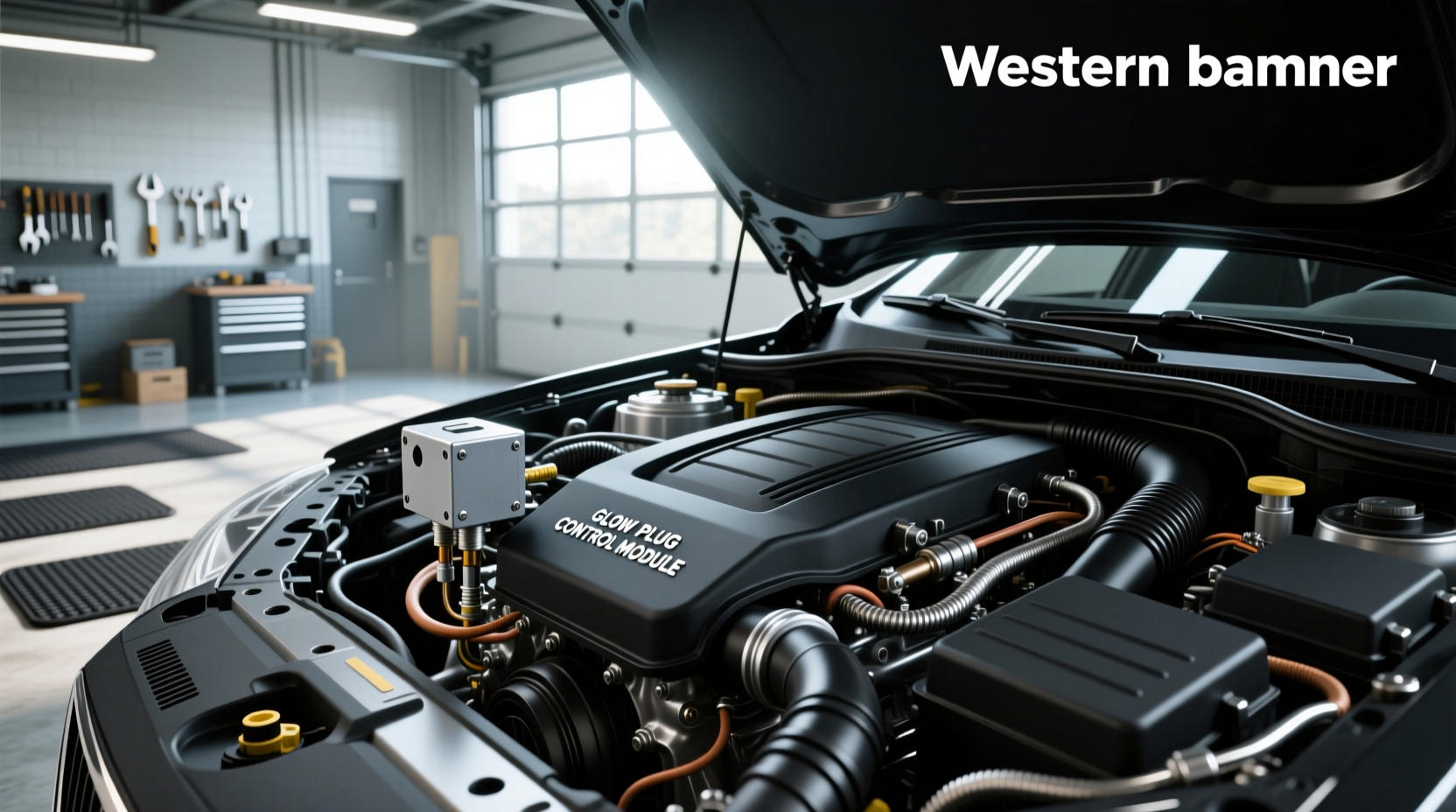
If you're searching for the glow plug control module location on your diesel vehicle, you're not alone. This small but critical component plays a vital role in cold-start performance and engine reliability. Typically, the glow plug control module (GPCM) is mounted near the engine's cylinder head or firewall, often on the driver’s side of the engine bay—though exact placement varies significantly by manufacturer, model, and engine type. For example, on many Ford Powerstroke 6.0L and 6.4L engines, it's located on the left valve cover, while some GM Duramax models house it behind the intake manifold. Knowing the precise glow plug control module location by model is essential for diagnostics, replacement, or maintenance tasks.
What Is a Glow Plug Control Module?
The glow plug control module (also called the glow plug timer, relay, or controller) manages the operation of glow plugs in diesel engines. Unlike gasoline engines that use spark plugs, diesel engines rely on compression ignition. However, during cold starts, the air temperature inside the cylinders may not be high enough to ignite the fuel efficiently. That’s where glow plugs come in—they heat the combustion chamber to ensure smooth ignition.
The GPCM receives signals from the engine control unit (ECU), analyzes engine coolant temperature, intake air temperature, and other parameters, then activates the glow plugs for a predetermined duration before and sometimes after startup. This ensures optimal combustion, reduces white smoke, and minimizes wear during cold cranking.
Why the Location Matters
Finding the correct glow plug control module location is crucial for several reasons:
- Diagnostic accuracy: Misdiagnosing a failed glow plug as a bad module—or vice versa—can lead to unnecessary repairs.
- Replacement access: Some modules are buried under intake manifolds or wiring harnesses, requiring partial disassembly.
- Environmental exposure: The module is often exposed to heat, moisture, and vibration, making location a factor in premature failure.
- Wiring inspection: Corrosion or damaged connectors near the module can mimic internal failure symptoms.
Common Locations by Manufacturer
While there’s no universal rule, manufacturers tend to follow design patterns based on engine architecture. Below is a breakdown of typical glow plug control module locations across popular diesel platforms.
Ford Diesel Engines (6.0L, 6.4L, 7.3L Powerstroke)
📍 On most Ford Super Duty trucks with the 6.0L and 6.4L Powerstroke engines, the GPCM is mounted directly on the **left (driver’s side) valve cover**. It appears as a black rectangular box with multiple electrical connectors and is secured with two bolts.
🔧 Access is relatively straightforward, though the area can be tight. You may need to remove the plastic engine cover and nearby hoses for better visibility. For the older 7.3L Powerstroke, the module is typically found on the **passenger side fender well**, inside the engine compartment, protected by a metal shield.
GM Duramax Engines (LB7, LMM, LBZ, L5P)
⚙️ GM vehicles, particularly those with the 6.6L Duramax engine, often place the glow plug control module **behind the intake manifold**. This makes it less accessible than Ford designs.
📌 On LB7 and LLY models, the module sits near the rear of the engine, close to the firewall. Replacing it usually requires removing the intake manifold—a labor-intensive process taking 3–5 hours even for experienced mechanics.
❗ A common issue with these models is water intrusion due to poor sealing, leading to corrosion and short circuits. If you're troubleshooting starting issues on a Duramax, checking the GPCM's condition—even if you can’t see it—is wise.
Ram Trucks (5.9L and 6.7L Cummins)
🛒 The Cummins-powered Ram trucks vary slightly between generations. On the 5.9L ISB (1998–2007), the glow plug controller is usually mounted on the **driver’s side inner fender** or near the battery tray.
For the newer 6.7L Cummins (2007–present), the module is typically located on the **front corner of the engine block**, near the timing cover. It’s more exposed to road debris and heat cycles, which can degrade solder joints over time.
Volkswagen TDI Models (ALH, BEW, BHW, etc.)
🔍 VW TDI engines, especially the popular 1.9L Pumpe Düse units, have the glow plug module mounted either **under the hood near the brake fluid reservoir** or integrated into the **main fuse box** on later models.
🧰 Early ALH engines (like in the Jetta TDI) feature a standalone relay-style module that can be tested and replaced easily. Later BEW and CR engines moved toward ECU-controlled systems, reducing the need for a separate physical module—but when present, it’s often labeled clearly in the fuse panel.
Mercedes-Benz CDI Models
🌐 Mercedes diesel engines (e.g., OM648, OM651) use sophisticated glow plug control systems. The module is commonly located on the **right-hand side of the engine**, near the camshaft cover, or tucked beneath protective covers.
Some W211 and W220 chassis models require removal of cosmetic engine shrouds to access the unit. These modules are sensitive to voltage spikes and often fail due to poor grounding or aftermarket accessory installations.
Symptoms of a Failing Glow Plug Control Module
Before diving into location-based diagnostics, recognize the signs that your GPCM might be failing:
- Hard starting in cold weather: Engine cranks but won’t fire until several attempts.
- White smoke at startup: Indicates incomplete combustion due to unheated cylinders.
- Check engine light with glow plug circuit codes: Common OBD-II codes include P0670–P0678 (circuit/open/low/high).
- Glow plug indicator stays on longer than usual: Suggests extended pre-heating due to faulty feedback.
- No power to glow plugs: Verified via multimeter testing at the plug terminals.
⚠️ Note: These symptoms can also stem from individual glow plug failure, wiring damage, or sensor errors. Always verify the root cause before replacing the module.
How to Confirm the Glow Plug Control Module Location for Your Vehicle
Since location varies so widely, here’s how to pinpoint yours accurately:
- Consult the service manual: Factory repair manuals (Haynes, Mitchell1, or OEM-specific) provide exploded diagrams showing exact positions.
- Use VIN-specific databases: Websites like Alldata or Identifix offer year/make/model-specific schematics.
- Search using engine code: Instead of just the model name, search “glow plug control module location 6.6L LMM” or “Duramax GPCM location LBZ” for precision.
- Inspect visually: Look for a box with thick gauge wires leading to the cylinder head—usually 4–8 output wires plus power and ground inputs.
- Follow the wiring harness: Trace wires from the glow plugs back to their source; they’ll converge at the module.
Tools Needed to Access and Test the Module
To safely inspect or replace the glow plug control module, gather these tools:
- Digital multimeter 🧮
- Socket set and extensions 🔧
- Trim removal tools (for plastic covers) 🛠️
- Dielectric grease (for resealing connectors) 🧼
- Shop towels and contact cleaner 🧽
- Repair manual or wiring diagram 📎
Testing the Glow Plug Control Module
You don’t always need to replace the module—sometimes cleaning connections or repairing relays fixes the issue. Here’s how to test it:
Step 1: Check Power Supply
Set your multimeter to DC volts. With the key ON (engine off), probe the main power input to the module (usually a large red or yellow wire). You should read battery voltage (~12.6V). If not, check fuses and relays upstream.
Step 2: Verify Ground Connection
Test continuity between the module’s ground terminal and the negative battery post. Resistance should be less than 0.5 ohms. Clean any corroded grounding points.
Step 3: Measure Output to Glow Plugs
Using the multimeter in voltage mode, connect one lead to each glow plug terminal and the other to ground. Crank the engine or activate the glow cycle manually. Each should receive 10–12V for several seconds. No voltage? The module may not be signaling properly.
Step 4: Inspect Internal Relays (Advanced)
Some technicians open failed modules to inspect solder joints and relay contacts. As shown in DIY videos, burnt contacts or cracked solder on copper traces are common failure points 1. While repairable, this voids warranties and isn’t recommended long-term.
Does the Glow Plug Control Module Need Programming?
In most cases, no programming is required when replacing a GPCM. These are passive control units that operate based on analog/digital signals from the ECU. However, some late-model European vehicles (especially Mercedes and BMW) may require module registration via a scan tool.
✅ Always disconnect the battery before replacement to prevent short circuits.
Common Misconceptions About Glow Plug Modules
Let’s clear up frequent misunderstandings:
- Misconception 1: "All diesels have a visible external module."
Reality: Many modern engines integrate glow plug control directly into the ECU, eliminating a standalone unit. - Misconception 2: "If the glow plug light works, the module must be fine."
Reality: The dashboard indicator only confirms the system is receiving power—not that the module outputs correctly. - Misconception 3: "Replacing the module fixes all cold-start issues."
Reality: Glow plug health, fuel quality, battery strength, and ambient temperature all affect starting. - Misconception 4: "Location is the same across all trims of a model."
Reality: Engine upgrades or facelifts (e.g., LBZ vs. LMM) can change component placement.
Preventive Maintenance Tips
To extend the life of your glow plug control module:
- Keep the engine bay clean and dry—avoid pressure washing near electrical components.
- Ensure proper battery health; low voltage stresses the entire glow system.
- Use dielectric grease on connectors during servicing.
- Inspect wiring periodically for chafing or rodent damage.
- Address check engine lights promptly to avoid compounding issues.
When to Replace vs. Repair
While some users successfully repair modules by resoldering broken joints or cleaning relays, it’s generally safer to replace them—especially in harsh operating environments. Repairs lack durability and aren't covered under warranty. If you're experiencing repeated failures, investigate root causes like voltage surges, poor grounding, or excessive idling.
| Vehicle | Engine | Typical GPCM Location | Access Difficulty |
|---|---|---|---|
| Ford F-250/F-350 | 6.0L Powerstroke | Driver’s side valve cover | Easy |
| Chevrolet Silverado | 6.6L LMM Duramax | Behind intake manifold | Difficult |
| Ram 2500 | 6.7L Cummins | Front engine block corner | Moderate |
| Volkswagen Jetta | 1.9L TDI (ALH) | Near brake fluid reservoir | Easy |
| Mercedes E320 CDI | OM648 | Right side of engine | Moderate |
Final Thoughts
Finding the glow plug control module location doesn’t have to be frustrating. By understanding your engine type, consulting reliable resources, and using systematic diagnostic steps, you can locate, test, and service this critical component effectively. Remember: location varies widely, so never assume it’s in the same spot as another model—even within the same brand. Prioritize accurate identification over guesswork to save time, money, and avoid unnecessary part replacements.
Frequently Asked Questions
- Where is the glow plug control module located on a 6.0 Powerstroke?
- It's mounted on the driver’s side valve cover, appearing as a black control box with multiple wire connectors. Access is straightforward once the engine cover is removed.
- Can a bad glow plug control module prevent the engine from starting?
- Yes, especially in cold conditions. Without proper glow plug activation, the engine may crank but fail to ignite due to insufficient cylinder temperature.
- Do all diesel engines have a separate glow plug control module?
- No. Many modern diesels integrate glow plug control into the engine control unit (ECU), eliminating the need for a standalone module.
- How do I know if my glow plug controller is faulty?
- Look for hard starting, prolonged glow plug light, white smoke at startup, or OBD-II codes related to glow plug circuits (e.g., P0671–P0678).
- Is it safe to drive with a bad glow plug control module?
- You can drive short distances once the engine is warm, but cold starts will be difficult, and prolonged operation may increase engine wear and emissions.





 浙公网安备
33010002000092号
浙公网安备
33010002000092号 浙B2-20120091-4