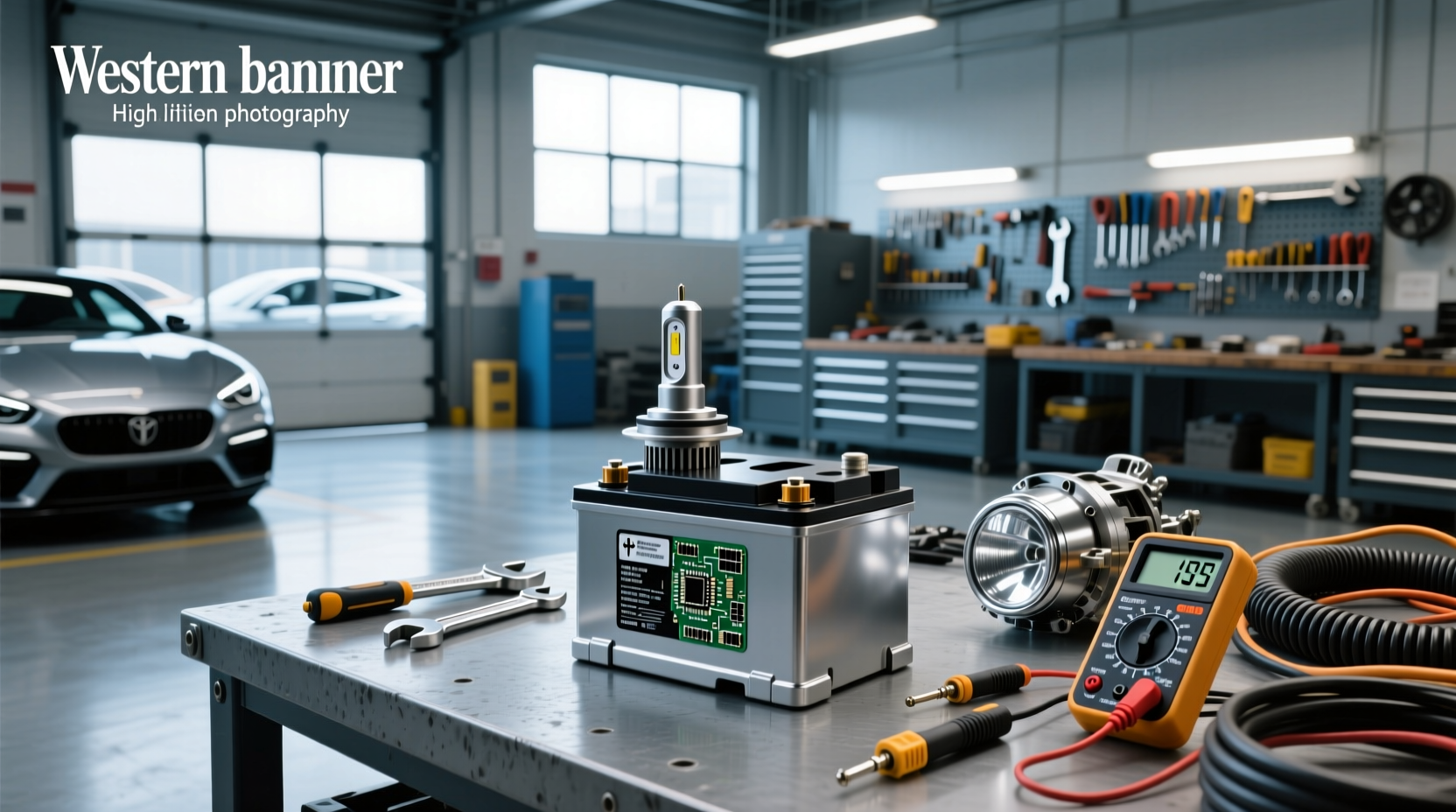
When searching for solutions related to a headlight battery, many users are actually trying to understand whether vehicle headlights rely on the car’s battery, how rechargeable headlamps function, or if standalone LED headlights can operate independently. The term “headlight battery” doesn’t refer to a specific automotive part but rather points to two distinct applications: (1) how a vehicle’s electrical system—including its 12V battery—powers factory-installed headlights, and (2) portable, battery-operated headlamps used for outdoor activities or emergency repairs. This guide clarifies both contexts, explains technical differences between halogen, HID, and LED systems, and helps you choose the right lighting solution based on power source, brightness, durability, and use case.
Understanding Vehicle Headlights and Power Sources
🚗 Most drivers assume that headlights generate light independently, but in reality, all vehicle headlights—whether halogen, HID (High-Intensity Discharge), or LED—are powered by the car’s 12-volt electrical system, which is maintained by the vehicle’s battery and alternator ⚡. When you turn on your headlights, the switch sends a signal through the fuse box to complete the circuit, drawing power from the battery. While the engine runs, the alternator recharges the battery and supplies continuous electricity to keep lights functioning without draining the battery.
This means there's no such thing as a standalone “headlight battery” in modern automobiles. Instead, the entire lighting system relies on integrated wiring connected to the main battery. If the battery fails or the alternator malfunctions, even high-efficiency LED headlights will dim or fail entirely. 🔋 Understanding this relationship is crucial when diagnosing dim lights, flickering beams, or slow startup issues after long periods of inactivity.
Why Battery Health Affects Headlight Performance
A weak or aging car battery can significantly impact headlight performance, especially with energy-sensitive technologies like LED or HID. Unlike older halogen bulbs that tolerate voltage fluctuations better, LEDs require stable current regulation. Low voltage due to a degraded battery may cause:
- Reduced brightness or uneven beam output
- Delayed activation or intermittent operation \li>Fault codes in advanced driver-assistance systems (ADAS) that monitor lighting circuits
🔧 Regular battery testing—especially before winter—is recommended to ensure consistent headlight functionality. Most auto shops offer free battery checks using conductance testers that measure cold cranking amps (CCA) and state of charge.
Portable Headlamps vs. Vehicle Headlights: Key Differences
While vehicle headlights depend on the car’s built-in electrical system, another category of products often searched under “headlight battery” includes rechargeable LED headlamps designed for personal use. These wearable lights are commonly used during camping, hiking, night running, or mechanical repairs where hands-free illumination is essential 🌍.
✅ These devices typically feature:
- Integrated lithium-ion batteries (often USB-rechargeable)
- Brightness levels ranging from 100 to over 1,400 lumens
- Beam modes: spot, flood, strobe, red night vision
- Water-resistant or waterproof designs (IPX4 to IPX7 ratings)
- Adjustable straps and swivel heads for directional control
🛒 Unlike vehicle headlights, these portable units are self-contained systems. They don’t connect to a car battery unless specifically designed for dual use (e.g., some models include 12V adapters). Their internal battery capacity—measured in milliampere-hours (mAh)—determines runtime. For example, a 2,000 mAh battery might power a 300-lumen setting for up to 8 hours.
Rechargeable vs. Disposable Battery Headlamps
When choosing a portable headlamp, one key decision involves power type:
| Feature | Rechargeable Headlamps | Disposable Battery Models |
|---|---|---|
| Power Source | Lithium-ion (built-in) | AA/AAA alkaline or lithium cells |
| Initial Cost | Higher ($20–$90) | Lower ($10–$40) |
| Long-Term Cost | Lower (no replacement batteries) | Higher (ongoing battery purchases) |
| Runtime | Varies by lumen setting; usually 3–10 hrs at max | Can exceed 50+ hours in low mode |
| Environmental Impact | More sustainable | Higher waste generation |
| Emergency Use | Risk of dead battery if not charged | Easier to swap in fresh batteries |
📌 Users in remote areas or those preparing emergency kits often prefer disposable battery models because spare AA/AAA cells are widely available. However, everyday users benefit more from rechargeable options due to convenience and lower total cost of ownership.
LED Headlight Assemblies and Electrical Compatibility
As consumers upgrade from halogen to LED headlights, confusion arises about compatibility with existing vehicle electrical systems. Some aftermarket LED headlight assemblies come with integrated drivers that regulate voltage drawn from the car’s battery, preventing flickering or error messages on digital dashboards.
⚠️ Important: Not all vehicles handle LED upgrades seamlessly. Many newer cars have CANBUS systems that detect changes in wattage draw. Since LEDs consume less power than halogens (e.g., 30W vs. 55W), the vehicle may register a “bulb out” warning even though the light works fine. In such cases, adding resistor harnesses or upgrading to CANBUS-compatible LED bulbs resolves the issue.
🏭 OEM (Original Equipment Manufacturer) LED headlights are engineered to match the vehicle’s exact voltage, amperage, and communication protocols. Aftermarket units vary in quality; look for DOT/SAE certification to ensure road legality and safety compliance.
Do LED Headlights Drain the Car Battery?
A common concern among drivers is whether switching to LED headlights increases parasitic drain or shortens battery life. The truth is the opposite: LEDs consume significantly less power than halogen bulbs.
- Halogen H7 bulb: ~55 watts per unit
- LED equivalent: ~30 watts or less
This reduction means LED headlights place less load on the alternator and reduce overall strain on the battery during nighttime driving. However, leaving any lights on overnight—even efficient LEDs—can still deplete a standard 12V lead-acid battery within 6–12 hours depending on capacity and ambient temperature.
Brightness Metrics: Lumens, Beam Patterns, and Visibility
When evaluating either vehicle headlights or portable headlamps, brightness is measured in lumens, while beam distance and spread are described by beam type (spot, flood, hybrid).
- Under 200 lumens: Suitable for close-range tasks (e.g., reading, minor repairs)
- 200–800 lumens: Ideal for hiking, urban commuting, or basic roadside fixes
- 800–1,600 lumens: High-performance options for trail running, off-roading, or detailed mechanical work
- Over 1,600 lumens: Professional-grade illumination; may require active cooling
🔍 Note that higher lumens don’t always mean better visibility. Poor optics or misaligned beams can create glare without improving usable light. Always consider beam focus and color temperature (measured in Kelvin). Lights around 5,000K–6,000K mimic daylight and provide optimal contrast and clarity.
Water Resistance and Durability Ratings
For both portable headlamps and vehicle-mounted lights, environmental protection matters. Look for IP (Ingress Protection) ratings:
- IPX4: Splash-resistant from any direction
- IPX6: Protected against powerful water jets
- IPX7: Can withstand immersion in 1 meter of water for 30 minutes
🌧️ Outdoor enthusiasts should prioritize IPX7-rated headlamps. For vehicle headlights, sealed housings with rubber gaskets prevent moisture intrusion that could damage internal components or cause condensation.
Common Misconceptions About 'Headlight Battery' Systems
Despite growing awareness, several myths persist:
Myth 1: “A Separate Battery Powers Each Headlight”
No. All factory headlights receive power from the central 12V battery via relays and fuses. There is no individual “headlight battery” installed near each lamp housing.
Myth 2: “Rechargeable Headlamps Last Forever”
While durable, rechargeable lithium-ion batteries degrade over time. After 300–500 charge cycles, capacity drops to about 80% of original. Eventually, the battery must be replaced or the unit retired.
Myth 3: “Higher Lumens Always Mean Better Night Vision”
Excessively bright lights without proper cutoffs cause glare, blinding oncoming drivers. Proper beam alignment and lens clarity matter more than raw output.
Myth 4: “You Can Replace Halogen Bulbs with LEDs Without Modifications”
Some plug-and-play LED kits work, but others trigger errors or fail to focus correctly due to different filament positioning. True retrofitting may require new projectors or reflectors.
Selecting the Right Lighting Solution: Decision Framework
To determine whether you need a vehicle headlight upgrade or a portable battery-powered headlamp, ask:
- Use Case: Are you improving nighttime driving visibility or needing hands-free task lighting?
- Power Access: Will the device be used near a vehicle (with 12V access) or in remote locations?
- Budget: Are you willing to invest upfront for long-term savings (rechargeable) or prefer low initial cost?
- Durability Needs: Do you require waterproofing, shock resistance, or extreme temperature tolerance?
- Regulatory Compliance: Must the light meet DOT, SAE, or FAA standards (for aviation use)?
📋 Based on answers, here’s a quick reference:
- Vehicle Lighting Upgrade → Focus on certified LED assemblies compatible with your make/model.
- Camping/Hiking → Choose lightweight, rechargeable headlamps with 300–800 lumens and IPX6+ rating.
- Emergency Kit → Opt for dual-power models (USB rechargeable + AA backup) or disposable-battery types.
- Mechanical Work → Prioritize adjustable beam angles, high CRI (Color Rendering Index), and red-light mode.
Maintenance Tips for Longevity
Whether dealing with vehicle headlights or portable units, maintenance extends lifespan:
- 🧼 Clean lenses regularly with non-abrasive cleaners to prevent hazing.
- 🔋 Charge rechargeable headlamps every 3–6 months if stored long-term.
- 🔌 Inspect vehicle headlight connectors for corrosion or loose pins.
- 🌡️ Store batteries at room temperature; avoid prolonged exposure to heat or freezing conditions.
- 📎 Update firmware (if applicable) on smart headlamps with Bluetooth connectivity.
Regional Considerations and Legal Standards
Headlight regulations vary globally. In the U.S., headlights must comply with Federal Motor Vehicle Safety Standard (FMVSS) No. 108, administered by NHTSA 1. This includes requirements for beam pattern, intensity, and color. Aftermarket modifications that produce excessive blue-white light (>6,000K) or glare may be illegal in certain states.
In Europe, ECE regulations govern headlight performance and installation. Vehicles equipped with adaptive driving beams (ADB) must meet strict calibration standards to avoid dazzling other drivers.
🌐 Before purchasing any headlight product, verify it carries appropriate certifications for your region. Look for labels such as:
- DOT (U.S.)
- ECE R112 (Europe)
- SAE J1127/J1128 (North America)





 浙公网安备
33010002000092号
浙公网安备
33010002000092号 浙B2-20120091-4