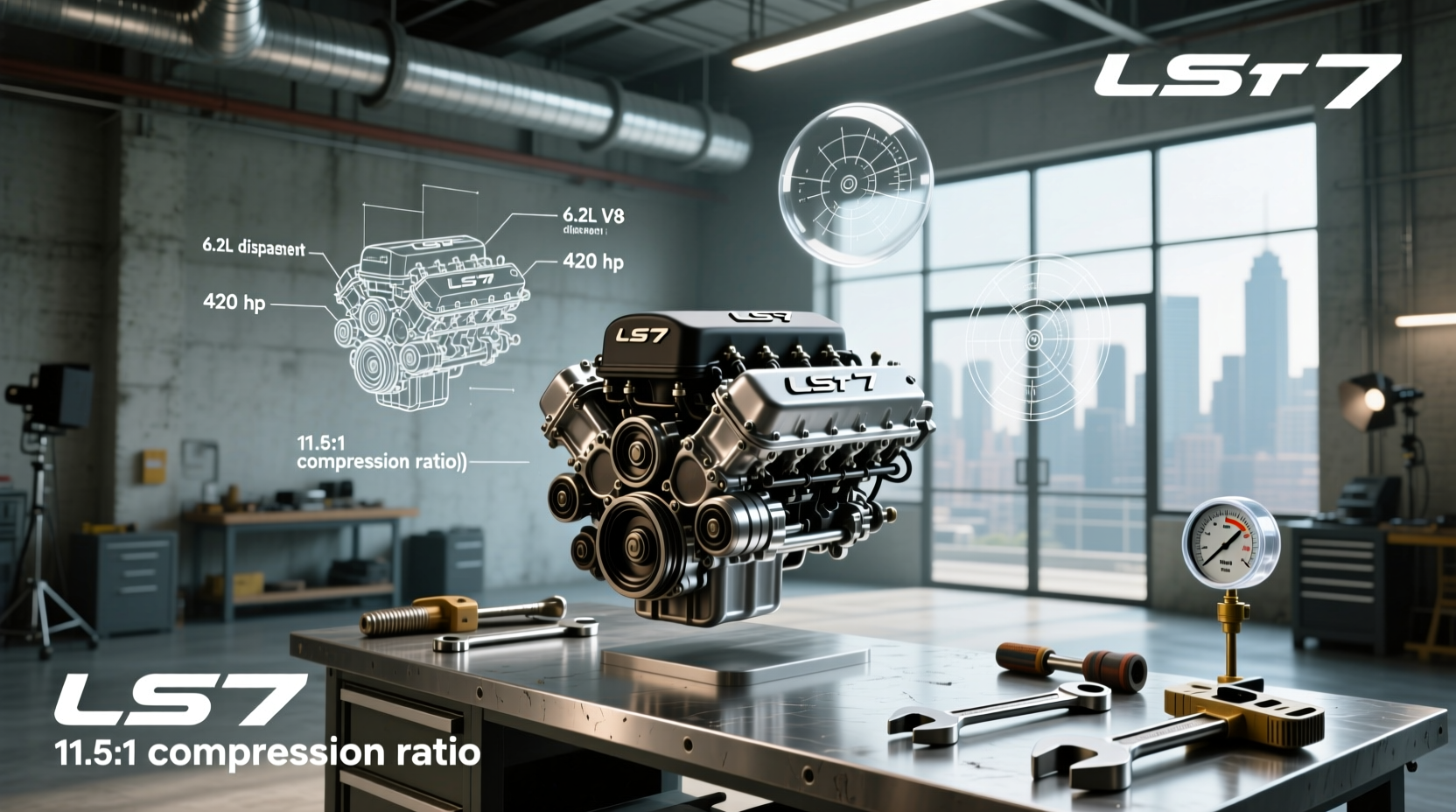
The Chevrolet LS7 engine is a high-performance, naturally aspirated 7.0L (427 cubic inch) V8 that stands out in GM’s LS engine family for its large displacement, hand-built construction, and track-focused engineering ✅. Designed primarily for the C6 Corvette Z06 and later used in the Camaro Z/28, the stock LS7 delivers 505 horsepower and 470 lb-ft of torque ⚡. Its unique features—such as titanium intake valves, forged steel crankshaft, and aluminum block with pressed-in iron sleeves—make it one of the most revered small-block engines in modern American automotive history 🏭. This article breaks down every critical aspect of the LS7 engine specs, from internal components to real-world reliability, helping enthusiasts and builders understand what makes this engine both legendary and complex.
Overview of the LS7 Engine: A High-Revving Powerhouse
Introduced in 2005 for the 2006 model year, the LS7 marked a departure from typical production-based small-blocks by borrowing technology directly from GM’s racing program—the C5-R Le Mans prototype 🌐. Unlike other LS engines derived from passenger car platforms, the LS7 was engineered for maximum power at high RPMs, capable of revving safely up to 7,000 rpm 🔧. It remains the largest-displacement pushrod V8 ever offered in a production Corvette.
As part of the Gen IV LS engine series, the LS7 introduced several innovations not seen before in mass-produced GM engines. These include:
- Aluminum cylinder block with deep skirt design and priority-main oiling system
- Large-bore spacing (4.125 inches) allowing for bigger cylinders than previous LS variants
- Titanium intake valves reducing reciprocating mass for improved valve train stability
- Dry-sump oiling system (in Z06 application) enhancing lubrication during aggressive cornering
- Hydraulic roller camshaft with aggressive profile tuned for top-end power
This combination allows the LS7 to produce impressive specific output—about 72 hp per liter—without forced induction, making it a benchmark for naturally aspirated performance.
Detailed LS7 Engine Specifications
To fully appreciate the engineering behind the LS7, it's essential to examine its core specifications in detail. Below is a comprehensive breakdown of key technical data:
| Specification | Value |
|---|---|
| Engine Family | GM LS Series (Gen IV) |
| Displacement | 7.0L (427 cubic inches) |
| Configuration | 90° V8, OHV, 2 valves per cylinder |
| Bore × Stroke | 4.125 in × 3.622 in (104.8 mm × 92.0 mm) |
| Block Material | 319-T7 cast aluminum with ductile iron main caps |
| Cylinder Liners | Pressed-in wet iron sleeves |
| Head Material | CNC-ported aluminum |
| Valvetrain | Hydraulic roller lifters, stamped rocker arms (1.8:1 ratio) |
| Intake Valves | 2.200 in titanium |
| Exhaust Valves | 1.610 in sodium-filled stainless steel |
| Camshaft Type | Hydraulic roller, flat-plane style profile |
| Lift (Intake/Exhaust) | 0.585 in / 0.570 in |
| Duration @ 0.050" | 211° / 230° |
| Compression Ratio | 10.9:1 |
| Fuel System | Sequential port fuel injection |
| Redline | 7,000 rpm (fuel cutoff at 7,200 rpm) |
| Horsepower (SAE net) | 505 hp @ 7,000 rpm |
| Torque | 470 lb-ft @ 4,800 rpm |
| Oiling System | Dry sump (Corvette Z06), wet sump (crate engines) |
| Weight (dry, approx.) | 475 lbs (aluminum block) |
These specs reflect a deliberate focus on high-RPM efficiency and lightweight internals, distinguishing the LS7 from more street-oriented LS3 or LS2 engines.
Key Design Features That Define the LS7
The LS7 isn’t just about raw displacement; its internal architecture sets it apart from other members of the LS family.
Aluminum Block with Pressed-In Sleeves ⚙️
Unlike earlier LS engines like the LS1 or LS6 that used thin-wall cast iron blocks, the LS7 uses a lightweight 319-T7 aluminum block with deep skirts for increased rigidity. However, due to the large bore size (4.125”), GM opted for pressed-in iron cylinder liners rather than traditional casting methods. While this reduces overall weight, some long-term users have reported concerns about potential sleeve movement under extreme heat or high boost conditions if modified 1.
Titanium Intake Valves and High-Lift Cam
The use of titanium intake valves (2.2”) significantly reduces valve train mass, enabling higher engine speeds without valve float. Combined with a relatively aggressive hydraulic roller camshaft, these components allow the LS7 to breathe efficiently at high RPMs. However, because the valvetrain relies on stamped rocker arms instead of aftermarket-style roller rockers, longevity under sustained high-rpm operation may require upgrades for track use.
Forged Internal Components
The LS7 comes equipped with a forged steel crankshaft, forged powder-metal connecting rods, and hypereutectic pistons. This combination ensures strength and durability even when pushing beyond stock power levels. The crankshaft features six counterweights and is supported by five main bearings, contributing to smooth operation at high engine speeds.
Unique Head Design and Port Flow
The cylinder heads are CNC-ported aluminum units with large ports optimized for airflow above 5,000 rpm. With intake ports flowing over 330 cfm at 0.700” lift, they outperform many aftermarket heads of the era. The exhaust ports also benefit from efficient routing and larger valves, improving scavenging and reducing backpressure.
Applications: What Cars Came With an LS7 Engine?
The LS7 was never widely available across GM’s lineup but reserved for flagship performance models:
- 2006–2013 Chevrolet Corvette Z06: First application of the LS7; featured dry-sump oiling, carbon fiber hood, and aggressive cooling systems.
- 2014–2015 Chevrolet Corvette Stingray Z51 (Crate Engine Option): Available as a dealer-installed performance upgrade.
- 2014–2015 Chevrolet Camaro Z/28: Used in the track-focused Z/28 model with enhanced cooling, suspension, and aerodynamics.
- Chevrolet Performance Crate Engines: Sold separately for restomods, hot rods, and custom builds.
In each case, the LS7 was paired with a six-speed manual transmission (Tremec TR6060), emphasizing driver engagement and mechanical precision.
Performance Potential and Aftermarket Support
While factory-rated at 505 hp, the LS7 has substantial headroom for modification. Due to its strong bottom end and excellent breathing characteristics, many builders report reliable outputs of 650–750 hp with forced induction or nitrous oxide.
Naturally Aspirated Upgrades
For NA builds, common enhancements include:
- High-flow intake manifolds (e.g., FAST EZ-EFI or LS7-specific tunnel rams)
- Long-tube headers with 1¾” to 2” primaries
- Custom camshafts with extended duration for broader power bands
- Port-matched intakes and throttle bodies
With these modifications, peak horsepower can exceed 600 hp while maintaining daily drivability.
Forced Induction and Nitrous Options
Adding a supercharger or turbo system requires careful planning due to the 10.9:1 compression ratio. Most forced-induction builds lower compression via forged pistons (to 9.0:1 or lower) before installing blowers or turbos. With proper tuning, intercooling, and fuel delivery (e.g., dual fuel pumps, E85 conversion), 800+ hp is achievable reliably.
Reliability Considerations When Modifying
Despite its robust design, certain limitations must be addressed:
- Cylinder Sleeve Stability: High cylinder pressures from boost can stress the pressed-in liners. Some builders opt for sonic testing or full sleeves replacement for safety.
- Stock Piston Limitations: Hypereutectic pistons are not ideal for high-boost applications; forged alternatives are recommended.
- Oil System: Dry-sump setup in OEM Z06 improves oil control but adds complexity. Wet-sump crate versions need windage trays and high-volume pumps for track use.
Common Issues and Known Weaknesses ❗
No engine is immune to problems, and the LS7 has a few documented concerns:
Valve Guide Wear and Oil Consumption
One of the most frequently reported issues involves premature wear of the exhaust valve guides, leading to increased oil consumption and smoking under load. This tends to occur after 80,000+ miles, especially in vehicles with poor maintenance histories. The root cause appears to be marginal lubrication design and high operating temperatures. Aftermarket solutions include upgraded bronze valve guides and improved PCV systems.
Sleeve Movement Concerns
Though rare, there have been isolated cases of cylinder sleeve shifting under extreme thermal cycling or detonation events. This risk increases with modifications that raise cylinder pressure significantly. Pre-build inspection using bore scoping or sonic checking is advised for high-performance applications.
Cost of Repairs and Parts Availability
Due to its low production volume and specialized nature, OEM LS7 parts (especially cylinder heads and blocks) can be expensive and hard to source. Reconditioned cores often sell for $5,000+, and complete long blocks from reputable builders range from $15,000 to $25,000 depending on configuration.
How the LS7 Compares to Other LS Engines
Understanding where the LS7 fits within the broader LS family helps contextualize its strengths and trade-offs.
| Engine | Displacement | Horsepower | Block Type | Best For |
|---|---|---|---|---|
| LS7 | 7.0L (427ci) | 505 hp | Aluminum w/sleeves | Track, high-RPM performance |
| LS3 | 6.2L (376ci) | 430 hp | Aluminum | Street performance, affordability |
| LS1 | 5.7L (346ci) | 345 hp | Cast iron/aluminum | Restomods, budget swaps |
| LQ4 | 6.0L (364ci) | 300 hp | Cast iron | Trucks, towing, durability |
| LSX (aftermarket) | Up to 8.0L | 700+ hp | Cast iron/aluminum | Race, extreme builds |
The LS7 excels in high-RPM responsiveness and specific output but comes at a premium cost and complexity compared to more common LS3 or LQ4 engines.
Buying a Used LS7: What to Look For
If considering a used LS7—whether in a vehicle or as a crate engine—inspect the following:
- Maintenance History: Verify regular oil changes and coolant flushes.
- Compression and Leakdown Test Results: Should show consistent readings across all cylinders.
- Signs of Oil Burning or Smoking: Could indicate valve guide wear.
- Presence of Modifications: Aftermarket turbos or nitrous without supporting upgrades may compromise longevity.
- Core Condition: Check for cracks, sleeve movement, or overheating damage.
Rebuilding an LS7 should only be done by specialists familiar with its nuances, given the precision required in aligning sleeves and setting clearances.
Frequently Asked Questions About the LS7 Engine
- Is the LS7 a 427 cubic inch engine?
- Yes, the LS7 has a displacement of exactly 427 cubic inches (7.0 liters), reviving the classic '427' designation used in 1960s Corvettes and muscle cars.
- How much horsepower does a stock LS7 make?
- A stock LS7 produces 505 horsepower at 7,000 rpm and 470 lb-ft of torque at 4,800 rpm, as rated by GM for the Corvette Z06 application.
- What cars came with an LS7 engine?
- The LS7 was factory-installed in the 2006–2013 Chevrolet Corvette Z06 and the 2014–2015 Camaro Z/28. It was also available as a crate engine through Chevrolet Performance.
- Are LS7 engines reliable?
- The LS7 is generally reliable when maintained properly, though some models exhibit exhaust valve guide wear after high mileage. Modified versions require additional safeguards like forged internals and proper cooling.
- Can you swap an LS7 into another vehicle?
- Yes, the LS7 can be swapped into various platforms using compatible mounts, wiring harnesses, and transmissions. However, its width and dry-sump requirement (in OEM form) add complexity compared to smaller LS engines.





 浙公网安备
33010002000092号
浙公网安备
33010002000092号 浙B2-20120091-4