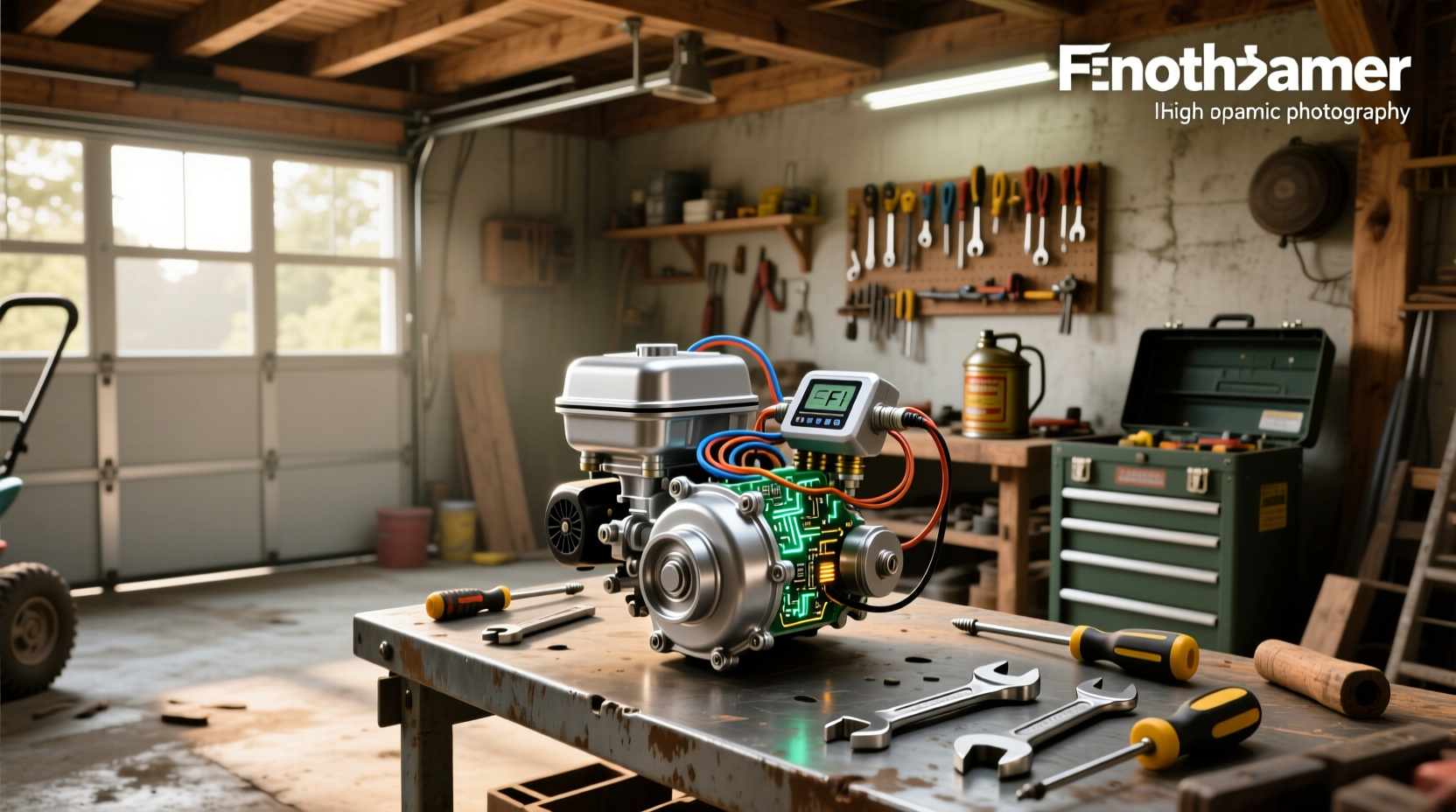
Upgrading from a carburetor to a small engine EFI kit can significantly improve fuel efficiency, cold-start performance, and throttle response—especially in engines ranging from 35cc to 800cc used in motorcycles, ATVs, go-karts, and lawn equipment. Electronic Fuel Injection (EFI) systems deliver precise fuel metering by using sensors and an ECU to adjust air-fuel ratios in real time, unlike carburetors that rely on mechanical settings and atmospheric conditions 1. This guide breaks down everything you need to know before purchasing or installing an EFI conversion system, including compatibility, cost factors, technical requirements, and common pitfalls to avoid.
What Is a Small Engine EFI Kit?
An electronic fuel injection (EFI) kit for small engines is a complete system designed to replace traditional carburetors with a modern, computer-controlled fuel delivery mechanism. These kits typically include fuel injectors, an electronic control unit (ECU), throttle body, sensors (such as MAP, TPS, IAT, and O2), a high-pressure fuel pump, wiring harness, and mounting hardware. The primary purpose is to optimize combustion efficiency across varying load and temperature conditions.
Unlike carburetors, which mix air and fuel based on vacuum and jet sizing, EFI systems use sensor inputs to calculate the ideal fuel pulse width and timing. This results in smoother idling, better acceleration, lower emissions, and improved reliability—particularly in cold weather or at high altitudes where carburetors often struggle.
Why Convert to EFI? Key Benefits Explained
There are several compelling reasons to consider upgrading to a small engine EFI system:
- Fuel Efficiency: Precise fuel metering reduces waste, leading to measurable improvements in miles per gallon compared to carbureted setups.
- Better Cold Starts: EFI eliminates the need for choking or priming, delivering consistent starts even in sub-zero temperatures.
- Improved Throttle Response: Instantaneous adjustments to airflow and fuel delivery result in more linear power delivery.
- Reduced Maintenance: No float bowls, jets, or diaphragms to clean or replace; fewer issues with varnish buildup from stale gasoline.
- Altitude Compensation: Sensors automatically adjust mixture strength when operating at higher elevations.
- Emissions Compliance: Many regions now require low-emission operation for off-road and recreational vehicles—EFI helps meet these standards.
For DIY enthusiasts working on custom builds like electric bike conversions or performance-enhanced scooters, adding an EFI system not only improves drivability but also adds a level of technological sophistication that supports future tuning and diagnostics.
Common Applications for Small Engine EFI Kits
While originally developed for automotive and motorcycle use, EFI technology has been adapted for smaller displacement engines. Typical applications include:
| Application | Engine Size Range | Typical Use Case |
|---|---|---|
| Motorcycles & Scooters | 50cc – 800cc | Performance upgrades, vintage restoration, racing |
| Go-Karts & Mini-Bikes | 100cc – 300cc | Racing, youth training, backyard fun |
| ATVs & UTVs | 250cc – 600cc | Off-road recreation, farm utility |
| Lawn Equipment (Zero-Turn Mowers) | 400cc – 800cc | Commercial landscaping, long runtime demands |
| Marine Outboards (Small) | 90cc – 250cc | Trolling motors, auxiliary propulsion |
Manufacturers like Kawasaki Engines USA have already integrated factory EFI into commercial-grade lawn mowers and industrial equipment due to the operational advantages under continuous load and variable ambient conditions 1.
Types of EFI Systems Available for Small Engines
Not all EFI kits are created equal. Understanding the differences between system types will help you choose one suited to your needs:
Throttle Body Injection (TBI)
Also known as single-point injection, TBI places the injector(s) above the throttle body, similar to how a carburetor mounts. It's simpler and less expensive than multi-port systems but offers less precision since fuel must travel through the intake manifold before reaching cylinders.
Multi-Port Fuel Injection (MPFI)
In MPFI systems, each cylinder has its own dedicated injector located near the intake valve. This allows for better atomization and timing control, resulting in superior performance and efficiency—ideal for high-revving or modified engines.
Direct Injection (DI)
Rare in small engines due to complexity and cost, DI sprays fuel directly into the combustion chamber. While offering maximum efficiency and power density, it requires advanced ECUs and higher fuel pressure pumps, making it impractical for most aftermarket conversions.
Standalone vs Piggyback ECUs
- Standalone ECU: Fully replaces stock management; gives full tunability. Best for custom builds without existing engine computers.
- Piggyback ECU: Modifies signals from an existing ECU rather than replacing it. Limited flexibility but easier integration in some OEM-based platforms.
Compatibility: Will an EFI Kit Work With Your Engine?
Before purchasing any motorcycle EFI conversion kit or universal small engine setup, verify compatibility with your specific engine model. Key factors include:
- Number of Cylinders: Most kits are designed for single-cylinder engines (common in go-karts, scooters, generators). Four-cylinder motorcycle EFI conversion kits exist but are rarer and more complex.
- Intake Manifold Design: You’ll need space to mount a throttle body and possibly modify the intake tract.
- Electrical System: EFI requires a stable 12V supply and sufficient charging capacity. Engines with magneto-only ignition may need alternator upgrades.
- Physical Space: Fuel rails, injectors, and sensors take up room. Compact engines (e.g., chainsaws, leaf blowers) usually aren’t viable candidates.
- Fuel Type: Ensure the kit supports gasoline (most do); some support ethanol blends up to E10 or E85 if components are compatible.
Some kits, such as those offered by Ecotrons, explicitly list supported engine models and displacement ranges (e.g., 35cc–300cc or 400cc–800cc), helping narrow choices 2.
Installation Process: What to Expect
Installing a small engine EFI kit is not plug-and-play for most users. It involves both mechanical and electrical work:
- Remove Carburetor: Disconnect linkages, fuel lines, and air cleaner. Unbolt and remove the old carb.
- Install Throttle Body: Mount the new throttle body onto the intake using appropriate gaskets/adapters.
- Mount Injectors & Fuel Rail: Position injectors so they spray toward intake valves (in MPFI) or into the plenum (in TBI).
- Install Sensors: Attach MAP (manifold pressure), TPS (throttle position), coolant temp, and O2 sensors as required.
- Wiring Harness Setup: Connect all sensors, injectors, idle air control valve, and ECU. Route wires safely away from heat sources.
- Fuel System Upgrade: Install a return-style fuel pump capable of 40–60 psi (vs ~5 psi for carburetors). A fuel pressure regulator and filter are essential.
- ECU Configuration: Load base calibration maps. Some kits come pre-tuned; others require manual tuning via software.
- Testing & Tuning: Start the engine and monitor for leaks, misfires, or error codes. Fine-tune air-fuel ratio using feedback from a wideband O2 sensor.
⏱️ Time estimate: 8–20 hours depending on experience and engine accessibility.
Cost Considerations and Budget Planning
Prices for small engine EFI kits vary widely based on features and engine size:
- Basic single-cylinder kits: $200–$500
- Mid-range systems with standalone ECU: $600–$1,200
- High-end race-oriented kits (e.g., RB Racing): $1,500+
Additional costs may include:
- Fuel pump upgrade: $80–$150
- Wideband O2 sensor and gauge: $200–$400
- Custom fabrication (brackets, adapters): $100–$300
- Tuning software/license: $100–$300
Total project cost can reach $2,000+ for fully optimized installations. However, budget-friendly entry-level kits are available for hobbyists testing the concept.
Common Challenges and How to Avoid Them
Despite the benefits, EFI conversions carry risks if not done properly:
- Incorrect Sensor Calibration: Misaligned TPS or faulty MAP readings can cause stalling or rich/lean conditions. Always calibrate sensors after installation.
- Insufficient Fuel Pressure: Using a low-pressure pump meant for carburetors leads to lean running and engine damage.
- Voltage Drops: Poor grounding or undersized wiring causes erratic ECU behavior. Use proper gauge wire and clean connections.
- Lack of Tuning Knowledge: Without access to tuning software or experience, achieving optimal performance is difficult. Look for kits with preloaded maps or community support.
- Water Intrusion: Exposed electronics (ECU, connectors) should be sealed or relocated to dry areas, especially on off-road machines.
EFI vs Carburetor: A Practical Comparison
While many still swear by carburetors for simplicity, EFI outperforms them in nearly every functional category:
| Factor | Carburetor | EFI |
|---|---|---|
| Fuel Efficiency | Moderate | ✅ High |
| Cold Starting | ❌ Requires choke | ✅ Instant start |
| Altitude Adjustment | Manual re-jetting needed | ✅ Automatic |
| Maintenance Frequency | Every few months | ✅ Minimal |
| Tuning Flexibility | Limited (jet changes) | ✅ Real-time adjustments |
| Initial Cost | ✅ Low | Higher |
| Durability in Storage | Prone to gumming | ✅ Resistant |
The main disadvantage of EFI remains complexity and upfront cost. But for anyone relying on consistent performance—especially in variable environments—the long-term advantages outweigh initial hurdles.
Where to Buy Reliable Small Engine EFI Kits
Kits are available from specialty suppliers focused on performance and conversion markets:
- Ecotrons: Offers kits tailored for 35cc–800cc engines with clear documentation and customer support.
- RB Racing: Known for high-performance motorcycle EFI systems with proprietary software and durable components 3.
- RevZilla: Sells branded EFI upgrade parts and kits for popular motorcycle models.
- Online Marketplaces: Platforms like Alibaba.com list numerous manufacturers offering universal EFI kits at competitive prices, though vetting quality is critical.
When shopping, prioritize vendors who provide:
- Detailed installation guides
- Accessible technical support
- Community forums or user groups
- Warranty and return policies
Final Tips Before Converting
Before committing to an EFI conversion, ask yourself:
- Do I have basic mechanical and electrical skills?
- Is my engine’s electrical system robust enough?
- Am I prepared to invest time in tuning and troubleshooting?
- Will this add value to my use case (e.g., daily rider vs show bike)?
If you're uncertain, consider starting with a simpler kit on a secondary machine. Alternatively, consult with experienced builders in forums or local clubs to assess feasibility.
Frequently Asked Questions (FAQ)
Can I install a small engine EFI kit myself?
Yes, if you have intermediate mechanical and electrical knowledge. You’ll need tools for fuel line routing, wiring, and sensor mounting. Software tuning adds another layer of complexity, so look for kits with pre-programmed maps if you’re not experienced.
Are EFI kits legal for street use?
In most cases, yes—but only if the kit is EPA-certified or CARB-compliant for your region. Non-certified systems may pass visual inspection but could fail emissions testing. Always check local regulations before registering a converted vehicle.
Do EFI systems work with ethanol-blended fuels?
Most modern EFI components tolerate E10 (10% ethanol). For higher blends like E85, ensure the kit uses alcohol-resistant materials (viton seals, stainless steel rails). Otherwise, corrosion and seal degradation can occur over time.
How do I tune an EFI system after installation?
Tuning involves adjusting fuel maps via software connected to the ECU. Use a wideband O2 sensor to monitor air-fuel ratio under different loads. Start with manufacturer-provided base maps, then refine idle, part-throttle, and WOT (wide-open throttle) zones incrementally.
Can I revert back to a carburetor later?
Yes, though it may require sourcing original parts or adapters. Keep your old carburetor and intake manifold in case you want to switch back due to reliability concerns or tuning difficulties.





 浙公网安备
33010002000092号
浙公网安备
33010002000092号 浙B2-20120091-4