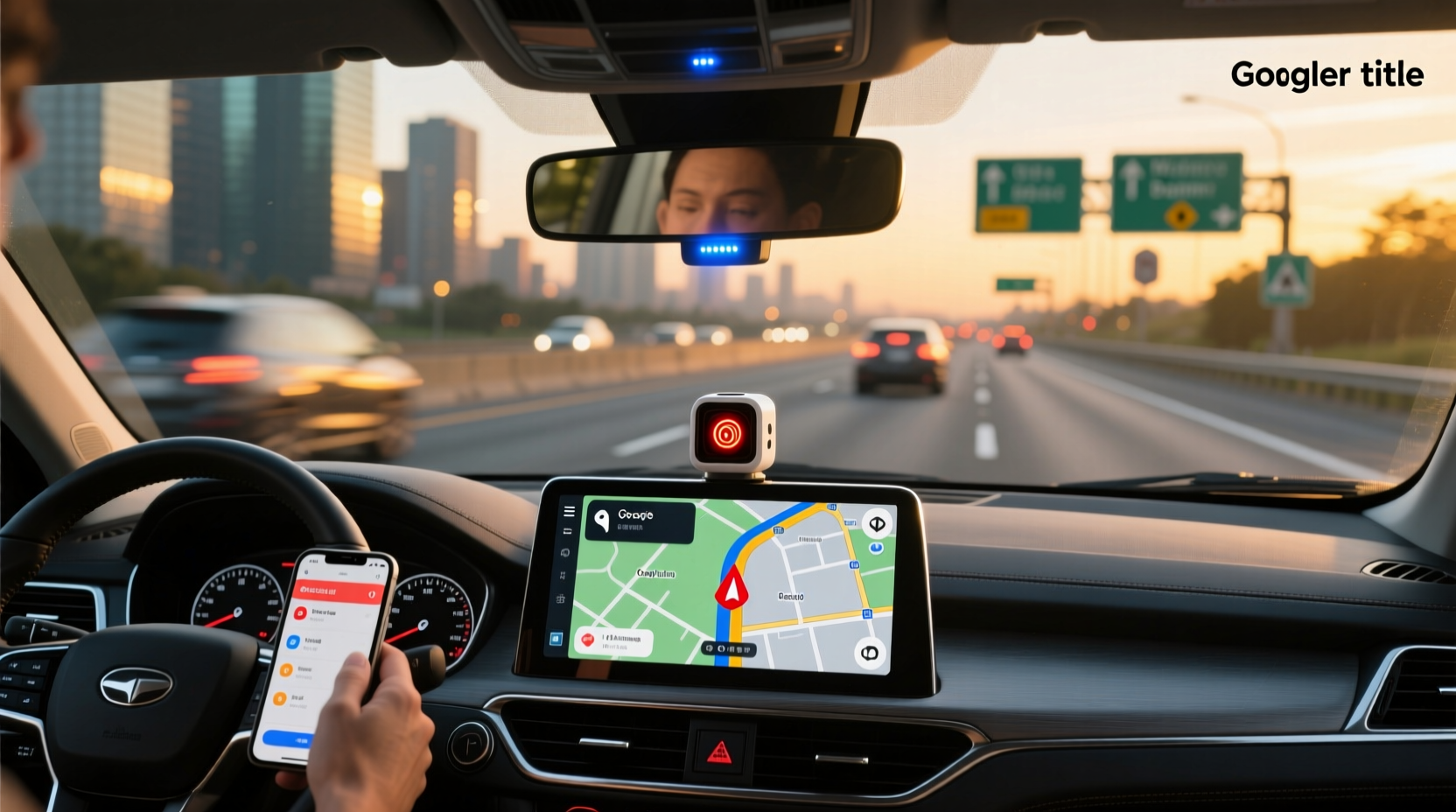
Google Maps can display speed camera locations and red light cameras in select countries using community-reported data and official sources, but it does not actively detect radar or laser signals like a physical speed camera detector. This means while speed camera detector Google Maps integration offers basic hazard awareness, it lacks real-time detection capabilities for mobile enforcement units or unmarked zones. For drivers seeking proactive alerts beyond static database entries, understanding the differences between app-based warnings and hardware detectors is essential.
How Google Maps Shows Speed Camera Alerts
📍 Google Maps provides speed camera notifications as part of its navigation interface when enabled. These alerts appear on the map and through voice prompts when approaching known fixed or mobile speed enforcement locations. The feature relies on two primary data sources: user-submitted reports via the app’s ‘Report’ function and government or third-party databases where available.
To activate these alerts:
- Open Google Maps on your smartphone
- Start turn-by-turn navigation
- Tap the settings icon (⚙️) during navigation
- Select “Driving options”
- Ensure “Speed limits,” “Speed cameras,” and “Red light cameras” are toggled on
Once configured, Google Maps will warn users approximately 500–800 feet before reaching a reported speed trap, depending on road conditions and speed. However, this system only works if the camera location has been previously logged in the database or reported by another user in near real time.
Limitations of Relying Solely on Google Maps for Speed Awareness
While convenient, depending exclusively on Google Maps for speed enforcement alerts comes with significant drawbacks that affect reliability and safety.
Data Accuracy Varies by Region
🌐 The availability and precision of speed camera data in Google Maps differ widely across countries. In regions like the UK, Germany, and Australia, coverage is relatively robust due to active user communities and public data sharing agreements. In contrast, rural areas or countries with limited crowd-sourced reporting—such as parts of Eastern Europe or Southeast Asia—may have outdated or missing entries.
A study conducted by Car and Driver noted that Google Maps missed over 30% of active mobile speed traps during a cross-state test drive in the U.S., primarily because enforcement vehicles were not stationary or recently reported 1.
No Real-Time Radar or Laser Detection
⚡ Unlike dedicated radar detectors, Google Maps cannot sense active police radar guns (K-band, Ka-band, or X-band) or LIDAR used for speed measurement. This creates a critical blind spot when encountering unreported mobile patrols, especially those operating from hidden positions such as highway overpasses or side roads.
For example, an officer using a hand-held radar gun in a construction zone may not trigger any alert in Google Maps unless someone else reports them immediately—a delay that often renders the warning ineffective.
Dependence on Internet Connectivity
🔗 Google Maps requires a stable internet connection to fetch updated traffic and hazard data. In remote areas with poor cellular coverage—such as mountain passes or desert highways—the app may fail to load new reports or update existing ones. Offline maps do not include dynamic speed camera alerts unless pre-downloaded with embedded data, which quickly becomes stale.
Limited Update Frequency
⏱️ Even in well-covered areas, there can be delays between when a mobile unit is deployed and when it appears on the map. User-generated reports depend on timely input, and automated systems may take hours to verify and publish changes. This lag reduces effectiveness compared to instant signal detection offered by hardware devices.
What Is a Dedicated Speed Camera Detector?
🔧 A dedicated speed camera detector is a standalone electronic device mounted inside a vehicle that uses GPS and/or radio frequency (RF) sensors to identify potential speed enforcement zones. There are two main types:
- GPS-Based Detectors: These rely on preloaded or cloud-updated databases of fixed camera locations (e.g., red light cameras, average speed check zones). They provide alerts based on geographic coordinates but cannot detect unplanned or mobile units.
- Radar/Laser Detectors: These actively scan for radar and laser emissions from police speed guns. High-end models combine GPS mapping with live RF detection for comprehensive coverage.
Some advanced units also offer Bluetooth connectivity to sync with smartphone apps, enabling live updates from crowd-sourced networks similar to Waze or Radarbot.
Comparing Google Maps vs. Dedicated Detectors
To help clarify the trade-offs, here's a detailed comparison of key performance factors:
| Feature | Google Maps | Dedicated Detector |
|---|---|---|
| Real-time radar detection | ❌ No | ✅ Yes (on radar-capable models) |
| Mobile speed trap alerts | 🟡 Only if reported | ✅ Yes (via user network or direct detection) |
| Offline functionality | 🟡 Limited (requires pre-loaded data) | ✅ Full (with GPS database) |
| Installation effort | ✅ None (app-based) | 🔧 Moderate (mounting, power wiring) |
| Cost | ✅ Free | 💰 $100–$900+ |
| Data freshness | 🟡 Variable | ✅ Regularly updated via app/cloud |
| False alerts | ✅ Low | 🟡 Moderate to high (depending on model/filtering) |
When Google Maps Is Sufficient
✅ For casual city driving or occasional trips on familiar routes, Google Maps may provide adequate advance notice of common speed enforcement points. Drivers who prioritize simplicity and cost-effectiveness without needing real-time threat detection can rely on it as a supplementary tool.
When You Need a Hardware Detector
❗ Frequent highway travelers, long-distance commuters, or those driving in areas with aggressive speed enforcement should consider investing in a combined GPS and radar detector. These devices offer faster response times, broader detection ranges (up to several thousand feet), and immunity to connectivity issues.
Legal Considerations by Country
🌍 Laws regarding speed camera detectors vary significantly worldwide. While using Google Maps for speed camera alerts is generally legal, possessing active radar-detecting hardware may be restricted or prohibited in certain jurisdictions.
- United States: Legal in most states except Virginia and Washington D.C., where radar detectors are banned. Commercial vehicles are prohibited from using them under federal law.
- Canada: Illegal in Ontario, Quebec, and Manitoba; permitted elsewhere with restrictions.
- Europe: Banned in France, Germany (if obstructing view), Belgium, and Austria. Permitted in the UK, Spain, and Italy with caveats.
- Australia: Illegal in all states except Western Australia for non-commercial vehicles.
Always verify local regulations before installing or using any detection device. Violations can result in fines, confiscation, or penalties.
Improving Alert Accuracy: Tips for Users
Whether relying on Google Maps or combining it with other tools, users can enhance alert reliability through proactive habits.
Contribute to Crowd-Sourced Data
📌 While navigating, use the “Report” feature in Google Maps to mark active speed cameras or mobile units. Tap the blue “+” icon > “Add a report” > “Speed camera.” Accurate submissions improve collective awareness and benefit future drivers.
Combine Tools for Maximum Coverage
✨ Many drivers use both Google Maps and specialized apps like Waze or Radarbot simultaneously. Some premium radar detectors even integrate with Android Auto or Apple CarPlay to overlay alerts directly onto navigation screens.
However, running multiple location services can drain battery life and cause interface clutter. Test combinations carefully to ensure usability isn’t compromised.
Regularly Update Detector Databases
🔄 If using a GPS-based detector or app, ensure firmware and camera databases are updated monthly. Outdated lists increase the risk of missed alerts, especially in cities where enforcement patterns change frequently.
Common Misconceptions About Speed Camera Detection
Several myths persist about what these systems can and cannot do. Clarifying them helps set realistic expectations.
Misconception 1: “All Speed Cameras Are Detected Automatically”
🔍 Neither Google Maps nor most detectors can identify every type of enforcement method. Average speed cameras (like SPECS or VECTOR systems) measure travel time over distance and leave no detectable signal. Alerts for these rely entirely on mapped entry and exit points.
Misconception 2: “Detectors Prevent Tickets”
🚫 No device guarantees immunity from speeding tickets. Their purpose is driver awareness, not evasion. Overreliance on alerts can lead to complacency, increasing accident risks.
Misconception 3: “Mobile Cameras Can’t Be Tracked”
📋 Mobile speed vans are often parked in predictable locations (e.g., school zones, accident-prone curves). Crowd-sourced platforms frequently log recurring spots, making them partially predictable despite mobility.
Alternatives to Google Maps for Speed Alerts
While Google Maps offers built-in functionality, alternative apps provide enhanced features tailored specifically for driver safety and compliance.
Waze
🛒 Waze operates on a hyper-local crowd-sourcing model, allowing users to report speed traps in real time. Its interface emphasizes community interaction and often delivers faster updates than Google Maps. However, it reroutes more aggressively and may encourage risky maneuvers.
Radarbot
📱 Available on iOS and Android, Radarbot combines GPS-based camera databases with real-time user alerts. It supports custom vehicle profiles (cars, motorcycles, trucks) and includes offline maps. Premium versions offer voice guidance and automatic database syncing.
Dedicated Devices with App Integration
🔧 Brands like Escort and Uniden offer radar detectors that pair with companion apps to deliver hybrid alerts—blending live radar detection with crowd-sourced data. These systems typically outperform standalone apps in responsiveness and range.
Final Recommendations: Choosing the Right Solution
Selecting between Google Maps and dedicated solutions depends on driving patterns, legal environment, and personal risk tolerance.
- Urban Commuters: Google Maps or Waze alone may suffice, especially in cities with transparent enforcement policies.
- Highway Drivers: Consider a mid-tier GPS/radar detector for early warnings on open roads where patrol cars operate at long range.
- International Travelers: Research local laws first. In restricted countries, rely solely on navigation apps and obey posted limits.
- Fleet Operators: Avoid radar detectors entirely due to regulatory restrictions. Focus on telematics and driver training instead.
Ultimately, no technology replaces attentive driving and adherence to posted speed limits. Use these tools as supplemental aids—not substitutes—for responsible behavior behind the wheel.
Frequently Asked Questions
- Can Google Maps detect mobile speed cameras?
- Google Maps can show mobile speed camera locations only if they have been recently reported by users or included in official datasets. It does not actively detect radar or laser signals from mobile units.
- Is it legal to use a speed camera detector with Google Maps?
- Using Google Maps for speed camera alerts is legal in most countries. However, pairing it with a radar-detecting device may violate laws in regions like France, Germany, or Canada, where such hardware is banned.
- Do I need a radar detector if I use Google Maps?
- It depends on your driving environment. For daily commuting in urban areas, Google Maps may be sufficient. For frequent highway travel or areas with hidden enforcement, a radar detector adds valuable real-time protection.
- Why doesn’t Google Maps show speed cameras in my country?
- Availability depends on data partnerships and user contributions. Countries with low user engagement or government restrictions may lack comprehensive coverage. Check Google’s official support page for regional feature availability.
- How accurate are speed camera alerts on Google Maps?
- Accuracy varies by region. In well-mapped areas, success rates exceed 70%, but false negatives occur regularly, especially with temporary or mobile setups. Always remain cautious even when no alert appears.





 浙公网安备
33010002000092号
浙公网安备
33010002000092号 浙B2-20120091-4