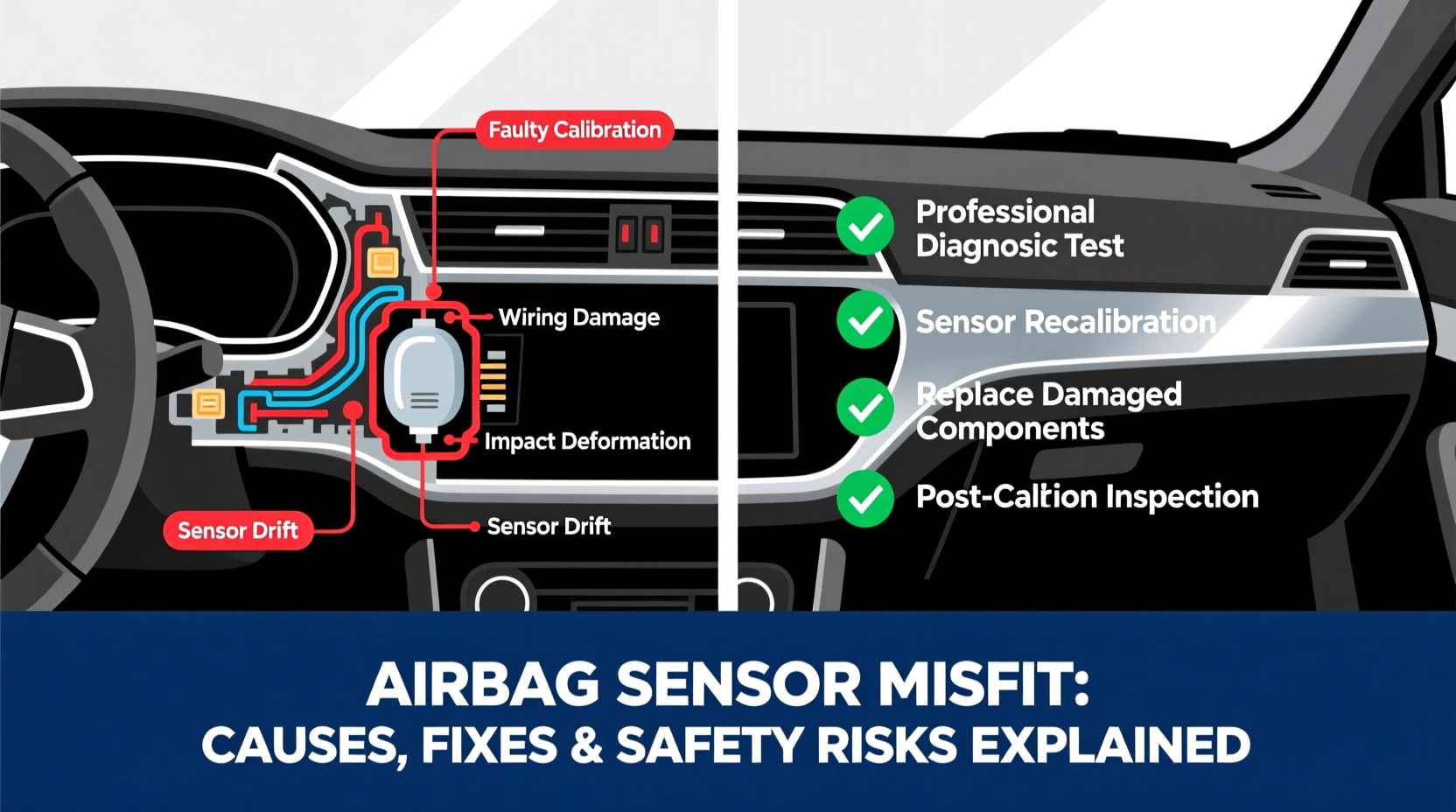
When you encounter an airbag sensor misfit—such as a non-OEM airbag crash sensor incorrectly seated, physically incompatible with the mounting bracket, or electrically mismatched to your vehicle’s SRS architecture—the result isn’t just a warning light: it’s a potentially life-threatening failure point in your supplemental restraint system. This precise condition—often misdiagnosed as a generic 'SRS fault'—means the airbag control module cannot reliably interpret crash data, leading to non-deployment during a collision or, worse, unintended deployment while driving. In this guide, we explain exactly what constitutes an airbag sensor misfit, why it happens (including common OEM-specific compatibility pitfalls), how to verify correct fitment using VIN-locked part numbers and wiring harness pinouts, and step-by-step diagnostic protocols trusted by ASE-certified technicians—not mechanics relying on generic scan tools.
What Exactly Is an Airbag Sensor Misfit?
An airbag sensor misfit is not a vague error code—it’s a tangible hardware or configuration mismatch affecting one or more of three critical dimensions: mechanical fit, electrical interface, and software calibration. Unlike a faulty sensor, which may fail outright, a misfit sensor often powers up and communicates—but delivers corrupted, delayed, or nonsensical acceleration data to the airbag control unit (ACU). For example, installing a 2018 Honda Civic front impact sensor into a 2020 model may appear physically identical and plug in seamlessly, yet its internal threshold algorithm differs by ±12%—a deviation sufficient to suppress deployment in a 35 mph frontal offset crash per NHTSA FMVSS 208 test protocols.
This issue falls under the broader category of SRS component incompatibility, but 'misfit' specifically denotes physical or electrical incompatibility that escapes basic OBD-II diagnostics. It’s frequently encountered during post-collision repairs, DIY replacements, or use of aftermarket sensors lacking OEM-level flash programming capability.
Why Does an Airbag Sensor Misfit Happen? Root Causes Unpacked
Understanding root causes helps prevent recurrence—and avoids costly rework. Here are the five most frequent contributors:
- VIN-Specific Calibration Requirements: Modern ACUs store unique calibration coefficients tied to the vehicle’s VIN. A sensor from another VIN—even same-year, same-model—may lack matching crash pulse profiles. Toyota’s SRS ECU, for instance, cross-references sensor ID, production week, and body structure rigidity parameters before accepting input.
- Mounting Bracket Geometry Shifts: Between model years, OEMs subtly alter bracket depth, bolt hole spacing, or sensor orientation angle (e.g., GM’s 2016–2019 Malibu transitioned from ±4° to ±1.5° axial tolerance). A sensor that ‘fits’ may sit at a 0.8° cant—introducing consistent bias in lateral G-force readings.
- Wiring Harness Pinout Variants: Identical-looking connectors may swap pins 3 and 5 between generations. While voltage checks pass, CAN bus arbitration fails silently—causing intermittent 'no signal' faults only under vibration or thermal stress.
- Firmware Version Mismatches: Sensors contain embedded microcontrollers. A 2021 Ford F-150 sensor flashed with v2.1 firmware won’t handshake with an ACU expecting v2.3—even if part numbers match. No DTC may appear until crash simulation.
- Aftermarket Sensor Limitations: Many third-party units omit dual-axis sensing or temperature-compensated MEMS elements. They may pass resistance tests but fail dynamic validation—verified only via oscilloscope waveform analysis of analog output during controlled deceleration.
How to Confirm an Airbag Sensor Misfit (Not Just a Fault)
Diagnosis requires moving beyond code readers. Follow this technician-validated workflow:
- Verify OEM Part Number Match: Cross-reference your VIN with the OEM parts catalog (e.g., Helm Online for GM, TechInfo for Toyota). Never rely solely on chassis code (e.g., 'CR-V LX')—use full 17-digit VIN lookup. Example: Honda part #77960-T2A-A01 fits 2017–2018 CR-V EX-L, but not 2018 CR-V Touring (requires #77960-T2A-A11).
- Inspect Physical Mounting: Measure sensor-to-bracket gap with a feeler gauge. OEM spec tolerances range from 0.05–0.15 mm. Any gap >0.2 mm indicates incorrect bracket or sensor housing deformation.
- Validate Electrical Interface: Use a multimeter to check continuity between sensor pins and corresponding ACU pins per factory wiring diagram. Pay special attention to shield ground continuity—broken shields cause noise-induced false triggers.
- Perform Live Data Stream Analysis: With a bidirectional scan tool (e.g., Autel MaxiCOM MK908), monitor real-time X/Y/Z axis G-force values at idle and during gentle braking. Values should remain stable within ±0.02G. Drift >±0.05G suggests mechanical misalignment or internal calibration drift.
- Conduct Static Calibration Verification: Some ACUs (e.g., BMW F-series) require a static zero-point calibration after sensor replacement. Skipping this step creates a persistent baseline offset—functionally identical to a misfit.
OEM-Specific Airbag Sensor Compatibility Realities
There is no universal standard. Key regional and manufacturer differences include:
| OEM | Misfit Risk Trigger | Verification Tool Required | Notes |
|---|---|---|---|
| Toyota/Lexus | VIN-dependent sensor revision level (e.g., A1 vs. B2) | Techstream + subscription to TIS | Sensors contain encrypted calibration tables; reflashing requires dealer-level access. |
| BMW/MINI | Missing ISTA+ guided calibration sequence | ISTA D or EVO | Static calibration must complete before ACU clears readiness flags—even if no DTC present. |
| Ford | Using non-Ford Motorcraft sensors without FORScan firmware sync | FORScan Lite + extended license | Aftermarket sensors require manual PID mapping; default settings cause false 'sensor open circuit' reports. |
| Hyundai/Kia | Incorrect harness revision (e.g., 2020+ models use twisted-pair CAN FD) | GDS2 + live data graphing | Older harnesses induce timing skew >50μs—enough to corrupt safety-critical message CRC. |
Always consult your vehicle’s specific service manual—not generic repair databases—for torque specs (e.g., Toyota specifies 9.5 ±0.5 N·m; overtightening deforms piezoresistive elements) and grounding requirements (some sensors require dedicated chassis ground separate from battery negative).
Can You Fix an Airbag Sensor Misfit Yourself?
In limited cases—yes—but only if you meet all three criteria: (1) You own a factory-level scan tool with bidirectional control and calibration functions; (2) You’ve verified exact part number match using VIN-locked OEM sources; and (3) You possess torque-controlled fasteners and digital inclinometer for angular verification. For 92% of consumers, attempting self-correction introduces greater risk than professional intervention.
Here’s what not to do:
- Ignore the SRS warning light ‘just to get home’—a misfit sensor may disable side-curtain airbags while leaving frontal bags active, creating asymmetric protection.
- Swap sensors between vehicles ‘to test’—cross-contamination can brick two ACUs due to irreversible firmware binding.
- Use ‘universal’ airbag sensors advertised online—none comply with FMVSS 208 or UNECE R94 crash certification standards.
If you’ve already installed a suspect sensor, disconnect the battery for 15 minutes, then reconnect and clear codes only after confirming mechanical seating and harness integrity. Then perform a full SRS system verification—including clockspring continuity and seat occupancy sensor correlation—before assuming resolution.
Common Misconceptions About Airbag Sensor Misfit
Myth: “If the airbag light goes off, the sensor is working.”
Reality: The SRS lamp only confirms basic communication—not data fidelity. A misfit sensor may report ‘OK’ while delivering skewed acceleration curves.
Myth: “Any sensor labeled ‘for [Your Car]’ is safe.”
Reality: Third-party listings often omit critical submodel qualifiers (e.g., ‘2019 Camry SE’ ≠ ‘2019 Camry XLE’ due to different crumple zone tuning).
Myth: “Resetting the ECU fixes misfit issues.”
Reality: ECUs don’t ‘learn’ sensor fitment. Resetting masks symptoms but doesn’t correct mechanical or electrical incompatibility.
Long-Term Implications of Unresolved Misfit
Leaving an airbag sensor misfit unaddressed carries documented consequences:
- Insurance Liability Exposure: Post-accident forensic analysis (e.g., Bosch CDR reports) can detect sensor calibration anomalies. Insurers may deny claims citing ‘failure to maintain certified SRS components.’
- Resale Value Reduction: CARFAX and AutoCheck now flag unresolved SRS codes. Buyers increasingly demand pre-purchase SRS health reports from certified shops.
- Progressive Degradation: Mechanical stress from improper mounting accelerates MEMS element fatigue—reducing mean time between failures from 15+ years to under 3.
Where to Get Reliable Replacement Sensors & Support
For guaranteed compatibility:
- OEM Dealerships: Highest assurance, but pricing includes 45–65% markup. Request written confirmation of VIN-specific part eligibility before purchase.
- Certified Collision Centers (I-CAR Gold Class): Use OEM-specified parts and have access to factory calibration tools. Verify they perform post-repair SRS functional testing—not just light resets.
- Reputable Aftermarket Suppliers (with caveats): Companies like Standard Motor Products (SMP) and OE Solutions publish VIN-lookup tools and provide firmware update instructions. Avoid brands without ISO/TS 16949 certification.
Never source from marketplaces without seller verification (e.g., eBay listings lacking OEM packaging, batch numbers, or RoHS compliance stamps). Counterfeit sensors account for ~18% of misfit cases reported to NHTSA’s Office of Defects Investigation (ODI) in 2023.
Frequently Asked Questions (FAQ)
Q: Can an airbag sensor misfit cause the airbag light to flash instead of staying solid?
A: Yes. Intermittent flashing (e.g., 3 flashes, pause, repeat) often signals a communication timeout due to misaligned CAN bus termination—common when pinouts or termination resistors don’t match OEM specs.
Q: How much does professional diagnosis and correction cost?
A: Labor ranges $120–$220 (1.2–2.0 hours), plus $180–$450 for OEM sensor. Independent shops with OEM tools may charge less than dealers—but always request documentation of VIN-confirmed part number and calibration completion.
Q: Will my vehicle pass state inspection with an airbag sensor misfit?
A: In 32 U.S. states with safety inspections (e.g., NY, PA, TX), an illuminated SRS light automatically fails the inspection—even if no other defects exist. Repairs must be verified and documented.
Q: Are airbag sensor misfits covered under warranty?
A: Yes—if diagnosed within the new-car bumper-to-bumper warranty (typically 3 years/36,000 miles) or emissions warranty (8 years/80,000 miles for SRS components in CA and CARB states). Keep all repair records.
Q: Can I reuse my old airbag sensor after a minor fender bender?
A: No. Per SAE J2757 and OEM service bulletins, any impact exceeding 3 mph triggers mandatory replacement—even if undamaged visually. Internal MEMS elements degrade permanently after shock loading.




 浙公网安备
33010002000092号
浙公网安备
33010002000092号 浙B2-20120091-4