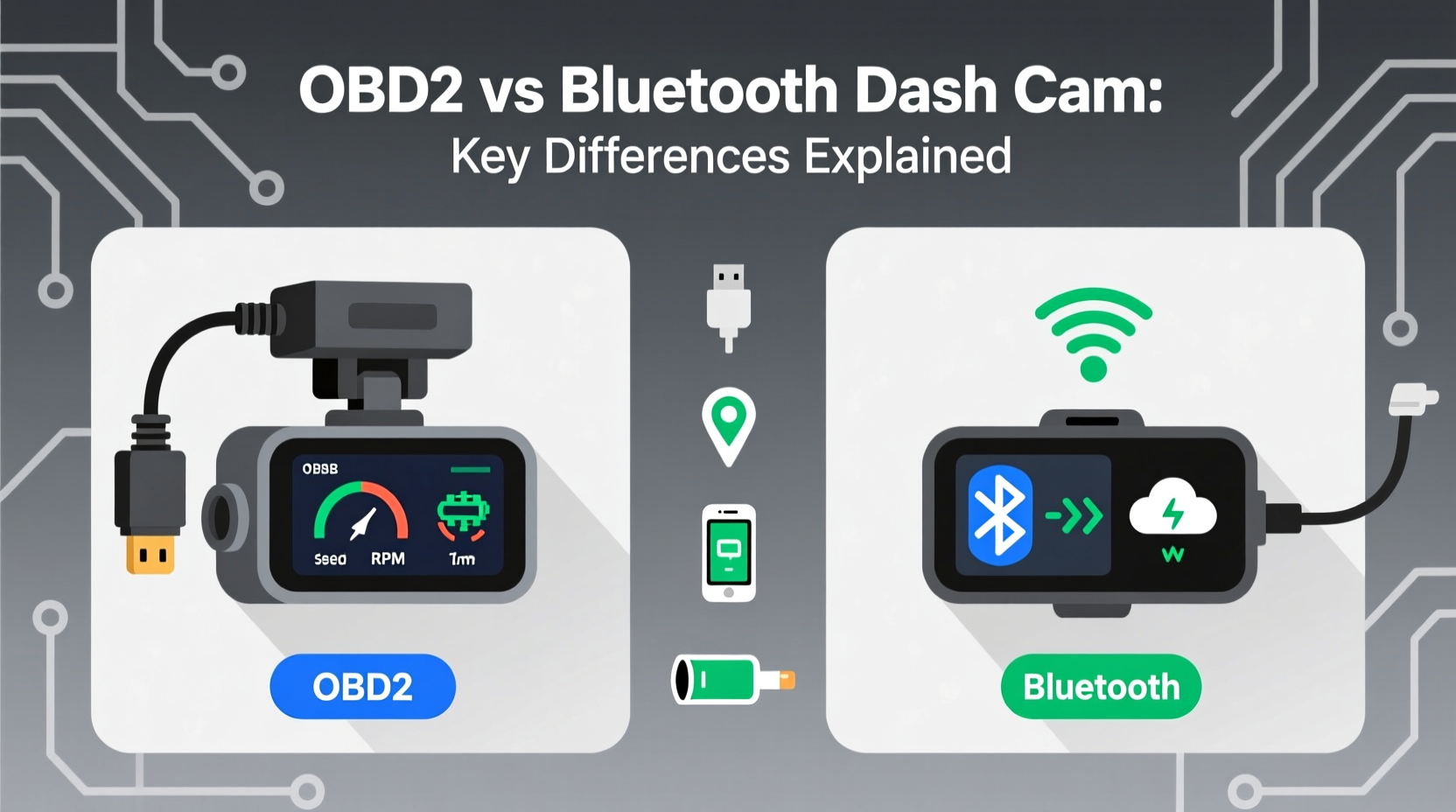
Looking for an OBD2 dash cam versus Bluetooth dash cam comparison? Here’s the bottom line: OBD2 dash cams are vehicle-integrated recording devices that draw power and real-time driving data (speed, RPM, braking, fault codes) directly from your car’s OBD-II port—while Bluetooth dash cams use wireless connectivity solely for remote configuration, live preview, or firmware updates, but rely on internal batteries or cigarette-lighter power and do not access vehicle diagnostics. If you want GPS-accurate speed overlays, automatic incident-triggered recording based on hard braking or collision detection, or engine health monitoring alongside video, an OBD2-enabled dash cam is essential. A Bluetooth-only model offers convenience—not vehicle integration. This definitive guide breaks down technical specs, compatibility limits, installation realities, privacy implications, and real-world performance across U.S., EU, and AU markets—so you choose with confidence, not confusion.
Why This Comparison Matters Right Now
As of 2024, over 68% of new dash cams sold in North America include at least one wireless interface—but fewer than 12% support true OBD-II protocol communication (SAE J1850, ISO 9141-2, or CAN bus). Many consumers mistakenly assume "Bluetooth dash cam" implies vehicle telemetry integration. It doesn’t. That misconception leads to buyer’s remorse, unsupported features, and missed insurance or fleet-management advantages. Understanding the functional boundary between OBD2 capability and Bluetooth convenience isn’t optional—it’s foundational to selecting a system that delivers measurable safety, liability protection, and operational insight.
Core Definitions: What Each Term Actually Means
OBD2 (On-Board Diagnostics II) is a standardized automotive communications protocol mandated in all U.S. vehicles since 1996 (and EU vehicles since 2001). It provides direct, real-time access to the Engine Control Unit (ECU) and other modules. An OBD2-compatible dash cam must contain a certified OBD-II interface chip (e.g., ELM327 v1.4+ or STN1110), interpret PID (Parameter ID) requests, and translate raw CAN bus or K-line signals into usable metadata—like vehicle speed (PID 0D), throttle position (PID 11), or diagnostic trouble codes (DTCs).
Bluetooth, by contrast, is a short-range wireless communication standard (IEEE 802.15.1) used exclusively for device-to-device pairing—typically between the dash cam and a smartphone app. It transmits no vehicle data unless the dash cam itself first collects and processes it via another method (e.g., built-in GPS or accelerometer). Bluetooth does not grant access to CAN bus signals, ECU logs, or proprietary manufacturer protocols like Toyota’s TIS or Ford’s FDR.
Functional Comparison: Side-by-Side Capabilities
| Feature | OBD2 Dash Cam | Bluetooth Dash Cam |
|---|---|---|
| Power Source | OBD-II port (provides stable 12V; enables parking mode with voltage cutoff) | Internal battery (≤ 30 min runtime) or 12V cigarette adapter (no smart voltage monitoring) |
| Speed & Location Accuracy | Vehicle-speed PID (±0.3 mph error); GPS + OBD fusion reduces drift | GPS-only (±2–5 mph error in tunnels/urban canyons; no redundancy) |
| Event Triggering | Hard braking (g-force + deceleration rate), airbag deployment signal, or DTC-triggered recording | Accelerometer-based only (prone to false positives on bumpy roads) |
| Data Logging Depth | Records up to 32 PIDs simultaneously (e.g., coolant temp, fuel level, ABS status) | No vehicle data logging—only timestamp, GPS coordinates, and motion events |
| Installation Complexity | Requires OBD-II port access (often under dashboard; may need extension cable) | Mount-and-go; no wiring beyond power cord |
Real-World Use Cases: Which One Solves Your Problem?
Fleet Managers & Commercial Drivers: OBD2 dash cams are non-negotiable. The Federal Motor Carrier Safety Administration (FMCSA) requires electronic logging devices (ELDs) for Hours-of-Service compliance—and while dash cams aren’t ELDs, OBD2-integrated models (e.g., Samsara Dash Cam Gen 3 or Lytx DriveCam) feed verified speed, ignition status, and harsh event data directly into telematics platforms. Bluetooth-only units cannot satisfy this requirement.
Rideshare & Delivery Drivers: You need verifiable trip context. An OBD2 model timestamps video with actual engine-on/off states—not just motion detection—and correlates footage with fare app start/end events. Uber and Lyft accept OBD2-sourced video as evidentiary support in dispute resolution; Bluetooth footage alone lacks chain-of-custody credibility.
Insurance Discount Seekers: Progressive Snapshot and State Farm Drive Safe & Save require hardware that validates driving behavior via vehicle signals—not inferred behavior. Only OBD2-certified devices qualify for premium reductions (up to 30% in select U.S. states). Bluetooth dash cams are excluded from all major usage-based insurance (UBI) programs.
Compatibility Reality Check: Not All Cars Are Equal
OBD2 functionality depends entirely on your vehicle’s year, make, and communication protocol:
- Pre-2008 gasoline vehicles often use ISO 9141-2 or SAE J1850 VPW—requiring legacy-compatible chips. Many modern OBD2 dash cams default to CAN bus and fail silently on older cars.
- Diesel trucks (e.g., Ford Powerstroke, GM Duramax) use J1939—a heavy-duty variant requiring specialized firmware. Standard OBD2 dash cams won’t read DEF level or regen cycles without J1939 support.
- EVs (Tesla, Rivian, Lucid) use proprietary CAN variants. Tesla Model Y (2023+) blocks third-party OBD access via its gateway module—rendering most OBD2 dash cams inert unless paired with a Tesla-specific adapter like the TeslaTap.
Verification step: Before purchase, confirm compatibility using your VIN at OBDII.com/VIN-Check or consult the manufacturer’s supported vehicle list—not Amazon Q&A or forum posts.
Bluetooth: What It Does Well (and Where It Falls Short)
Bluetooth excels at three tasks: quick firmware updates, real-time camera preview (useful for framing before driving), and manual clip download without removing the microSD card. But critical limitations persist:
- No background operation: iOS restricts Bluetooth background activity. If your phone locks or switches apps, the connection drops—breaking live view and disabling remote alerts.
- No encryption by default: Most consumer-grade Bluetooth dash cams use unencrypted BLE (Bluetooth Low Energy), making signal interception possible within ~10 meters. Avoid models without AES-128 pairing encryption.
- Bandwidth ceiling: BLE 4.2 maxes out at ~1 Mbps—insufficient for streaming 1080p video. “Live view” is always heavily compressed (≤ 480p) and introduces 1.2–2.8 sec latency.
If your priority is reviewing footage post-trip, Bluetooth adds negligible value. If you need instant verification of parking mode activation or want to mute audio remotely, it’s useful—but never a substitute for OBD2 telemetry.
Privacy & Data Ownership: Critical Legal Distinctions
In the EU, GDPR treats OBD2-collected data (especially DTCs revealing emissions system faults) as personal data if linked to a driver profile. Under Article 22, automated decisions based solely on such data (e.g., insurance denial triggered by frequent DTCs) require human review. Bluetooth-only cams collect less regulated data—but location history combined with license plate recognition (LPR) still triggers GDPR and California CCPA obligations.
In the U.S., NHTSA has issued non-binding guidance stating that “OBD2 data generated by aftermarket devices remains the property of the vehicle owner”—but court rulings (e.g., State v. Thomas, Ohio Ct. App. 2022) have upheld warrantless seizure of OBD2 logs during traffic stops if the device was visibly installed. Always disable OBD2 data transmission when lending your car—and verify whether your dash cam stores raw CAN frames (high-risk) or only processed summaries (lower risk).
Installation Best Practices: Avoiding Common Pitfalls
For OBD2 dash cams:
- Never use a generic OBD-II extension cable longer than 3 ft—signal degradation causes PID timeouts and intermittent disconnects.
- Enable “ignition-sense” mode in firmware settings to prevent parasitic drain. Test voltage cutoff thresholds (e.g., 12.2V = safe for AGM batteries; 12.6V for flooded lead-acid).
- Mount the main unit away from HVAC vents—OBD2 chips generate heat; sustained >70°C degrades CAN transceiver lifespan.
For Bluetooth dash cams:
- Disable Bluetooth auto-connect in your phone’s OS settings—prevents battery drain and unintended pairing with rental cars.
- Format the microSD card in-camera every 30 days. FAT32 fragmentation cripples write speeds faster on Bluetooth models due to fragmented firmware update writes.
Price & Value Analysis: Beyond the Sticker Cost
A mid-tier OBD2 dash cam (e.g., Vantrue N4 Pro with OBD dongle) retails for $229–$279. A comparable Bluetooth-only model (e.g., Garmin Dash Cam Mini 2) sells for $149–$199. The $80–$100 delta pays for:
- Verified speed overlay accuracy (reducing liability in contested incidents)
- Parking mode reliability (OBD2 voltage sensing prevents deep battery discharge)
- Telematics readiness (future-proofing for fleet software integration)
However, if you drive a classic car (pre-1996), rent vehicles frequently, or prioritize minimalist setup, Bluetooth simplicity delivers higher net utility. There is no universal “better”—only better-for-your-use-case.
Frequently Asked Questions (FAQ)
- Can I add Bluetooth to an OBD2 dash cam?
Yes—if the model supports it (e.g., Thinkware U1000). But Bluetooth remains auxiliary; it doesn’t enable OBD2 functionality on a non-OBD2 device. - Do all OBD2 dash cams read check-engine lights?
No. Only those with full DTC decoding (not just MIL-on detection) display specific codes like P0420. Verify DTC library depth in spec sheets. - Will a Bluetooth dash cam work with Android Auto or CarPlay?
No. Neither platform supports third-party dash cam video input. Bluetooth pairing is strictly for companion apps. - Is OBD2 data encrypted during transmission?
Rarely. Most consumer OBD2 dash cams transmit unencrypted CAN frames. Enterprise models (e.g., Motive) use TLS 1.2 for cloud uploads—but local OBD link is plaintext. - Can I use both OBD2 and Bluetooth simultaneously?
Yes—and recommended. OBD2 handles core telemetry; Bluetooth manages UI convenience. Just ensure firmware versions are compatible (e.g., Viofo A129 Pro Duo v3.2+ supports concurrent modes).





 浙公网安备
33010002000092号
浙公网安备
33010002000092号 浙B2-20120091-4