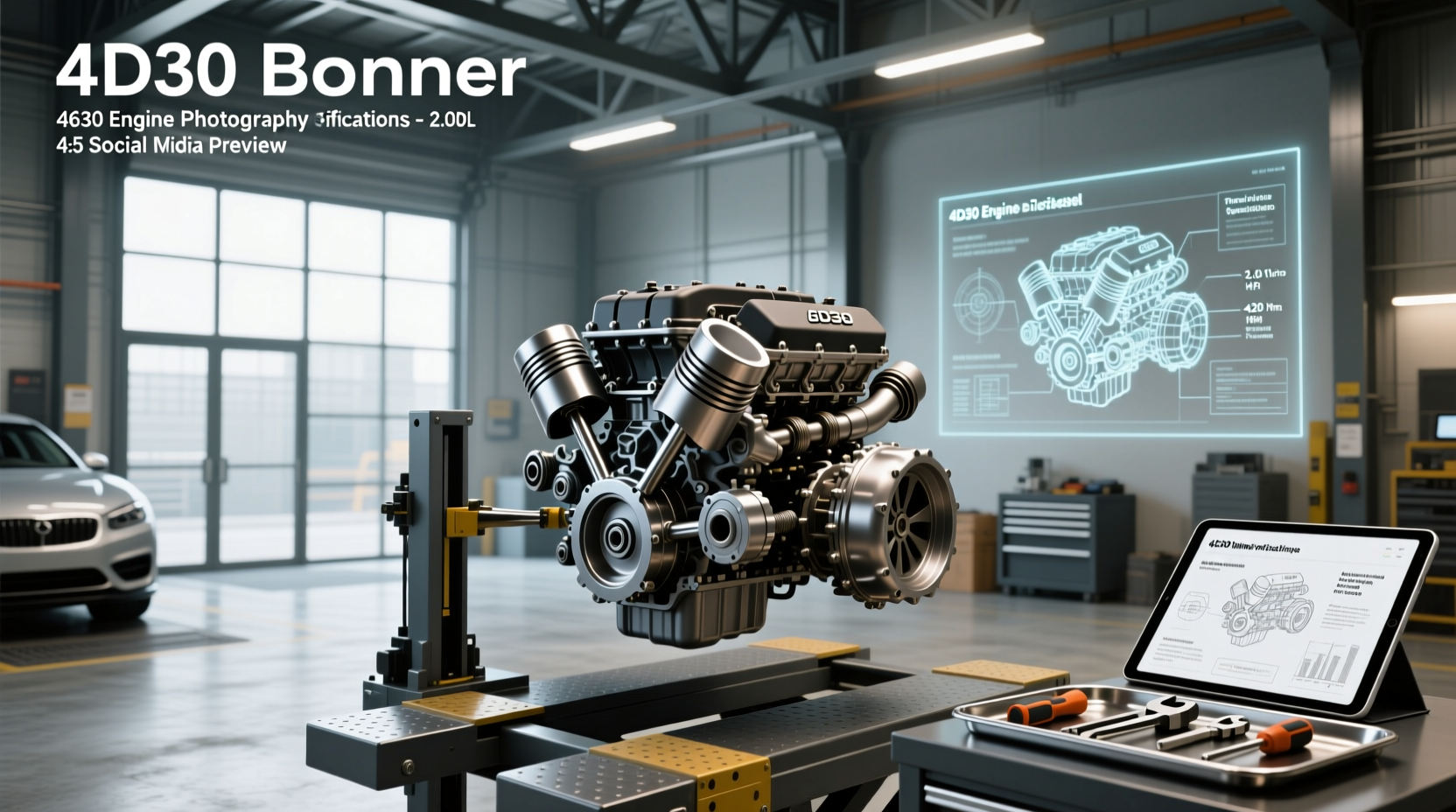
🔧 If you're searching for 4D30 engine specifications, you're likely evaluating a used Mitsubishi Canter or Fuso truck, rebuilding an older diesel engine, or sourcing parts for maintenance. The Mitsubishi 4D30 is a naturally aspirated, indirect-injection diesel engine produced from the early 1980s through the early 1990s, primarily used in light-duty commercial vehicles like the Mitsubishi Fuso Canter. Understanding its exact displacement, power output, torque curve, fuel efficiency, and long-term reliability is crucial for making informed decisions—whether you’re repairing, upgrading, or purchasing a vehicle equipped with this engine.
This guide delivers a comprehensive technical overview of the 4D30 engine, including verified specs, real-world performance insights, common failure points, and how it compares to later models like the 4D31 and 4D33. We’ll also cover practical advice on identifying variants, diagnosing wear, and sourcing reliable rebuild kits—helping you avoid costly mistakes when working with this aging but durable powerplant.
4D30 Engine Overview: Design and Applications
The Mitsubishi 4D30 is a four-cylinder, inline, water-cooled diesel engine developed during the late 1970s and widely deployed throughout the 1980s and early 1990s. It was primarily used in the fourth and fifth generations of the Mitsubishi Fuso Canter (model years approximately 1985–1993), serving as the base diesel option before turbocharged variants became standard.
⚙️ Key design features include:
- Engine Type: Naturally aspirated, indirect injection diesel
- Cylinder Arrangement: Inline-4
- Valvetrain: SOHC (Single Overhead Camshaft), 2 valves per cylinder
- Fuel System: Mechanical rotary injection pump with swirl chamber combustion
- Cooling System: Liquid-cooled with radiator and thermostat control
- Lubrication: Wet sump, gear-type oil pump
Unlike modern direct-injection diesels, the 4D30 relies on a pre-combustion (swirl) chamber system, which improves cold-start capability but reduces thermal efficiency compared to later designs. This makes it less fuel-efficient than successors like the 4D31T or 4D33, but also simpler mechanically and easier to maintain in regions with limited access to high-quality diesel fuel or advanced diagnostic tools.
Detailed 4D30 Engine Specifications
Below is a complete technical specification table based on factory data and verified service manuals from Mitsubishi Fuso documentation1.
| Specification | Value |
|---|---|
| Engine Model | 4D30 |
| Displacement | 3.3 L (3298 cc) |
| Bore × Stroke | 100 mm × 105 mm |
| Aspiration | Naturally Aspirated |
| Fuel System | Indirect Injection (Swirl Chamber) |
| Compression Ratio | 21.5:1 |
| Maximum Power Output | 90–95 PS (66–70 kW) @ 3,000 rpm |
| Maximum Torque | 200–210 N·m (148–155 lb·ft) @ 1,800 rpm |
| Redline / Max RPM | 3,500 rpm |
| Oil Capacity | 7.5 liters (with filter) |
| Coolant Capacity | Approx. 12–14 liters |
| Firing Order | 1-3-4-2 |
| Engine Weight (dry) | ~220 kg (485 lbs) |
Note that some sources list slightly different displacements (e.g., 2958 cc), but these typically refer to earlier prototypes or misrecordings. The correct displacement for production 4D30 engines is 3298 cc, consistent across official Mitsubishi documentation2.
Power and Performance: How Much Horsepower Does a 4D30 Have?
❓ One of the most frequently asked questions about the 4D30 engine is: “How many horsepower does it have?” Based on OEM specifications, the 4D30 produces between 90 and 95 PS (metric horsepower), which equates to roughly 89–94 bhp (brake horsepower). While modest by today’s standards, this output was sufficient for urban delivery trucks and small cargo vans of its era.
⚡ Torque delivery is smooth and linear, peaking around 1,800 rpm, making it well-suited for stop-and-go driving and low-speed hauling. However, due to its natural aspiration and older combustion design, the engine lacks high-end power and responsiveness. Drivers often report sluggish acceleration above 2,500 rpm, especially when fully loaded or climbing hills.
🚚 In real-world applications such as city logistics or rural transport, the 4D30 performs reliably under moderate loads. But if your operation requires frequent highway use or heavy payloads, consider upgrading to a turbocharged variant like the 4D31T, which offers over 120 PS and significantly improved mid-range torque.
Fuel Consumption and Efficiency
⛽ Average fuel consumption for the 4D30 engine ranges from 10 to 14 km/L (approx. 23–33 mpg-US), depending on load, terrain, and maintenance condition. These figures are based on aggregated user reports and fleet operator logs from Japan and Southeast Asia, where these vehicles remain in widespread use.
📉 Factors affecting fuel economy include:
- Injector nozzle condition
- Air filter cleanliness
- Driving style (aggressive vs. steady)
- Tire pressure and rolling resistance
- Transmission gear ratios
🧼 Poorly maintained 4D30 engines can drop below 8 km/L (19 mpg), especially if injectors are dripping or glow plugs are faulty. Regular cleaning of the injection pump and replacement of worn nozzles can restore efficiency. Unlike modern common-rail diesels, the 4D30 doesn’t rely on electronic sensors, so tuning must be done manually using mechanical gauges and timing lights.
Reliability and Common Issues
✅ The 4D30 is generally considered a robust and dependable engine, provided it receives regular maintenance. Its simplicity—lacking turbos, intercoolers, EGR systems, or DPFs—means fewer components can fail. Many examples have exceeded 400,000 km (250,000 miles) with proper care.
❗ However, several known weaknesses should be monitored:
1. Cylinder Head Cracking
📍 Particularly in high-mileage engines or those subjected to overheating, the aluminum cylinder head may develop cracks between exhaust valve seats. Symptoms include coolant loss without visible leaks, white smoke at startup, and rising temperature under load.
🛠️ Prevention: Maintain proper coolant levels, replace the thermostat every 3 years, and avoid prolonged operation at high temperatures.
2. Injector Pump Wear
🔧 The rotary distributor pump (typically made by Diesel Kiki or Zexel) is prone to internal wear after 200,000+ km. This leads to hard starting, rough idle, and reduced power.
🔧 Solution: Rebuild or replace the pump; ensure timing is reset correctly afterward.
3. Glow Plug Failures
❄️ Cold weather starting can become difficult if glow plugs degrade. Since the 4D30 uses indirect injection, it depends heavily on pre-heating for cold starts.
✅ Tip: Test each glow plug annually and replace in sets to prevent uneven heating.
4. Oil Leaks from Valve Cover Gasket
🧽 A minor but common issue is seepage from the valve cover gasket due to age and thermal cycling. While not critical, it can create mess and attract dirt.
🛠️ Fix: Replace with a high-quality rubber gasket rather than cork, which degrades faster.
Rebuild Kits and Maintenance Parts Availability
🛒 For owners maintaining or overhauling a 4D30 engine, rebuild kits are still available through specialized suppliers and online marketplaces. A typical overhaul kit includes:
- Piston rings
- Main and rod bearings
- Valve seals
- Gaskets and O-rings
- Head bolts (in premium kits)
📌 Prices range from $190 to $750 depending on brand and completeness. Brands like FridayParts, Fab Heavy Parts, and Battle Dental offer globally shipped kits with compatibility guarantees for the 4D30 and Fuso Canter FB series34.
⏱️ When ordering, always confirm your engine serial number and model year, as bore sizes and bearing tolerances can vary slightly between production batches. Using incorrect components may lead to premature failure.
Comparison with Similar Engines: 4D30 vs 4D31 vs 4D33
To better understand where the 4D30 stands, here's a comparison with two of its more advanced siblings:
| Engine | Aspiration | Power (PS) | Torque (N·m) | Fuel System | Typical Use Case |
|---|---|---|---|---|---|
| 4D30 | Naturally Aspirated | 90–95 | 200–210 | Indirect Injection | Urban delivery, light cargo |
| 4D31T | Turbocharged | 115–125 | 280–300 | Direct Injection | Highway transport, heavier loads |
| 4D33 | NA or Turbo | 95–135 | 220–320 | Direct Injection | Versatile; newer Cantrucks |
📈 The 4D31T and 4D33 offer significantly better performance and efficiency due to turbocharging and direct injection. However, they are more complex and sensitive to poor fuel quality and inadequate maintenance. The 4D30 remains a solid choice where simplicity and ease of repair outweigh the need for higher output.
Where Is the 4D30 Still Used Today?
🌍 While discontinued in new production, the 4D30 continues to operate in developing markets such as Indonesia, Philippines, Sri Lanka, and parts of Africa, where secondhand Japanese imports dominate the light-truck segment. Its durability and ease of field repair make it ideal for remote areas with limited workshop infrastructure.
🏭 Some industrial equipment, including generators and marine auxiliary drives, also use modified versions of the 4D30. Always verify the application-specific configuration before swapping or retrofitting.
How to Identify a Genuine 4D30 Engine
🔍 To confirm you're dealing with a true 4D30, check the following:
- Engine ID Tag: Located near the alternator or on the block side. Should read "4D30" followed by a serial number.
- No Turbocharger: The absence of a turbo is a quick visual clue.
- Injection Pump Type: Look for a rotary-style pump (not inline).
- Model Year Cross-Reference: Installed mainly in Canter models from 1985–1993.
⚠️ Beware of misrepresented engines sold online claiming to be “rebuilt 4D30” but actually being 4D31 cores with re-stamped tags. Verify part numbers on major components like the cylinder head and oil pan.
Final Verdict: Is the 4D30 a Good Engine?
⭐ Yes—the Mitsubishi 4D30 is a good engine for specific use cases. If you need a simple, repairable diesel for low-speed, light-load operations and value mechanical simplicity over performance, the 4D30 is a sound choice. It excels in environments where spare parts are scarce and skilled labor is limited.
🚫 However, if you require strong acceleration, highway cruising, or maximum fuel economy, newer engines like the 4D31T or 4D33 are far superior. Additionally, due to increasingly strict emissions regulations in many countries, registering or operating a non-turbo, pre-EPA diesel like the 4D30 may be restricted.
📋 Before buying or rebuilding a 4D30-powered vehicle, assess your operational needs, local regulations, and long-term maintenance strategy. Consider getting a compression test and oil analysis to evaluate engine health.
Frequently Asked Questions (FAQs)
Q: What is the displacement of the Mitsubishi 4D30 engine?
A: The 4D30 has a displacement of 3.3 liters (3298 cc), with a bore of 100 mm and stroke of 105 mm.
Q: How much horsepower does the 4D30 engine produce?
A: It produces 90–95 PS (approximately 89–94 bhp) at 3,000 rpm, with peak torque between 200–210 N·m at 1,800 rpm.
Q: Is the 4D30 engine reliable?
A: Yes, it is generally reliable due to its mechanical simplicity and rugged construction, especially when maintained properly. However, it is prone to cylinder head cracking and injector pump wear over time.
Q: Can I upgrade the 4D30 to a turbo engine?
A: While technically possible, turbocharging a 4D30 requires significant modifications including a new manifold, intercooler, strengthened internals, and fuel tuning. Most owners find it more practical to swap in a complete 4D31T engine instead.
Q: Where can I buy a 4D30 engine or rebuild kit?
A: Rebuild kits and complete engines are available through specialized suppliers like Fab Heavy Parts, FridayParts, and Battle Dental, often shipped worldwide. Always verify compatibility before purchase.





 浙公网安备
33010002000092号
浙公网安备
33010002000092号 浙B2-20120091-4