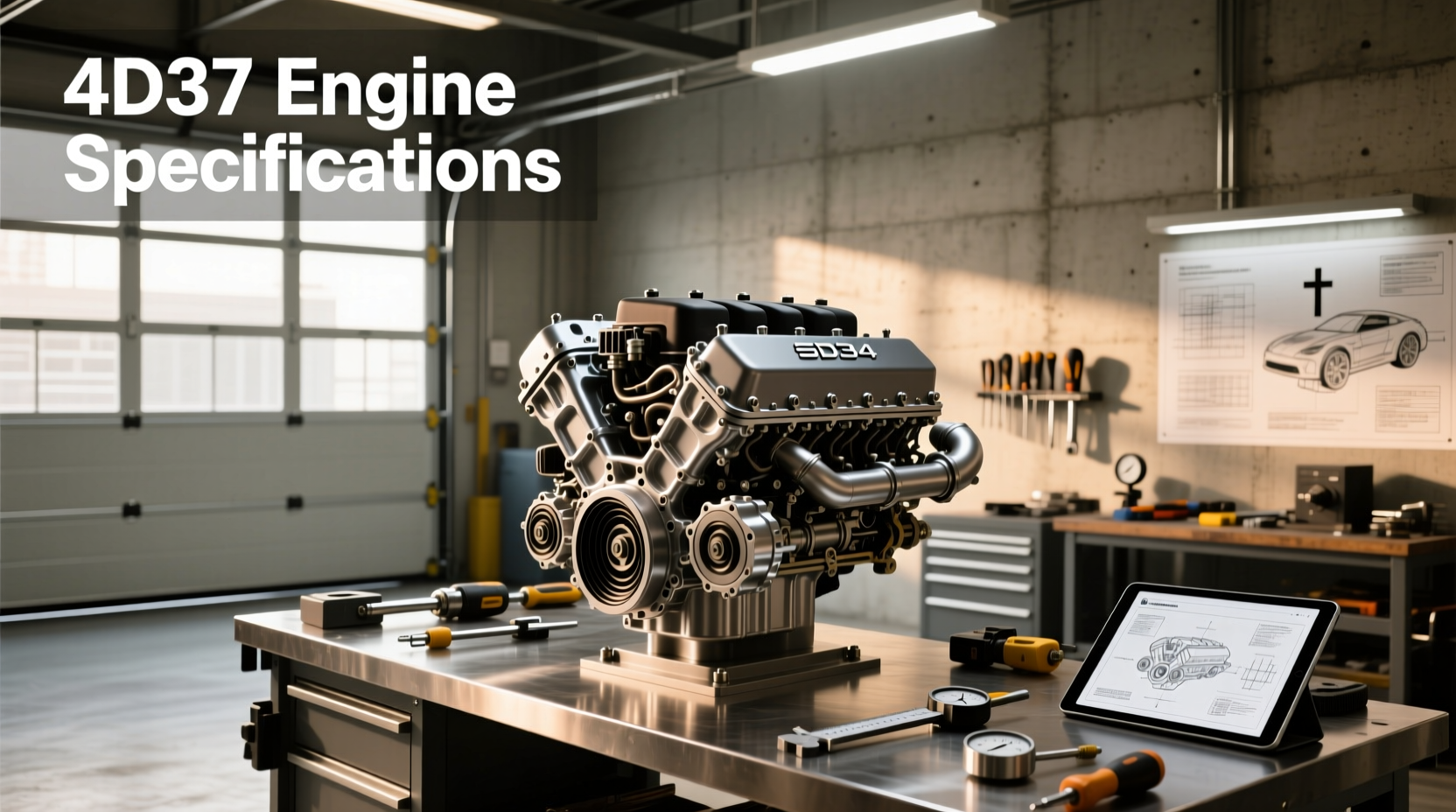
When searching for reliable diesel engine specifications for light to medium-duty commercial vehicles, the Mitsubishi 4D37 engine specs are frequently referenced across repair forums, parts marketplaces, and fleet maintenance logs. This inline-four, direct-injection diesel engine was designed primarily for Mitsubishi’s Canter truck series and various industrial applications. Key technical details include a 3.9-liter (3908 cc) displacement, producing between 110 and 145 horsepower depending on configuration, with peak torque ranging from 285 to 360 Nm. It features a cast-iron block, aluminum head, SOHC valvetrain, and mechanical fuel injection in earlier models, later upgraded to electronic control in some variants. Understanding these core 4D37 engine specifications is essential for proper diagnostics, part sourcing, and performance evaluation.
Understanding the Mitsubishi 4D37 Engine: Background and Applications
The Mitsubishi 4D37 is part of the manufacturer's long-running '4D' series of diesel engines, which began development in the 1970s and evolved into one of the most widely used light-duty diesel platforms in Asia, Europe, and Latin America. Introduced in the late 1990s as an update to the 4D34, the 4D37 brought improved emissions compliance, better fuel efficiency, and increased durability for urban delivery trucks, refrigerated vans, and small construction equipment.
⚙️ Primary Applications:
- Mitsubishi Fuso Canter (3.5–5-ton GVW variants)
- Forklifts and industrial machinery
- Marine auxiliary power units (limited models)
- Emergency generators and pump sets
This engine became especially popular in regions where low-cost, durable workhorse engines were needed without requiring advanced after-treatment systems. Its simplicity made it ideal for markets with limited access to high-grade diesel fuel or sophisticated diagnostic tools.
Detailed 4D37 Engine Specifications
To fully understand what makes the 4D37 suitable for its intended roles, let’s break down the full technical specification by category.
| Specification | Details |
|---|---|
| Engine Type | Inline-4, water-cooled diesel |
| Displacement | 3,908 cc (3.9L) |
| Bore × Stroke | 104 mm × 115 mm |
| Compression Ratio | 17.5:1 |
| Aspiration | Naturally aspirated or turbocharged (varies by model) |
| Max Power Output | 110–145 hp (82–108 kW) @ 2,900–3,500 rpm |
| Max Torque | 285–360 Nm @ 1,800–2,200 rpm |
| Fuel System | Rotary injection pump (early), electronically controlled VE-type (later) |
| Valvetrain | SOHC, 2 valves per cylinder |
| Lubrication | Forced feed with full-flow filter |
| Cooling System | Pressurized liquid cooling with thermostat |
| Oil Capacity | Approx. 10.5 liters |
| Weight (dry) | ~420 kg |
These numbers reflect typical configurations found in European and North American export models. However, actual outputs may vary based on emission standards, tuning, and regional calibration—especially between pre-2005 mechanically injected units and post-2006 models equipped with electronic governors.
How the 4D37 Compares to Other Mitsubishi Diesel Engines
While the 4D37 is well-regarded for reliability, it’s important to compare it against other engines in Mitsubishi’s lineup to determine suitability for specific tasks.
🆚 4D37 vs. 4D34
The older 4D34 (3.7L) predates the 4D37 and shares a similar architecture but produces less power (typically 105–125 hp). The 4D37 offers better low-end torque and improved thermal efficiency due to revised combustion chamber design and larger displacement. Many fleet operators upgraded from the 4D34 to the 4D37 for enhanced hauling capability in hilly terrain.
🆚 4D37 vs. 4M40/4M41 (Canter GTS)
The 4M40 (3.2L) and 4M41 (3.5L) are more modern, featuring DOHC heads, four valves per cylinder, and common rail injection. They offer superior refinement and meet Euro IV/V standards, but come at higher maintenance costs. The 4D37 remains favored in developing markets due to lower repair complexity and part availability.
🆚 4D37 vs. 8DC8 (Heavy-Duty V8)
Some users confuse the 4D37 with larger Mitsubishi Fuso engines like the 8DC8—a 14.8L V8 used in heavy-duty dump trucks and buses 1. While both are diesel engines under the Fuso brand, they serve entirely different vehicle classes. The 8DC8 produces over 400 hp and weighs nearly twice as much. Confusion often arises because both appear in parts catalogs and salvage listings.
Common Use Cases and Real-World Performance
The 4D37 shines in stop-and-go urban delivery environments. Fleets operating Mitsubishi Canter trucks equipped with this engine report average lifespans of 350,000 to 500,000 km when maintained properly. Fuel consumption typically ranges from 10–14 L/100km depending on load and driving conditions.
🚚 Urban Delivery Trucks: With strong low-RPM torque, the 4D37 accelerates well from idle, making it efficient for frequent stops. Turbocharged versions handle city gradients effectively.
🏭 Industrial Equipment: Used in generator sets and hydraulic pumps, the naturally aspirated variant runs reliably under constant RPM loads. Its mechanical fuel system avoids reliance on electronics, reducing failure risk.
🔧 Aftermarket Support: Due to widespread use, rebuild kits, gasket sets, injectors, and timing components are readily available globally. Many third-party manufacturers produce compatible parts, though quality varies significantly.
Potential Issues and Known Weaknesses
No engine is immune to problems, and the 4D37 has several known areas of concern that owners should monitor:
❌ Head Gasket Failures (Pre-2003 Models)
Early batches of the 4D37 suffered from premature head gasket leaks, particularly when subjected to prolonged overheating or incorrect coolant mixtures. Symptoms include white smoke, coolant loss, and pressure buildup in the overflow tank. Replacing with an upgraded multi-layer steel (MLS) gasket during overhaul can prevent recurrence.
❌ Injector Pump Wear
The rotary (VE-type) injection pump is robust but sensitive to contaminated fuel. In regions with poor diesel quality, internal wear leads to hard starting, rough idling, and black smoke. Regular fuel filtration and using cetane boosters help extend pump life.
❌ Crankshaft Sensor Failure (Electronic Versions)
Late-model 4D37 engines with electronic governors rely on a crank position sensor for timing control. A failing sensor causes intermittent stalling or no-start conditions. Keeping a spare sensor on hand is advisable for remote operations.
❌ Oil Leaks from Valve Cover and Rear Main Seal
Over time, rubber gaskets degrade, leading to minor oil seepage. While not critical, persistent leaks attract dirt and complicate maintenance. Using OEM-spec silicone sealants during servicing reduces recurrence.
Maintenance Best Practices for Longevity
Extending the service life of a 4D37 engine requires consistent, proactive care. Follow these guidelines to avoid costly repairs:
✅ Change Oil Every 7,500–10,000 km: Use API CF-4 or CI-4 grade oil. Extended intervals increase sludge buildup.✅ Inspect Coolant Condition Quarterly: Maintain proper pH balance and replace every two years to prevent corrosion.✅ Clean Air Filter Monthly in Dusty Environments: Restriction reduces efficiency and increases soot accumulation.✅ Check Injection Pump Drive Belt Tension Biannually: A loose belt causes timing drift and poor fuel delivery.✅ Use Fuel Additives in Cold Climates: Prevents waxing and improves lubricity in low-sulfur diesel.Rebuild and Replacement Options
When major component wear occurs, you have three primary paths:
🛒 Option 1: Complete Rebuild Kit InstallationAvailable from suppliers like Fab Heavy Parts and FridayParts, these kits include pistons, rings, bearings, gaskets, and liners. Cost-effective for engines with moderate wear. Requires professional machining in most cases.
🔧 Option 2: Exchange Remanufactured EngineMany dealers offer core-exchange remanufactured 4D37 units tested to OEM specs. Faster than rebuilding and includes warranty coverage. Typical turnaround: 3–7 business days.
🌐 Option 3: Used Engine ImportPopular via online marketplaces such as Alibaba.com, used 4D37 engines from Japan or Europe are sold with running hours and test videos 2. Exercise caution: verify seller reputation, request compression test results, and confirm compatibility with your chassis model.
How to Verify Genuine 4D37 Engine Specs for Your Unit
Because specifications can vary by production year and region, always cross-check the data using your engine’s identification plate. Locate the metal tag near the alternator or on the side of the block. It will list:
- Model: 4D37 or 4D37T (turbo)
- Serial Number
- Power Rating (kW/hp)
- Emission Standard (e.g., Euro II, Tier 2)
- Manufacture Date
You can then reference official service manuals or contact authorized Mitsubishi Fuso distributors for verification. Avoid relying solely on online listings, which may mislabel engines or omit critical variants.
Conclusion: Is the 4D37 Right for Your Needs?
The Mitsubishi 4D37 engine remains a solid choice for operators seeking a proven, easy-to-maintain diesel platform. Its strengths lie in simplicity, durability, and broad support infrastructure. However, it lacks the emissions compliance and refinement of newer engines. If you're maintaining an existing fleet or sourcing a replacement for a legacy vehicle, understanding the full 4D37 engine specifications ensures informed decisions about repairs, upgrades, or replacements.
Frequently Asked Questions (FAQs)
❓ What vehicles use the Mitsubishi 4D37 engine?
The Mitsubishi 4D37 is primarily used in the Fuso Canter light-duty truck (models from late 1990s to mid-2000s), as well as certain forklifts, generators, and industrial machines.
❓ How much horsepower does a 4D37 engine produce?
Depending on configuration, the 4D37 produces between 110 and 145 horsepower. Naturally aspirated versions are on the lower end, while turbocharged models reach up to 145 hp.
❓ Is the 4D37 engine reliable?
Yes, the 4D37 is considered highly reliable when regularly maintained. Many units exceed 400,000 km of service with only routine upkeep and timely repairs.
❓ Can I replace a 4D34 with a 4D37 engine?
In most cases, yes—the engines share similar mounting points and ancillary layouts. However, modifications to the fuel line, ECU (if applicable), and cooling system may be required. Consult a qualified mechanic before swapping.
❓ Where can I find a service manual for the 4D37 engine?
Official Mitsubishi Fuso shop manuals are available through authorized dealers. Unofficial PDF versions can be found online through technical document repositories or parts supplier websites.





 浙公网安备
33010002000092号
浙公网安备
33010002000092号 浙B2-20120091-4