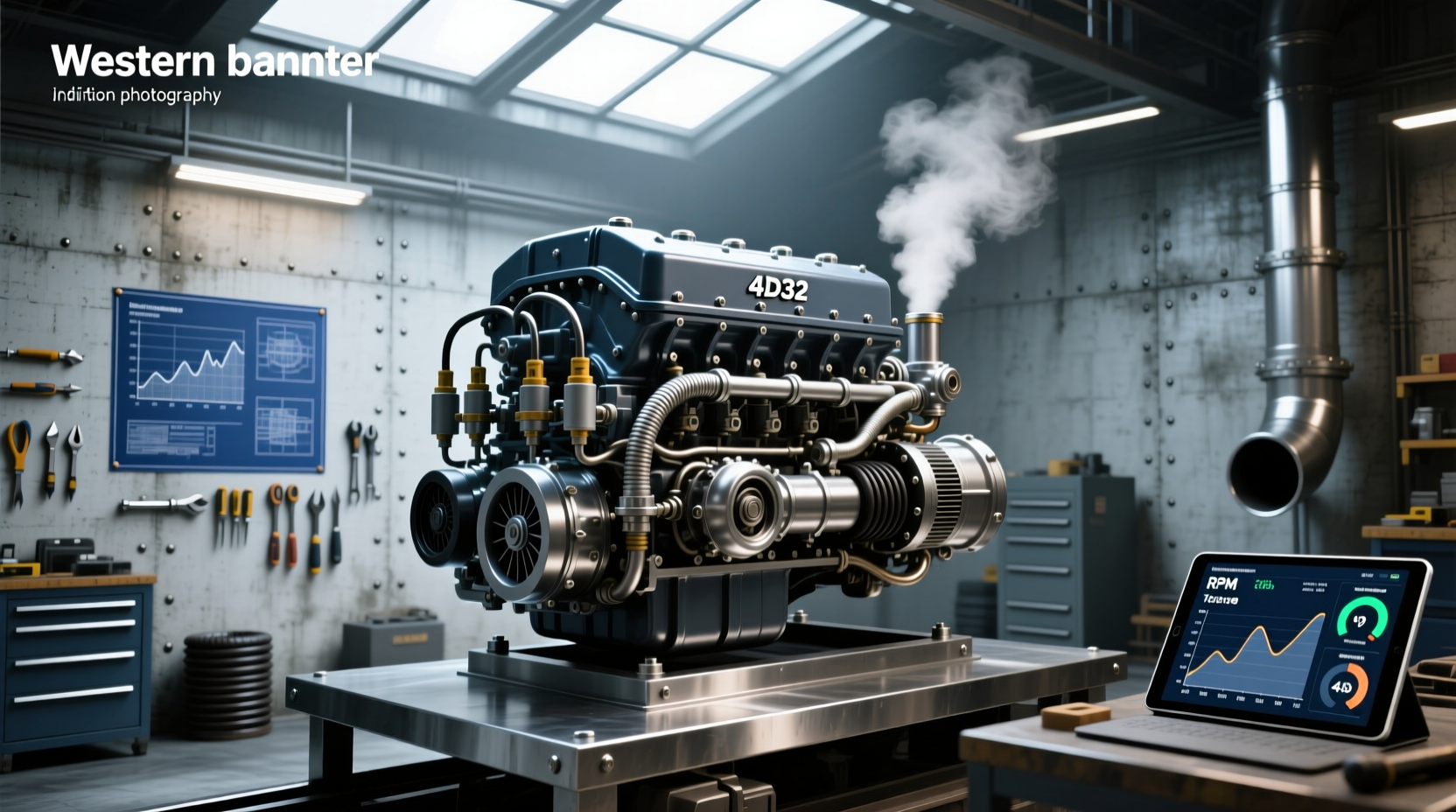
If you're researching the 4D32 engine specs, you're likely evaluating a durable diesel powerplant used widely in commercial trucks and construction equipment from the late 1980s through the early 2000s. The Mitsubishi 4D32 is an inline-four, direct-injection diesel engine known for its reliability, simple mechanical design, and long service life—especially in Mitsubishi Fuso Canter trucks and some Caterpillar machinery. Key specifications include a displacement of 3.6 liters (3567cc), output ranging from 110 to 130 horsepower, and peak torque between 260–280 Nm, depending on model year and configuration1. This article provides a comprehensive breakdown of technical data, real-world performance, maintenance considerations, and common use cases to help users understand whether this engine fits their needs for durability, repairability, or cost-effective fleet operations.
Understanding the Mitsubishi 4D32 Engine: A Mechanical Workhorse
The 4D32 engine was developed by Mitsubishi Motors as part of its 4D series of industrial diesel engines. First introduced in the mid-1980s, it powered various light-duty commercial vehicles, primarily the Mitsubishi Fuso Canter FE series. Unlike modern electronically controlled diesels, the 4D32 relies on purely mechanical fuel injection systems, making it easier to diagnose and repair in remote or low-infrastructure environments. Its robust cast iron block and aluminum cylinder head contribute to longevity under heavy loads and high mileage conditions.
This engine uses overhead valve (OHV) valvetrain architecture with two valves per cylinder, driven by a timing gear train rather than a belt. It features a naturally aspirated version as well as turbocharged variants (designated 4D32T), which deliver increased power and torque for more demanding applications like delivery trucks or small dump trucks operating on hilly terrain.
Detailed 4D32 Engine Specifications
To fully assess the capabilities of the 4D32 engine, let’s break down its core technical parameters:
| Specification | Value |
|---|---|
| Engine Type | Inline-4, OHV, Direct Injection Diesel |
| Bore × Stroke | 104 mm × 105 mm |
| Displacement | 3,567 cc (3.6L) |
| Aspiration | Naturally Aspirated / Turbocharged (4D32T) |
| Compression Ratio | Approx. 21:1 |
| Max Power Output | 110–130 hp (81–97 kW) @ 3,500 rpm |
| Peak Torque | 260–280 Nm (192–206 lb-ft) @ 2,000 rpm |
| Fuel System | Mechanical Inline Fuel Injection Pump |
| Cooling System | Liquid-cooled |
| Lubrication | Wet sump, forced circulation |
| Engine Block Material | Cast Iron |
| Cylinder Head Material | Aluminum Alloy |
| Valvetrain | SOHC, 2 Valves per Cylinder |
| Timing Drive | Gear-driven |
| Oil Capacity | Approx. 8.5 liters |
| Coolant Capacity | Approx. 12–14 liters |
These figures are consistent across multiple sources including OEM documentation, parts suppliers, and vehicle listings from Japanese exporters such as Carused.jp and EVERYCAR.jp2. Note that actual outputs may vary slightly due to calibration differences, emission standards compliance, and whether the unit is naturally aspirated or turbocharged.
Power Output Variations: Why Horsepower Differs Across Models
One frequently asked question is: how much horsepower does a Mitsubishi 4D32 have? The answer isn't uniform—it depends on several factors:
- Naturally aspirated vs. turbocharged: Base models without a turbocharger typically produce around 110 PS (81 kW), while turbo versions can reach up to 130 hp (97 kW).
- Model year and emissions tuning: Engines produced after 1990 often had slight adjustments to meet evolving regional regulations, affecting both power and smoke output.
- Application-specific tuning: Units installed in heavier chassis or export markets might be detuned for better low-end torque and fuel economy.
For example, the 4D32 engine in the Mitsubishi Fuso Canter FE325 generates approximately 110 hp, whereas later FE355 or FE445 models equipped with the turbo variant achieve closer to 130 hp. Always verify the exact engine code (e.g., 4D32T) when assessing performance claims.
Fuel Efficiency and Real-World Consumption
Fuel economy is a critical factor for operators managing fleets or using older diesel vehicles in developing regions. While official EPA-style ratings don’t exist for most 4D32-powered vehicles, field reports suggest average consumption between 8–12 L/100 km (20–29 mpg US), depending on load, driving style, and vehicle weight.
⚙️ Factors influencing fuel consumption:
- Vehicle weight and cargo load: Fully loaded trucks will see higher usage, especially in urban stop-and-go traffic.
- Tire pressure and rolling resistance: Underinflated tires increase drag and reduce efficiency.
- Engine condition: Worn injectors, clogged air filters, or poor compression significantly degrade fuel economy.
- Driving environment: Mountainous routes require more throttle input, increasing fuel burn.
Owners report best results when maintaining proper injector timing and ensuring the glow plug system functions correctly during cold starts. Because the 4D32 lacks electronic engine management, there's no way to 'tune' it via software—but mechanical adjustments to injection timing can yield modest improvements in efficiency.
Common Applications: Where Is the 4D32 Engine Used?
The 4D32 engine found its primary home in the Mitsubishi Fuso Canter light-duty truck line, particularly fifth-generation (1985–1993) and sixth-generation (1993–1997) models. However, its use extended beyond just one vehicle platform:
- 🚚 Mitsubishi Fuso Canter FE305, FE325, FE355, FE445: These are the most common carriers of the 4D32 engine, used globally for urban freight, refrigerated transport, and municipal services.
- 🔧 Caterpillar Compact Excavators: Some E307, E70B, and E311B mini-excavators were fitted with rebadged 4D32T engines under licensing agreements.
- 🏭 Industrial Equipment: Stationary generators, pumps, and agricultural machinery also utilized this engine due to its ruggedness and ease of integration.
Its widespread deployment means replacement parts and rebuild kits remain available through global aftermarket networks, especially from Japan, Southeast Asia, and Eastern Europe.
Maintenance and Longevity: What to Expect Over Time
🛠️ One of the biggest advantages of the 4D32 engine is its simplicity. With fewer electronic components compared to post-2000 diesels, troubleshooting is straightforward using basic tools. That said, regular maintenance is essential for reaching high mileage thresholds (many units exceed 400,000 km with proper care).
✅ Recommended maintenance intervals:
- Oil changes: Every 5,000–7,500 km using SAE 15W-40 CI-4 or equivalent diesel oil.
- Air filter inspection: Clean or replace every 10,000 km; critical in dusty environments.
- Fuel filter replacement: At least every 15,000 km to prevent water contamination and injector wear.
- Valve clearance check: Adjust every 30,000–40,000 km to maintain optimal combustion.
- Cooling system flush: Replace coolant every 2 years to avoid corrosion and overheating.
Common wear items include piston rings, main bearings, and fuel injection pumps—all of which are serviceable with standard machine shop support. Rebuild kits containing pistons, liners, gaskets, and bearings are readily available online from specialized suppliers3.
Reliability and Known Issues
❓ So, how good is the 4D32 engine? In general, it has a strong reputation for durability, especially in non-emission-regulated markets where owners prioritize uptime over cleanliness. However, certain weaknesses should be monitored:
- Head gasket failure: While less common than in some other diesels, prolonged overheating can lead to head warping or gasket blowout.
- Fuel pump wear: Mechanical injection pumps degrade over time, leading to hard starting or rough idle. Reconditioning is often more cost-effective than full replacement.
- Injector coking: Poor-quality diesel fuel leads to carbon buildup on injectors, reducing spray efficiency and increasing smoke.
- Timing gear noise: Due to gear-driven camshafts, some units develop whining sounds at higher RPMs—usually not critical but worth inspecting if loud.
Regular compression testing (target: >250 psi per cylinder) and leak-down tests help identify internal wear before catastrophic failure occurs.
Parts Availability and Rebuild Options
🛒 For those restoring or maintaining a 4D32-equipped vehicle, sourcing genuine or compatible parts is generally feasible. Major components like cylinder heads, crankshafts, and complete short blocks can be purchased from Japanese dismantlers or international suppliers specializing in used diesel engines.
🔧 Popular upgrade paths include:
- Installing a rebuilt injection pump with updated metering settings.
- Upgrading to stainless steel exhaust manifolds to resist cracking.
- Adding aftermarket oil coolers for improved thermal stability.
Overhaul kits—including pistons, rings, bearings, gaskets, and seals—are offered by多家 manufacturers and fit both standard and oversized bore configurations. When rebuilding, always measure cylinder wall taper and out-of-roundness before installing new liners.
Environmental Considerations and Emissions
🌍 The 4D32 predates stringent Euro 3+ emissions standards and therefore lacks diesel particulate filters (DPFs), selective catalytic reduction (SCR), or exhaust gas recirculation (EGR) systems. While this simplifies maintenance, it also means these engines emit visible smoke under acceleration and may not comply with modern urban low-emission zones.
In countries enforcing strict air quality laws, retrofitting or upgrading to a newer engine may be necessary for legal operation. However, in rural areas or off-road applications, the lack of complex aftertreatment systems remains a practical advantage.
How to Verify a 4D32 Engine’s Condition Before Purchase
🔍 If you're considering buying a used vehicle or standalone engine, perform these checks:
- Visual inspection: Look for oil leaks, rust, missing bolts, or signs of previous overheating (discoloration on exhaust manifold).
- Start-up behavior: Cold start should occur within 3–5 seconds; excessive cranking suggests glow plug or compression issues.
- Smoke test: Blue/gray smoke indicates burning oil; black smoke points to rich fuel mixture or injector problems.
- Compression test: Use a diesel compression gauge to confirm even pressure across all cylinders.
- Service history review: Ask for oil change records, recent repairs, and any past major work.
Consider hiring a mechanic familiar with older Japanese diesel engines to conduct a pre-purchase inspection, especially if importing from Japan.
Comparison with Similar Engines
ParallelGroup analysis helps contextualize the 4D32 among peers:
- Isuzu 4BD1: Similar displacement (3.7L), produces ~125 hp. More refined valvetrain but slightly more complex maintenance.
- Hino N04C: Modern common-rail equivalent (~150 hp), far cleaner but expensive to repair.
- Toyota 14B: 4.1L diesel, slightly more torque but heavier and less compact.
The 4D32 stands out for its balance of simplicity, availability, and proven track record in harsh operating conditions.
Frequently Asked Questions (FAQs)
- ❓ How much horsepower does a Mitsubishi 4D32 engine have?
- The Mitsubishi 4D32 produces between 110 and 130 horsepower, depending on whether it’s naturally aspirated (110 hp) or turbocharged (up to 130 hp).
- ❓ Are Mitsubishi diesel engines reliable?
- Yes, particularly older mechanical designs like the 4D32. They are known for durability, ease of repair, and long service life when properly maintained.
- ❓ What vehicles use the 4D32 engine?
- The 4D32 is primarily used in Mitsubishi Fuso Canter trucks (FE300 series) and select Caterpillar mini-excavators like the E307 and E70B.
- ❓ Can the 4D32 engine be upgraded for more power?
- Limited upgrades exist, such as improved turbochargers or tuned injection pumps, but significant gains require major modifications and may compromise reliability.
- ❓ Where can I find parts for a 4D32 engine rebuild?
- Rebuild kits and OEM-spec components are available from Japanese exporters, specialized diesel parts suppliers, and industrial engine vendors worldwide.





 浙公网安备
33010002000092号
浙公网安备
33010002000092号 浙B2-20120091-4