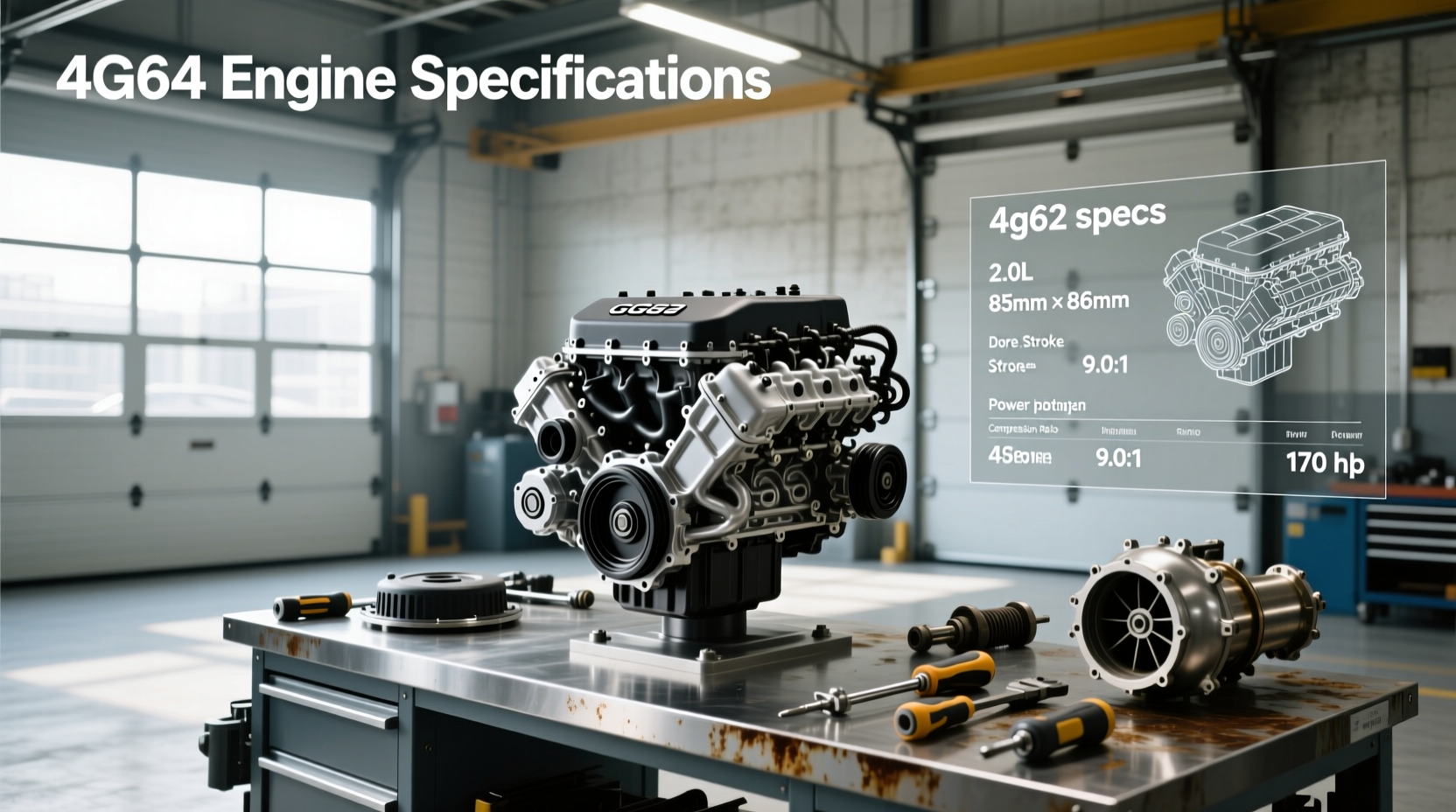
🔍 Looking for reliable 4G63 engine specs? You're not alone. Car enthusiasts and mechanics searching for '4g63 engine specifications' often want to know its power potential, durability, and compatibility with tuning upgrades. The truth is, the Mitsubishi 4G63 isn't just another inline-four—it's one of the most legendary turbocharged engines ever built. With a cast-iron block, aluminum head, and robust bottom end, the 4G63T (turbo version) can reliably handle up to 350–400 horsepower on stock internals when properly tuned 1. In this detailed breakdown, we’ll cover everything from factory specs to real-world tuning capabilities, common issues, and why this 2.0L four-cylinder remains a favorite in motorsports and street performance circles.
Understanding the Mitsubishi 4G63 Engine Family
The 4G63 is part of Mitsubishi’s Sirius engine series—specifically the 4G6 family—which includes both naturally aspirated (NA) and turbocharged variants. First introduced in 1980, the engine was initially designed as a 2.0-liter, DOHC, 16-valve inline-four with multi-point fuel injection or carburetor setups depending on market and model year 2.
⚙️ While early versions were NA and used in sedans like the Mitsubishi Galant and Dodge Colt, it was the turbocharged variant—the 4G63T—that gained global fame. This version powered the Mitsubishi Lancer Evolution I through IX (1992–2007), becoming synonymous with rally-bred performance and tuner culture.
📌 Key identifiers:
- Engine Code: 4G63 (N/A), 4G63T (Turbo)
- Configuration: Inline-4, DOHC, 16-valve
- Displacement: 1997 cc (2.0L)
- Bore x Stroke: 85.0 mm × 88.0 mm
- Compression Ratio: 8.5:1 (turbo), 9.5–10.0:1 (N/A)
- Max Factory HP: ~276 hp (JDM Evo IV–IX), ~210 hp (USDM Evo VII–IX)
- Redline: 7,500 rpm (Evo models)
- Fuel System: Sequential MPI
- Balance Shafts: Yes (to reduce vibration)
Factory vs. Tuned Performance: What Horsepower Can a 4G63 Handle?
⚡ One of the most frequently asked questions online is: How much horsepower can a 4G63 handle? The answer depends heavily on whether you're using stock components or building a fully forged setup.
| Build Level | Horsepower Potential | Key Components | Lifespan Expectation |
|---|---|---|---|
| Stock Internals | 300–350 hp | OEM pistons, rods, crank | 50,000+ miles with proper tuning |
| Supporting Mods Only | 400–500 hp | Upgraded turbo, fuel system, ECU | Varies; risk of failure above 450 hp |
| Fully Forged Build | 600–1000+ hp | Forged pistons, H-beam rods, billet crank | Long-term reliability at high boost |
✅ Realistically, the factory 4G63T block is incredibly strong due to its deep-skirt cast-iron construction and seven-main-bearing design. However, the stock connecting rods are a known weak point beyond 450 wheel horsepower, especially under aggressive launch conditions or track use.
🔧 To safely exceed 500 hp, most builders recommend upgrading to aftermarket forged internals such as those from Eagle, Manley, or CP-Carrillo. Combined with proper tuning and cooling management, these builds have been proven to survive over 1,000 hp in drag and time attack applications.
Which Cars Came With a 4G63 Engine?
📍 If you're wondering what car has a 4G63 engine, the list spans decades and continents. While the Lancer Evolution is the most famous host, several other vehicles used various forms of the 4G63.
🛒 Here’s a breakdown by application:
Mitsubishi Models
- Mitsubishi Lancer Evolution I–IX (1992–2007): Turbocharged 4G63T, AWD, manual transmission. The definitive performance version.
- Mitsubishi Eclipse GSX (1st & 2nd Gen): Shared platform with Plymouth Laser and Eagle Talon. Used turbo 4G63T in GS-T/GSX trims.
- Mitsubishi Galant VR-4 (6th & 7th Gen): High-performance sedan with turbo 4G63T and AWD.
- Mitsubishi Starion / Conquest (1980s): Early turbo applications with SOHC 4G63 variants.
- Mitsubishi Savrin (Taiwan Market): Later use of naturally aspirated 4G63 in minivan applications.
Chrysler/Dodge/Plymouth (DSM) Twin Platforms
- Dodge Stealth R/T Turbo
- Plymouth Laser RS Turbo
- Eagle Talon TSi AWD
These U.S.-market DSM (Diamond Star Motors) vehicles shared the same 4G63T engine found in the Eclipse and evolved alongside them through the 1990s. They’re highly sought after today for their tunability and lightweight chassis.
Decoding the Name: What Does 4G63 Stand For?
❓ Many users search “what does 4G63 stand for,” curious about the naming convention. Mitsubishi uses a standardized alphanumeric code:
- 4: Number of cylinders
- G: Gasoline engine
- 6: Sixth generation in the Sirius (4G6) family
- 3: Third variant within that generation
So, “4G63” literally means: a 4-cylinder gasoline engine from the 6th series, third evolution. It’s worth noting that while all 4G63 engines share core architecture, there are differences between early non-turbo, later turbo, and final Evolution-spec versions—especially regarding head design, oil squirters, and balance shaft systems.
Evo-Specific 4G63 Variants: Which Evo Has the 4G63?
✨ All Mitsubishi Lancer Evolution models from I to IX (1992–2007) used some form of the 4G63T engine. However, each generation brought refinements:
- Evo I–III: Featured a 16-valve head, hydraulic lifters, and lower redline (~7,000 rpm).
- Evo IV–VI: Introduced MIVEC-like variable intake timing (though not true MIVEC), higher-flow heads, and increased boost pressure.
- Evo VII–IX: Transitioned to roller rockers, improved cooling, and more responsive turbos (e.g., TD05HRA). USDM versions had detuned output (~210–280 hp) due to emissions and fuel quality assumptions.
⚠️ Important note: Starting with the Lancer Evolution X (2008), Mitsubishi switched to the 4B11T engine—a completely new aluminum-block, DOHC 2.0L unit. So if someone asks which Evo has the 4G63, the answer is: I through IX only.
Common 4G63 Engine Problems and Reliability Concerns
🔧 Despite its reputation, the 4G63 isn’t immune to issues—especially when modified or poorly maintained. Here are the most common problems reported by owners and mechanics:
1. Head Gasket Failure
Under high boost or elevated coolant temperatures, the factory composite head gasket can fail. Upgrading to a multi-layer steel (MLS) gasket is standard practice in performance builds.
2. Rod Bearing Wear
The stock rod bearings are prone to accelerated wear under sustained high RPM or lean fuel conditions. Regular oil changes and quality synthetic oil help extend life.
3. Balance Shaft Issues
The 4G63 uses two balance shafts spinning at twice crank speed to reduce vibration. These require precise timing during assembly. Some racers remove them to save weight and parasitic loss, but this increases engine vibration.
4. Oil Pump Drive Gear Wear
In high-RPM applications, the oil pump drive gear (made of phenolic material in early models) can strip. Upgraded metal gears are available for serious builds.
5. Timing Belt Failures
The 4G63 is an interference engine. If the timing belt breaks, valve-to-piston contact will likely cause catastrophic damage. Replacement every 60,000 miles is strongly advised.
✅ Preventative tips:
- Use OEM-spec or better timing belts and tensioners
- Monitor coolant and oil temps closely
- Avoid aggressive spool-up before warm-up
- Ensure proper fuel delivery and ignition timing
Aftermarket Support and Build Options
🌐 Due to its popularity, the 4G63 has one of the most mature aftermarket ecosystems in the import performance world. Whether you're rebuilding a daily driver or building a 800-hp time attack monster, parts are readily available.
🧰 Common upgrade paths include:
- Short Blocks: Companies like HKS offer pre-built 2.3L short blocks using 4G63 architecture for increased displacement and torque.
- Turbos: From Garrett GT series to Precision 58mm units, forced induction options are nearly endless.
- ECUs: Standalone systems like Haltech, Motec, and AEM allow full control over fuel, spark, and boost.
- Cooling Systems: Upgraded radiators, oil coolers, and intercoolers are critical for heat management.
🏭 Reputable suppliers such as STM Tuned and Precision Racing offer complete long-block assemblies tailored to specific use cases—from street-tuned EVOs to circuit-ready race engines.
Myths and Misconceptions About the 4G63
❗ Over the years, several myths have grown around the 4G63. Let’s clarify a few:
Myth: The 4G63 is indestructible
Reality: While extremely durable, no engine lasts forever under abuse. Poor tuning, low oil pressure, or overheating can destroy even a forged build.
Myth: All 4G63 engines are the same
Reality: There are significant differences between N/A, turbo, and Evo-spec heads, blocks, and internal clearances. Always verify compatibility before swapping parts.
Myth: You need a 4G63 to be fast
Reality: Modern engines like the K20, B-series, or even turbo-four FWD platforms can outperform a stock 4G63. Its appeal lies in heritage, serviceability, and tuning depth—not raw factory output.
How to Identify a Genuine 4G63 Engine
🔍 Identification matters—especially when buying used or verifying authenticity. Look for:
- Engine Block Stamp: Located near the starter mount. Should read “4G63” or “4G63T”
- Head Design: Evo models have distinct casting numbers (e.g., 4G63Z for Evo IX)
- Intake Manifold: Plastic (Evo VII–IX) vs. metal (earlier models)
- VIN Decoding: Match engine number to vehicle history where possible
📌 Tip: Be cautious of “Frankenstein” engines—mixes of N/A and turbo parts that may not be balanced or safe at high RPM.
Is the 4G63 Still Relevant Today?
🌍 Given modern advancements in direct injection, turbocharging, and lightweight materials, is the 4G63 still a viable choice? The answer depends on your goals.
✅ For restoration or period-correct builds: Absolutely. Originality adds value, especially for DSMs and Evos.
✅ For budget performance: Yes—used 4G63 cores are relatively affordable, and the cost-per-horsepower ratio remains excellent.
✅ For daily driving: Only if well-maintained. It requires more attention than modern engines.
❌ For emissions compliance in strict states: Challenging. OBD-I and early OBD-II versions may not pass inspection without conversion.
The 4G63 thrives not because it’s the most advanced, but because it’s predictable, repairable, and deeply understood by the community.
Frequently Asked Questions (FAQs)
- What cars have a 4G63 engine?
- The 4G63 engine was used in the Mitsubishi Lancer Evolution I–IX, Eclipse GSX, Galant VR-4, Dodge Stealth R/T Turbo, Eagle Talon TSi AWD, and several other Mitsubishi models globally.
- How much horsepower can a 4G63 handle?
- With stock internals, the 4G63T can reliably handle 350–400 horsepower. Fully forged builds can exceed 1,000 horsepower with proper supporting modifications.
- What does 4G63 stand for?
- "4" = 4 cylinders, "G" = gasoline engine, "6" = sixth series in the Sirius family, "3" = third variant. So, 4G63 means a 4-cylinder gasoline engine from the 6th Sirius series, third version.
- Which Evo has the 4G63 engine?
- The 4G63 engine was used in the Lancer Evolution I through IX (1992–2007). The Evolution X switched to the 4B11T engine.
- Are 4G63 engines reliable?
- Yes, the 4G63 is known for durability, especially the turbocharged 4G63T. However, reliability depends on maintenance, tuning quality, and operating conditions. Proper care ensures long life even under high stress.





 浙公网安备
33010002000092号
浙公网安备
33010002000092号 浙B2-20120091-4