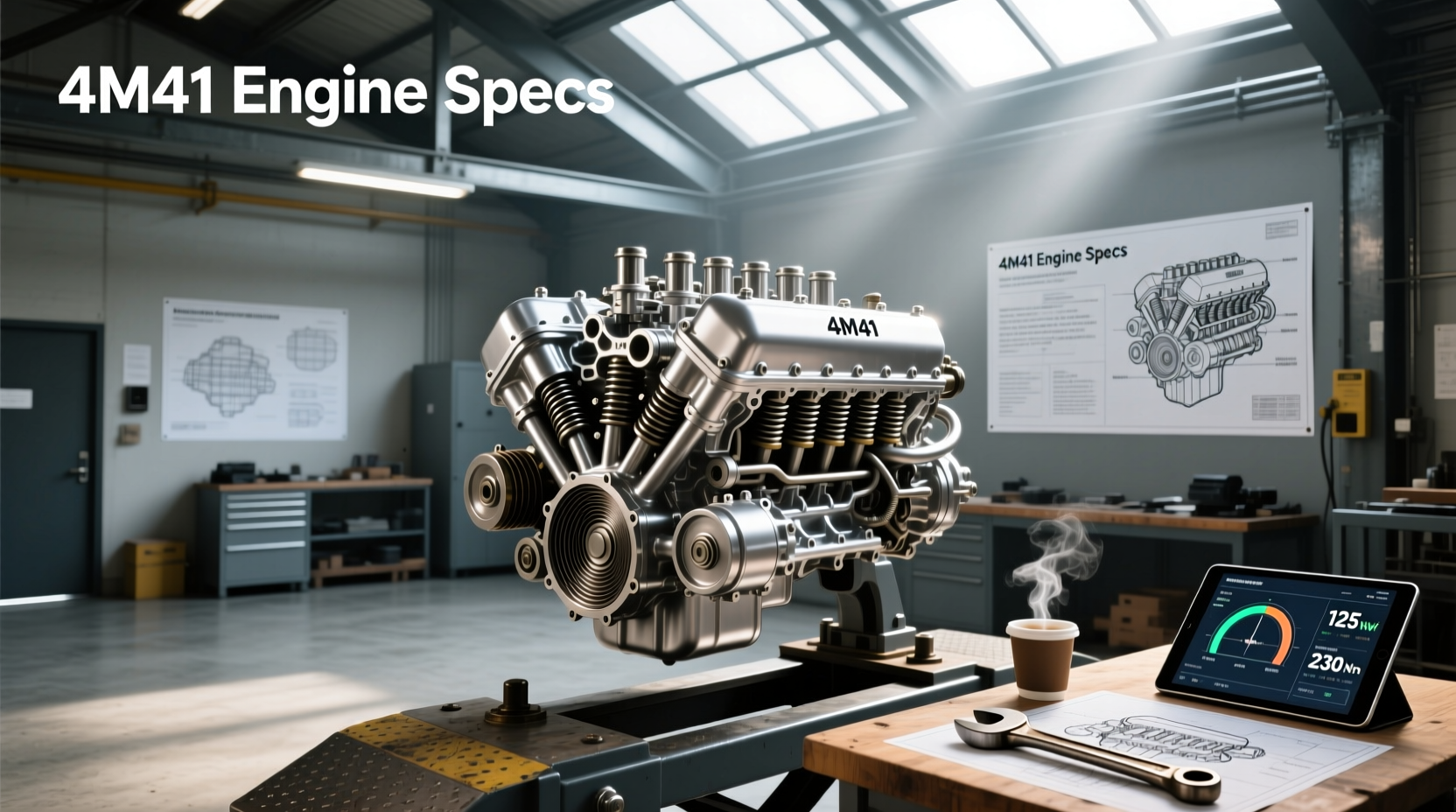
The Mitsubishi 4M41 engine is a 3.2L inline-4 turbocharged diesel known for its durability, strong low-end torque, and widespread use in off-road SUVs like the Mitsubishi Pajero (Shogun/Montero) and L200 (Triton/Strada). With Common Rail Direct Injection (CRDi) and Variable Geometry Turbo (VGT) technology, this engine delivers between 160 and 200 horsepower depending on the model year and market 1. Understanding the full 4M41 engine specifications helps buyers assess longevity, maintenance needs, and suitability for towing or overlanding applications.
Overview of the Mitsubishi 4M41 Diesel Engine
Introduced in the early 2000s as a successor to the 4M40, the 4M41 was designed to meet stricter emissions standards while improving fuel efficiency and power delivery. It's part of Mitsubishi’s 4M4 series of four-cylinder diesel engines and stands out for its cast iron block, aluminum head, and advanced fuel injection system. The engine has been used globally in both passenger and commercial variants of key Mitsubishi models, particularly where robustness and long-term reliability are prioritized.
This engine became especially popular in markets such as Australia, South Africa, the Middle East, and parts of Europe—regions with high demand for durable, serviceable diesel engines capable of handling rough terrain and extended highway driving.
Detailed 4M41 Engine Specifications
Below is a comprehensive technical specification table summarizing the core parameters of the 4M41 engine across various production years and configurations.
| Specification | Value / Detail |
|---|---|
| Engine Code | 4M41 |
| Type | Inline-4, SOHC, 16-valve |
| Displacement | 3.2L (3198 cc) |
| Bore × Stroke | 95 mm × 115 mm (3.74 in × 4.53 in) |
| Compression Ratio | 16.5:1 – 18.0:1 (varies by variant) |
| Fuel System | Denso Common Rail Direct Injection (Di-D) |
| Turbocharger | Variable Geometry Turbo (VGT), intercooled |
| Max Power Output | 120–150 kW (160–200 hp) |
| Max Torque | 340–430 Nm (250–317 lb-ft) |
| Cooling System | Water-cooled |
| Lubrication | Wet sump, pressure-fed |
| Timing Drive | Timing chain (non-interference design) |
| Fuel Type | Diesel (ULSD compatible) |
| Emissions Standard | Euro 3 to Euro 5 (depending on model year) |
These specs reflect the evolution of the engine from its initial release around 2000 through its peak usage up to 2020s in select markets. Notably, later versions improved emissions control without sacrificing real-world drivability—a rare balance in modern diesel engineering.
Power Output Variants by Model and Market
One of the most frequently asked questions about the 4M41 is: How much horsepower does a 4M41 have? The answer depends heavily on the vehicle model, region, and emission standard.
- Pajero (Gen 3 & Gen 4): Typically rated at 170 PS (125 kW / 168 hp) with 343 Nm of torque. Some later European models reached 190 hp due to updated tuning.
- L200/Triton (2006–2015): Offered in multiple tunes—160 hp (base), 175 hp (mid), and up to 197 hp in certain export markets.
- Commercial Derivatives: Lower-tuned versions exist for fleet use, often capped at 160 hp for better fuel economy and reduced stress.
This variation highlights that when evaluating a used vehicle with a 4M41 engine, it's essential to verify the exact specification based on VIN or factory data plate rather than assuming uniform performance.
Common Applications: What Vehicles Use the 4M41 Engine?
The 4M41 engine powers several well-known Mitsubishi models, primarily those built for rugged use:
- Mitsubishi Pajero (Third and Fourth Generations) – Sold as Shogun in the UK and Montero in Latin America
- Mitsubishi L200 (also known as Triton or Strada in different regions)
- Select Mitsubishi Delica vans in diesel configurations
- Some industrial and marine auxiliary units (rare)
In all these applications, the engine is paired with either a 5-speed manual or a 5-speed automatic transmission. Four-wheel-drive systems vary but typically include dual-range transfer cases and mechanical locking differentials—making them ideal for off-grid adventures.
Is the 4M41 Engine Reliable? Real-World Longevity Insights
⚙️ Yes, the 4M41 is generally considered reliable, especially when maintained properly. Many owners report exceeding 300,000 km (186,000 miles) without major repairs. However, longevity hinges on consistent oil changes, clean fuel, and timely servicing of critical components.
Factors contributing to reliability:
- Robust internal construction: Cast iron block provides excellent rigidity and heat tolerance.
- Non-interference design: If the timing chain fails, there's minimal risk of valve-to-piston contact, reducing repair costs.
- Servicability: Unlike many modern diesels, the 4M41 allows access to most components without extensive disassembly.
However, neglect can lead to accelerated wear—especially in hot climates or dusty environments where air and fuel filtration become critical.
Known Issues and Maintenance Pain Points
No engine is immune to problems, and the 4M41 has a few recurring concerns users should be aware of before purchase or long-term ownership.
1. Timing Chain Stretch and Failure
❗ While the timing chain is designed to last the life of the engine, some early models (pre-2007) experienced premature stretch due to inadequate tensioner design. Symptoms include rough idle, misfires, and eventually loss of compression.
Solution: Replace the entire timing kit (chain, guides, tensioner) proactively at 200,000 km or if noise develops from the front cover. Always check alignment marks and tone wheel positioning during reassembly 2.
2. EGR and DPF Clogging (Later Models)
Starting around 2010, emissions regulations required EGR (Exhaust Gas Recirculation) and DPF (Diesel Particulate Filter) systems on certain markets. These can clog if the vehicle isn’t driven long enough to reach regeneration temperatures.
Tips:
- Avoid short trips exclusively; aim for highway runs every few weeks.
- Use low-ash (C2/C3) diesel oil to reduce soot buildup.
- Consider retrofitting with an EGR delete only where legal (not advised for road-registered vehicles).
3. Oil Cooler Cracks
🧼 A known weak point is the factory oil cooler mounted near the block. Over time, thermal cycling can cause cracks, leading to coolant-diesel mixing—an issue that risks catastrophic engine damage.
Prevention: Inspect regularly for leaks or milky residue in the oil. Replacement with an upgraded aftermarket unit is recommended during major services.
4. Fuel Injector Failures
⚡ High-pressure common rail injectors are sensitive to poor fuel quality. In regions with inconsistent diesel standards, coking and nozzle wear are common after 150,000+ km.
Mitigation: Use fuel additives periodically and refuel only at reputable stations. Rebuilt or new Denso-pattern injectors cost $150–$300 each.
Fuel Efficiency and Real-World Consumption
📊 Average fuel consumption for the 4M41 varies significantly based on driving style, load, and terrain:
- City Driving: 10–13 L/100km (18–23 mpg)
- Highway Cruising: 8–9.5 L/100km (25–29 mpg)
- Off-Road / Towing: 13–16 L/100km (15–18 mpg)
These figures make the 4M41 competitive with other mid-size diesel SUVs of its era. Its flat torque curve means fewer gear changes and smoother acceleration under load.
Performance Upgrades and Tuning Potential
✨ Enthusiasts often ask whether the 4M41 can be modified for more power. The good news is that it responds well to conservative upgrades thanks to its sturdy internals.
- ECU Remapping: Can increase output to 220 hp and 500 Nm safely, provided cooling and transmission are in good condition.
- Upgraded Intercooler: Reduces intake temps, especially beneficial in desert climates.
- Free-Flow Exhaust: Minor gains in efficiency and sound; avoid oversized pipes that reduce backpressure too much.
- Boost Control Valve: Allows fine-tuning of VGT behavior for quicker spool-up.
⚠️ Caution: Aggressive tuning without supporting mods (like enhanced cooling or strengthened clutch) may shorten engine life.
Replacement Parts Availability and Cost
🛒 Sourcing genuine or high-quality aftermarket parts is relatively straightforward. Major suppliers offer complete kits for rebuilds, including gaskets, pistons, bearings, and timing components.
Common replacement costs (as of 2024):
- Timing Chain Kit: $200–$400
- Fuel Injector (each): $150–$300
- Oil Cooler Assembly: $120–$250
- Complete Engine (used): $3,000–$5,000 USD
- Rebuilt Long Block: $4,000–$6,000 USD
🔧 Labor costs vary widely by country. In North America or Western Europe, expect $1,500–$3,000 for complex jobs like timing chain replacement. In Southeast Asia or Eastern Europe, the same job might cost under $800.
Used Engine Buying Tips
If you're considering a used 4M41 engine—for replacement or project build—here’s what to verify:
- Service History: Look for stamped logbooks or digital records showing regular oil and filter changes.
- Compression Test Results: Should read within 10% across all cylinders (typically 350–400 psi).
- Leak Inspection: Check for oil seepage around the valve cover, rear main seal, and oil cooler.
- Smoke Test: Blue smoke indicates worn piston rings; white smoke suggests coolant leak.
- VIN Match: Ensure compatibility with your model year and emissions standard.
📍 Tip: Engines removed from low-mileage wrecks or fleet vehicles often provide better value than privately sold units with unknown pasts.
Comparison with Competitors: How Does the 4M41 Stack Up?
Let’s compare the 4M41 against similar diesel engines from Toyota, Nissan, and Isuzu:
| Engine | Displacement | Max Power | Max Torque | Key Strengths |
|---|---|---|---|---|
| Mitsubishi 4M41 | 3.2L | 200 hp | 430 Nm | Durable block, simple design, good tuning headroom |
| Toyota 1KD-FTV (4.0L I4) | 3.0L | 170 hp | 343 Nm | Excellent reliability, but limited tuning potential |
| Nissan YD25DDTi | 2.5L | 190 hp | 450 Nm | Strong low-end torque, but complex electronics |
| Isuzu 4JJ1-TCX | 3.0L | 190 hp | 430 Nm | Proven durability, widely used in D-Max and MU-X |
The 4M41 holds its own with solid power delivery and mechanical simplicity. While newer engines may offer better refinement or emissions compliance, the 4M41 remains favored among off-road purists who prioritize repairability over tech integration.
Environmental Considerations and Future Viability
🌍 As urban centers implement low-emission zones, older diesel vehicles face increasing restrictions. The 4M41, particularly pre-Euro 5 models, may encounter access limitations in cities like London, Berlin, or Paris.
Owners should consider:
- Checking local regulations before purchasing or importing.
- Using ultra-low sulfur diesel (ULSD) to minimize particulates.
- Installing auxiliary filters (e.g., diesel oxidation catalysts) to improve emissions profile.
Despite regulatory pressures, the 4M41 continues to thrive in rural and developing markets where infrastructure favors mechanical reliability over connectivity.
Frequently Asked Questions (FAQs)
Does the 4M41 engine have a timing belt or chain?
The 4M41 uses a timing chain, not a belt. It’s designed to last the engine’s lifetime but can stretch prematurely in poorly maintained units. Proactive replacement at 200,000 km is advisable.
How many kilometers will a 4M41 engine last?
With proper maintenance, the 4M41 commonly reaches 300,000–400,000 km. Some examples exceed 500,000 km with rebuilt turbos and injectors. Regular oil changes and clean fuel are crucial.
What causes 4M41 engine failure?
Major causes include neglected oil changes, coolant contamination (from cracked oil cooler), fuel contamination, and failure to address turbo or EGR issues early. Preventive maintenance prevents most failures.
Can the 4M41 engine be swapped into other vehicles?
Yes, though it requires significant fabrication. Popular swaps include older Land Cruisers, Broncos, and custom 4x4 builds. Transmission compatibility, mounts, and ECU integration must be addressed.
Is the Mitsubishi 4M41 better than the 4M40?
Generally yes. The 4M41 offers higher power, better fuel economy, lower emissions, and improved NVH (noise, vibration, harshness) thanks to common rail injection and VGT. However, the 4M40 is simpler and less expensive to repair.





 浙公网安备
33010002000092号
浙公网安备
33010002000092号 浙B2-20120091-4