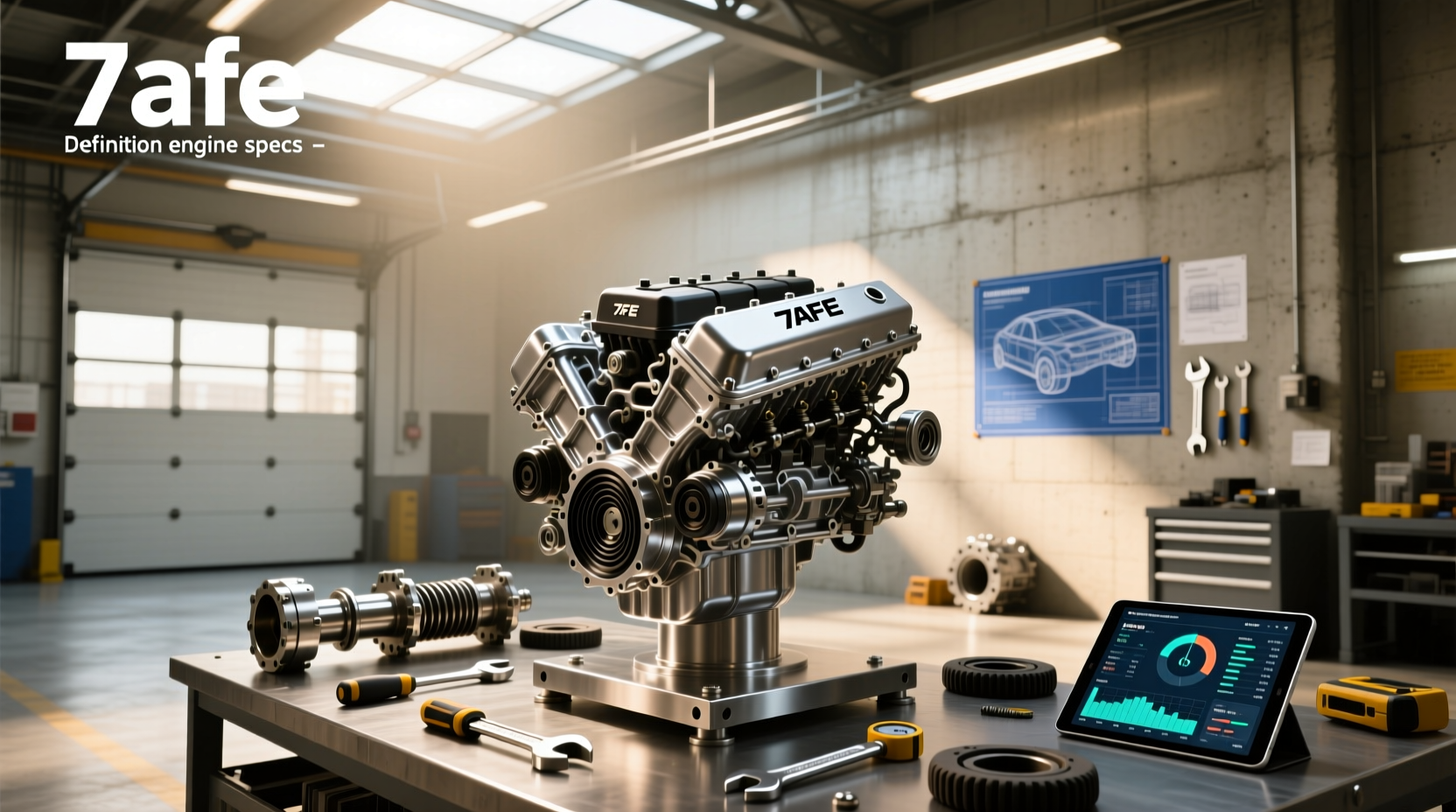
If you're searching for 7afe engine specs, you're likely evaluating this Toyota powerplant for a repair, swap, or performance upgrade. The 7A-FE is a 1.8L DOHC inline-four gasoline engine produced by Toyota from 1993 to 2002, known for its reliability and widespread use in models like the Corolla (AE101, AE102), Carina, and Celica. With a factory-rated output of approximately 115 horsepower and 110 lb-ft of torque, it offers balanced daily driving performance with excellent fuel efficiency and durability under normal conditions1. This guide breaks down every technical detail, real-world performance traits, common issues, tuning potential, and direct comparisons with related engines like the 4A-FE and 4A-GE to help you make informed decisions.
What Is the 7A-FE Engine?
The 7A-FE engine belongs to Toyota’s A-series family of inline-four engines, which includes variants such as the 3A, 4A, 5A, and 7A. Introduced in the early 1990s, the 7A-FE was designed as a durable, fuel-efficient engine for compact and mid-size sedans. It replaced earlier 1.6L engines in many markets where slightly more power and torque were desired without sacrificing economy.
Unlike high-performance versions like the 4A-GE, the 7A-FE focuses on smoothness, longevity, and ease of maintenance. Its designation breaks down as follows:
- 7A: Seventh generation of the A-series four-cylinder engine
- F: Engine configuration (DOHC, 16-valve)
- E: Electronic Fuel Injection (EFI)
This naming convention helps identify key characteristics at a glance—important when sourcing parts or comparing across models.
Detailed 7AFE Engine Specifications
Below is a comprehensive breakdown of the official 7AFE engine specs based on manufacturer data and verified service manuals:
| Specification | Value |
|---|---|
| Engine Code | 7A-FE |
| Configuration | Inline-4, DOHC, 16-valve |
| Displacement | 1.8 L (1762 cc) |
| Bore × Stroke | 81.0 mm × 85.0 mm |
| Compression Ratio | 9.5:1 |
| Max Power Output | 115 hp @ 5,600 rpm (86 kW) |
| Max Torque | 110 lb-ft @ 4,400 rpm (149 Nm) |
| Fuel System | Sequential Multi-Point Fuel Injection (SFI) |
| Valvetrain | DOHC, belt-driven |
| Redline | 6,200 rpm |
| Oil Capacity | 3.7 quarts (with filter) |
| Ignition System | Distributorless (waste spark) |
| Cooling System | Liquid-cooled |
| Engine Weight (dry) | Approx. 135 kg (298 lbs) |
These specifications highlight the engine's focus on low-to-mid range torque delivery, making it well-suited for city driving and highway cruising alike. While peak power arrives relatively late at 5,600 rpm, the flat torque curve ensures responsive acceleration in everyday scenarios.
Common Applications: Which Cars Used the 7AFE Engine?
The 7A-FE was primarily used in Japanese domestic market (JDM) and international export models during the 1990s and early 2000s. Key vehicles include:
- Toyota Corolla (AE101, AE102, AE111 – sedan, hatchback)
- Toyota Carina (AT190 series)
- Toyota Celica (T180 – ST180/ST181)
- Toyota Corona (ST190)
- Toyota Sprinter (AE101)
In North America, the 7A-FE saw limited availability, with most Corollas using the 4A-FE or later VVT-i engines. However, it remains popular among import enthusiasts and those restoring JDM models. In regions like South Africa, the Middle East, and Southeast Asia, the 7A-FE-equipped Corolla became a staple due to its mechanical simplicity and resistance to harsh operating conditions.
Performance Characteristics: How Does the 7AFE Drive?
While not built for sporty performance, the 7A-FE delivers predictable and consistent behavior. Drivers often describe it as “torquey” for a naturally aspirated 1.8L engine, especially when compared to the smaller 1.6L 4A-FE. The longer stroke contributes to better low-end pull, reducing the need to rev hard in traffic.
Real-world testing shows that a stock AE102 Corolla with a 7A-FE can achieve 0–60 mph in around 10.5 seconds, depending on transmission type (manual vs automatic) and vehicle weight. Top speed is electronically limited to about 112 mph (180 km/h) in most configurations.
Fuel economy averages between 28–34 mpg (city/highway), with some owners reporting over 35 mpg on long highway trips. This efficiency stems from conservative tuning, a moderate compression ratio, and lightweight internals.
Reliability and Longevity: Is the 7AFE a Good Engine?
✅ Yes—the 7A-FE has earned a strong reputation for durability. Many examples exceed 200,000 miles (320,000 km) with only routine maintenance. Key factors contributing to its longevity include:
- Simple, proven design with minimal electronic complexity
- Robust bottom end with forged steel crankshaft and cast aluminum pistons
- Timing belt (replaced every 60,000–90,000 miles) protects valves in non-interference design
- Few known weak points when maintained properly
However, neglect can lead to issues. Common failure points include:
- Intake manifold gasket leaks: Can cause vacuum leaks and rough idle
- Throttle body carbon buildup: Leads to hesitation and poor idle control
- Ignition coil packs: Prone to cracking over time, causing misfires
- Coolant temperature sensor degradation: Results in incorrect fuel mixture and cold-start problems
Regular oil changes, air filter replacements, and cooling system flushes go a long way in preserving engine health. Compression tests typically show 180–210 psi per cylinder in good condition, indicating healthy ring seal and valve seating.
Tuning and Modification Potential
Although the 7A-FE wasn’t designed as a performance engine, it offers modest gains through bolt-on upgrades. Popular modifications include:
- Cold Air Intake (CAI): Improves airflow and throttle response ⚡
- Exhaust Header + Cat-Back System: Reduces backpressure and enhances scavenging
- ECU Reflashing or Piggyback Tuner: Adjusts fuel and timing maps for modified components
- Lightweight Pulleys: Frees up parasitic loss for slight power increase
- Performance Camshafts: Increases valve lift/duration for higher RPM power
With these upgrades, outputs can reach 130–140 hp at the crank. For greater gains, forced induction is possible but requires supporting mods:
- Turbocharger kit (e.g., T25 or GT28RS)
- Higher-flow fuel injectors (270–310 cc/min)
- Upgraded fuel pump and regulator
- Intercooler and reinforced cooling system
- Standalone engine management (e.g., Haltech, Link, or MegaSquirt)
When tuned conservatively, turbocharged 7A-FE builds reliably produce 180–220 hp. However, exceeding factory boost levels significantly reduces engine lifespan unless internal components (pistons, rods) are upgraded.
Comparison: 7AFE vs 4AFE vs 4AGE
Many users search for what is the difference between 4age and 7afe, so a side-by-side comparison clarifies their roles:
| Feature | 7A-FE | 4A-FE | 4A-GE |
|---|---|---|---|
| Displacement | 1.8L (1762cc) | 1.6L (1587cc) | 1.6L (1587cc) |
| Power (Stock) | 115 hp | 105–110 hp | 130–165 hp |
| Torque | 110 lb-ft | 100–105 lb-ft | 100–105 lb-ft |
| Redline | 6,200 rpm | 6,200 rpm | 7,600–8,200 rpm |
| Cam Profile | Mild, economy-focused | Moderate | Aggressive (high-lift) |
| Target Use | Daily driver, reliability | Balanced economy/performance | Sporty driving, track use |
The 7A-FE trades high-RPM excitement for stronger low-end torque than both 4A variants. The 4A-GE, particularly the "Red Top" or "Black Top," is vastly more performance-oriented with twin cams, high compression, and advanced intake systems (e.g., T-VIS). Meanwhile, the 4A-FE shares the same architecture as the 7A-FE but in a smaller displacement package.
Engine Swaps: Is the 7AFE a Good Swap Candidate?
🔧 The 7A-FE is a viable candidate for certain engine swaps, especially in older Toyotas originally equipped with 4A or 5A engines. Benefits include:
- Increased displacement without major chassis modifications
- Direct fitment into AE86, AE92, and other A-platform cars with minor fabrication
- Compatibility with factory ECU and harness in some cases
- Affordable donor engines available globally
However, consider these challenges:
- Heavier than 1.6L engines—may affect front/rear weight balance
- Requires updated wiring loom if moving from carbureted or distributor-based systems
- Radiator and cooling lines may need repositioning
- Transmission compatibility: W55, S53, or C56 gearboxes commonly used
For budget-friendly daily drivers or mild performance restorations, the 7A-FE swap makes sense. Enthusiasts seeking higher performance usually opt for the 4A-GE or modern K-series swaps instead.
Common Misconceptions About the 7AFE
Despite its popularity, several myths persist:
- Myth: The 7A-FE is an interference engine. ❌ False. It is a non-interference design—timing belt failure won’t bend valves.
- Myth: It’s just a bored-out 4A-FE. ❌ Not entirely accurate. While sharing basic architecture, the 7A has a longer stroke, different block casting, and revised head flow.
- Myth: No tuning potential. ✅ Debunked. As shown, moderate NA or forced induction builds are feasible with proper support.
- Myth: Only found in Corollas. ❌ Incorrect. Also used in Celicas, Carinas, and Coronas.
How to Source a 7AFE Engine
🛒 Whether replacing a failed unit or planning a project, sourcing options include:
- Junkyards / Salvage Yards: Cost-effective, often with low mileage
- Online Marketplaces: Platforms like eBay list complete engines with accessories
- Used Engine Suppliers: Companies specializing in tested, warrantied units
- Alibaba / Export Dealers: Global suppliers offering Japanese-used engines with shipping 🚚
When purchasing, verify:
- Actual mileage and ownership history
- Compression test results (should be within 10% across cylinders)
- Presence of all sensors, manifolds, and brackets
- Leak-free oil pan and valve cover
- Last service date and fluid condition
Pricing varies by region: $500–$1,200 USD for a bare long block; $1,500+ for complete turnkey units with ECU and harness.
Maintenance Tips for Maximum Longevity
To keep your 7A-FE running smoothly for years, follow these best practices:
- ✅ Change engine oil every 5,000 miles (or 6 months), preferably with 10W-30 or 5W-30 synthetic blend
- ✅ Replace timing belt, water pump, and tensioners every 75,000 miles ⏱️
- ✅ Clean throttle body and MAF sensor annually to prevent drivability issues 🧼
- ✅ Flush coolant every 2 years to protect aluminum components from corrosion 🔧
- ✅ Inspect spark plugs and wires every 30,000 miles; replace with OEM-type iridium plugs
- ✅ Use top-tier gasoline to minimize carbon deposits in combustion chambers
Keeping records of all services helps diagnose future problems and increases resale value if selling the engine or vehicle.
Frequently Asked Questions (FAQs)
- How much horsepower does a 7AFE engine have?
- The stock 7A-FE produces 115 horsepower at 5,600 rpm and 110 lb-ft of torque at 4,400 rpm. Output may vary slightly depending on model year and emissions tuning.
- What is the difference between 4AFE and 7AFE?
- The main differences are displacement (1.6L vs 1.8L), torque output, and bore/stroke dimensions. The 7A-FE has more low-end pulling power, while the 4A-FE is lighter and slightly more fuel-efficient.
- Is the 7AFE engine reliable?
- Yes, the 7A-FE is highly reliable when maintained properly. It commonly lasts beyond 200,000 miles with regular oil changes and timely timing belt replacement.
- Can you turbocharge a 7AFE engine?
- Yes, the 7A-FE can be turbocharged. Successful builds require upgraded fuel delivery, intercooling, and engine management. Conservative setups yield 180–220 hp reliably.
- Which Toyota models have the 7AFE engine?
- The 7A-FE was used in the Toyota Corolla (AE101/102), Carina (AT190), Celica (ST180), and Corona (ST190), primarily in international markets from 1993 to 2002.





 浙公网安备
33010002000092号
浙公网安备
33010002000092号 浙B2-20120091-4