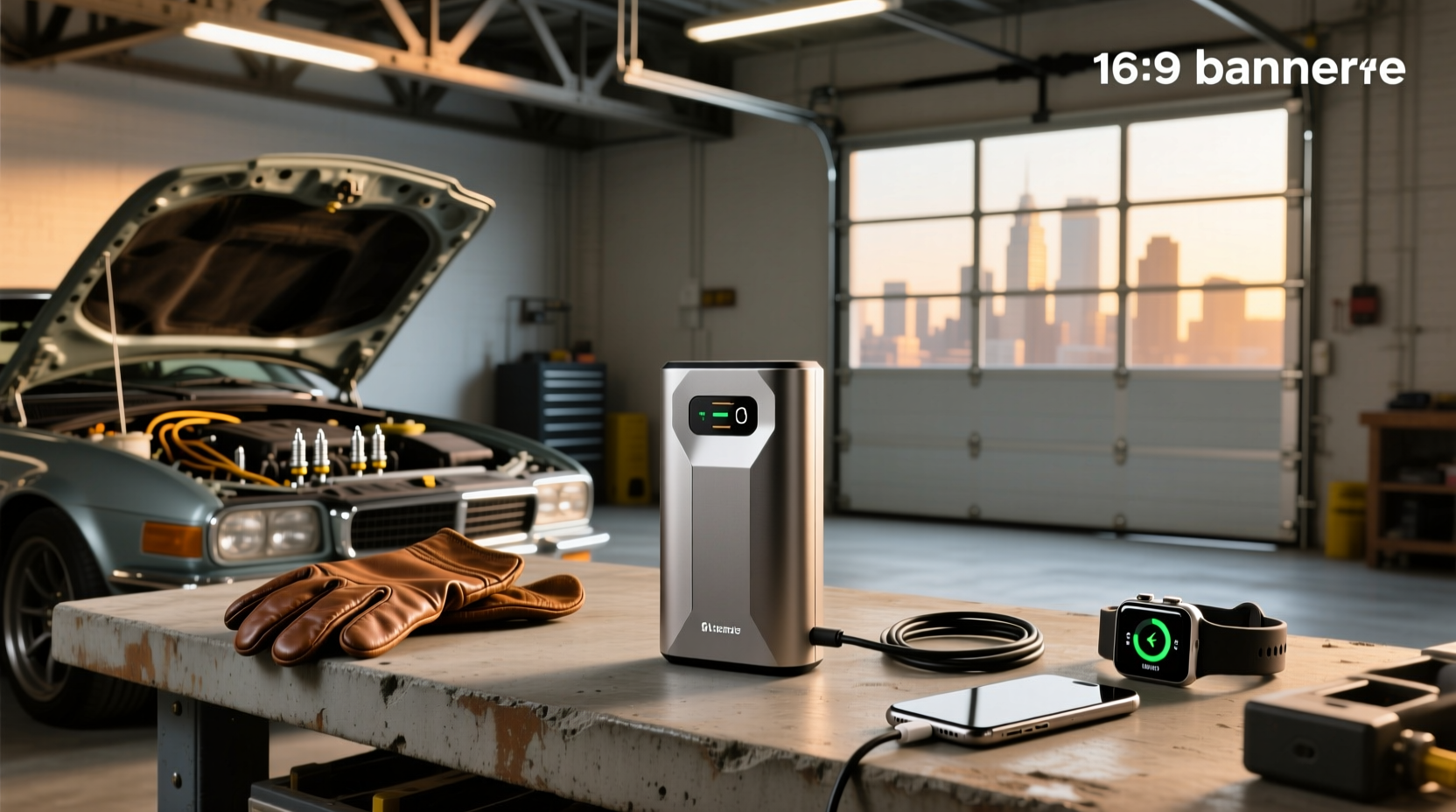
⚡ A batteryless jump starter uses supercapacitor technology instead of a lithium-ion or lead-acid battery to deliver a powerful burst of energy capable of starting a vehicle—even with a completely dead battery. Unlike traditional portable jump starters that rely on stored chemical energy, these devices charge in minutes and provide instant power when needed. This makes them ideal for quick roadside assistance, especially in extreme temperatures where conventional batteries underperform.
If you've ever been stranded with a no-start vehicle in freezing cold or scorching heat, you know how critical fast, reliable jump-starting can be. The growing popularity of capacitor jump starters stems from their ability to overcome common limitations of battery-powered models—no memory effect, minimal degradation over time, and rapid recharge from weak sources like solar panels or alternators. But do they really work? And are they worth replacing your trusty LiFePO4 pack?
What Is a Batteryless Jump Starter?
A batteryless jump starter, also known as a supercapacitor jump starter, operates using high-capacity capacitors rather than electrochemical cells. Capacitors store electrical energy directly in an electric field between two conductive plates, allowing near-instantaneous charging and discharging cycles 1. This fundamental difference gives them unique performance traits compared to standard lithium-ion (Li-Ion) or lithium iron phosphate (LiFePO4) jump starters.
These units typically feature:
- ⚡ Rapid charge time: Full recharge in 1–5 minutes
- 🔋 No internal battery: Eliminates long-term capacity loss
- 🌡️ Wide operating temperature range: Often functional from -40°C to +65°C
- 🔄 Thousands of charge/discharge cycles without degradation
- 🔌 Ability to draw charge even from deeply depleted vehicle batteries
This makes them particularly useful in commercial fleets, remote worksites, and emergency response scenarios where reliability under stress is paramount.
How Does a Capacitor-Based Jump Starter Work?
The core principle behind a supercapacitor jump starter lies in physics, not chemistry. When connected to a power source—even one with very low voltage—a capacitor begins accumulating electrons almost immediately. Once charged, it releases all stored energy in a sudden surge, which is exactly what’s required to turn over an engine starter motor.
Here's the step-by-step process:
- 🔌 Connect the device to any 12V DC source (e.g., cigarette lighter socket, weak car battery, solar charger).
- ⏱️ Wait 60–180 seconds while the supercapacitors charge.
- 📎 Attach jumper clamps securely to the correct battery terminals.
- 🚗 Start the engine—the capacitor dumps its full charge instantly to crank the motor.
- 🔁 Recharge the unit once the engine runs via alternator output.
Unlike battery-based jump starters, which require periodic full recharges and suffer from self-discharge over time, capacitor models remain ready indefinitely because they don’t hold a charge chemically. They only build up energy moments before use.
Advantages of Batteryless Jump Starters
| Feature | Capacitor Jump Starter | Battery-Powered Jump Starter |
|---|---|---|
| Charge Time | 1–5 minutes | 30 minutes – 6 hours |
| Lifespan (Cycles) | 50,000+ cycles | 500–2,000 cycles |
| Cold Weather Performance | Excellent (-40°C) | Fair to Poor (reduced capacity below 0°C) |
| Self-Discharge Rate | Negligible (discharges when not in use) | 5–10% per month |
| Maintenance Needs | None | Periodic charging recommended |
| Safety Risk | Low (no thermal runaway) | Moderate (fire risk if damaged/overcharged) |
✅ Key benefits include:
- Rapid readiness: You don't need to pre-charge weeks in advance; just plug into any available 12V source minutes before attempting a start.
- Longevity: Supercapacitors degrade far more slowly than lithium batteries, making them suitable for industrial or fleet applications.
- Extreme environment resilience: Operates reliably in sub-zero arctic conditions or desert heat where batteries fail.
- No shelf-life concerns: Ideal for emergency kits that may sit unused for years.
- Safe charging from weak sources: Can pull micro-currents from nearly-dead batteries that wouldn't register enough voltage to charge a Li-Ion pack.
Limitations and Real-World Considerations
Despite their advantages, capacitor jump starters aren't perfect for every user. Understanding their limitations helps avoid frustration during emergencies.
Shorter Cranking Duration
One major drawback is limited cranking time. While supercapacitors deliver immense peak current (some claim up to 6000A), they discharge fully within 1–3 seconds. If the engine doesn’t start in that window, you must wait another 1–2 minutes to recharge before trying again.
This contrasts with battery-powered units, which can sustain multiple longer cranks due to higher total energy storage (measured in watt-hours). For older engines requiring extended turnover or vehicles with flooded carburetors, this can be a serious constraint.
Lower Total Energy Capacity
Supercapacitors excel at delivering power (watts), but lack energy capacity (watt-hours). That means they’re great for jump-starting but poor as multi-function power banks. Most batteryless models offer little to no USB output or auxiliary charging ports—unlike modern Li-Ion jump starters that double as phone chargers or power tools.
Potential Compatibility Issues
Some users report issues with vehicles equipped with sensitive electronics or start-stop systems. Because capacitor units release energy so abruptly, there’s a theoretical risk of voltage spikes. However, most reputable models now include built-in regulators and reverse polarity protection to mitigate this.
Higher Initial Cost
Due to advanced materials and circuitry, high-amperage capacitor jump starters often cost more upfront than comparable battery-based units. Prices commonly range from $150–$500+, depending on peak current rating and durability features.
When Should You Use a Batteryless Jump Starter?
📌 These devices shine in specific scenarios:
- Fleet maintenance: Trucks, buses, mining equipment, and agricultural machinery benefit from durable, always-ready units.
- Emergency services: Fire departments, roadside assistance crews, and military units value reliability after long storage periods.
- Cold climate operation: In regions with harsh winters, capacitor jump starters outperform lithium batteries that lose efficiency below freezing.
- Solar or off-grid setups: Their ability to charge from low-power sources makes them compatible with solar trickle chargers or small generators.
However, for average drivers who want a compact, multi-purpose tool for occasional home use, a LiFePO4 jump starter might still be more practical due to added features like flashlight modes, USB-C outputs, and sustained cranking capability.
How to Choose the Right Batteryless Jump Starter
Selecting the best model involves evaluating several technical and practical factors:
Peak Amperage Rating
Look for at least 750A–1000A peak current for gasoline engines up to 6.0L or diesel engines up to 4.0L. Larger engines (e.g., V8s, heavy-duty trucks) may require 1500A+ models. Be cautious of inflated marketing claims—check independent reviews or test data if available.
Voltage Compatibility
Most consumer-grade capacitor jump starters support 12V systems. Some industrial versions also handle 24V vehicles (common in trucks, construction gear, and military transport). Ensure compatibility with your vehicle type.
Charging Input Options
Check how the unit charges. Common inputs include:
- OBD2 port (via included adapter)
- Cigarette lighter socket
- Alligator clips to weak battery
- External DC power supply (e.g., wall adapter, solar panel)
Units with OBD2 charging are convenient since they integrate directly with the vehicle’s diagnostics system and prevent incorrect connections.
Durability and Build Quality
🔧 Since these tools are often used in tough environments, look for rugged casing, IP-rated protection against dust and moisture, and clamp insulation rated for high voltages. Rubberized grips and secure cable routing help prevent damage during field use.
Safety Features
Mandatory protections should include:
- Reverse polarity warning/shutdown
- Overcurrent protection
- Spark-proof technology
- Short-circuit prevention
- Thermal overload cutoff
Always verify these features are present before purchase.
Common Misconceptions About Capacitor Jump Starters
❓ Despite increasing adoption, several myths persist about how these devices function and affect vehicle systems.
Myth 1: "They Damage Your Car Battery"
❌ False. A properly designed capacitor jump starter does not backfeed into or damage your existing battery. It provides a temporary boost to the starter circuit, much like connecting jumper cables from another car. Many models actually include safeguards that prevent activation if the host battery voltage is too low (typically below 8–9V), avoiding strain on severely degraded cells.
Myth 2: "They’re Just Gimmicks with Fake Specs"
⚠️ Partially true—but misleading. While some budget brands exaggerate amperage ratings, legitimate engineering exists behind high-end models used in professional settings. Independent testing shows real-world success rates exceeding 90% for engines within specified limits 2.
Myth 3: "You Need a Running Vehicle to Charge Them"
❌ Incorrect. Supercapacitors can charge from very low-voltage sources. Even a nearly dead battery (as low as 3–5V) can transfer enough energy to charge the unit in 2–3 minutes, provided the connection path has low resistance.
Tips for Using a Batteryless Jump Starter Effectively
To maximize success during an emergency start:
- ✅ Turn off all accessories (lights, radio, AC) before attempting a jump.
- ✅ Clean battery terminals to ensure solid contact.
- ✅ Charge the unit for the full recommended duration—even if lights indicate ‘ready’ early.
- ✅ Clamp red to positive (+), black to negative (-) or grounded metal surface.
- ✅ Attempt startup within 30 seconds of disconnecting the charger to minimize discharge loss.
- ✅ After starting, let the engine run for at least 10 minutes to recharge the vehicle battery.
Are Batteryless Jump Starters Worth It?
The answer depends on your use case.
For professional mechanics, tow truck operators, or off-grid adventurers, the longevity, speed, and environmental tolerance of a supercapacitor jump starter make it a smart investment. Its maintenance-free design ensures decades of service with zero capacity fade.
For casual drivers seeking peace of mind in the trunk, a mid-range LiFePO4 jump starter may offer better value with added convenience features and longer cranking times.
Ultimately, both technologies have merit. The key is matching the tool to your actual needs—not just the highest amperage number on the box.
Frequently Asked Questions (FAQs)
- Can a capacitor jump starter start a car with a completely dead battery?
- Yes, provided the capacitor unit itself can draw enough charge from an external source (like an OBD2 port or solar panel). It doesn’t rely on the car’s battery being functional—only on having a conductive path to ground and positive.
- How long does it take to charge a batteryless jump starter?
- Most models fully charge in 60 to 180 seconds when connected to a viable 12V source. Charging time may increase slightly if the source voltage is very low.
- Do supercapacitor jump starters require maintenance?
- No. Unlike lithium batteries, they don’t degrade with storage and require no periodic recharging. Just keep the clamps clean and inspect cables for wear.
- Can I leave a batteryless jump starter plugged in overnight?
- It’s unnecessary and potentially risky. These devices charge extremely fast and should be disconnected once full. Leaving them connected indefinitely could stress onboard electronics or wiring.
- Are capacitor jump starters safer than lithium-ion ones?
- In terms of fire risk, yes. Supercapacitors don’t experience thermal runaway like lithium batteries. However, improper use (e.g., reverse polarity) can still damage vehicle electronics regardless of type.





 浙公网安备
33010002000092号
浙公网安备
33010002000092号 浙B2-20120091-4