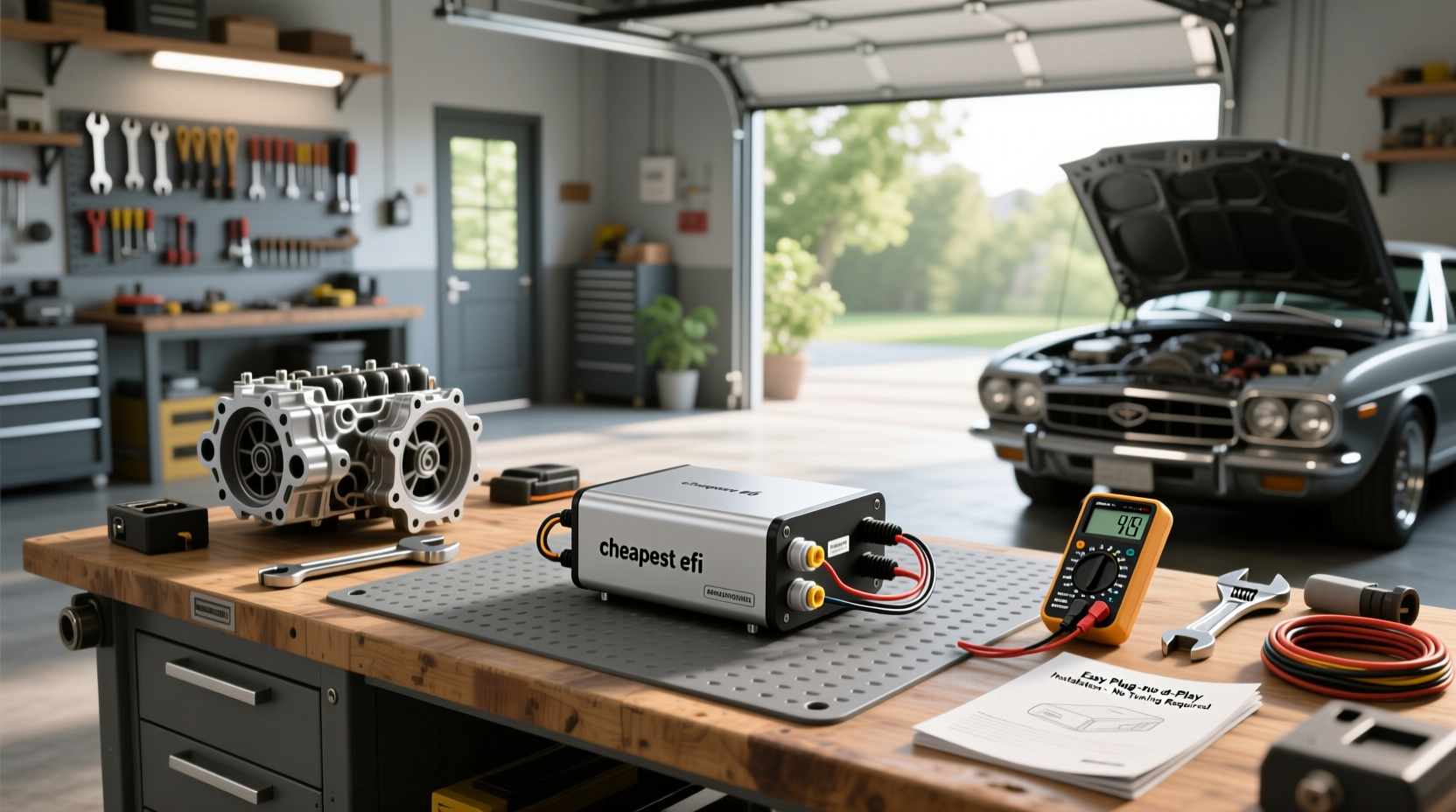
If you're searching for the cheapest EFI conversion kit to upgrade your classic car from a carburetor to electronic fuel injection (EFI), you’re not alone. Many enthusiasts are making the switch for improved drivability, fuel efficiency, and reliability. While budget-friendly options exist—such as throttle-body EFI systems from brands like FiTech, Holley Sniper, and Edelbrock—the true cost of conversion goes beyond the sticker price. Hidden expenses like fuel pump upgrades, wiring harnesses, ECU tuning, and sensor integration can significantly impact your total investment. This guide breaks down what makes an EFI kit truly affordable, compares top low-cost solutions, and helps you avoid common pitfalls when converting from carbureted to fuel-injected performance.
Why Convert from Carburetor to EFI?
🔧 For decades, carburetors were the standard for engine fuel delivery. However, they come with well-known limitations: inconsistent air-fuel ratios, sensitivity to temperature and altitude changes, hard starts, and frequent tuning needs. Electronic Fuel Injection (EFI) addresses these issues by using sensors, an Engine Control Unit (ECU), and precisely timed fuel injectors to optimize combustion under all conditions.
⚡ The benefits of switching include:
- Better fuel economy due to precise metering
- Smoother idle and throttle response \li> Easier cold starts, even in extreme weather
- Self-tuning capabilities in modern kits that adapt automatically
- Improved emissions and compliance with modern standards
- Enhanced performance tuning potential without mechanical adjustments
Despite these advantages, many owners hesitate—especially when faced with high upfront costs or complex installations. That’s where understanding the real cost of entry becomes essential.
Understanding What Makes an EFI Kit 'Cheap'
🛒 When evaluating the cheapest EFI conversion kit, it's critical to distinguish between initial purchase price and total installed cost. A $600 kit may seem like a bargain until you realize it requires a $300 fuel pump, $150 wiring harness, and several hours of fabrication.
📌 Key factors that influence overall affordability:
- Kit Completeness: Does it include ECU, sensors, harness, throttle body/injectors, and mounting hardware?
- Fuel System Requirements: Will your existing mechanical fuel pump suffice, or do you need an electric high-pressure unit?
- Installation Complexity: Can it be done DIY with basic tools, or does it require professional calibration?
- Tuning Method: Is it self-learning (like FiTech Go Street or FAST EZ-EFI), or does it require laptop-based tuning?
- Compatibility: Will it bolt onto your existing intake manifold, or require modifications?
✅ Truly affordable kits minimize add-on costs and simplify installation—making them ideal for weekend mechanics on a budget.
Top Budget-Friendly EFI Conversion Kits
Below is a breakdown of some of the most commonly cited low-cost EFI systems available today, based on market presence, user feedback, and component inclusion.
| Brand & Model | Approx. Price | HP Rating | Key Features | Best For |
|---|---|---|---|---|
| FiTech Go Street EFI | $780–$870 | 400 HP | Self-tuning, drop-in TBI, includes pump option | Small-block V8s, street rods |
| Holley Sniper 2 EFI | $1,200–$1,350 | 650 HP | Wi-Fi tuning, full kit, excellent support | GM small blocks, universal fit |
| Edelbrock Pro-Flo 4 XP | $1,900+ | 650+ HP | Port injection, advanced tuning, premium build | High-performance builds |
| Killshot Fusion EFI | $550 | 450 HP | Compact design, basic self-tune, minimal wiring | Small engines, budget swaps |
| FAST EZ-EFI 2.0 (Base Kit) | $2,900+ | 500 HP | Legacy self-tuning system, proven reliability | Classic muscle cars |
🔍 From this comparison, Killshot Fusion EFI and FiTech Go Street stand out as the lowest-cost complete solutions. However, note that Killshot lacks widespread third-party support and detailed documentation compared to more established brands.
Hidden Costs in Low-Cost EFI Conversions
❗ Many users underestimate the additional components required for a successful EFI conversion—even with a “complete” kit. Here are common hidden expenses:
- Fuel Pump Upgrade: Most EFI systems require 43–60 psi fuel pressure. Mechanical pumps typically deliver only 6–10 psi. An inline electric pump (e.g., Aeromotive, Holley, or DeatschWerks) adds $200–$500.
- Fuel Lines & Filters: Rubber lines aren’t safe for high-pressure fuel. You’ll likely need braided stainless lines or PTFE hoses ($100–$300).
- Wiring Harness Extensions: Some kits assume short runs; longer vehicles may need extensions or relays.
- MAP/TPS/O2 Sensors: While included in most kits, replacements or upgrades later can add cost.
- Mechanical Modifications: Clearance issues with throttle linkages, radiator hoses, or air cleaners may require custom brackets or spacers.
- ECU Mounting & Protection: The ECU should be mounted away from heat and moisture—often requiring enclosures or relocation kits.
🧰 Tip: To keep costs down, consider reusing compatible sensors from donor vehicles or sourcing used OEM parts from salvage yards.
Throttle Body vs. Port Injection: Which Is More Affordable?
⚙️ Two main types of EFI systems dominate the retrofit market: Throttle Body Injection (TBI) and Multi-Point (Port) Injection.
Throttle Body EFI (e.g., Holley Sniper, FiTech Go Street):
- Replaces the carburetor directly
- Bolts onto standard 4-barrel intake flanges
- Limited number of injectors (usually 1–2)
- Lower cost, simpler installation
- Slightly less efficient than port systems
Port EFI Systems (e.g., Edelbrock Pro-Flo 4, FAST XFI):
- Injects fuel directly at each intake port
- Requires new intake manifold with injector bungs
- More complex plumbing and wiring
- Better atomization, power, and efficiency
- Higher initial cost and labor requirement
📌 For budget-conscious builders, throttle body kits offer the cheapest path to EFI because they reuse existing manifolds and simplify setup.
DIY Installation Tips to Save Money
⏱️ One of the biggest ways to reduce total cost is doing the work yourself. Here’s how to approach it efficiently:
- Start with a Plan: Map out fuel line routing, ECU placement, sensor locations, and electrical connections before disassembling anything.
- Inspect Your Current Setup: Check fuel tank cleanliness, verify voltage at ignition sources, and test ground points.
- Upgrade Fuel Delivery First: Install the pump, filter, and lines before connecting the throttle body.
- Use Quality Connectors: Seal all electrical connections with heat-shrink terminals—not wire nuts or tape.
- Follow Priming Procedures: Most systems require multiple ignition cycles to prime the rails before startup.
- Allow Time for Learning Mode: Self-tuning ECUs need 10–30 minutes of varied driving to calibrate properly.
🔧 Common mistakes to avoid:
- Reversing power and ground wires
- Improper TPS calibration leading to idle surges
- Using undersized fuel lines causing lean conditions
- Mounting the ECU near exhaust or radiators
Brand Comparison: Who Offers the Best Value?
🏭 While price matters, long-term value includes reliability, customer support, software updates, and community knowledge base.
FiTech has gained popularity for its aggressive pricing and self-learning algorithms. Their Go Street series is frequently mentioned in forums as one of the most accessible entry points1.
Holley’s Sniper line offers slightly higher pricing but comes with robust build quality, Wi-Fi tuning via smartphone app, and extensive technical documentation.
Edelbrock focuses on premium port EFI systems with OEM-level engineering, making them less competitive on price but strong in performance and longevity.
FAST (Fuel Air Spark Technology) pioneered the EZ-EFI line, which remains reliable but is now priced significantly higher than newer entrants.
👥 Verdict: If minimizing upfront cost is your goal, FiTech and Killshot lead the pack. For better long-term usability and support, Holley Sniper provides better balance.
When NOT to Choose the Cheapest Kit
❌ While saving money is smart, there are scenarios where opting for the absolute cheapest EFI conversion kit can backfire:
- High-Horsepower Engines: A $550 kit rated for 450 HP may struggle on a modified 500+ HP build.
- Daily Drivers in Extreme Climates: Cheap ECUs may lack adaptive learning for cold winters or high-altitude regions.
- Future Upgrades Planned
- Entry-level kits often lack expandability for nitrous, forced induction, or data logging.
- Limited Technical Skills: Some ultra-budget systems have poor instructions or no phone support.
📌 In such cases, spending more initially avoids costly rework later.
Where to Buy Affordable EFI Kits
🌐 Major retailers like Summit Racing, JEGS, and individual manufacturer websites (Holley, FiTech) are primary sources. Avoid third-party marketplaces that don't specialize in automotive electronics, as counterfeit or outdated units sometimes appear.
🚚 Look for vendors offering:
- Free shipping over a certain amount
- At least 30-day return policies
- Technical support access
- Warranty coverage (preferably 1 year minimum)
📍 Pro tip: Compare prices across multiple specialty shops—some offer seasonal discounts or bundle deals with fuel pumps or gauges.
Real User Experiences and Forum Insights
👥 Online communities like Reddit’s r/classiccars and r/EngineBuilding provide honest feedback about real-world performance2.
Common themes from users who chose lower-cost kits:
- “FiTech got me running in a weekend with zero tuning experience.”
- “Had to replace the stock fuel pump immediately—should’ve planned for that.”
- “Love the simplicity of Holley Sniper, but wish the app was more intuitive.”
- “Regret skipping a wideband O2 sensor—it would’ve helped dial-in faster.”
These insights reinforce that success depends not just on the kit, but on preparation and realistic expectations.
Final Recommendations
✨ If you're seeking the cheapest EFI conversion kit that actually works, focus on:
- Complete throttle-body systems under $900
- Included self-tuning capability
- Proven compatibility with your engine type
- Availability of customer support and tutorials
🛒 Based on current market data and user reports, the FiTech Go Street EFI 400HP Kit represents one of the best combinations of low cost, ease of installation, and functional self-learning technology. Alternatives like the Killshot Fusion EFI offer even lower entry points but with trade-offs in documentation and service network.
📌 Always factor in auxiliary costs and assess your mechanical skill level before purchasing. A successful EFI conversion enhances enjoyment and reliability—if done right.
Frequently Asked Questions
- Can I convert my carbureted engine to EFI myself?
- Yes, many modern EFI kits are designed for DIY installation with basic hand tools and fundamental wiring knowledge. Throttle-body systems like FiTech Go Street or Holley Sniper are especially user-friendly for first-time installers.
- How much does it cost to switch from carburetor to fuel injection?
- Total costs typically range from $600 to $1,500 for a complete throttle-body EFI conversion, including necessary upgrades like fuel pumps and filters. Port injection systems can exceed $2,000.
- What is the best cheap EFI conversion kit for a Chevy 350?
- The FiTech Go Street EFI and Holley Sniper 2 are both excellent choices for small-block Chevys. They bolt directly onto common intake manifolds and offer self-tuning features ideal for street use.
- Do I need a new fuel pump for an EFI conversion?
- Yes, almost all EFI systems require a high-pressure electric fuel pump (typically 43–60 psi). Mechanical pumps used with carburetors only supply 6–10 psi and are insufficient.
- Are self-tuning EFI systems reliable?
- Modern self-tuning systems from reputable brands are generally reliable for street applications. They use feedback from oxygen sensors to adjust fuel curves automatically, reducing the need for manual tuning.





 浙公网安备
33010002000092号
浙公网安备
33010002000092号 浙B2-20120091-4