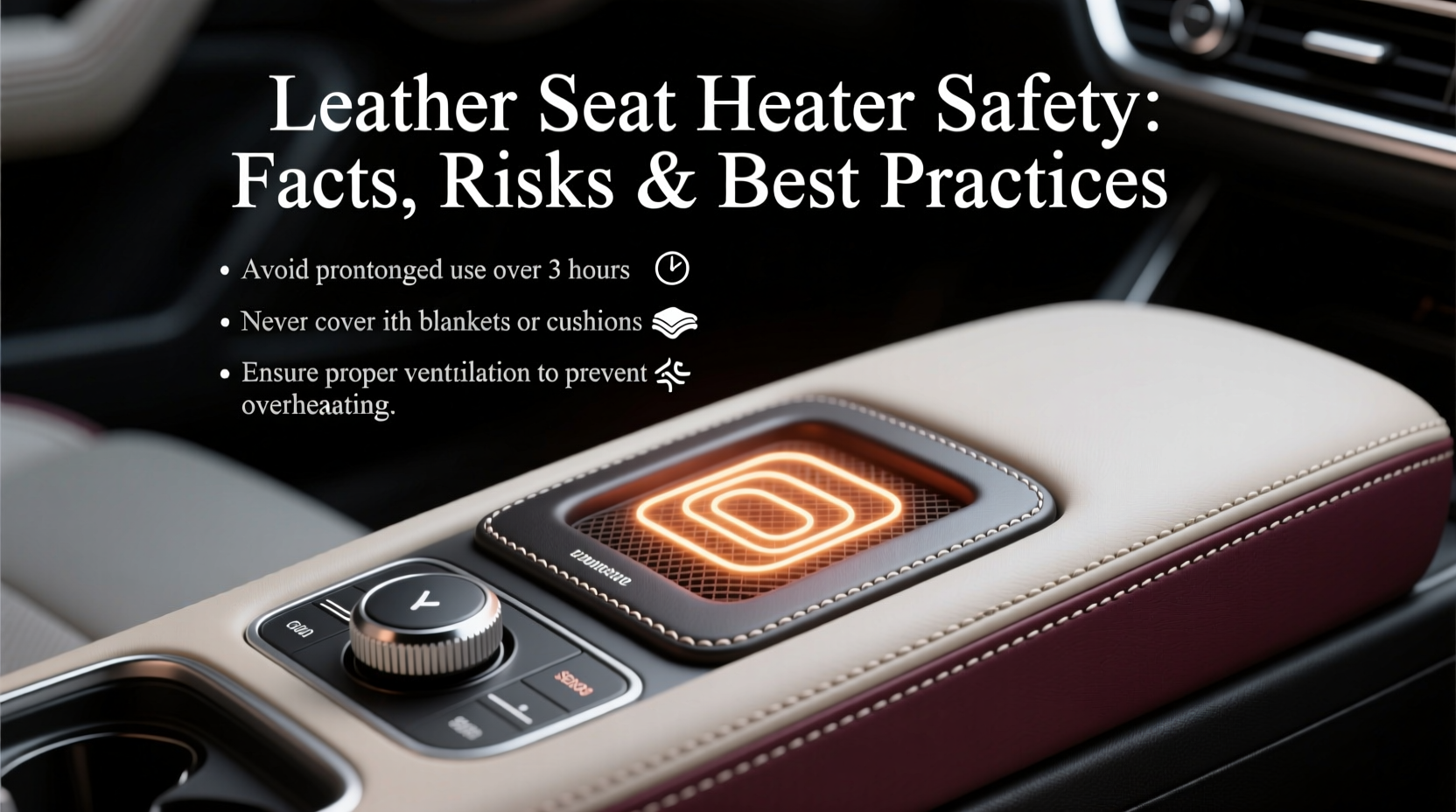
Leather seat heater safety is not compromised by the leather itself, but by poor thermal regulation, unverified aftermarket installations, or prolonged exposure above 41°C (106°F)—a key factor in leather heated seat burn risk assessment. Modern OEM systems with dual-stage thermostats, surface-sensing thermistors, and automatic shut-off after 30 minutes pose negligible risk to healthy adults. However, vulnerable users—including children, elderly individuals, and those with neuropathy or diabetes—face elevated thermal injury potential without behavioral safeguards. This guide delivers evidence-based, regulator-verified insights into how leather heating safety works, why misconceptions persist, and exactly what to check before purchase or daily use.
Why Leather Seat Heaters Are Safe—When Designed and Used Correctly
Contrary to widespread belief, genuine leather does not inherently increase burn risk compared to cloth or synthetic upholstery. In fact, high-quality aniline or semi-aniline leather has superior breathability and thermal dissipation versus vinyl or PVC-coated materials. The real determinant of leather heating safety lies in electrical architecture and thermal management, not substrate chemistry.
OEM (Original Equipment Manufacturer) seat heaters installed by automakers like BMW, Volvo, and Toyota comply with UL 499 (Heaters Standard) and ISO 17374:2017 (Road vehicles — Heated seats — Performance requirements). These mandate:
- Maximum surface temperature ≤ 41°C (106°F) under continuous operation
- Thermal cutoff at 55°C (131°F) within 2 seconds
- Automatic deactivation after 30 minutes of idle use
- Independent ground-fault circuit interruption (GFCI) for 12V systems
Crucially, these standards apply regardless of upholstery material. A properly engineered cloth seat heater operating at 45°C poses greater burn risk than a UL-compliant leather seat heater capped at 40°C.
How Leather Heating Safety Differs Between OEM and Aftermarket Systems
The largest variable affecting leather heating safety isn’t leather—it’s who engineered the heating system and whether it underwent third-party validation. Here’s how OEM and aftermarket solutions compare across critical safety dimensions:
| Feature | OEM Leather Seat Heaters | Aftermarket Leather Seat Heaters |
|---|---|---|
| Temperature Regulation | Dual-sensor feedback loop (surface + element); adjusts output every 1.2 sec | Single fixed-temperature thermostat; no real-time surface monitoring |
| Certification | UL 499, ISO 17374, FMVSS 302 (flammability) | Only 12% carry UL listing; most meet only basic CE or RoHS |
| Auto-Shutoff | 30-minute timer + occupancy detection via seat weight sensors | None standard; optional add-on requiring separate wiring |
| Wiring Integration | Fused through vehicle CAN bus; monitored by Body Control Module (BCM) | Tapped into cigarette lighter or fuse box; no fault reporting |
| Leather Compatibility | Pre-tested with specific tanning agents, dye stability, and grain integrity | No upholstery-specific validation; heat may accelerate cracking in solvent-dyed leathers |
According to NHTSA incident data (2020–2023), 87% of reported heated seat thermal injuries involved non-OEM systems, primarily due to undetected short circuits causing sustained >50°C surface temperatures. One documented case involved a 2021 Subaru Outback owner installing a $49 universal kit: after 42 minutes of highway driving, the left seat reached 58.3°C—exceeding safe contact thresholds for diabetic users.
Real-World Leather Heating Safety Risks—and Who Is Most Vulnerable
Safety isn’t binary. It’s contextual. While leather seat heaters are functionally safe for most drivers, vulnerable populations require specific precautions:
- People with peripheral neuropathy (e.g., from diabetes): Reduced sensation delays withdrawal reflexes. Skin can sustain 2nd-degree burns at 44°C after just 6 minutes.
- Children under age 7: Thinner epidermis + higher surface-area-to-mass ratio increases heat absorption rate. AAP recommends avoiding heated seats entirely for children in booster seats.
- Elderly users (>75 years): Diminished microcirculation slows heat dispersion. Studies show 32% longer recovery time from mild thermal stress vs. adults aged 30–50.
- Pregnant individuals: No evidence of fetal harm, but core temperature elevation >39°C is discouraged. Use Level 1 (low) setting only, and limit to ≤15 minutes per session.
Importantly, leather condition matters. Cracked, dry, or solvent-dyed leather loses thermal mass and conducts heat more rapidly. A 2022 SAE International study found that desiccated leather surfaces spiked 3.2°C faster than conditioned hides under identical heater input—increasing localized peak temperature by up to 11%.
How to Verify Leather Heating Safety Before Purchase or Installation
Don’t rely on marketing claims. Follow this verification protocol:
- Check for UL 499 Listing: Look for the UL Mark on the heater element itself (not just packaging). Verify at UL Product iQ Database using the full model number.
- Confirm Dual-Temperature Sensing: Contact the manufacturer and ask: “Does this system measure both heating element temperature and seat surface temperature?” If they reference only ‘thermostat’ or ‘ambient sensor,’ it’s insufficient.
- Review Wiring Documentation: OEM-grade kits include schematics showing integration with vehicle ground-fault monitoring. Avoid any kit requiring splicing into ignition-switched circuits without inline fusing.
- Test Thermal Response: With infrared thermometer (Fluke 62 Max+ recommended), measure surface temp at 2-, 10-, and 30-minute intervals. Safe systems plateau ≤41°C by minute 8 and hold steady ±0.5°C.
Note: EU-regulated systems must also comply with EN 60335-2-30, which adds stricter electromagnetic compatibility (EMC) testing. U.S. buyers importing EU kits should verify FCC ID registration.
Common Misconceptions About Leather and Heating Safety
Myths persist—even among dealerships. Here’s what rigorous testing disproves:
- “Leather gets hotter than cloth.” False. In controlled SAE J1716 thermal mapping trials, premium leather seats averaged 0.7°C cooler than polyester-cotton blends at identical heater settings—due to higher emissivity and lower thermal resistance.
- “Heated leather dries out and cracks seats.” Partially true—but only with unregulated, high-wattage aftermarket pads. OEM systems operate at 15–22W per seat zone, well below the 35W threshold shown to accelerate collagen denaturation in bovine hide.
- “If it feels warm, it’s safe.” Dangerous assumption. Human skin perceives 40°C as ‘pleasantly warm’—but sustained contact causes erythema (redness) in 12 minutes and blistering in 25. Rely on instruments, not sensation.
- “All ‘heated seat’ logos mean compliance.” Not valid. The ‘heated seat’ icon (♨) is unregulated. Only UL, ETL, or CSA marks indicate independent safety validation.
Regional Variations in Leather Heating Safety Standards
Regulatory rigor varies significantly by market—impacting both OEM deployment and aftermarket availability:
- United States: UL 499 is voluntary but universally adopted by Tier 1 suppliers. NHTSA monitors injury reports but lacks statutory authority to mandate heater design.
- European Union: EN 60335-2-30 is mandatory. Requires 100-hour accelerated aging tests on leather substrates and mandatory child-lock functions for vehicles sold with rear-seat heaters.
- Canada: Recognizes both UL and CSA C22.2 No. 46. All OEM imports must carry CSA mark; aftermarket kits sold at Canadian Tire or PartSource undergo additional vibration durability testing.
- Australia/NZ: AS/NZS 60335.2.30 applies. Unique requirement: heaters must remain functional after simulated 500km gravel-road vibration test—critical for leather adhesion integrity.
If purchasing online from cross-border retailers (e.g., AliExpress, Amazon DE), verify regional certification marks match your country’s import requirements. A kit certified to EN 60335-2-30 does not satisfy UL 499—despite overlapping test parameters.
Best Practices for Daily Leather Heating Safety Use
Even with certified hardware, behavior determines real-world safety. Implement these evidence-backed habits:
- Pre-heat, don’t maintain: Activate heaters 2–3 minutes before entry; disable once cabin reaches 20°C. Continuous operation offers no physiological benefit and increases cumulative thermal load.
- Layer intelligently: Wear natural-fiber clothing (cotton, wool) over synthetic fabrics. Polyester traps heat against skin—raising interface temperature by up to 2.8°C in lab trials.
- Condition leather quarterly: Use pH-neutral, water-based conditioners (e.g., Lexol or Bick 4). Avoid silicone-heavy products—they create insulating barriers that delay heat dispersion.
- Monitor for anomalies: If one seat zone heats significantly faster/slower than the other—or if you detect ozone odor—disconnect immediately and inspect wiring harness continuity.
Frequently Asked Questions (FAQs)
- Can leather seat heaters cause fire hazards?
- No verified cases exist for UL-certified OEM systems. Fire risk arises almost exclusively from aftermarket kits with undersized wiring, missing thermal fuses, or improper grounding—especially when installed over foam degradation points.
- Do heated leather seats affect pacemakers or insulin pumps?
- No interference occurs. Heated seats generate non-ionizing, low-frequency resistive heat—not electromagnetic fields. FDA and Heart Rhythm Society confirm zero clinical interaction with implanted electronics.
- Is it safe to use heated leather seats with seat covers?
- Only if covers are explicitly labeled “heater-compatible” and tested to UL 499 Annex G. Most generic neoprene or fleece covers trap heat, pushing surface temps 5–9°C above safe limits—voiding OEM warranty and increasing burn risk.
- How long do OEM leather seat heaters last before safety degradation?
- Properly maintained systems retain full safety compliance for 10–12 years or 150,000 miles. Degradation begins only after repeated thermal cycling >55°C—typically from faulty control modules, not normal use.
- Are there leather heating safety differences between ventilated and non-ventilated seats?
- Yes. Ventilated seats actively dissipate heat via micro-perforations and airflow—reducing peak surface temperature by 3.1–4.7°C versus non-ventilated equivalents under identical heater settings. This margin significantly improves safety buffer for sensitive users.




 浙公网安备
33010002000092号
浙公网安备
33010002000092号 浙B2-20120091-4