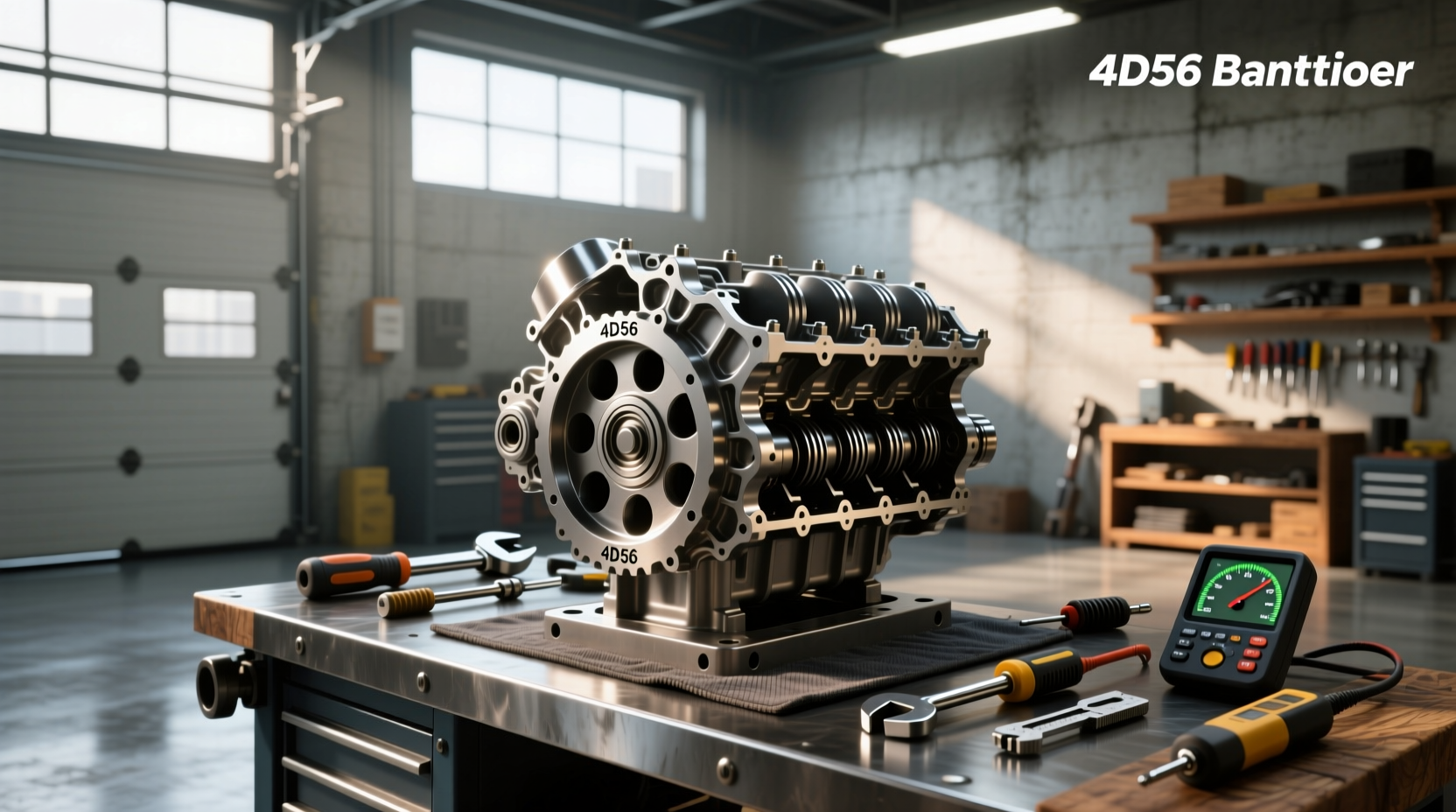
⚙️ Setting the correct 4D56 timing marks is essential for maintaining engine performance and preventing catastrophic damage in Mitsubishi diesel engines like those found in the L200, Pajero, Delica, and Triton models. Misaligned timing can lead to valve-to-piston contact, poor combustion, hard starting, or complete engine failure. This comprehensive guide walks you through every step of identifying and aligning the 4D56 engine timing marks, including main camshaft, crankshaft, and balance shaft synchronization—critical whether you're replacing the timing belt, water pump, or hydraulic tensioner. We'll also cover common pitfalls, torque specs, component variations across model years, and best practices verified by experienced diesel mechanics.
Understanding the 4D56 Engine and Its Timing System
The Mitsubishi 4D56 is a 2.5L inline-four turbo-diesel engine produced from the early 1980s through the 2000s, widely used in light trucks and SUVs such as the L200 (Triton), Pajero (Montero), Delica van, and L300 Adventure. It features an interference design, meaning that if the timing belt fails or slips, internal components like valves and pistons can collide, causing severe mechanical damage 1.
🔧 The engine uses a toothed rubber timing belt to synchronize the rotation of the crankshaft and camshaft(s). Additionally, many variants—including most 4D56T and 4D56TD models—include a secondary balance shaft driven by its own smaller belt, which reduces vibration and improves ride comfort. Because of this dual-belt system, setting the 4D56 timing marks involves more than just aligning the cam and crank gears—it requires precise positioning of all three (or four) sprockets before tightening.
Why Proper Timing Alignment Matters
❌ Even a single tooth off on the camshaft timing can result in:
- Reduced power output
- Increased fuel consumption
- Excessive smoke or rough idle
- Difficulty starting when hot
- Potential valve bending if interference occurs
✅ Correctly aligned timing marks on 4D56 engine ensure optimal valve opening/closing relative to piston position, allowing efficient combustion and smooth operation. Given that these engines often operate under heavy loads—especially in off-road or commercial applications—precision during reassembly is non-negotiable.
Locating and Identifying Key 4D56 Timing Marks
To properly set the timing, you must first identify the physical marks on each rotating component. These are typically stamped lines, notches, or dimples located on gear teeth or flanges.
Crankshaft Timing Mark (Bottom End)
📍 Found on the crankshaft pulley or harmonic balancer at the front of the engine. On most 4D56 engines, there’s a protruding tab or pointer on the timing cover with a corresponding degree scale. When the piston in cylinder #1 is at Top Dead Center (TDC) on the compression stroke, the mark on the pulley should align with the “0” indicator on the cover.
⚠️ Note: Some older models use a notch on the flywheel viewed via an inspection hole, requiring transmission removal or access from below. Always confirm your model year’s method before proceeding.
Camshaft Timing Mark (Top End)
🔧 Located on the camshaft sprocket. There will be a small punch mark or engraved line on the edge of the sprocket that must line up with a fixed reference point—usually a machined notch or bolt head on the cylinder head or timing cover.
In most configurations, when the camshaft mark aligns with its reference, the lobes for cylinder #1 should be pointing slightly upward and away from the rocker arms—indicating both intake and exhaust valves are closed (compression TDC).
Balance Shaft Timing Marks (If Applicable)
⚙️ Many 4D56 variants include a counter-rotating balance shaft to reduce engine vibrations. This shaft is driven by a separate belt (often called the balance belt) and has its own alignment requirements.
📌 The balance shaft sprocket usually has two marks: one for the gear itself and another on the housing. Alignment varies slightly between versions—for example, some require the mark to face directly forward; others may need it oriented vertically or toward a specific bolt.
🔍 Common balance belt part numbers include MD310484 (99 teeth) and MD152622 (83 teeth), depending on application 2. Using the wrong belt or misaligning it can cause increased noise, vibration, and premature bearing wear.
Step-by-Step Procedure: Setting 4D56 Timing Marks
Follow this sequence carefully to avoid errors during timing belt replacement or engine assembly.
- Remove Accessories and Covers: Disconnect the battery. Remove radiator shroud, fan, belts, and timing covers to expose the front of the engine.
- Set Cylinder #1 at TDC (Compression Stroke): Rotate the crankshaft clockwise using a socket on the crank pulley bolt until the timing mark aligns with “0” on the scale. Confirm it's the compression stroke by checking that both valves for #1 cylinder are closed (use a straw or pressure test).
- Align Camshaft Sprocket: With the crankshaft at TDC, rotate the camshaft until its timing mark lines up with the reference point on the head. Do not rely solely on crank position—verify cam alignment independently.
- Install Main Timing Belt: Place the new belt over the crankshaft sprocket, then up to the camshaft sprocket. Use a timing belt tensioner tool or follow manufacturer specs to apply proper tension after initial installation.
- Check Balance Shaft Alignment (if equipped): Before installing the balance belt, verify the shaft is correctly positioned. On many models, a pin should drop into a hole in the block when properly timed. If no pin exists, refer to service manual diagrams.
- Install Balance Belt: Route the smaller belt (typically 83–99 teeth) and adjust tension according to specifications. Over-tightening can damage bearings.
- Rotate Engine Twice by Hand: Turn the crankshaft two full revolutions clockwise and recheck all marks. They should realign perfectly. Any deviation means the timing is incorrect and must be corrected before starting.
- Reassemble and Test: Replace all covers, refill coolant (especially if water pump was replaced), reconnect battery, and start the engine. Listen for unusual noises and monitor for warning lights.
Common Mistakes When Setting 4D56 Timing Marks
Avoid these frequent errors that lead to failed startups or engine damage:
- Mistaking Exhaust TDC for Compression TDC: Just because the piston is at top doesn’t mean the valves are closed. Always double-check valve position.
- Assuming All 4D56 Engines Are Identical: There are differences between naturally aspirated (4D56), turbocharged (4D56T), and intercooled (4D56TD) versions. Some have different tooth counts (e.g., 154 vs. 163 teeth main belts) and balance shaft designs.
- Ignoring the Hydraulic Tensioner: Some 4D56 engines use self-adjusting hydraulic tensioners that must be bled before installation. Failure to do so results in slack and potential belt jump.
- Not Rotating the Engine After Installation: Final verification requires turning the engine over twice manually to catch any hidden misalignment.
- Using Aftermarket Belts Without Verification: While OEM belts (like MD300470) are reliable, some aftermarket kits may have slight dimensional differences affecting fit and timing accuracy.
Timing Belt Specifications and Replacement Intervals
📅 Mitsubishi originally recommended replacing the timing belt every 60,000–100,000 km (approx. 37,000–62,000 miles), but many experts now advise a more conservative interval due to the high cost of engine repairs if the belt fails.
| Engine Variant | Main Belt Teeth | Balance Belt Teeth | Recommended Interval | Includes Water Pump? |
|---|---|---|---|---|
| 4D56 (NA) | 154–163 | 83 | 60,000 km / 37k mi | Sometimes |
| 4D56T / TD | 163 | 99 | 80,000–100,000 km | Often |
| L300 Adventure | 163 | 99 | 80,000 km / 50k mi | Yes |
| Pajero IO / Shogun Pinin | 154 | N/A | 60,000 km | No |
🛒 When sourcing parts, look for reputable suppliers offering genuine Mitsubishi or high-quality aftermarket equivalents (such as Gates or Mitsuboshi). Kits often include the main belt, balance belt (if applicable), tensioner, idler pulleys, and sometimes the water pump.
Regional Differences and Model Year Variations
🌍 The 4D56 engine was sold globally, leading to regional tuning and configuration differences:
- Australian/European Models: Often feature stricter emissions controls and revised injection pumps, which may affect cold-start behavior post-repair.
- Asian Market Vehicles (e.g., Thai-built Triton): May use slightly different accessory layouts or sensor placements affecting service access.
- Post-2000 Models: Some later 4D56U engines eliminated the balance shaft entirely, simplifying the timing setup but altering the torque characteristics.
📌 Always consult a workshop manual specific to your vehicle’s VIN or chassis code rather than relying on generic advice.
Frequently Asked Questions About 4D56 Timing Marks
Can I set the 4D56 timing without tools?
Yes, basic alignment can be done using visual marks and hand rotation, but precision tools like a degree wheel or tension gauge improve accuracy. For DIYers, following factory notations carefully is sufficient if done methodically.
What happens if the balance shaft is out of time?
An incorrectly timed balance shaft increases engine vibration, especially at idle and mid-range RPMs. While it won't cause immediate engine seizure, long-term operation can damage mounts, bearings, and accessories.
Do all 4D56 engines have a balance shaft?
No. Early and high-output variants (like the 4D56HT) typically include one, but some later models (especially 4D56U D.I.D.) removed it for simplicity and reduced maintenance.
How do I know if my timing belt jumped a tooth?
Symptoms include hard starting, loss of power, metallic tapping noises, or the engine running then dying suddenly. The only definitive way is to remove the timing cover and inspect alignment of the marks under load-free conditions.
Should I replace the water pump when doing the timing belt?
✅ Highly recommended. Since the water pump is often driven by the timing belt or located behind it, accessing it requires the same labor. Replacing it preemptively avoids future breakdowns and saves money in the long run.





 浙公网安备
33010002000092号
浙公网安备
33010002000092号 浙B2-20120091-4