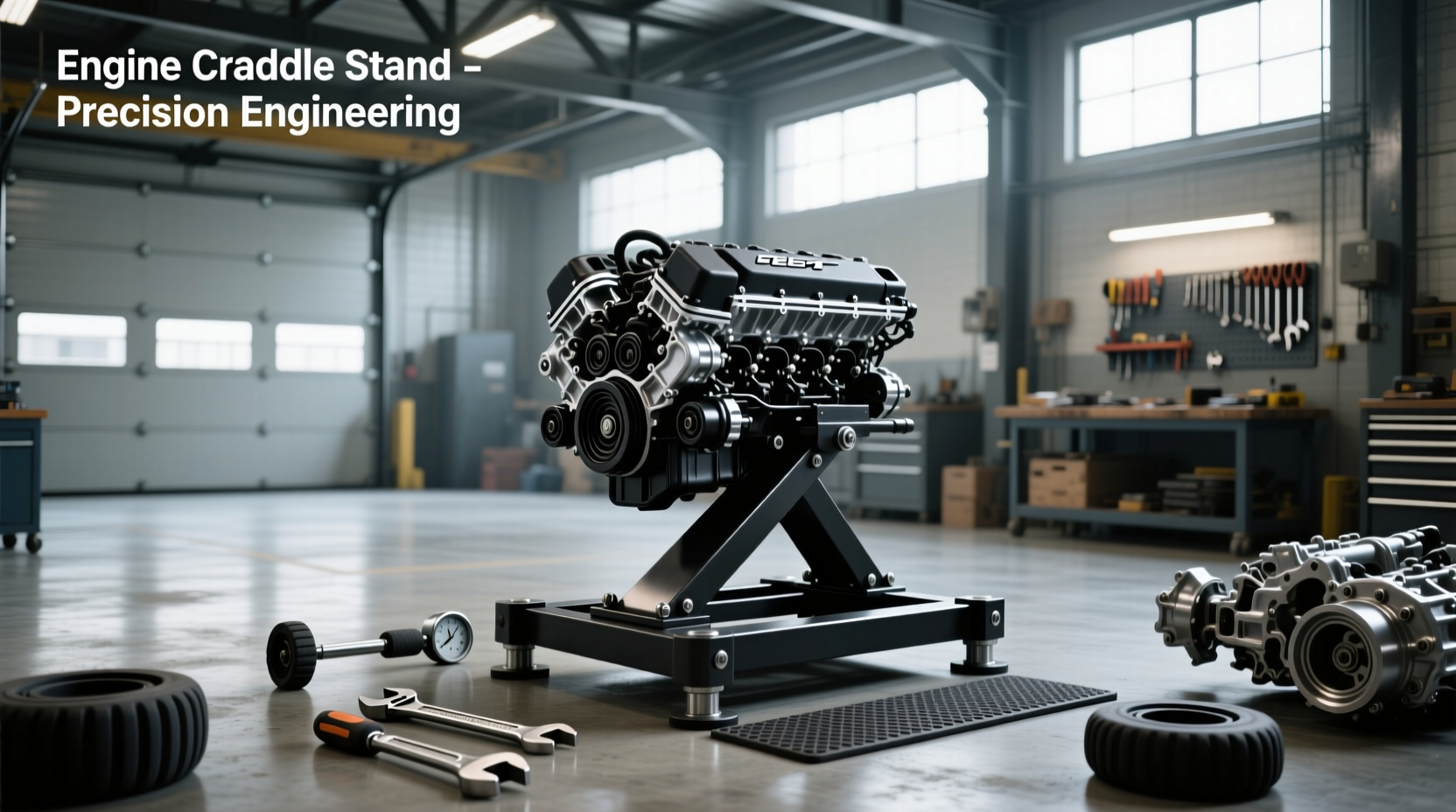
🔧 An engine cradle stand is a critical tool for mechanics and DIY enthusiasts who need safe, stable, and mobile support when removing, repairing, or storing vehicle engines. Unlike basic engine hoists, a rolling engine cradle stand holds the engine securely at waist height, allowing full 360-degree access for inspection, maintenance, or rebuilds. This comprehensive guide explains exactly what an engine cradle stand does, how it differs from similar tools like engine lifts or subframes, and what factors matter most when selecting one—capacity, compatibility, mobility, and construction quality.
Understanding the Role of an Engine Cradle Stand
An engine cradle stand—also known as a rolling engine dolly, engine support stand, or simply engine cradle—is designed to hold an internal combustion engine off the ground after removal from a vehicle. It typically consists of a welded steel frame with four swivel casters, adjustable arms, and mounting points that connect to the engine block using bolts. Once secured, the engine can be rotated, tilted, or moved around a workshop safely.
⚙️ The primary advantage over static storage or floor placement is accessibility. With the engine elevated and supported on a mobile base, technicians can inspect oil pans, intake manifolds, exhaust ports, and transmission mating surfaces without repositioning heavy equipment repeatedly.
✅ Common applications include:
- Post-removal engine cleaning and inspection
- Complete engine rebuilds
- Transporting engines between workstations
- Storing spare or rebuilt engines in garages
- Facilitating LS swap preparation (in compatible models)
Engine Cradle vs. Other Automotive Support Tools
While often confused with related tools, an engine cradle stand serves a distinct purpose compared to other lifting and support systems.
🆚 Engine Cradle Stand vs. Engine Hoist (Cherry Picker)
An engine hoist, commonly called a cherry picker, is used to lift the engine out of the engine bay. It uses a hydraulic jack and boom arm to raise and lower the engine vertically. However, once removed, the engine remains suspended unless transferred to another system.
In contrast, an engine cradle stand provides horizontal stability and mobility. Many workshops use both: the hoist removes the engine, then it’s placed onto the cradle stand for long-term handling.
🆚 Engine Cradle vs. Subframe (K-Frame)
❗ A frequent point of confusion arises between the engine cradle and the vehicle’s subframe. These are entirely different components:
- Subframe: A structural part of the car chassis that supports the engine, suspension, and sometimes transmission while the vehicle is operational.
- Engine cradle stand: A standalone workshop tool used only during service or storage.
🔍 So, no—you cannot drive with a broken engine cradle stand because it’s not installed on the vehicle. But you can have serious drivability issues if your vehicle’s actual engine subframe is damaged.
Key Features to Evaluate When Choosing an Engine Cradle Stand
Selecting the right engine cradle stand involves more than just price or appearance. Here are the most important technical and functional considerations.
1. Load Capacity (Weight Rating)
📌 Most standard engine cradle stands are rated between 750 lbs (340 kg) and 1,500 lbs (680 kg). Always verify the gross weight of the engine you plan to support.
For example:
- Chevrolet Small Block V8: ~575–650 lbs (cast iron version)
- Ford 302/5.0L V8: ~450–500 lbs
- Diesel I6 (e.g., GM Duramax): Up to 900+ lbs
⚡ Recommendation: Choose a stand with at least 25% higher capacity than your engine’s dry weight to ensure safety margin and longevity.
2. Compatibility and Mounting Points
Not all engine cradles fit all engines. Some are universal; others are model-specific.
🔧 Universal cradles use adjustable arms and multiple bolt-hole patterns to accommodate various engine blocks. They usually come with a set of adapter plates or hardware kits.
🚗 Model-specific designs—such as those marketed for Chevy small block or Ford FE engines—have fixed brackets optimized for common mounting locations. These offer faster setup but less flexibility.
❗ Note: Many engine cradle stands explicitly exclude GM LS series engines due to their unique front-mounted accessory layout and compact design. Always check product specifications before purchase.
3. Mobility and Wheel Quality
🛒 Since these stands are meant for movement within a shop, wheel type matters. Look for:
- Swivel casters with dual wheels for better load distribution
- Locking brakes on at least two wheels to prevent accidental movement
- Nylon or polyurethane treads that won’t mark garage floors
- Diameter of 4 inches or more for smoother roll over debris or thresholds
📍 Poor-quality wheels can make a heavy engine difficult to maneuver, especially on uneven concrete.
4. Frame Construction and Stability
The frame should be made of thick-wall steel tubing, ideally powder-coated to resist rust and chipping.
🏗️ Key indicators of build quality:
- Welded joints (not bolted assembly)
- Low center of gravity design to prevent tipping
- Reinforced cross-bracing under the cradle arms
- At least four mounting legs or a wide triangular base
A wobbly or top-heavy stand increases risk during engine rotation or transport.
5. Adjustability and Rotational Capability
Some advanced engine cradle stands allow rotation around the longitudinal axis (front-to-back), enabling easier access to rear components like flywheels or bellhousing areas.
However, full 360° rotation requires a balanced engine and secure fastening. Not all stands support this feature, so confirm specifications if needed.
Common Use Cases and Workshop Scenarios
Different users interact with engine cradle stands in varied ways depending on environment and goals.
🔧 For Home Mechanics and DIY Enthusiasts
If you're rebuilding a classic car engine in a two-car garage, a mid-range engine cradle stand (750–1000 lb capacity) offers excellent value. Prioritize ease of assembly and compact footprint.
🛠️ Pro tip: Consider pairing the stand with a portable engine leveler or pivot stand for precise positioning during timing gear installation or head work.
🏭 For Professional Repair Shops
Commercial facilities handling high-volume repairs may invest in heavy-duty industrial-grade cradles with capacities up to 2,000 lbs. These often include built-in tool trays, labeling systems, and color-coded arms for quick identification across engine types.
⏱️ Efficiency matters here—look for modular designs where adapters can be swapped quickly between jobs.
🚚 For Engine Swaps and Performance Builds
In performance tuning or EV conversion projects, engine cradle stands help test-fit new powertrains before final installation. For instance, when swapping a traditional V8 into a lightweight chassis, the stand allows mock-ups of clearance, exhaust routing, and cooling line paths.
🌐 In electric vehicle conversions, some fabricators repurpose engine cradles to hold electric motors during bench testing—even though they weren’t originally designed for such use.
Budget Options and DIY Alternatives
🛒 While commercial engine cradle stands range from $200 to over $600, budget-conscious builders sometimes opt for homemade solutions.
🔨 DIY Wooden Engine Cradle Dolly
YouTube tutorials show builds using 2x8 lumber, metal corner brackets, and heavy-duty furniture dollies. These can cost under $50 in materials and support smaller engines (<600 lbs).
⚠️ Caveats:
- Wood may warp or crack under prolonged load
- No inherent adjustability for different engine types
- Limited durability in humid or oily environments
✅ Best suited for temporary use or single-project builds.
🔩 Hybrid Approach: Adapter Kits on Generic Dollies
Some users mount universal engine adapter plates onto flatbed hand trucks or scissor lifts. This works for short-distance moves but lacks rotational control and long-term stability.
🧰 If going the DIY route, always reinforce connection points and perform a dry run with lighter loads first.
Potential Risks and Safety Precautions
Handling multi-hundred-pound engines demands strict adherence to safety practices.
❌ Common Mistakes to Avoid
- Using undersized hardware: Never substitute grade 5 bolts with lower-grade ones. Engine vibrations can loosen weak fasteners.
- Improper balance: Ensure the engine’s center of gravity aligns with the stand’s pivot point. An unbalanced load stresses welds and wheels.
- Ignoring fluid drainage: Oil, coolant, or fuel left inside adds significant weight and creates slip hazards.
- Operating near foot traffic: Keep the workspace clear—especially during rotation or movement.
✅ Recommended Safety Practices
- Inspect welds and casters monthly for wear or cracks
- Use jack stands as backup support during initial mounting
- Wear steel-toed boots and gloves when securing the engine
- Store the cradle on a level surface away from moisture
Regional Differences and Market Availability
🌏 Depending on location, availability and pricing vary significantly.
In India, for example, engine cradle stands are available through B2B platforms like IndiaMART and TradeIndia, with prices ranging from ₹3,600 to ₹40,000 based on load rating and material quality 1. Units often emphasize powder-coated finishes and 1000kg+ capacity to meet local industrial standards.
In North America, brands like Harbor Freight, OTC, and Performance Tool dominate the mid-tier market, offering stands compatible with popular American V8s.
🏭 Manufacturers in China frequently export economical steel cradles via Alibaba.com, which are widely used by small workshops globally due to competitive pricing and bulk options.
Maintenance and Longevity Tips
To extend the life of your engine cradle stand:
- Clean regularly: Wipe down grease and grime buildup, especially around pivot points.
- Lubricate moving parts: Apply light machine oil to adjustment threads and caster bearings every 3–6 months.
- Check bolt tightness: Retighten mounting hardware after each major use.
- Store indoors: Prevent rust by avoiding outdoor exposure.
🛠️ Minor repairs—like replacing a caster wheel or tightening a loose bracket—are usually straightforward with standard wrenches and replacement parts available online.
Environmental and Workshop Integration
Integrating an engine cradle stand into your workflow improves efficiency, but space planning is essential.
📏 Recommended clearances:
- At least 3 feet of clearance on all sides for safe rotation
- Aisle width of 4+ feet for pushing through doorways
- Overhead clearance if using alongside a lift or gantry crane
🔌 Consider adding LED task lighting mounted above or on the stand itself for better visibility during evening work.
Frequently Asked Questions (FAQs)
❓ Can I use an engine cradle stand for diesel engines?
Yes, provided the stand’s load capacity exceeds the engine’s weight. Diesel engines, especially inline-six configurations, tend to be heavier than gasoline equivalents. Verify that the cradle has sufficient vertical and lateral clearance for large turbochargers or exhaust manifolds.
❓ Is a rotating engine cradle worth the extra cost?
It depends on your use case. If you frequently remove oil pans, install clutch assemblies, or rebuild rear main seals, a rotating stand saves time and physical strain. For static display or occasional use, a fixed cradle is sufficient.
❓ Are universal engine cradle stands reliable?
Many universal models are well-engineered and tested for broad compatibility. However, they may require trial-and-error to find optimal mounting positions. Read user reviews focused on your specific engine type before buying.
❓ What size bolts do I need for my engine cradle?
Bolt size varies by engine manufacturer. Common sizes include M10x1.5 for Asian imports and 3/8"-16 UNC or 7/16"-14 UNC for American V8s. Always refer to your engine service manual for correct thread pitch and engagement depth.
❓ Can I leave an engine on the cradle for months?
Yes, as long as the stand is stored indoors on a level surface and the engine is properly secured. Cover the intake and exhaust openings to prevent dust or pest intrusion.





 浙公网安备
33010002000092号
浙公网安备
33010002000092号 浙B2-20120091-4