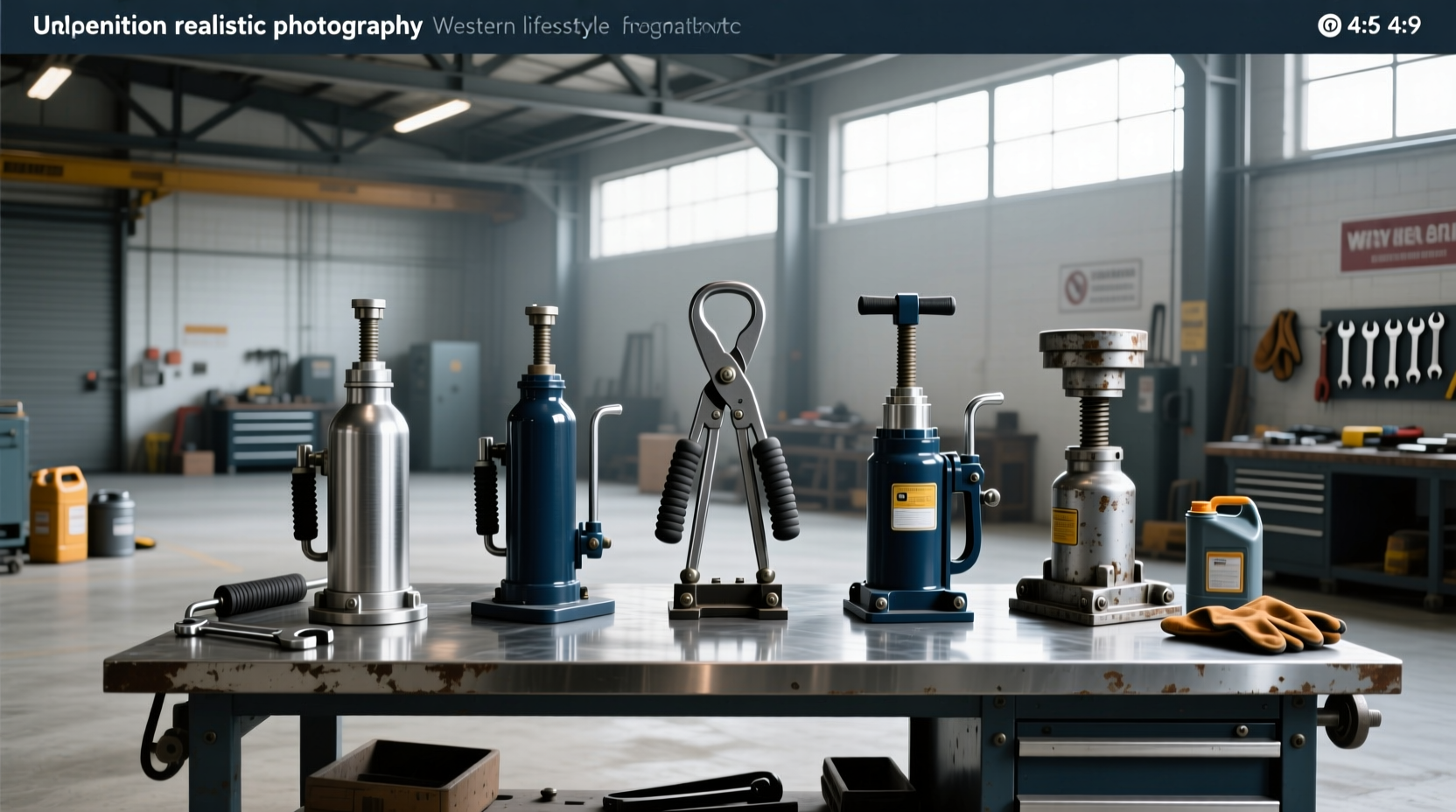
When it comes to lifting heavy loads—whether changing a tire on a pickup truck or supporting machinery in a factory—the hydraulic jack remains one of the most reliable and widely used tools. Understanding the different types of hydraulic jacks is essential for safety, efficiency, and matching the tool to your specific task. From bottle jacks ideal for tight spaces to floor trolley jacks preferred in professional garages, each type offers unique advantages depending on load capacity, portability, stability, and application environment. This guide breaks down all major hydraulic jack types, compares them with mechanical alternatives, and helps you make an informed decision based on real-world use cases.
Why Hydraulic Jacks Are Used Across Industries
Hydraulic jacks operate using Pascal’s Law: applying pressure to a confined fluid transfers force uniformly, allowing a small input force (like pumping a handle) to lift extremely heavy objects. This principle makes them far more efficient than purely mechanical systems for high-load applications 1. They are commonly found in automotive repair shops, construction sites, manufacturing plants, and even home garages due to their power-to-size ratio.
Unlike mechanical jacks that rely on gears, screws, or levers alone, hydraulic models provide smoother operation and higher lifting capacities with less physical effort. However, not all hydraulic jacks work the same way or serve the same purpose. Choosing the wrong type can lead to inefficiency, safety hazards, or equipment damage.
Main Types of Hydraulic Jacks
There are several distinct categories of hydraulic jacks, each designed for specific lifting scenarios. Below is a detailed breakdown of the five primary types:
1. Bottle Jack (Vertical Hydraulic Jack)
📍 Best for: Compact spaces, SUVs, trucks, and emergency roadside use🔧 Lifting Range: Typically 6”–18”
🛒 Common Capacities: 2 tons to 20+ tons
Bottle jacks get their name from their upright, cylindrical shape resembling a bottle. These jacks use a vertical piston housed inside a sealed cylinder filled with hydraulic fluid. When the pump handle is operated, fluid is forced into the chamber, pushing the piston upward.
Pros:
- Compact and portable ✅
- High lift height relative to base size ✨
- Ideal for vehicles with limited ground clearance 🚗
- Affordable compared to other hydraulic types 💰
Cons:
- Narrow base reduces stability ❗
- Must be used vertically only ⚙️
- Slower cycling rate than trolley jacks ⏱️
Bottle jacks are often included with larger vehicles like trucks and SUVs because they can fit into tighter frame points. However, due to their instability under lateral load, they should never be used without additional support like jack stands during prolonged work.
2. Floor Jack (Trolley Jack)
🏭 Best for: Automotive workshops, frequent lifting, low-clearance vehicles🔧 Lifting Range: 5”–20”, with some low-profile models going as low as 3.5”🛒 Capacities: 2 tons to 20 tons
Floor jacks, also known as trolley jacks, feature a wide base with casters, a long handle, and a horizontal hydraulic pump system. Their design allows smooth rolling under vehicles and stable lifting over repeated use.
Pros:
- Excellent stability thanks to wide footprint ✅
- Rolls easily into position ✨
- Faster pump action means quicker lift times ⚡
- Available in low-profile versions for sports cars 🏎️
Cons:
- Bulkier and heavier than bottle jacks 🚚
- Requires more storage space 📦
- Higher initial cost 💸
Floor jacks are the go-to choice for mechanics and auto enthusiasts who perform regular maintenance. The ability to move the jack while loaded slightly (with caution) adds convenience when aligning with lift points.
| Jack Type | Typical Use Case | Max Capacity | Mobility | Stability |
|---|---|---|---|---|
| Bottle Jack | Roadside changes, trucks | Up to 20+ tons | Low (fixed position) | Moderate |
| Floor/Trolley Jack | Garage repairs, daily use | 2–20 tons | High (wheeled) | High |
| Transmission Jack | Engine/transmission removal | 500–1,000 lbs | High (caster wheels) | Moderate (adjustable) |
| Scissor Jack | OEM spare tire kits | 1.5–3 tons | None | Low |
| Pneumatic/Hydro-Pneumatic | Industrial settings | 5–100+ tons | Varies | Very High |
3. Transmission Jack
🛠️ Best for: Removing engines, transmissions, heavy components🔧 Lifting Range: Adjustable up to 40”
🛒 Capacity: Usually 500–1,000 lbs (0.25–0.5 tons)
Though often grouped with hydraulic jacks, transmission jacks are specialized tools. They feature a telescoping shaft and adjustable arms that cradle irregularly shaped components. Most use hydraulic lifting mechanisms but are designed for precision placement rather than maximum vertical lift.
Pros:
- Adjustable saddle supports uneven loads ✅
- Swivel base allows rotation during installation ✨
- Narrow profile fits between engine bays 🧰
Cons:
- Not suitable for lifting entire vehicles ❌
- Lower capacity than standard jacks ⚖️
- More complex setup required ⏳
These are indispensable in engine rebuilds or drivetrain swaps where controlled lowering and alignment are critical. Always ensure the load is balanced before releasing pressure.
4. Scissor Jack (Mechanical vs Hydraulic Variants)
👥 Best for: Emergency tire changes, OEM inclusion🔧 Lift Height: Up to 15”
🛒 Capacity: 1.5–3 tons
Most scissor jacks are mechanical, using a threaded screw mechanism turned by a lever. However, some modern variants incorporate hydraulic assistance to reduce effort. True hydraulic scissor jacks are rare but exist in niche industrial applications.
Pros:
- Extremely compact when collapsed ✅
- Included with most passenger vehicles 🚘
- Durable with no fluid leaks 💧
Cons:
- Slow to operate ⏱️
- Low stability and wobble under load ❗
- Limited lift speed and height 📉
While convenient for emergencies, scissor jacks should not be relied upon for extended under-vehicle work. Never crawl underneath a vehicle supported only by a scissor jack.
5. Pneumatic (Air/Hydro-Pneumatic) Jacks
🏭 Best for: Industrial maintenance, assembly lines, rapid cycling🔧 Lift Speed: Very fast (air-powered)
🛒 Capacity: 5–100+ tons
Pneumatic jacks use compressed air to drive hydraulic fluid, combining the speed of air tools with the power of hydraulics. Also called air-over-hydraulic or hydro-pneumatic jacks, they require an air compressor but deliver rapid, consistent lifts.
Pros:
- Fastest lifting speed available ⚡
- Minimal physical effort required ✅
- Suitable for repetitive industrial tasks 🔄
Cons:
- Requires air supply (not portable) 🔌
- Higher cost and complexity 💸
- Limited to fixed workstations 📍
Used in commercial trucking depots, rail yards, and factories, these jacks enable quick lifting of trailers or heavy machinery without manual pumping.
Hydraulic vs Mechanical Jacks: Key Differences
A common point of confusion is distinguishing hydraulic from mechanical jacks. While both are used for lifting, their operating principles differ significantly.
Hydraulic Jacks: Use incompressible fluid (oil) to transfer force. A small piston pumps fluid into a larger cylinder, creating mechanical advantage through surface area difference.
Mechanical Jacks: Rely on physical mechanisms like screw threads (e.g., scissors or screw jacks), rack-and-pinion, or ratcheting levers. No fluid involved.
| Feature | Hydraulic Jack | Mechanical Jack |
|---|---|---|
| Power Source | Fluid pressure | Manual leverage / screw |
| Lifting Effort | Low (easy pumping) | High (continuous cranking) |
| Lift Speed | Faster | Slower |
| Maintenance | Seals, fluid checks | Less maintenance |
| Portability | Good (except large models) | Excellent (lightweight) |
| Durability | High (if maintained) | Very high (no seals) |
For example, a bottle jack is typically hydraulic, while a ratchet jack or screw jack is mechanical. Each has its place: hydraulic for power and speed, mechanical for simplicity and reliability in remote conditions.
How to Choose the Right Hydraulic Jack
Selecting the appropriate hydraulic jack involves evaluating several key factors:
1. Vehicle or Load Weight
Always choose a jack rated for at least 75% of the vehicle’s gross weight, but preferably 100% per axle. For instance, if your truck weighs 6,000 lbs, and you’re lifting one end (3,000 lbs), use a jack rated for at least 3 tons. Overloading risks seal failure or catastrophic collapse.
2. Ground Clearance
Low-profile floor jacks (as low as 3.25”) are necessary for sports cars or lowered vehicles. Standard bottle jacks may not fit under such chassis.
3. Frequency of Use
Occasional users may prefer a compact bottle jack. Frequent users benefit from the durability and ease of a floor jack.
4. Workspace Environment
Garages with concrete floors suit wheeled jacks. Outdoor or uneven terrain calls for sturdier bases or stabilizing pads.
5. Safety Requirements
No jack should be used as a sole support. Always pair with jack stands rated for the load. Look for safety valves that prevent sudden descent if pressure drops.
Common Misconceptions About Hydraulic Jacks
- Myth: Hydraulic jacks don’t need maintenance.
Fact: Seals degrade, fluid contaminates, and air can enter the system. Check fluid levels annually and bleed air if pump feels spongy. - Myth: All jacks can lift any part of a vehicle.
Fact: Lifting on improper points (like suspension components) can cause damage. Refer to your owner’s manual for designated lift points. - Myth: Higher tonnage always means better.
Fact: Oversized jacks are bulkier and harder to store. Match capacity to actual needs.
Safety Tips When Using Hydraulic Jacks
- ✅ Inspect Before Use: Check for oil leaks, bent handles, or damaged wheels.
- 📍 Use on Solid Surface: Avoid gravel, dirt, or slopes. Use plywood under the base if needed.
- 🔧 Position Correctly: Align with manufacturer-recommended lift points.
- ❗ Never Work Under a Vehicle on a Jack Alone: Always use secondary support (jack stands).
- ⚙️ Bleed Air from System: If the jack won’t lift fully, open the release valve, lower completely, then repump.
- ✨ Store Properly: Lower piston fully and keep in dry conditions to prevent seal drying.
When to Replace a Hydraulic Jack
Even well-maintained jacks wear out. Signs it’s time to replace include:
- Failure to hold pressure (slow sinking)
- Visible fluid leakage around seals
- Pumping handle feels soft or unresponsive
- Rust inside cylinder or on piston rod
- Inability to reach full lift height
Attempting to repair internal seals without proper tools often leads to contamination or misalignment. Consider replacement unless rebuilding is cost-effective.
Regional and Industry-Specific Variations
In North America, floor jacks dominate automotive use, while Europe sees more compact bottle jacks due to smaller vehicle designs. Industrial sectors like mining or aerospace may use custom-designed hydraulic gantry systems or synchronised multi-jack setups for precise control.
Some countries enforce stricter workplace safety regulations requiring secondary locking mechanisms or certified load testing. Always verify local standards if using jacks in commercial operations.
Conclusion
Understanding the different types of hydraulic jacks ensures you select the right tool for safety, efficiency, and longevity. Whether you're a DIYer changing a flat tire or a technician handling heavy machinery, knowing the strengths and limitations of bottle jacks, floor jacks, transmission jacks, and pneumatic models empowers smarter decisions. Remember: no single jack fits all jobs. Evaluate your load, workspace, frequency of use, and safety requirements before purchasing or deploying any lifting device.





 浙公网安备
33010002000092号
浙公网安备
33010002000092号 浙B2-20120091-4