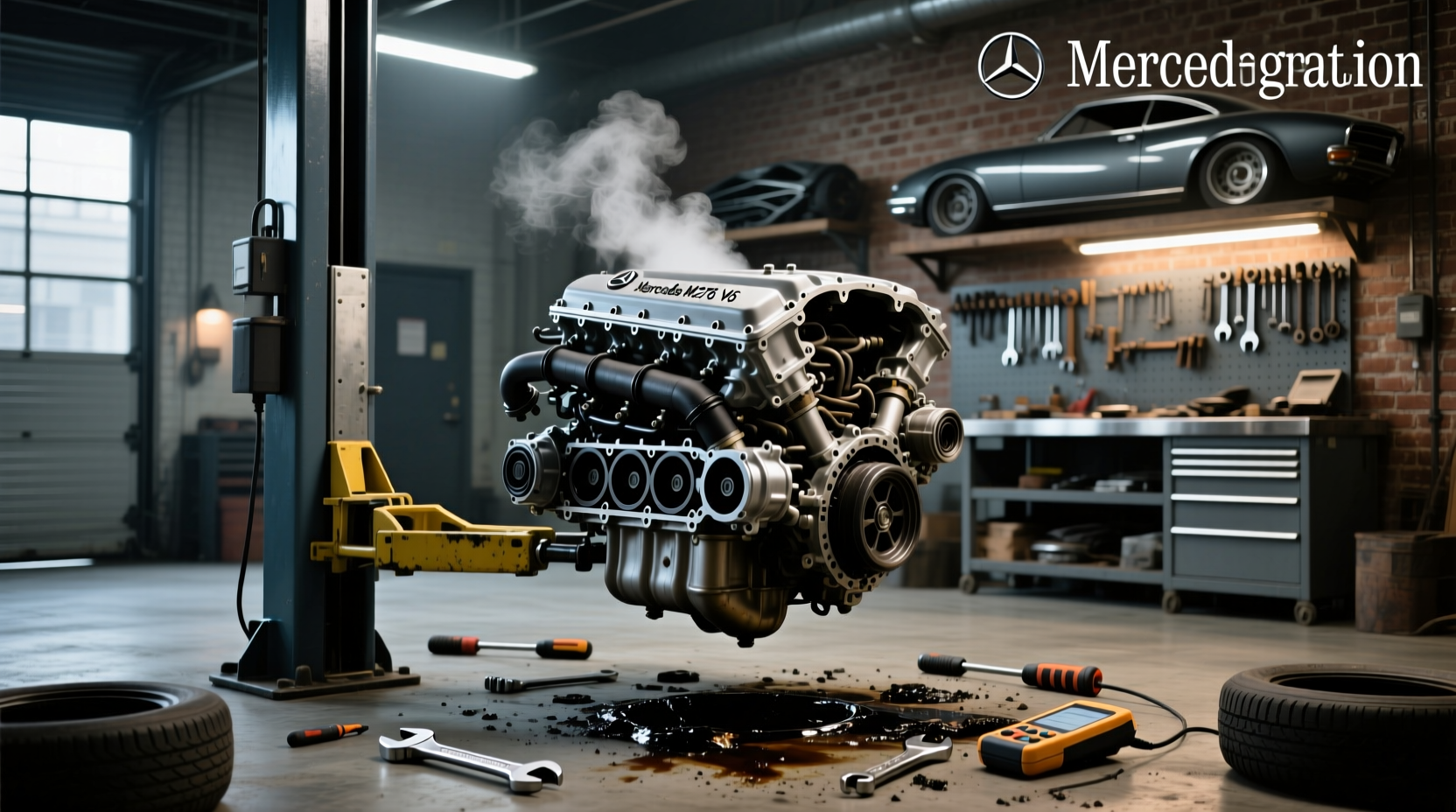
For owners of Mercedes-Benz vehicles equipped with the M276 V6 engine, understanding common M276 engine problems is essential for long-term reliability. This 3.0L and 3.5L gasoline direct-injection V6, used in models like the C-Class, E-Class, and GLK from 2012 onward, offers strong performance and smooth operation—but it's not without known mechanical concerns. Based on technician reports, owner forums, and repair shop data, the most frequently reported issues include timing chain tensioner failures, camshaft adjuster wear, ignition coil degradation, carbon buildup on intake valves, and cooling system leaks. Addressing these proactively can prevent costly repairs down the road.
Understanding the Mercedes-Benz M276 Engine
The M276 engine was introduced by Mercedes-Benz as a modern, lightweight V6 powerplant designed to replace the older M272. It features an aluminum block with Nanoslide® cylinder coating, dual overhead camshafts (DOHC), and variable valve timing on both intake and exhaust camshafts 1. Available in both naturally aspirated (DE30, DE35) and turbocharged (DE30LA) variants, the M276 delivers between 248 hp and 302 hp depending on displacement and tuning. It powers a wide range of vehicles including the W204/W205 C-Class, W212/W213 E-Class, W166 ML/GLE, and R172 SLK.
⚙️ Key Specifications:
- Configuration: 60° V6
- Displacement: 3.0L (2996 cc) or 3.5L (3498 cc)
- Valvetrain: DOHC, 24-valve with Camtronic variable timing
- Fuel System: Direct fuel injection (CGI)
- Block Material: Aluminum with iron-lined cylinders replaced by Nanoslide coating
- Power Output: 248–302 hp / 273–295 lb-ft torque
- Production Years: 2011–2017 (naturally aspirated), extended into 2020s for turbo variants
Common Mercedes M276 Engine Problems
While the M276 is generally considered a solid engine, several recurring mechanical issues have emerged over time—many tied to design choices aimed at reducing weight and improving efficiency. Below are the top five problems reported across owner communities and independent repair shops.
🔧 1. Timing Chain and Tensioner Failures
One of the most serious and expensive M276 engine problems involves the timing chain system. Unlike traditional roller chains, the M276 uses a toothed belt-style timing chain with plastic guides and hydraulic tensioners. Over time, these plastic components degrade, especially under high heat or if oil changes are delayed.
Symptoms include:
- Rattling noise from the front of the engine on cold start
- Check engine light with codes related to camshaft timing (P0016, P0017)
- Potential engine misfires or rough idle
If left unaddressed, excessive chain slack can lead to incorrect valve timing, piston-to-valve contact, and catastrophic engine damage. Some technicians recommend replacing the entire timing chain kit—including front covers, tensioners, rails, and sprockets—around 100,000 miles as a preventive measure 2.
🧼 2. Carbon Buildup on Intake Valves
Due to its gasoline direct injection (CGI) system, the M276 does not spray fuel through the intake manifold. As a result, oil vapors and combustion byproducts accumulate on the back of the intake valves, leading to carbon deposits. This issue is particularly prevalent in stop-and-go driving conditions where the engine operates below optimal temperature.
Effects of carbon buildup:
- Reduced airflow and poor combustion
- Hard starts, rough idle, hesitation under acceleration
- Increased fuel consumption
Prevention includes regular use of intake cleaning services every 20,000–25,000 miles. Products like CRC GDI Intake Valve Cleaner can be applied via the throttle body using a fogging tool. For severe cases, walnut blasting may be required—a more invasive process that physically removes deposits 3.
⚡ 3. Ignition Coil and Spark Plug Degradation
The M276 uses individual coil-on-plug ignition systems. Over time, coils can develop internal resistance issues, especially in hotter engine bays. Combined with high-compression combustion, this leads to weak spark, misfires, and poor fuel economy.
Warning signs:
- Intermittent misfire codes (P0300–P0306)
- Vibration or shaking at idle
- Difficulty starting when hot
Best practice: Replace all six ignition coils and spark plugs as a set around 80,000–100,000 miles. Use OEM-spec or higher-quality aftermarket coils to avoid premature failure.
🌡️ 4. Cooling System Leaks (Thermostat, Water Pump, Fittings)
The M276 relies on a complex cooling circuit with electric water pumps and thermostats. The thermostat housing and plastic coolant connectors are prone to cracking due to thermal cycling and material fatigue.
Common leak points:
- Electric water pump seals
- Thermostat assembly gasket
- Plastic Y-pipe or coolant elbows near the intake manifold
A failing thermostat can cause overheating or delayed warm-up, triggering the check engine light. Replacing the thermostat and water pump together during routine maintenance helps avoid repeat labor costs. Always inspect hoses and connectors for brittleness during service.
🔧 5. Camshaft Adjuster Wear
The Camtronic variable valve timing system uses oil-pressure-driven adjusters to optimize camshaft position. These units contain internal vanes and seals that can wear out, especially if oil changes are infrequent or low-quality oil is used.
Symptoms of failing adjusters:
- Loud ticking or knocking on startup
- Delayed throttle response
- CAMSHAFT POSITION SENSOR codes (P0010–P0020 range)
Some owners report success with upgraded metal-reinforced adjusters to prevent recurrence. Proper oil viscosity (typically 0W-40 or 5W-40 full synthetic) and regular oil changes are critical for longevity.
M276 Engine Reliability: Is It a Good Long-Term Choice?
❓ So, is the Mercedes M276 a reliable engine? The answer depends heavily on maintenance history and driving patterns. When properly cared for—with timely fluid changes, use of correct oil, and proactive attention to known weak points—the M276 can reliably reach 150,000+ miles. However, neglecting key services can lead to early and costly failures.
📈 Factors influencing long-term reliability:
- Maintenance Frequency: Oil changed every 7,500–10,000 miles with OEM-grade synthetic oil significantly reduces wear.
- Driving Conditions: Frequent short trips worsen carbon buildup; highway driving promotes cleaner operation.
- Model Year: Earlier M276 engines (2012–2014) show higher incidence of timing chain issues than later models.
- Turbo vs. Naturally Aspirated: The turbocharged M276 DE30LA adds complexity but improves efficiency; however, it introduces potential turbocharger and intercooler concerns not present in NA versions.
Compared to other Mercedes engines like the M272 (older V6) or M278 (V8), the M276 offers better fuel economy and smoother power delivery, but requires more diligent upkeep due to its advanced design.
Which Mercedes Models Use the M276 Engine?
The M276 engine was widely used across the Mercedes lineup from 2011 through the late 2010s. Here’s a breakdown of common applications:
| Model | Chassis Code | Years | Engine Variant |
|---|---|---|---|
| C-Class | W204, W205 | 2012–2017 | M276 DE35 (3.5L), DE30 (3.0L) |
| E-Class | W212, W213 | 2012–2019 | M276 DE35, DE30, DE30LA (turbo) |
| GLK-Class | X166 | 2012–2015 | M276 DE35 |
| ML-Class / GLE | W166 | 2012–2018 | M276 DE30, DE30LA |
| S-Class | W221, W222 | 2013–2017 | M276 DE30LA (turbo) |
| SLK-Class | R172 | 2012–2016 | M276 DE35 |
Knowing your specific model and engine code (found on the engine cover or via OBD2 scan) helps identify which variant you own and what known issues apply.
How to Maintain an M276 Engine for Maximum Longevity
To get the most out of your M276-powered Mercedes, follow these best practices:
✅ Recommended Maintenance Schedule
- Oil Changes: Every 7,500–10,000 miles using MB-approved 0W-40 or 5W-40 full synthetic (e.g., Mobil 1 Turbo, Liqui Moly Top Tec 4600).
- Intake Cleaning: Perform every 20,000–25,000 miles to combat carbon buildup.
- Cooling System Service: Flush coolant every 4 years; inspect water pump and thermostat for leaks.
- Timing Chain Inspection: Consider full replacement at 100,000 miles, especially if rattling noises occur.
- Ignition System: Replace coils and spark plugs at 90,000 miles.
- Air Filter: Replace annually or every 15,000 miles in dusty environments.
🛠️ DIY Tips vs. Professional Service
While some tasks like air filter replacement or adding fuel additives are DIY-friendly, others—like timing chain work or valve cleaning—require specialized tools and expertise. Attempting major repairs without proper knowledge risks further damage. Always use a qualified independent Mercedes specialist or dealer for complex diagnostics and repairs.
Buying a Used Mercedes with the M276 Engine: What to Watch For
If you're considering a pre-owned C350, E350, or GLK350 with the M276, perform a thorough inspection before purchase:
- CallCheck engine light history and pull stored codes with an OBD2 scanner.
- Listen for timing chain rattle on cold startup.
- Review service records—consistent oil changes are a strong indicator of care.
- Inspect for coolant leaks around the water pump and thermostat housing.
- Ask for a compression test or leak-down test to assess internal engine health.
- Consider a pre-purchase inspection (PPI) by a trusted mechanic familiar with Mercedes engines.
A well-maintained M276-equipped vehicle can offer years of reliable driving. But one with spotty service history may hide expensive surprises.
FAQs About the Mercedes M276 Engine
- ❓ Is the Mercedes M276 engine reliable?
- Yes, when properly maintained. Regular oil changes, intake cleaning, and attention to cooling system components help prevent major issues. Neglect can lead to timing chain or carbon buildup problems.
- ❓ Does the M276 engine have a turbo?
- The original M276 engines (DE30, DE35) are naturally aspirated. Later versions, labeled M276 DE30LA, feature twin-turbocharging and were used in models like the E400 and S350.
- ❓ How much does it cost to fix a timing chain on an M276?
- Replacement typically costs $2,500–$4,500 at a dealership or specialty shop due to labor intensity. Early intervention can prevent engine damage and higher repair bills.
- ❓ Can I prevent carbon buildup on my M276 engine?
- Yes. Use intake valve cleaners every 20,000–25,000 miles and drive at highway speeds regularly to keep the engine hot and clean. Walnut blasting is effective for existing deposits.
- ❓ What oil should I use in my M276 engine?
- Use MB-Approved 229.51 or 229.52 specification oil—typically 0W-40 or 5W-40 full synthetic. Brands like Mobil 1, Liqui Moly, and Castrol offer suitable options.





 浙公网安备
33010002000092号
浙公网安备
33010002000092号 浙B2-20120091-4