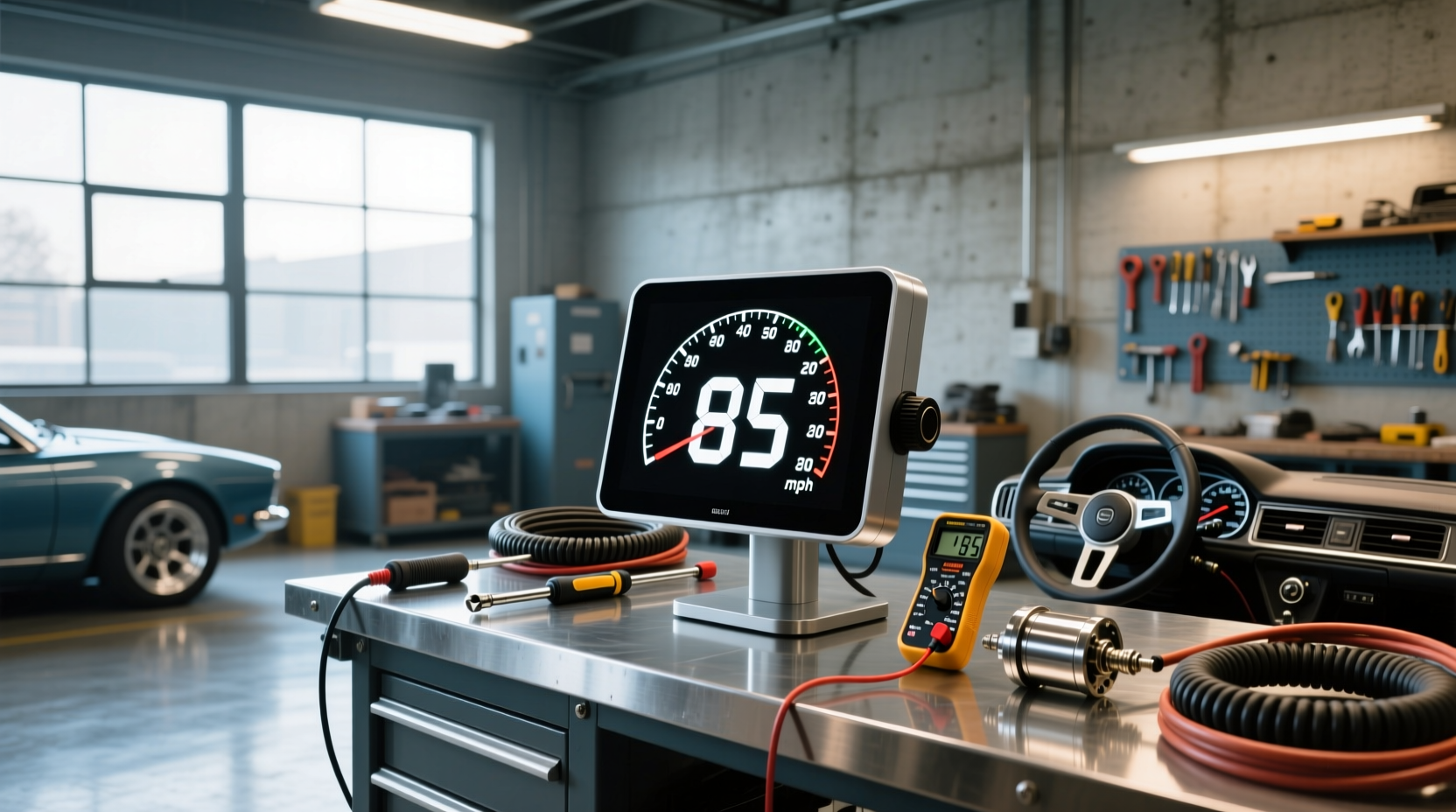
When diagnosing vehicle performance or preparing for official inspection, one critical component mechanics and technicians evaluate is the accuracy of the speedometer. A speedometer tester is a specialized diagnostic tool used to measure and verify the precision of a vehicle’s speed reading under controlled conditions. Unlike general-purpose diagnostic scanners, this equipment directly assesses whether the displayed speed matches actual wheel rotation and road speed, which is essential for safety compliance, fleet maintenance, and regulatory testing in many regions.
While searching for solutions related to vehicle inspection lanes, users often confuse speedometer testers with other diagnostic tools like side slip testers, brake testers, or suspension analyzers1. However, each serves a distinct function. This article clarifies what a speedometer tester does, how it differs from similar equipment, where it's used, and when you might need one—whether you're managing a commercial garage, operating an inspection station, or maintaining a private fleet.
Understanding the Role of a Speedometer Tester
A speedometer tester evaluates the accuracy of a vehicle’s speed indication system. Modern vehicles rely on sensors—typically at the transmission or wheel hubs—to send rotational data to the engine control unit (ECU), which then translates that into speed shown on the dashboard. Over time, changes such as tire size modifications, sensor wear, or ECU calibration issues can cause discrepancies between true speed and displayed speed.
The primary purpose of a speedometer tester is to detect these inaccuracies. It works by comparing the vehicle’s reported speed (via OBD-II signal or direct sensor input) against a reference standard—often derived from a calibrated roller bed or GPS-based measurement system. Some advanced models integrate both methods to ensure cross-verification.
This type of testing is especially important in countries with strict annual inspection requirements, such as those in the European Union, where incorrect speed readings can lead to failed MOT-style tests. For example, EU regulations typically allow a maximum variance of +10% plus 4 km/h above actual speed but prohibit any negative deviation (i.e., showing slower than actual)2.
How a Speedometer Tester Works: Key Components and Process
There are two main types of speedometer testers: portable handheld units and fixed installation systems found in professional test lanes.
1. Portable Speedometer Testers ⚙️
- Design: Compact, battery-powered devices that connect via OBD-II port or wireless Bluetooth.
- Sensors Used: Often use internal accelerometers, GPS modules, or wheel-speed simulation inputs.
- Use Case: Ideal for mobile mechanics, pre-inspection checks, or small workshops without full test lanes.
These testers record real-time driving data over a set distance and compare it to the vehicle’s internal speed reporting. They generate reports showing percentage error and whether the reading falls within legal tolerance.
2. Fixed Roller-Based Systems 🏭
- Installation: Built into inspection bays with motorized rollers that simulate road movement.
- Operation: The driver accelerates gently while front or all wheels rotate the rollers.
- Measurement: High-precision encoders on the roller shafts calculate actual surface speed, which is compared to the vehicle’s transmitted speed signal.
These systems are part of comprehensive vehicle inspection lines that may also include brake testers, headlight aligners, emission analyzers, and side slip detection platforms3.
| Feature | Portable Tester | Fixed Roller System |
|---|---|---|
| Accuracy | Moderate (±1–2%) | High (±0.5%) |
| Cost | $150–$500 | $5,000–$20,000+ |
| Space Required | Minimal | Large bay with foundation |
| Calibration Needs | Annual or per manufacturer | Quarterly certified calibration |
| Best For | Small shops, diagnostics | Official inspection stations |
Differences Between Speedometer Testers and Other Inspection Equipment
One common point of confusion arises between speedometer testers and side slip testers. While they may be located near each other in a test lane, their functions are entirely different.
Speedometer Tester vs. Side Slip Tester 🔍
A side slip tester measures lateral deviation caused by improper toe alignment in the front axle. When wheels are misaligned, they push the vehicle sideways slightly during straight-line travel, increasing tire wear and reducing stability. The side slip plate detects this force using sliding steel plates equipped with strain gauges4.
In contrast, a speedometer tester has no mechanical interaction with steering geometry. Its sole focus is verifying speed signal integrity. Confusing the two can lead to misdiagnosis—for instance, attributing poor handling to speed sensor errors when the real issue is alignment.
Integration with Brake Testing Systems ⚠️
In modern inspection lanes, speedometer testing often occurs before or after brake testing because accurate speed data is needed to validate deceleration rates. However, brake testers themselves (like the MAHA MBT 2250) measure stopping force using load cells and roller resistance, not speed accuracy5.
Some integrated systems display combined results: if a vehicle shows inconsistent speed signals during braking, it could indicate ABS malfunction or sensor failure—issues a standalone brake tester alone wouldn’t catch.
Where Are Speedometer Testers Used?
Several industries and environments rely on accurate speed verification:
🔧 Commercial Vehicle Inspection Stations
In regulated markets, every truck, bus, or taxi must pass periodic technical inspections (PTI). These include mandatory speedometer accuracy checks. In the UK, for example, DVSA guidelines require that at 50 mph, the speedometer reads no less than 50 mph and no more than 60 mph + 6.25% (approx. 71 mph total upper limit).
🚚 Fleet Maintenance Facilities
Fleet operators modify tire sizes or install aftermarket telematics that affect speed calculations. Regular testing ensures compliance and prevents speeding violations due to inaccurate displays.
👥 Independent Repair Shops
After replacing transmissions, ECUs, or ABS modules, technicians should verify that speed readings remain accurate. A portable speedometer tester allows quick validation without requiring a road test.
🌐 Government and Municipal Testing Centers
National standards bodies often mandate certified testing environments. These centers use fully integrated lanes where speedometer testers work alongside emission analyzers, headlight aimers, and noise meters.
Common Misconceptions About Speedometer Accuracy
Many drivers assume that if their speedometer 'looks right,' it is accurate. But several factors influence readings:
- Tire Diameter Changes: Larger or smaller tires change the distance traveled per revolution, skewing speedometer output.
- Wear and Pressure: Underinflated or worn tires have reduced diameter, causing overestimation of speed.
- Aftermarket Modifications: Upgraded rims, lift kits, or off-road tires alter factory calibration.
- Digital Recalibration Needs: After certain repairs, some vehicles require ECU reprogramming to adjust for new sensor values.
Manufacturers intentionally design speedometers to read slightly high (never low) as a safety buffer. But even within legal tolerances, significant deviations can accumulate over time and pose risks during audits or legal disputes.
How to Choose the Right Speedometer Tester
Selecting appropriate equipment depends on your operational scale and regulatory obligations.
Evaluate Your Testing Volume ✅
If you perform fewer than 10 verifications per week, a portable OBD-II-linked device may suffice. Look for models with GPS synchronization and downloadable PDF reports for client documentation.
Check Regulatory Compliance Requirements 📋
In regions like Germany or France, only metrologically certified testers are accepted for official inspections. Certification involves regular third-party calibration and traceable standards. If you plan to operate a licensed inspection lane, confirm local approval lists before purchasing.
Consider Integration Capability 🌐
Larger facilities benefit from systems that interface with workshop management software. Data export via USB, Ethernet, or cloud APIs enables seamless recordkeeping and audit trails.
Assess Calibration and Support ⏱️
Ask suppliers about calibration intervals, availability of service technicians, and spare parts. Avoid units without clear documentation or international traceability (e.g., ISO 17025 accreditation).
Practical Tips for Conducting Accurate Tests
To get reliable results, follow standardized procedures regardless of equipment type:
- Warm Up the Vehicle: Cold tires have lower pressure and diameter; run the vehicle for 5–10 minutes before testing.
- Ensure Proper Tire Inflation: Use manufacturer-recommended PSI levels.
- Drive Smoothly on Rollers: Sudden acceleration or braking disrupts measurement stability.
- Verify Sensor Signals First: Check for DTCs related to VSS (Vehicle Speed Sensor) or CAN bus errors before starting.
- Test Across Multiple Speeds: Record results at 30, 50, and 70 km/h (or mph) to identify non-linear errors.
Regional Variations in Speedometer Testing Standards
Legal requirements vary significantly across jurisdictions:
- European Union: EN 15725 standard governs speedometer accuracy in PTI. Maximum allowable error is +10% + 4 km/h, with zero tolerance for under-reading.
- United States: No federal mandate for periodic testing, but individual states may require checks during safety inspections (e.g., Virginia, Texas). FMVSS 101 sets manufacturing standards.
- Australia: Speedometers must not show less than true speed; upper limit is 110% of actual speed + 4 km/h.
- Canada: CMVSS 101 aligns closely with U.S. standards; enforcement varies by province.
If operating internationally, ensure your tester supports multiple units (km/h vs. mph) and complies with regional norms.
Limitations and What Speedometer Testers Can’t Detect
Despite their utility, these tools have boundaries:
- They do not diagnose root causes of inaccuracies (e.g., faulty sensor vs. ECU glitch).
- Portable GPS-based testers can lose signal in urban canyons or tunnels.
- Roller systems assume uniform tire grip; wet or contaminated rollers reduce accuracy.
- None can compensate for illegal modifications unless explicitly programmed to flag anomalies.
For deeper diagnostics, pair speedometer testing with full OBD-II scans and physical inspections of drivetrain components.
Future Trends in Vehicle Speed Verification
As vehicles become more connected, traditional speedometer testers face evolution:
- Over-the-Air (OTA) Diagnostics: Future systems may pull speed data remotely via telematics platforms.
- AI-Powered Anomaly Detection: Machine learning models could predict drift based on usage patterns.
- Blockchain-Backed Records: Immutable logs of calibration history for audit purposes.
- Integration with ADAS Calibration: Speed accuracy affects adaptive cruise and collision avoidance systems.
However, physical verification will remain necessary for certification until fully autonomous validation frameworks emerge.
Conclusion: Is a Speedometer Tester Necessary for Your Operation?
A speedometer tester is not just another diagnostic gadget—it’s a compliance-critical tool for ensuring road safety and legal adherence. Whether you’re running a municipal inspection center or managing a private fleet, understanding its function, limitations, and proper use helps avoid costly errors and enhances service credibility.
Before investing, clarify your needs: Are you conducting official inspections? Do you modify vehicle configurations? Is accurate speed logging required for insurance or regulatory reasons? Answering these questions determines whether a basic portable unit or a full roller-based system is appropriate.
Always prioritize equipment with clear calibration paths, regulatory recognition, and compatibility with your existing workflow. And remember: while technology evolves, the principle remains unchanged—knowing how fast you're going matters for everyone on the road.
Frequently Asked Questions
- Can I test my speedometer accuracy at home?
- Yes, using a GPS-based app or portable OBD-II tester. Drive at a steady speed on a highway with known distance markers (e.g., mile posts) and compare your speedometer to the GPS reading. Ensure good satellite reception and repeat the test multiple times for consistency.
- Why does my speedometer show higher than my GPS?
- Manufacturers calibrate speedometers to read slightly high as a safety margin. Most regulations prohibit showing a lower speed than actual. A difference of up to 10% + 4 km/h is generally acceptable and intentional.
- Do digital speedometers need testing too?
- Yes. Even fully digital clusters rely on sensor inputs and software calibration. After repairs involving the transmission, ABS module, or ECU, verification is recommended to ensure accuracy hasn't drifted.
- How often should a speedometer tester be calibrated?
- Portable units typically require annual calibration. Fixed systems in official inspection lanes may need quarterly certification by accredited labs, depending on local regulations.
- Is a speedometer tester the same as a dyno?
- No. A dynamometer (dyno) measures engine power and torque under load, while a speedometer tester verifies the accuracy of the speed display. Some roller-type speedometer testers resemble small dynos but lack load resistance and power measurement capabilities.





 浙公网安备
33010002000092号
浙公网安备
33010002000092号 浙B2-20120091-4