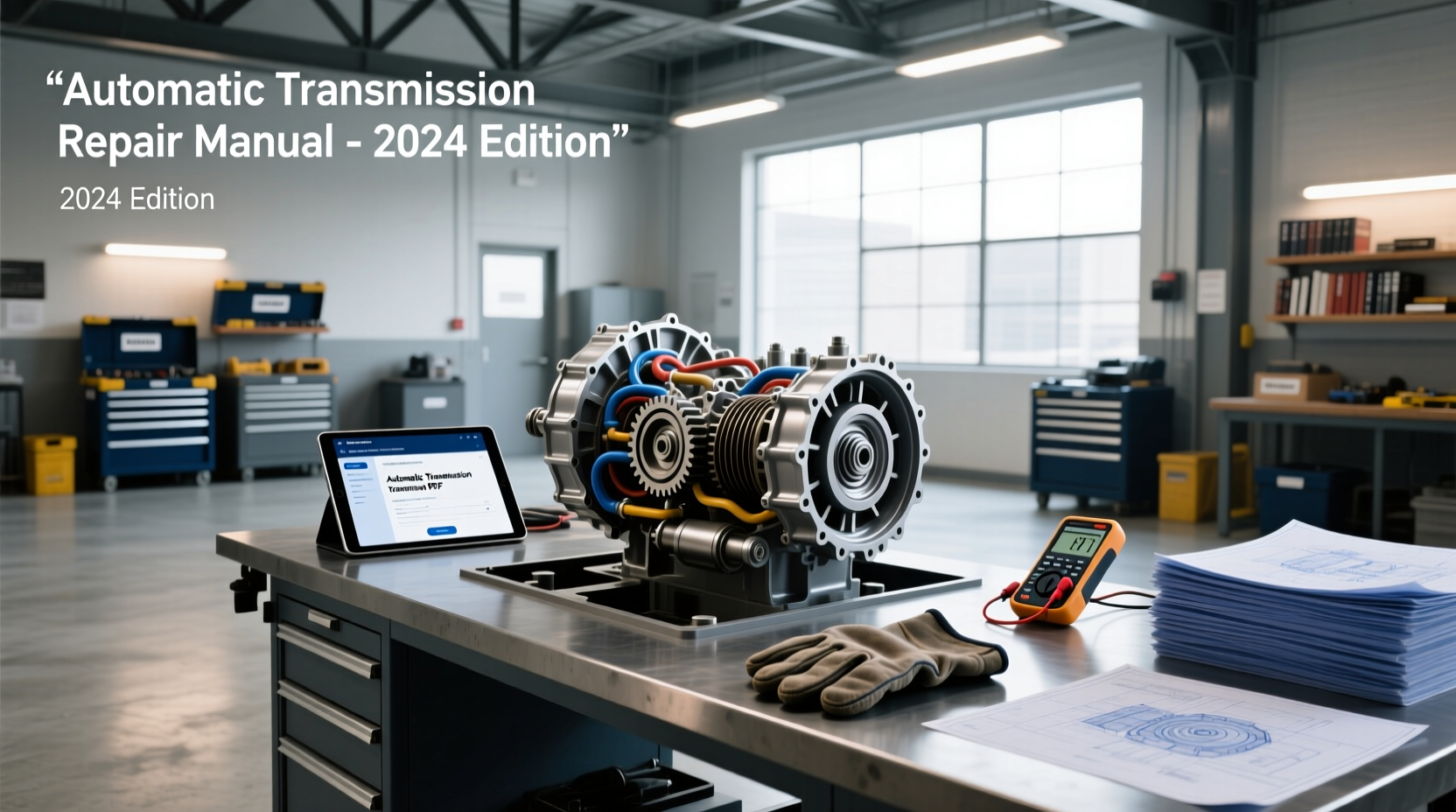
Understanding how an automatic transmission works is essential for car owners, mechanics, and automotive enthusiasts alike. If you're searching for an automatic transmission PDF to study internal components, gear shifting mechanisms, or troubleshooting procedures, you're likely looking for detailed technical documentation that explains planetary gear sets, torque converters, hydraulic control systems, and electronic shift logic. This guide delivers a comprehensive breakdown of automatic transmissions—including working principles, types (AT, CVT, DCT), common failure signs, and where to access accurate, downloadable resources such as service manuals and educational diagrams in PDF format.
How Does an Automatic Transmission Work?
An automatic transmission (AT) automatically changes gear ratios as the vehicle moves, allowing the engine to operate within its optimal RPM range without driver input. Unlike manual transmissions that require clutch engagement and gear shifting, automatics use a combination of hydraulic pressure, mechanical components, and electronic controls to manage power delivery from the engine to the wheels ⚙️.
The core mechanism revolves around the planetary gear set, which consists of a sun gear, planet gears, and a ring gear. By locking or releasing different elements of this system using clutches and bands, various gear ratios are achieved. These operations are controlled by the transmission valve body, which directs pressurized transmission fluid based on speed, throttle position, and load conditions ✅.
A key component in traditional automatics is the torque converter, which replaces the clutch found in manual transmissions. It transfers engine power to the transmission via fluid coupling, allowing the engine to idle while the vehicle is stationary. Modern units also include a lock-up clutch to improve fuel efficiency at cruising speeds 🔧.
Types of Automatic Transmissions
Not all automatic gearboxes function the same way. Over time, several variations have emerged, each with distinct advantages and limitations. Understanding these differences helps when interpreting technical documents or selecting repair strategies.
1. Conventional Hydraulic Automatic (AT)
This is the most common type found in vehicles since the mid-20th century. It uses hydraulic fluid pressure regulated by a valve body to engage clutches and bands inside the transmission. Shift timing depends on governor pressure (speed) and throttle valve pressure (load). Newer models integrate electronic control modules (TCM) for smoother shifts and adaptive learning 🌐.
🔧 Pros: Proven reliability, smooth operation, good towing capacity
❗ Cons: Lower fuel efficiency compared to newer designs, more complex maintenance
2. Continuously Variable Transmission (CVT)
Instead of fixed gears, CVTs use a belt or chain running between two pulleys that can vary their diameter. This allows infinite gear ratios within a range, keeping the engine at peak efficiency during acceleration. Common in brands like Nissan, Honda, and Subaru ✨.
🔧 Pros: Improved fuel economy, seamless acceleration
❗ Cons: Can feel unnatural under hard acceleration, higher repair costs
3. Dual-Clutch Transmission (DCT)
DCTs combine features of manual and automatic transmissions. They use two separate clutches—one for odd gears and one for even—allowing pre-selection of the next gear. Shifts occur rapidly with minimal power interruption, making them popular in performance cars ⚡.
🔧 Pros: Fast shifts, high efficiency, sporty driving experience
❗ Cons: Can be jerky at low speeds, expensive repairs if clutch fails
4. Automated Manual Transmission (AMT)
Also known as semi-automatic, AMTs are essentially manual transmissions with automated actuators for clutch and shifting. Found in budget-friendly models and commercial vehicles due to lower production cost 🏭.
🔧 Pros: Low manufacturing cost, better fuel economy than traditional AT
❗ Cons: Rough shifts, noticeable delay during gear changes
5. Automated Sequential Gearbox
Used primarily in racing and high-performance vehicles, this system allows sequential gear changes via paddles or lever without a clutch pedal. While technically automatic in actuation, it operates similarly to a manual gearbox but with faster execution ⏱️.
| Type | Mechanism | Fuel Efficiency | Driving Feel | Common Applications |
|---|---|---|---|---|
| Hydraulic AT | Planetary gears + fluid pressure | Moderate | Smooth | Sedans, SUVs, trucks |
| CVT | Pulley-belt system | High | Seamless but synthetic | Compact cars, hybrids |
| DCT | Dual wet/dry clutches | High | Fast, responsive | Sports cars, performance sedans |
| AMT | Automated manual clutch | Good | Jerky, delayed | Budget vehicles, commercial fleets |
| Sequential | Gear selector automation | Varies | Race-oriented | Racing, supercars |
Why People Search for Automatic Transmission PDF Resources
There are multiple reasons why users look up automatic transmission PDF files online. Whether you're a DIY mechanic, student, technician, or engineer, accessing well-structured technical documentation provides clarity beyond what videos or summaries offer. Here’s a breakdown of common use cases:
- Educational Purposes: Automotive students often need schematics, cutaway diagrams, and functional descriptions to understand gear train dynamics and fluid circuits 📎.
- Repair & Maintenance: Technicians refer to service manuals containing torque specs, disassembly sequences, and diagnostic flowcharts before servicing a transmission 🛠️.
- Design Reference: Engineers may analyze existing designs when developing new drivetrain components or retrofitting engines with compatible gearboxes 🔍.
- Troubleshooting Help: Owners facing slipping gears, delayed engagement, or warning lights might download PDF guides to identify possible causes before visiting a shop ❓.
Where to Find Reliable Automatic Transmission PDF Files
While many websites claim to offer free downloads, not all sources provide accurate or safe content. Below are trusted avenues for obtaining legitimate technical documents:
1. Manufacturer Service Manuals
Car manufacturers such as Ford, GM, Toyota, and BMW publish official repair manuals that include detailed sections on transmission operation and diagnostics. Some are available through subscription platforms like Alldata or Mitchell1, while others release limited documentation publicly 1.
2. Technical Training Institutions
Vocational schools and community colleges offering automotive programs sometimes share sample curriculum materials, including illustrated PDFs explaining transmission fundamentals. These are typically used for classroom instruction and may cover both basic and advanced topics.
3. Industry Supplier Documentation
Companies like AISIN, ZF, and BorgWarner produce transmissions and often release technical brochures or white papers describing their products’ design and capabilities. These are valuable for understanding real-world applications and engineering choices 2.
4. Government and Military Vehicle Guides
The U.S. Department of Defense and other agencies publish public-domain maintenance manuals for military vehicles. Many contain in-depth coverage of automatic transmissions used in heavy-duty applications. These can be accessed via archives like the Defense Logistics Agency website.
5. Open Educational Resources (OER)
Websites like MIT OpenCourseWare or university engineering departments occasionally post lecture notes or lab guides related to automotive systems. While less focused on consumer vehicles, they offer rigorous theoretical background.
⚠️ Note: Avoid downloading PDFs from unverified file-sharing sites, as they may contain malware or outdated/inaccurate information. Always verify the source and publication date before relying on any document.
Key Components Covered in Most Automatic Transmission PDFs
If you’re evaluating whether a particular PDF meets your needs, check if it includes explanations of the following critical parts:
- Torque Converter: Explains stall speed, impeller-turbine-stator interaction, and lock-up clutch operation.
- Planetary Gear Sets: Details sun, planet carrier, and ring gear arrangements across forward and reverse gears.
- Hydraulic System: Covers pump, valve body, solenoids, pressure regulators, and fluid pathways.
- Clutch Packs and Bands: Describes friction materials, apply mechanisms, and wear indicators.
- Electronic Control Module (TCM): Discusses sensor inputs (vehicle speed, throttle position), shift scheduling, and fault code handling.
- Cooling System: Shows transmission cooler location, oil-to-air or oil-to-water configurations.
A high-quality automatic transmission PDF should include labeled diagrams, cutaway illustrations, and step-by-step functional sequences. Look for documents that explain not just what happens, but why certain components behave the way they do under varying loads and temperatures.
Common Misconceptions About Automatic Transmissions
Despite widespread use, several myths persist about how automatic gearboxes work and how they should be maintained:
Myth 1: “You Should Always Come to a Complete Stop Before Shifting into Reverse”
✅ Reality: Modern transmissions have safety interlocks preventing engagement unless the vehicle is nearly stopped. However, doing so abruptly can cause shock loading. Smooth transitions are best.
Myth 2: “Letting Your Car Roll in Neutral Saves Fuel”
✅ Reality: In modern fuel-injected vehicles, coasting in gear uses zero fuel due to deceleration fuel cutoff. Coasting in neutral actually consumes more because the engine must idle.
Myth 3: “Transmission Fluid Never Needs Changing”
✅ Reality: Fluid degrades over time due to heat and contamination. Most manufacturers recommend changes every 60,000–100,000 miles depending on usage 3.
Myth 4: “Manual Transmissions Are Always More Efficient”
✅ Reality: While historically true, modern DCTs and CVTs often match or exceed manual gearbox efficiency, especially in city driving.
Tips for Using Automatic Transmission PDFs Effectively
To get the most out of technical documentation, follow these best practices:
- Verify Model Compatibility: Ensure the PDF applies to your specific make, model, and year. Transmission designs vary significantly even within the same brand.
- Cross-Reference Multiple Sources: Compare diagrams and procedures across different manuals to confirm accuracy.
- Use PDF Search Function: Press Ctrl+F to quickly locate terms like "shift solenoid," "valve body removal," or "torque specs."
- Print Key Pages: Having physical copies of wiring diagrams or assembly sequences can help during hands-on work.
- Check Revision Dates: Engineering updates happen frequently; always use the latest version available.
Frequently Asked Questions (FAQs)
Here are answers to some of the most commonly asked questions about automatic transmissions and related PDF resources:
- Can I repair an automatic transmission myself using a PDF manual?
- Yes, experienced DIYers can perform basic services like fluid changes, filter replacements, and external solenoid swaps using a proper service manual. However, full rebuilds require specialized tools, clean environments, and deep knowledge of internal tolerances.
- Where can I find a free automatic transmission PDF online?
- Free resources are limited but available through manufacturer training portals, government archives, and educational institutions. Be cautious of unofficial sites offering "free downloads"—they may host pirated or corrupted files.
- What does PRND mean on my gear shifter?
- PRND stands for Park, Reverse, Neutral, Drive—the primary positions on an automatic transmission. Each engages different mechanical states: Park locks the output shaft, Reverse reverses rotation, Neutral disconnects drive, and Drive enables forward motion.
- How do I know if my transmission fluid needs changing?
- Check the color and smell: fresh fluid is red and slightly sweet; dark brown or burnt-smelling fluid indicates degradation. Also watch for delayed engagement, slipping, or rough shifts.
- Are all automatic transmissions the same across car brands?
- No. While operating principles are similar, designs differ significantly between manufacturers. For example, ZF 8HP, Aisin AA80E, and GM 10L90 are all 8- or 10-speed automatics but are not interchangeable and require unique service procedures.





 浙公网安备
33010002000092号
浙公网安备
33010002000092号 浙B2-20120091-4