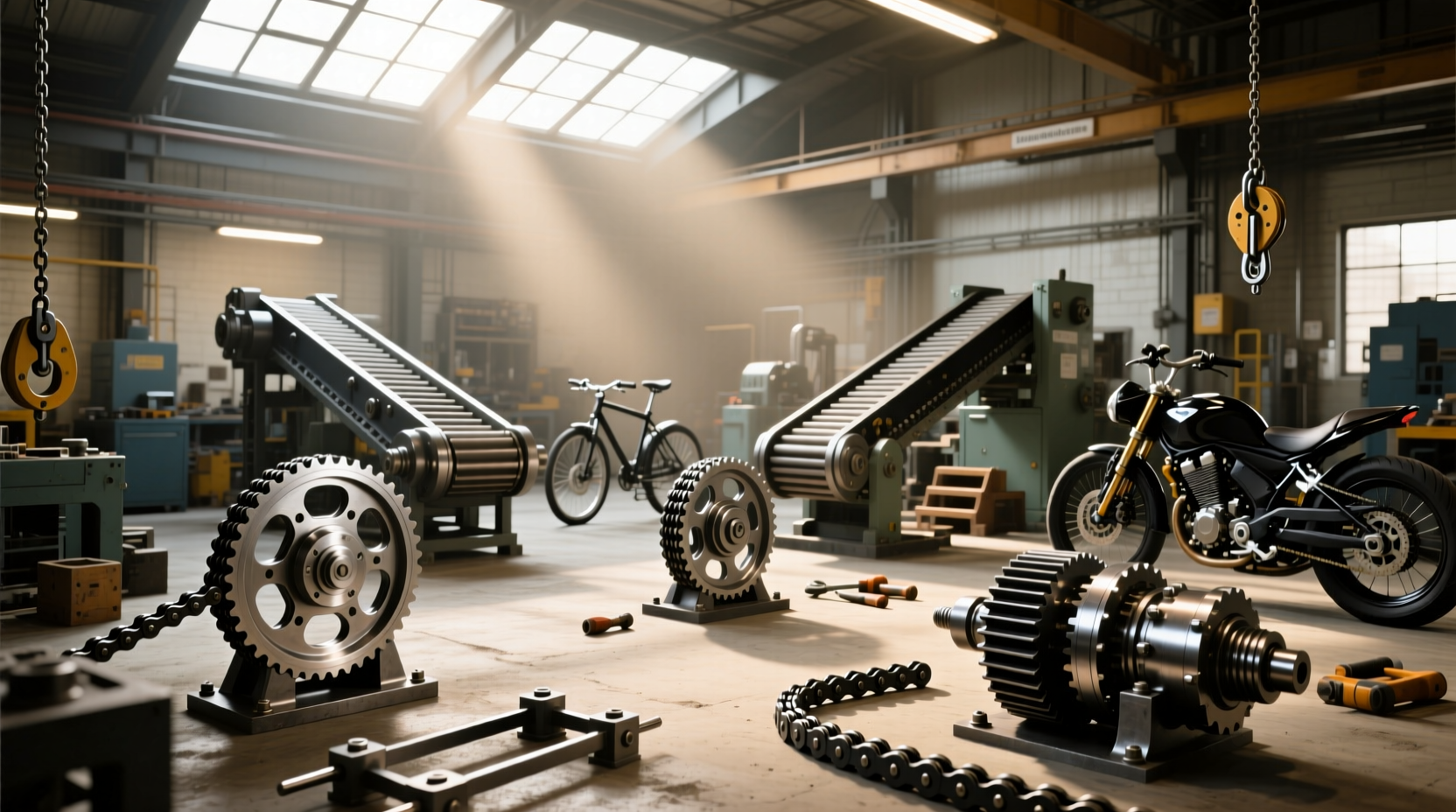
Chain drives are a fundamental method of mechanical power transmission, commonly found in applications ranging from bicycles to industrial conveyor systems. A typical chain drive example includes the drivetrain of a motorcycle, where a roller chain transfers engine power to the rear wheel via sprockets. This system is valued for its efficiency, durability, and ability to operate under high-torque conditions. Unlike belt or gear drives, chain drives offer precise power transfer with minimal slippage, making them ideal for performance-critical and heavy-duty environments.
Understanding common chain drive examples helps engineers, mechanics, and DIY enthusiasts make informed decisions when selecting or maintaining power transmission systems. Whether you're working on a go-kart, an industrial gearbox, or an electric bike conversion, recognizing how different chain configurations function—and where they excel or fall short—is crucial. This article explores real-world implementations of chain drives, compares them with alternative systems, outlines maintenance best practices, and addresses frequently asked questions to help users evaluate suitability based on load, environment, and performance needs.
How Chain Drives Work: The Basics
A chain drive operates by using a roller chain that meshes with toothed sprockets mounted on rotating shafts. When one sprocket (typically connected to a power source like an engine or motor) rotates, it pulls the chain, which in turn rotates the second sprocket connected to the driven component—such as a wheel, conveyor, or generator.
The key components of a basic chain drive include:
- Roller chain: Made of inner and outer plates, pins, bushings, and rollers designed to engage smoothly with sprocket teeth.
- Sprockets: Toothed wheels that match the pitch of the chain; size differences between driving and driven sprockets determine speed and torque ratios.
- Tensioning mechanism: Ensures proper chain tightness to prevent slack, skipping, or excessive wear.
- Lubrication system: Critical for reducing friction and extending service life, especially in high-load or continuous operation scenarios.
⚙️ Chain drives rely on positive engagement—meaning there's no slippage under normal operating conditions—making them more reliable than belt drives when consistent speed ratio and high torque transmission are required.
Common Chain Drive Examples in Transportation
One of the most recognizable chain drive examples is in two-wheeled vehicles such as motorcycles and bicycles. These applications highlight the balance between simplicity, efficiency, and serviceability.
Motorcycles
Many modern motorcycles use a final drive chain system to transfer power from the transmission to the rear wheel. This setup is particularly popular in sport bikes, dirt bikes, and cruisers due to its lightweight nature and ease of customization.
🔧 Advantages:
- High mechanical efficiency (typically over 95%)
- Easy to modify gear ratios by changing sprocket sizes
- Lower cost compared to shaft or belt-driven alternatives
- Requires regular lubrication and tension adjustment
- Exposed chains can collect dirt and debris
- Shorter lifespan than shaft drives if not maintained properly
Despite these drawbacks, chain drives remain dominant in performance-oriented models because of their responsiveness and reduced rotational inertia.
Bicycles
In bicycles, chain drives connect the pedal crankset to the rear hub. Modern derailleur systems allow riders to shift across multiple gears by moving the chain laterally between sprockets.
📌 Key features:
- Lightweight construction using narrow pitch chains (e.g., 1/2" x 1/8" or 3/32")
- Compatibility with multi-speed cassettes (up to 12 speeds)
- Widespread availability of replacement parts
However, bicycle chains are prone to stretching (actually wear-induced elongation), corrosion, and contamination from road grime. Regular cleaning and lubrication significantly extend their operational life.
E-Bike Conversions
An emerging application involves retrofitting traditional bicycles with electric motors using chain-assisted drive systems. In many e-bike kits, the motor outputs to a front or mid-drive sprocket that feeds into the existing chain.
❗ Challenges:
- Increased stress on original chain and drivetrain components
- Potential mismatch between motor output RPM and optimal chain speed
- Risk of chain slippage if the smallest sprocket is worn
Users often report chain slip issues when operating in low gears after conversion, typically due to accelerated wear caused by higher torque loads 1. Proper component upgrades—such as hardened chains and reinforced derailleurs—are recommended for long-term reliability.
Industrial and Mechanical Chain Drive Applications
Beyond personal transportation, chain drives play a vital role in industrial automation, material handling, and manufacturing equipment.
Conveyor Systems
🏭 In factories and distribution centers, chain-driven conveyors transport products along assembly lines or sorting stations. These systems often use double-pitch or heavy-duty roller chains capable of carrying substantial loads over long distances.
⚙️ Design considerations:
- Use of side-flexing or modular plastic chains for curved paths
- Integration with variable frequency drives (VFDs) for speed control
- Sealed or self-lubricating bushings to reduce maintenance frequency
While effective, chain conveyors can suffer from misalignment, wear-induced elongation, and noise generation. Preventive maintenance programs—including periodic inspection and automatic lubricators—are essential for minimizing downtime.
Go-Karts and Small Engine Vehicles
🛒 Recreational go-karts frequently employ simple single-speed chain drives connecting small gasoline engines (e.g., 49cc or 200cc) to live axles. These setups are cost-effective and easy to assemble, making them popular among hobbyists and educational robotics teams.
🔧 Example configuration:
- Engine output sprocket: 10 teeth
- Rear axle sprocket: 60 teeth
- Resulting reduction ratio: 6:1
This provides sufficient torque for acceleration while keeping top speed manageable. Some advanced builds use dual chain transmissions for improved weight distribution and redundancy 2.
❗ A common issue arises when converting from torque converter (CVT) systems to fixed-ratio chain drives. Without careful calculation, users may end up with either poor acceleration or limited top speed. Matching the final drive ratio to intended usage—track racing vs. off-road—is critical.
Industrial Gearboxes and Power Transmission Units
🏭 Heavy machinery often uses chain-coupled gearboxes to transmit power between non-adjacent shafts. For instance, a dual chain transmission might link a hydraulic motor to a crusher or mixer in a mining operation.
✅ Benefits:
- Accommodates large center distances between shafts
- Can handle shock loading better than belts
- Allows for compact design compared to direct coupling
Renold and other manufacturers produce specialized industrial transmission chains engineered for fatigue resistance and extended wear life under harsh conditions 3. These are often seen in cement plants, paper mills, and steel processing facilities.
Types of Chain Drives and Their Uses
Not all chain drives are created equal. Different designs serve specific purposes depending on load, speed, environment, and precision requirements.
| Type of Chain Drive | Typical Applications | Advantages | Limits |
|---|---|---|---|
| Roller Chain Drive | Motorcycles, bicycles, conveyors | High efficiency, widely available | Requires lubrication, wears over time |
| Double Pitch Chain | Light-duty conveyors, packaging machines | Cost-effective, lighter weight | Lower strength, not for high torque |
| Inverted Tooth (Silent) Chain | Automotive timing systems, printing presses | Quiet operation, smooth engagement | Higher cost, complex manufacturing |
| Leaf Chain | Forklifts, lifting mechanisms | High tensile strength, excellent for vertical loads | No sprockets, only for lifting, not power transmission |
| Engineering Steel Chain | Ovens, furnaces, extreme temps | Heat resistant, durable | Heavy, requires special mounting |
Choosing the right type depends on understanding both the mechanical demands and environmental constraints of the application.
Chain Drive vs. Other Power Transmission Methods
To fully appreciate the value of chain drives, it’s useful to compare them with alternative systems like belt drives and gear drives.
Chain Drive vs. Belt Drive
- Efficiency: Chains generally have higher mechanical efficiency (95–98%) compared to V-belts (90–95%).
- Maintenance: Belts require less maintenance but can slip under overload; chains need lubrication but don’t slip.
- Noise: Belts run quieter, whereas chains generate more vibration and sound.
- Environment: Belts degrade faster in oily or UV-exposed environments; chains fare better but corrode without protection.
Chain Drive vs. Gear Drive
- Distance: Gears must be closely aligned; chains can span longer distances between shafts.
- Shock Absorption: Chains absorb sudden load changes better than rigid gear meshes.
- Precision: Gears offer exact motion control (used in CNC machines); chains have slight backlash due to wear.
- Cost: Gearing systems are more expensive to manufacture and install.
⚡ Ultimately, the choice hinges on whether the priority is longevity, precision, cost, or adaptability.
Maintenance Tips for Long-Lasting Chain Drives
Even the best-designed chain drive will fail prematurely without proper care. Here are proven strategies to maximize uptime and performance:
- Check Tension Weekly: Use a deflection gauge or ruler to ensure sag is within manufacturer specs (usually 1–2% of span length).
- Lubricate Appropriately: Apply oil or grease based on operating conditions—dry environments benefit from wax-based lubes, while wet areas need water-resistant formulas.
- Inspect for Wear: Measure chain elongation with a chain checker tool. Replace if elongation exceeds 1.5–2%.
- Align Sprockets: Misalignment causes uneven tooth wear and premature failure. Use laser alignment tools for critical applications.
- Clean Before Lubricating: Remove built-up grit before applying fresh lubricant to avoid abrasive paste formation.
🧼 Neglecting any of these steps accelerates wear and increases energy consumption due to increased friction.
Common Misconceptions About Chain Drives
Despite their widespread use, several myths persist about chain drive performance and reliability.
- Myth: All chains stretch permanently.
Reality: What appears as stretching is actually pin-and-bushing wear causing pitch increase. True plastic deformation is rare unless overloaded. - Myth: Chain drives are outdated technology.
Reality: Modern materials and coatings (like X-ring seals and nickel plating) have greatly enhanced durability and corrosion resistance. - Myth: Harleys don't use chain drives.
Reality: Many Harley-Davidson models now use chain final drives, especially in Sportster and Softail lines, due to weight savings and tuning flexibility.
Final Considerations When Selecting a Chain Drive System
When evaluating whether a chain drive is suitable for your project, consider the following factors:
- Load Requirements: Will the system experience constant or intermittent torque? High shock loads favor robust chain types.
- Operating Environment: Is the unit exposed to moisture, dust, chemicals, or temperature extremes?
- Accessibility for Maintenance: Can technicians easily reach the chain for inspection and lubrication?
- Budget Constraints: While initial costs may be low, ongoing maintenance adds up over time.
- Desired Lifespan: Match expected service life with replacement intervals and spare part availability.
📌 Always consult engineering standards such as ANSI B29.1 or ISO 606 when specifying chains and sprockets to ensure compatibility and safety.
Frequently Asked Questions (FAQs)
What is a chain transmission?
A chain transmission is a mechanical system that uses a roller chain and sprockets to transfer power from a source (like an engine or motor) to a driven component, commonly used in vehicles and industrial machines.
Why are some Harleys not chain driven?
Some Harley-Davidson models use belt or shaft drives for aesthetic appeal, reduced maintenance, or brand tradition. However, many newer models do use chain drives for performance and weight reasons.
What are the disadvantages of chain drive?
Chain drives require regular lubrication, are sensitive to misalignment, can be noisy, and wear over time, requiring periodic replacement. They also expose moving parts, posing potential safety risks.
What is the problem with chain conveyors?
Common issues include chain elongation, sprocket wear, misalignment, and buildup of debris. Without proper tensioning and cleaning, performance degrades rapidly, leading to unplanned downtime.
Can I convert a belt-driven system to a chain drive?
Yes, but only with proper engineering analysis. You’ll need compatible sprockets, adequate space for chain routing, and a way to maintain correct tension. Ensure the motor and load can handle the change in drive characteristics.





 浙公网安备
33010002000092号
浙公网安备
33010002000092号 浙B2-20120091-4