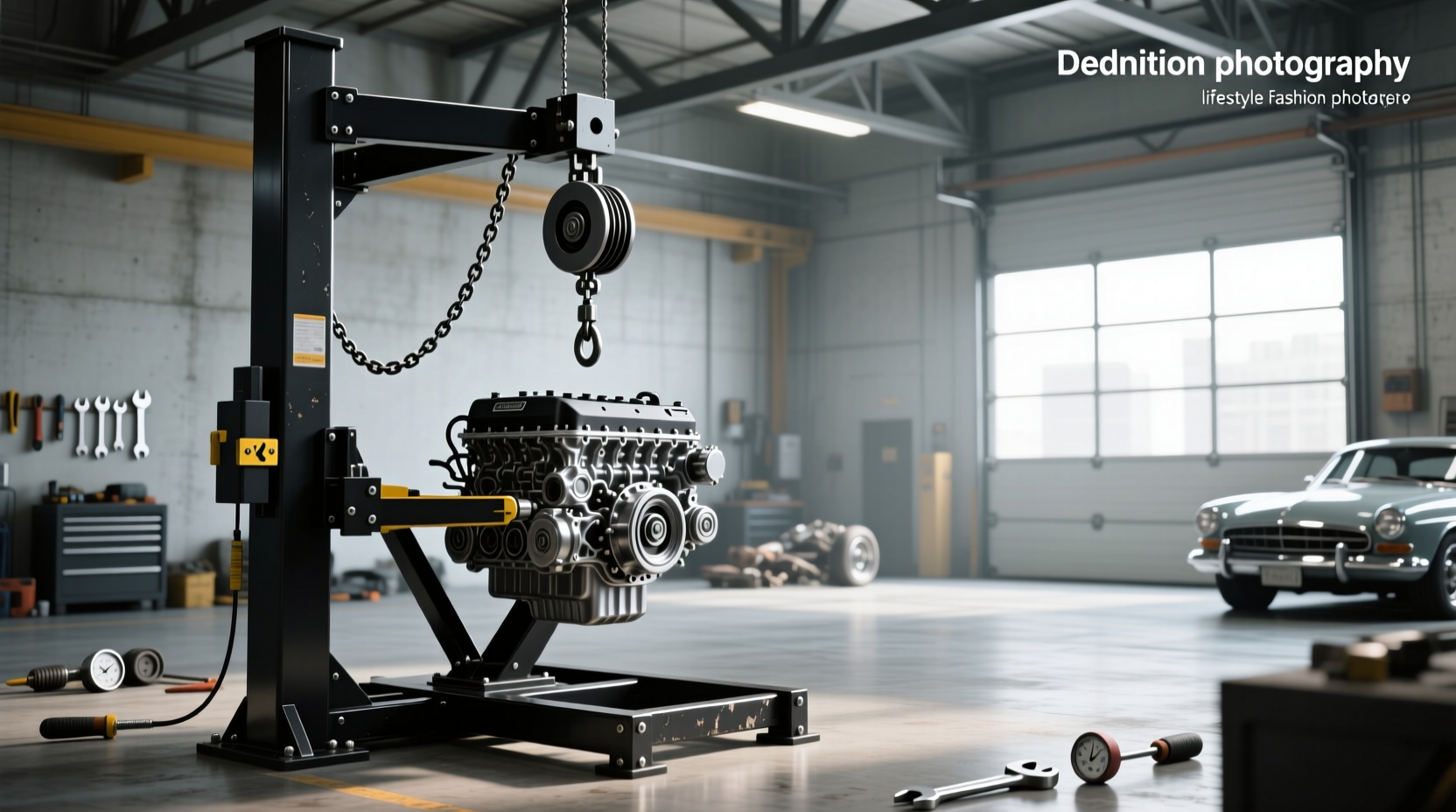
When working on engine overhauls, rebuilds, or removals, choosing between an engine stand and hoist can significantly impact your workflow, safety, and project efficiency. While both tools support engines during service, they serve fundamentally different purposes. An engine stand holds a removed engine securely for inspection, disassembly, and reassembly, allowing 360-degree rotation and access from all angles. In contrast, an engine hoist lifts and moves an engine in and out of a vehicle’s chassis, typically during installation or extraction. Understanding this distinction is critical for proper tool selection, workspace planning, and long-term maintenance success—especially for DIY mechanics and small garage operators.
Why the Confusion Between Engine Stands and Hoists Exists
The terms "engine stand" and "hoist" are often used interchangeably, but they refer to distinct tools with unique roles in automotive repair. This confusion arises because both involve lifting and supporting heavy engines, usually weighing between 300–750 lbs (136–340 kg) for typical passenger vehicles. However, their design, function, and operational context differ significantly. Misidentifying one for the other can lead to unsafe practices, inefficient workflows, or even equipment damage.
For example, attempting to remove an engine using only a static engine stand is impossible—it lacks lifting capability. Conversely, using a hoist to hold an engine for prolonged servicing is unsafe and impractical. A clear understanding of each tool’s purpose ensures that you select the right equipment for the task at hand, avoid unnecessary risks, and maintain productivity in your workspace.
What Is an Engine Stand? Purpose, Design, and Types
An engine stand is a stationary support frame designed to securely hold a detached internal combustion engine during maintenance, rebuilding, or testing. Once the engine has been removed from the vehicle using a hoist or lift, it is mounted onto the engine stand where it can be rotated, tilted, and accessed from any angle.
Core Features of Engine Stands
- Rotating Head: Most modern stands feature a 360-degree swivel mechanism, enabling full access to all sides of the engine ✅
- Adjustable Arms: Typically four arms extend and lock into place to accommodate various engine block configurations ⚙️
- Mounting Bolts: Use existing threaded holes in the engine block (often bellhousing or cylinder head locations) to secure the engine 🔧
- Load Capacity: Ranges from 500 lbs (227 kg) for compact engines to over 2,000 lbs (907 kg) for large V8s or diesel units 🏭
- Casters/Wheels: Allow mobility around the shop while keeping the engine elevated 🚚
Common Types of Engine Stands
| Type | Best For | Key Benefit | Limited Use Case |
|---|---|---|---|
| Standard Rotating Stand | General rebuilds, cleaning, inspections | Full rotation, easy access | Not suitable for dynamic testing |
| Running Engine Stand | Dyno prep, fuel/ignition testing | Supports radiator, wiring, gauges | Requires additional components |
| Split/Tipping Stand | Transmission separation, deep block work | Allows tilting for oil pan or clutch access | Less stable than fixed base |
| Universal Adapter Plate Stand | Multiple engine types (e.g., A-series Mini) | Interchangeable mounting plates | May require custom fabrication |
Some advanced setups, such as running engine stands, include provisions for attaching radiators, fuel pumps, spark plug wires, and monitoring gauges, allowing technicians to test engine performance outside the vehicle 1. These are particularly useful in restoration projects or performance tuning environments.
What Is an Engine Hoist? Function and Variants
An engine hoist, also known as an engine crane or engine lift, is a mobile lifting device used to raise, lower, and transport heavy engines during removal or installation. Unlike a stand, a hoist provides vertical lifting power via a hydraulic ram and chain assembly, allowing controlled movement of the engine within the engine bay or across the shop floor.
Key Components of an Engine Hoist
- Hydraulic Pump: Enables smooth lifting with minimal manual effort ⚡
- Lifting Boom: Articulating arm that extends over the engine compartment 📍
- Chain and Hook Assembly: Attaches to an engine lifting bracket or eyebolts 🔗
- Sturdy Base with Casters: Provides stability and maneuverability during operation 🛒
- Weight Capacity: Common models range from 1 to 2 tons (2,000–4,000 lbs) 💪
Varieties of Engine Hoists
While most hoists follow a standard A-frame design, variations exist based on application:
- Floor-Style Hydraulic Hoist: Most common; ideal for garages and home workshops
- Overhead Beam Hoist: Mounted to ceiling or gantry; saves floor space in commercial shops
- Transmission Jack-Compatible Hoists: Dual-function units that can switch between engine and transmission handling
- Compact Folding Hoists: Designed for limited storage spaces; lighter duty
Proper use of an engine hoist requires identifying secure lifting points on the engine—such as factory-installed lugs or reinforced brackets—and ensuring balanced load distribution to prevent tipping or slippage.
Functional Comparison: When to Use Each Tool
The decision between an engine stand and hoist isn’t about preference—it's dictated by the phase of the repair process.
Use an Engine Hoist When:
- You need to remove an engine from a vehicle chassis
- Installing a rebuilt or replacement engine into a car
- Working under tight clearance conditions where precision lifting is required
- Moving an engine short distances within a workshop
Use an Engine Stand When:
- The engine has already been removed and needs secure, rotatable support
- Performing detailed disassembly, cleaning, machining prep, or reassembly
- Inspecting internal components like pistons, crankshaft, or valves
- Testing engine systems (fuel, cooling, ignition) independently of the vehicle
In practice, these tools are complementary: the hoist removes the engine, and the stand supports it for service. Attempting to bypass either tool compromises safety and efficiency.
Safety Considerations for Both Tools
Safety should be the top priority when handling multi-hundred-pound engines. According to OSHA guidelines, improper lifting equipment use contributes to thousands of workplace injuries annually 2. Below are key precautions for each tool:
Engine Stand Safety Tips
- Always verify that mounting bolts engage fully into the engine block threads 🔍
- Ensure all four arms are securely locked before rotating the engine
- Check caster locks when performing work to prevent unintended movement
- Never exceed the manufacturer-specified weight limit
- Inspect welds and joints regularly for signs of stress or fatigue
Engine Hoist Safety Practices
- Confirm the hoist’s capacity exceeds the engine’s dry weight by at least 20%
- Use proper lifting points—never rely on fragile components like exhaust manifolds
- Keep hands and body parts clear during lifting/lowering operations
- Operate the pump slowly to maintain control
- Secure the engine with straps if moving across uneven surfaces
Additionally, always work on a level surface and ensure adequate overhead clearance when using a hoist. Never leave a suspended engine unattended.
Compatibility and Installation: Matching Tools to Engines
Not all engine stands or hoists fit every engine. Compatibility depends on several factors:
For Engine Stands:
- Mounting Pattern: The stand must align with the engine block’s bolt holes (e.g., bellhousing pattern on rear of block)
- Arm Reach: Adjustable arms should span the width of the engine without overextension
- Center of Gravity: Larger engines (like V8s) may require offset mounting to balance weight ✨
Some specialty engines (e.g., transverse-mounted FWD units or motorcycle engines) may require custom adapter plates. DIY fabricators often create offset brackets to centralize weight distribution, especially for compact engines like the Mini A-series 3.
For Engine Hoists:
- Lifting Point Availability: Older or modified engines may lack factory lifting lugs
- Clearance Height: Taller engines (e.g., big-block Chevys) may not fit under certain hoists
- Boom Reach: Must extend far enough to clear fenders and allow straight lift path
If no dedicated lifting points exist, consider installing threaded eye bolts into strong sections of the cylinder head or intake manifold—but only if structurally sound.
Cost, Space, and Workshop Planning
Budget and available space influence whether—and which—tools to acquire. Here’s a realistic overview:
Pricing Overview
- Basic Engine Stand: $150–$300 (500–1,000 lb capacity)
- Heavy-Duty Rotating Stand: $300–$600 (1,500+ lb)
- Running Engine Stand Kit: $500+ (includes accessories)
- Standard Hydraulic Hoist: $200–$400 (1–2 ton)
- Commercial Overhead Hoist: $800–$2,000+
Many users opt to rent hoists from auto parts stores rather than purchase, especially for one-time jobs. Engine stands, however, offer lasting value for frequent rebuilders.
Space Requirements
- Engine Stand: Occupies ~4 ft x 4 ft; needs clearance for rotation
- Floor Hoist: Requires ~3 ft x 3 ft footprint but needs vertical clearance (~7–8 ft)
Workshops with limited ceiling height may struggle with hoist operation, making jack-and-slide methods necessary. Wall-mounted or foldable designs help conserve space.
Common Misconceptions and Mistakes to Avoid
Several myths persist around engine handling equipment. Clarifying them helps prevent errors:
Misconception #1: “Any Strong Bolt Will Work to Mount an Engine”
False. Using undersized or low-grade bolts can result in shearing under load. Always measure thread depth in the block and match bolt length and grade (typically Grade 8 or metric 10.9). As demonstrated in practical guides, precise measurement prevents damage 4.
Misconception #2: “A Hoist Can Replace a Stand for Rebuilding”
No. A hoist keeps the engine suspended, limiting access and posing a constant fall risk. It’s neither stable nor safe for prolonged work.
Misconception #3: “All Stands Fit All Engines”
Universal doesn’t mean universal fit. Always check arm adjustability and mounting geometry before purchase.
DIY Options and Custom Fabrication
Some enthusiasts build their own engine stands using steel tubing, swivel joints, and casters. Successful DIY builds require:
- Structural steel (e.g., square tubing or channel iron)
- Ball-bearing swivel mechanism for rotation
- Welding capability and knowledge of load dynamics
- Accurate measurements based on specific engine dimensions
While cost-effective, homemade stands must meet safety standards. Improper welding or weak joints can fail catastrophically. If fabricating, consult engineering references or replicate proven designs.
Industry and Regional Differences
In professional settings—especially in Europe and North America—workshops often integrate both tools into standardized service bays. Some differences include:
- North America: Preference for heavy-duty floor hoists and high-capacity rotating stands
- Europe: Greater use of compact, wall-mounted solutions due to smaller garage sizes
- Asia-Pacific: Rising adoption of modular stands for training and vocational programs
Aircraft maintenance facilities use specialized aircraft engine stands designed for turbofans and turboprops, which differ significantly in scale and mounting requirements 5.
How to Choose the Right Setup for Your Needs
To determine whether you need an engine stand, hoist, or both, ask these questions:
- Are you removing or reinstalling an engine? → You’ll need a hoist.
- Will you rebuild, inspect, or test the engine off-vehicle? → You’ll need a stand.
- What is the engine’s weight and size? → Match to tool capacity.
- Do you have sufficient ceiling and floor space? → Plan accordingly.
- Is this a one-time job or recurring need? → Rent vs. buy decision.
Most serious DIYers and small shops benefit from owning both tools. Start with a mid-range hoist and a basic rotating stand, then upgrade as needed.
Conclusion: Complementary Tools for Complete Engine Service
An engine stand and hoist are not interchangeable—they are complementary components of a complete engine service toolkit. The hoist enables safe removal and installation, while the stand provides stable, accessible support for detailed work. Understanding their distinct roles, compatibility requirements, and safety protocols ensures efficient, injury-free repairs. Whether restoring a classic car, rebuilding a performance engine, or maintaining fleet vehicles, selecting the right equipment enhances precision, reduces labor time, and improves overall outcomes.
Frequently Asked Questions
- Can I use an engine hoist as a permanent holding stand?
- No. Engine hoists are not designed for long-term suspension. They lack the stability and safety features of dedicated engine stands and pose a fall hazard if left unattended.
- How do I know if my engine stand is compatible with my engine?
- Check that the stand’s adjustable arms can reach your engine’s mounting points and that the bolt pattern matches common attachment locations (usually on the rear of the block near the transmission).
- What size hoist do I need for a typical car engine?
- Most passenger vehicle engines weigh between 300–750 lbs. A 1-ton (2,000 lb) hoist provides a safe margin for lifting, including accessories and fluids.
- Can I rotate an engine on a hoist?
- No. Hoists do not allow controlled rotation. Only engine stands with swivel heads enable 360-degree access for comprehensive servicing.
- Are there universal engine stands that fit all vehicles?
- While many stands are labeled “universal,” true compatibility depends on arm adjustability and mounting geometry. Some engines may require custom adapters or plates.





 浙公网安备
33010002000092号
浙公网安备
33010002000092号 浙B2-20120091-4