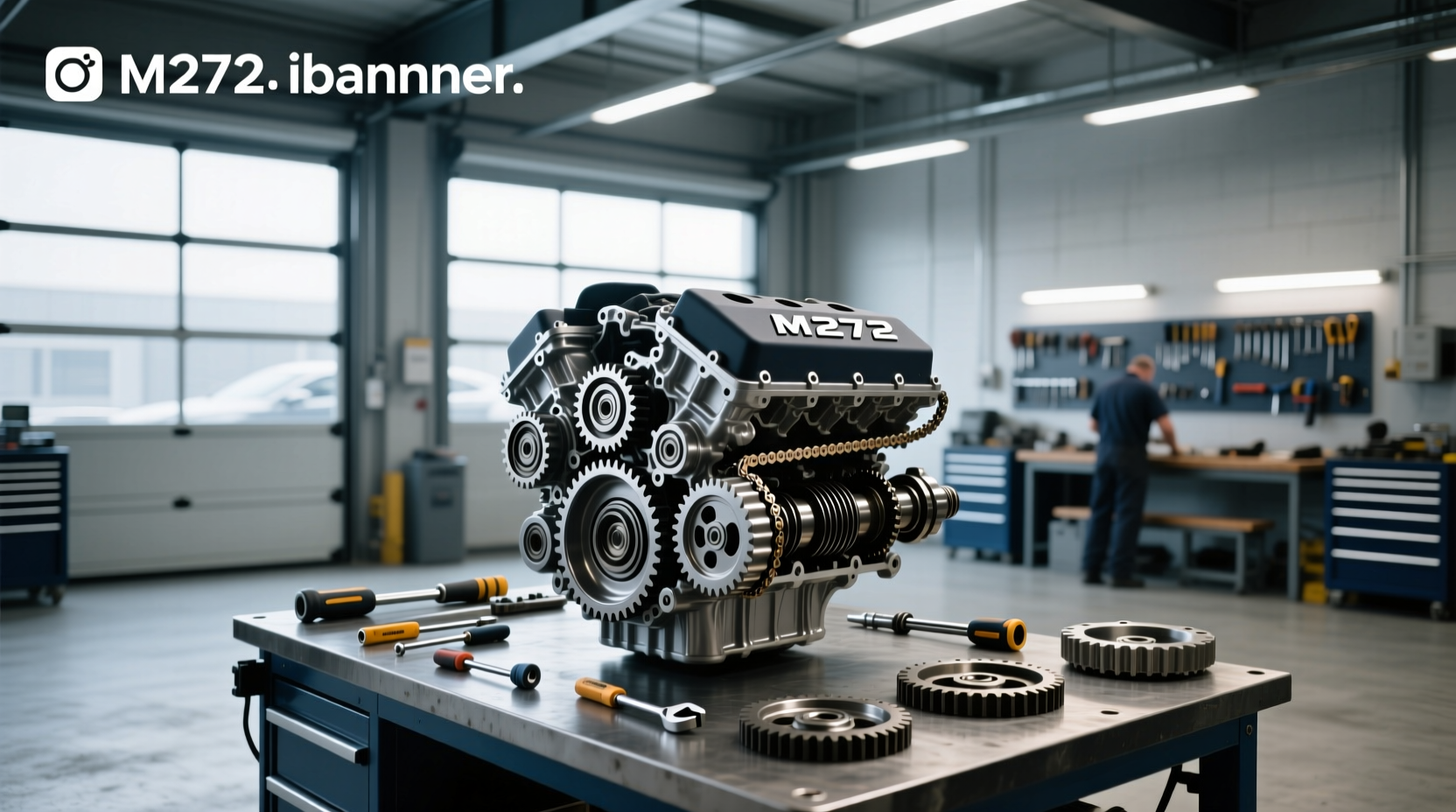
The Mercedes-Benz M272 engine timing system is critical for maintaining performance, fuel efficiency, and long-term reliability in vehicles equipped with this naturally aspirated V6. Improper or failed timing alignment, particularly due to balance shaft sprocket wear or camshaft actuator issues, can lead to severe internal damage if not diagnosed early 1. This comprehensive guide walks through the technical details of M272 engine timing setup, common failure points, diagnostic procedures, and best practices for repair—ensuring you understand exactly what to look for whether you're a DIY mechanic or evaluating a used W204, W212, or R171 model.
Understanding the M272 Engine Design and Timing Architecture
The M272 engine was introduced by Mercedes-Benz in 2004 as a modern aluminum-block, 90° V6 powerplant that replaced the earlier M112 series 1. Available in displacements of 2.5L, 3.0L, and 3.5L, it powered a wide range of models including the C-Class (W204), E-Class (W212), CLK (C209), SLK (R171), and GLK (X204). One of its defining features is the use of double overhead camshafts (DOHC) on both cylinder banks, along with variable valve timing (VVT) on both intake and exhaust camshafts via hydraulic cam adjusters.
⚙️ The timing system consists of multiple components working in precise synchronization:
- Dual timing chains (primary and secondary)
- Camshaft sprockets with integrated phasers (adjustable cam gears)
- Crankshaft sprocket and balance shaft drive
- Tensioners and guides (chain tensioners are hydraulic)
- Balancer shaft located between cylinder banks
Unlike simpler interference engines, the M272 uses a complex multi-chain layout where misalignment in one section can propagate across the entire valvetrain. The balance shaft, designed to reduce vibration in the 90° V6 configuration, is driven directly off the crankshaft via a separate chain—and this is where many timing-related failures originate.
Why M272 Engine Timing Fails: Root Causes and Failure Patterns
While the M272 engine is generally reliable when maintained properly, certain design weaknesses contribute to premature timing system degradation. These issues are especially prevalent in high-mileage vehicles (over 80,000 miles) or those with inconsistent service histories.
Balance Shaft Sprocket Wear (Most Common Issue)
❗ The most notorious problem affecting M272 engine timing integrity is the failure of the balance shaft drive sprocket. This plastic-lined sprocket connects the crankshaft to the balance shaft and is prone to cracking or stripping under thermal stress and oil contamination. Once the teeth shear off, the balance shaft stops rotating, causing increased engine vibration—but more critically, it can throw off crankshaft position sensor readings and indirectly affect ignition and valve timing synchronization.
This failure often goes unnoticed until significant drivability symptoms appear, such as rough idle, hesitation during acceleration, or check engine lights related to camshaft correlation (P0016-P0017 codes). In extreme cases, debris from the broken sprocket enters the oil pickup screen, leading to low oil pressure and potential bearing damage.
Timing Chain Stretch and Guide Wear
Over time, the primary and secondary timing chains can stretch due to inadequate lubrication or delayed oil changes. Stretched chains cause cam phasing inaccuracies, resulting in poor combustion efficiency and reduced power output. Additionally, the plastic chain guides degrade and may break apart, allowing erratic chain movement that risks jumping timing.
🔧 Warning signs include:
- A rhythmic ticking or rattling noise at startup (especially cold)
- Check engine light with P0010–P0020 series codes
- Reduced throttle response and fuel economy
- Difficulty starting after sitting overnight
These symptoms should prompt immediate inspection rather than deferred maintenance, as a jumped timing chain can bend valves in an interference engine like the M272.
Camshaft Adjuster ( Phaser ) Malfunction
The M272 employs continuously variable cam timing on both intake and exhaust sides using oil-pressure-driven actuators. If sludge builds up in the oil control valves (OCVs) or the phasers themselves become stuck, they lose the ability to advance or retard valve timing dynamically.
This leads to suboptimal airflow, misfires, and increased emissions. Diagnosing faulty phasers requires scanning for camshaft position deviation data using advanced diagnostic tools like STAR/XENTRY or compatible third-party systems (e.g., Autel, Snap-on).
How to Check and Set M272 Engine Timing Accurately
🔧 Setting M272 engine timing correctly requires specialized tools and a methodical approach. It's not simply a matter of aligning marks; modern VVT-equipped engines rely on electronic calibration after mechanical alignment.
Tools Required for Proper Timing Setup
- OEM-specific locking pins (camshaft locking tool set)
- Crankshaft locking pin or TDC fixture
- Balance shaft holding tool
- Diagnostic scanner capable of initializing camshaft adjusters
- Torque wrench (inch-lb and ft-lb)
- Fresh engine oil and filter (recommended before reassembly)
Step-by-Step Timing Alignment Procedure
- Disconnect battery and drain coolant/oil as needed for access.
- Remove valve covers, timing cover, and auxiliary drives (alternator, AC compressor if necessary).
- Rotate engine to Top Dead Center (TDC) on cylinder #1 using the crankshaft bolt.
- Install crankshaft locking pin to prevent rotation.
- Align camshafts using OEM locking bars—these fit into slots on the cam ends to ensure proper phase.
- Verify balance shaft position using dedicated alignment tool; replace sprocket if worn.
- Inspect all chain guides and tensioners; replace any showing cracks or excessive wear.
- Reassemble timing cover with new seals and gaskets.
- Refill fluids and reconnect battery.
- Use diagnostic scanner to initialize camshaft adjusters and clear adaptation values.
- Start engine and monitor for abnormal noises or warning lights.
- Perform road test and rescanning to confirm stable cam timing operation.
⏱️ This process typically takes 8–12 hours for experienced technicians. Skipping steps—especially electronic initialization—can result in persistent timing errors even with perfect mechanical alignment.
| Component | Failure Likelihood | Typical Mileage Onset | Repair Complexity |
|---|---|---|---|
| Balance Shaft Sprocket | High | 60,000–100,000 mi | ★★★★☆ |
| Timing Chain Guides | Moderate | 80,000–120,000 mi | ★★★★★ |
| Camshaft Adjusters | Moderate | 70,000–110,000 mi | ★★★☆☆ |
| Oil Control Valves (OCVs) | Low–Moderate | 90,000+ mi | ★★☆☆☆ |
Can You Drive With a Timing Problem? Risks and Realities
🚗 While some minor timing deviations may allow the engine to run temporarily, continuing to operate the vehicle increases the risk of catastrophic failure. Because the M272 is an interference engine, a jumped chain or severely misaligned camshaft can cause pistons to contact open valves, resulting in bent valves, damaged pistons, or cylinder head warpage.
✅ If you suspect timing issues:
- Stop driving immediately if knocking, backfiring, or loss of compression occurs.
- Scan for fault codes—even pending codes can indicate early phaser drift.
- Have a compression test or leak-down test performed to assess mechanical integrity.
- Consider replacing the entire timing kit (chains, guides, tensioners, sprockets) preemptively during disassembly.
Preventive Maintenance Tips to Extend M272 Timing System Life
Proactive care significantly reduces the likelihood of unexpected M272 engine timing failures. Follow these recommendations to protect your investment:
Use High-Quality Full-Synthetic Oil
Mercedes recommends 0W-40 or 5W-40 MB-approved synthetic oil (such as Mobil 1 Turbo or Liqui Moly Top Tec 4600). Conventional oils break down faster under heat, increasing sludge formation that clogs OCVs and starves timing components of lubrication.
Change Oil Every 7,500 Miles (or Annually)
Even if using extended-life intervals, annual oil changes help prevent moisture buildup and oxidation. Extended drain periods accelerate wear on hydraulic tensioners and phasers.
Monitor for Early Symptoms
Pay attention to subtle changes:
- Slight shudder at idle
- Delayed throttle response
- Increase in fuel consumption
- Occasional misfire under load
These could signal developing cam timing issues before major faults occur.
Replace Timing Components Proactively
Many experts recommend replacing the full timing kit—including balance shaft sprocket—between 90,000 and 120,000 miles, regardless of symptoms. Given the labor cost involved (~$2,500–$4,000 at dealerships), doing so prevents repeat disassembly later.
What Happens During a Professional M272 Timing Repair?
When taken to a qualified European repair shop, here’s what a complete M272 engine timing job entails:
- Initial Diagnosis: Scan for DTCs, review live camshaft position data, perform visual inspection for leaks or noise.
- Disassembly: Remove front engine cover, water pump, alternator, and timing cover to access internal components.
- Inspection: Evaluate chain stretch, guide condition, sprocket wear, and tensioner function.
- Replacement: Install new chains, guides, tensioners, balance shaft sprocket, and updated cam adjusters (if revised versions exist).
- Reassembly & Calibration: Reinstall components, torque to spec, refill fluids, initialize cam phasers via scan tool.
- Verification: Run engine, listen for noise, rescan for stability, conduct road test.
📌 Note: Some revised parts (like metal-reinforced balance shaft sprockets) are now available to address original design flaws. Always ask if updated components are being used.
Common Misconceptions About M272 Engine Timing
Several myths persist among owners and even some mechanics regarding M272 timing systems:
- Myth: "If there’s no noise, the timing must be fine."
Reality: Electronic phaser drift can occur silently. Data logging is required to detect small angular deviations. - Myth: "Only the main chains need replacement."
Reality: Secondary chains (like the balance shaft drive) are equally critical and often overlooked. - Myth: "Aftermarket scanners can’t initialize cam adjusters."
Reality: Tools like Autel MaxiCOM MC689 or Launch X431 support M272 initialization when updated.
FAQs About M272 Engine Timing
Below are answers to frequently asked questions based on real-world owner concerns and technical forums:





 浙公网安备
33010002000092号
浙公网安备
33010002000092号 浙B2-20120091-4